Volkswagen Transporter (T5) Panel Van 2.5 TDI (130 Hp) L1H2: A European Workhorse
The Volkswagen Transporter, a name synonymous with reliability and utility in the commercial vehicle sector, saw its fifth generation, the T5, introduced in 2003. Among its numerous configurations, the Volkswagen Transporter (T5) Panel Van 2.5 TDI (130 Hp) L1H2 stood out as a particularly capable and popular variant, primarily serving the demanding European market. Produced from 2003 to 2006, this specific model, characterized by its 2.5-liter Turbo Diesel Injection engine, represented a significant evolution in terms of engineering, comfort, and efficiency for its time. While never officially sold in the United States, the T5 continued Volkswagen’s legacy of robust and versatile vans, building upon decades of success in Europe and other global markets. It cemented its reputation as a go-to solution for businesses, tradespeople, and logistics operations, offering a balanced blend of power, payload capacity, and driving dynamics.
Engine and Performance: The 2.5 TDI Powerplant
At the heart of the Volkswagen Transporter (T5) Panel Van 2.5 TDI (130 Hp) L1H2 was Volkswagen’s venerable EA153 / AXD 2.5-liter (2460 cm3 or 150.12 cu. in.) inline five-cylinder turbo-diesel engine. This robust powertrain was engineered for durability and impressive torque delivery, essential for a commercial vehicle. It generated a healthy 130 horsepower at 3500 rpm, which, while not a sports car figure, was more than adequate for hauling substantial loads. Crucially, its torque output was a formidable 250.77 lb.-ft., available across a practical rev range of 2000-2300 rpm. This broad torque band ensured strong pulling power from low engine speeds, making it ideal for urban deliveries and highway cruising alike, even when fully laden.
Power was sent to the front wheels via a smooth and precise 6-speed manual transmission, offering drivers excellent control over the engine’s output and contributing to its fuel efficiency. The powertrain architecture, featuring a front, transverse-mounted engine driving the front wheels, provided a favorable packaging solution for maximizing interior cargo space. Performance figures for this panel van were respectable for its class; it could accelerate from 0 to 60 mph in approximately 14.7 seconds and reach a top speed of 101.28 mph. Fuel efficiency was a key selling point for diesel engines in Europe, and the T5 2.5 TDI delivered an impressive extra-urban economy of 36.2 US mpg (6.5 liters per 100 km), adhering to the Euro 3 emission standard of its production period.
Design and Features: Functionality Meets Practicality
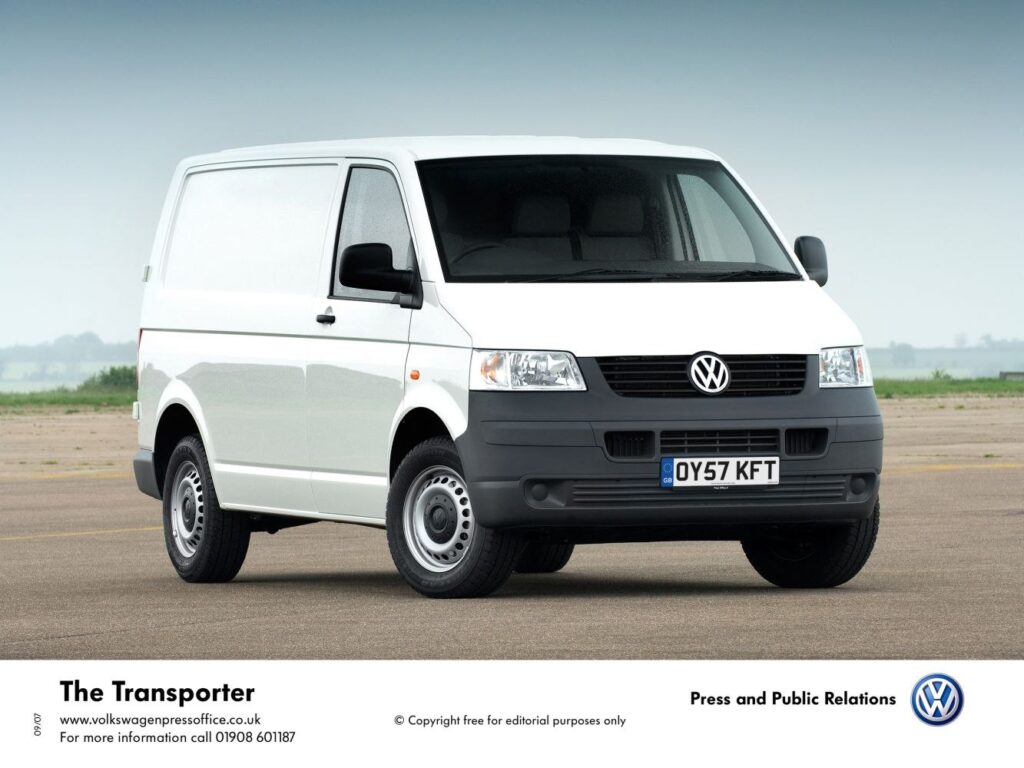
The design of the Volkswagen Transporter (T5) Panel Van 2.5 TDI (130 Hp) L1H2 was fundamentally driven by functionality. As a panel van, its primary purpose was cargo transportation, and the L1H2 designation indicated a specific configuration: L1 typically signifying a short wheelbase and H2 a high roof. This combination offered a substantial cargo volume of 236.61 cu. ft. (6700 liters), making it capable of accommodating a wide array of goods and equipment. The exterior styling was clean and purposeful, reflecting Volkswagen’s characteristic understated design language, prioritizing aerodynamics and practicality over flamboyant aesthetics.
Inside, the T5 Panel Van was designed with the working professional in mind. It typically offered seating for 2 to 3 occupants, with durable materials and an ergonomic layout for long hours behind the wheel. While the focus was on utility, modern amenities for the era, such as power steering (hydraulic), were standard, contributing to driver comfort and reduced fatigue. Safety features included an Anti-lock Braking System (ABS), a crucial addition for maintaining control under heavy braking, especially with a full load. The vehicle’s dimensions, with a length of 192.52 inches, a width of 74.96 inches (88.27 inches including mirrors), and a height of 85.04 inches, along with a 118.11-inch wheelbase, provided a stable and maneuverable platform. Its relatively tight turning circle of 39.04 feet further enhanced its agility in urban environments.
Suspension on the T5 was engineered for comfort and load-carrying capability, featuring an independent McPherson strut setup with coil springs and an anti-roll bar at the front, and an independent coil spring, transverse stabilizer, and trailing arm design at the rear. This sophisticated suspension system ensured a compliant ride even over rough terrain while maintaining stability under heavy loads. Braking was handled by ventilated discs both front (308×29.5 mm) and rear (294×22 mm), providing strong and consistent stopping power. The standard tire size was 215/65 R16 on 6.5J x 16 wheels, a common setup for commercial vehicles, balancing load capacity with ride quality.
Technical Specifications
| Category | Specification |
|---|---|
| General Information | |
| Brand | Volkswagen |
| Model | Transporter |
| Generation | Transporter (T5) Panel Van |
| Type (Engine) | 2.5 TDI (130 Hp) L1H2 |
| Start of Production | 2003 year |
| End of Production | 2006 year |
| Powertrain Architecture | Internal Combustion engine |
| Body Type | Van |
| Seats | 2-3 |
| Doors | 4-5 |
| Performance Specs | |
| Fuel Consumption (extra urban) | 36.2 US mpg (6.5 l/100 km) |
| Fuel Type | Diesel |
| Acceleration 0 – 60 mph | 14.7 sec |
| Maximum Speed | 101.28 mph (163 km/h) |
| Emission Standard | Euro 3 |
| Weight-to-Power Ratio | 14.7 kg/Hp (68.2 Hp/tonne) |
| Weight-to-Torque Ratio | 5.6 kg/Nm (178.5 Nm/tonne) |
| Engine Specs | |
| Power | 130 Hp @ 3500 rpm |
| Power per Liter | 52.8 Hp/l |
| Torque | 250.77 lb.-ft. @ 2000-2300 rpm (340 Nm) |
| Engine Layout | Front, Transverse |
| Engine Model/Code | EA153 / AXD |
| Engine Displacement | 2.5 liters (2460 cm3 / 150.12 cu. in.) |
| Number of Cylinders | 5 |
| Engine Configuration | Inline |
| Cylinder Bore | 3.19 in. (81 mm) |
| Piston Stroke | 3.76 in. (95.5 mm) |
| Compression Ratio | 18.5:1 |
| Number of Valves per Cylinder | 2 |
| Fuel Injection System | Pump-nozzle (Unit Injector) |
| Engine Aspiration | Turbocharger, Intercooler |
| Valvetrain | SOHC |
| Engine Oil Capacity | 7.82 US qt (7.4 l) |
| Coolant Capacity | 7.5 US qt (7.1 l) |
| Space, Volume and Weights | |
| Kerb Weight | 4199.81 – 4640.73 lbs. (1905-2105 kg) |
| Max. Weight (GVWR) | 6172.94 – 6613.87 lbs. (2800-3000 kg) |
| Max Load (Payload) | 1973.14 lbs. (895 kg) |
| Trunk (Boot) Space – Maximum | 236.61 cu. ft. (6700 l) |
| Fuel Tank Capacity | 21.13 US gal (80 l) |
| Permitted Trailer Load with Brakes (8%) | 5511.56 lbs. (2500 kg) |
| Permitted Trailer Load with Brakes (12%) | 5511.56 lbs. (2500 kg) |
| Permitted Trailer Load without Brakes | 1653.47 lbs. (750 kg) |
| Permitted Towbar Download | 220.46 lbs. (100 kg) |
| Dimensions | |
| Length | 192.52 in. (4890 mm) |
| Width | 74.96 in. (1904 mm) |
| Width Including Mirrors | 88.27 in. (2242 mm) |
| Height | 85.04 in. (2160 mm) |
| Wheelbase | 118.11 in. (3000 mm) |
| Front Track | 64.09 in. (1628 mm) |
| Rear Track | 64.09 in. (1628 mm) |
| Front Overhang | 35.2 in. (894 mm) |
| Rear Overhang | 39.21 in. (996 mm) |
| Ride Height (Ground Clearance) | 6.5 in. (165 mm) |
| Minimum Turning Circle (Turning Diameter) | 39.04 ft. (11.9 m) |
| Approach Angle | 22° |
| Departure Angle | 16° |
| Ramp-over (Brakeover) Angle | 14° |
| Wading Depth | 11.81 in. (300 mm) |
| Drivetrain, Brakes and Suspension Specs | |
| Drivetrain Architecture | Front-wheel drive, Internal Combustion engine |
| Drive Wheel | Front-wheel drive |
| Number of Gears and Type of Gearbox | 6 gears, manual transmission |
| Front Suspension | Independent, McPherson with coil spring and anti-roll bar |
| Rear Suspension | Independent coil spring, Transverse stabilizer, Trailing arm |
| Front Brakes | Ventilated discs, 308×29.5 mm |
| Rear Brakes | Ventilated discs, 294×22 mm |
| Assisting Systems | ABS (Anti-lock braking system) |
| Steering Type | Steering rack and pinion |
| Power Steering | Hydraulic Steering |
| Tire Size | 215/65 R16 |
| Wheel Rims Size | 6.5J x 16 |
Legacy and Market Impact in Europe
The Volkswagen Transporter series, often referred to as the “Bulli” in Germany, boasts a heritage that stretches back to the iconic T1 of the 1950s. The T5 generation, and specifically the Volkswagen Transporter (T5) Panel Van 2.5 TDI (130 Hp) L1H2, successfully continued this storied lineage, evolving the formula for the 21st century. In Europe, the T5 was a cornerstone of Volkswagen’s commercial vehicle offerings, competing fiercely with other prominent vans like the Ford Transit, Mercedes-Benz Vito, Renault Trafic, and Fiat Ducato. Its strong brand recognition, reputation for German engineering, and robust build quality gave it a significant edge in a highly competitive segment.
The 2.5 TDI variant, with its potent yet economical diesel engine, was particularly well-suited to European driving conditions, where diesel fuel was widely available and often preferred for its efficiency and torque characteristics. Its ability to handle substantial payloads (up to 1973.14 lbs.) and tow heavy trailers (up to 5511.56 lbs. with brakes) made it an indispensable tool for a wide range of businesses, from construction and delivery services to small trades and mobile workshops. The L1H2 configuration, with its ample cargo space and manageable dimensions, struck an excellent balance for urban maneuverability and cargo volume.
The T5 generation was praised for its car-like driving dynamics, a trait that had long been a hallmark of the Transporter series. This made it less fatiguing for drivers on long hauls and more pleasant to operate in daily city traffic. Its robust chassis, effective braking system, and reliable powertrain contributed to its strong resale values and enduring popularity. Even after the T5 concluded its production run in 2015 (with the 2.5 TDI engine phased out earlier), it remained a common sight on European roads, a testament to its durability and the lasting impact of its design and engineering. The Volkswagen Transporter (T5) Panel Van 2.5 TDI (130 Hp) L1H2 represents a key chapter in the evolution of the modern commercial van, embodying efficiency, practicality, and the enduring quality expected from Volkswagen.