The Skoda Octavia III (facelift 2017) 2.0 TDI (150 Hp) 6 DSG: A European Mainstay
The Skoda Octavia has long been a cornerstone of the European automotive market, renowned for its pragmatic approach, robust engineering, and exceptional value within the Volkswagen Group. The third generation, known as the Octavia III, received a significant mid-cycle refresh in 2017, introducing updated styling, enhanced technology, and refined powertrains. This article focuses on a particularly popular and efficient variant: the Skoda Octavia III (facelift 2017) 2.0 TDI (150 Hp) 6 DSG hatchback. While Skoda models are not officially sold in the United States, the Octavia represents a prime example of the compact family car segment’s evolution in Europe and other international markets, offering a compelling blend of space, comfort, and economical operation, often blurring the lines between the traditional compact and mid-size segments due to its generous dimensions.
Produced for a relatively short period between 2017 and 2018 before the introduction of the next generation, this facelifted Octavia III continued Skoda’s tradition of delivering “Simply Clever” solutions and high-quality vehicles. Its powertrain architecture relies on an internal combustion engine driving the front wheels, a common and efficient setup for its class. The hatchback body style, a staple for European family cars, provides immense practicality and cargo flexibility, making it a favorite for both private owners and fleet operators across the continent.
The Skoda Octavia III (facelift 2017) 2.0 TDI (150 Hp) 6 DSG: Powertrain and Efficiency
At the heart of this particular Octavia variant is a potent yet frugal 2.0-liter TDI (Turbocharged Direct Injection) diesel engine. This four-cylinder inline powerplant, identifiable by engine codes such as EA288, CKFC, or CRMB, delivers a robust 150 horsepower at a range of 3500-4000 rpm. Its power output per liter is a respectable 76.2 Hp/l, showcasing efficient engine design for its displacement of 1968 cubic centimeters (approximately 120.09 cubic inches).
However, the true strength of a diesel engine lies in its torque, and the 2.0 TDI does not disappoint. It generates a substantial 340 Newton-meters (250.77 lb.-ft.) of torque, available across a broad and usable band from 1750 to 3000 rpm. This ample torque, delivered at low engine speeds, contributes significantly to the Octavia’s effortless acceleration and flexible in-gear performance, making it well-suited for both city driving and highway cruising, even when fully loaded or towing.
Power is channeled to the front wheels through a sophisticated 6-speed automatic DSG (Direct Shift Gearbox) transmission. This dual-clutch unit is celebrated for its rapid, smooth shifts and efficiency, contributing to both the car’s dynamic feel and its impressive fuel economy. The combination of the 2.0 TDI engine and the DSG gearbox allows the Octavia to accelerate from 0 to 60 mph in a brisk 8.1 seconds (0-100 km/h in 8.5 seconds), with a maximum speed of 133.59 mph (215 km/h).
Fuel efficiency is a major highlight for the Skoda Octavia III (facelift 2017) 2.0 TDI (150 Hp) 6 DSG. According to NEDC (New European Driving Cycle) figures, the combined fuel consumption ranges from 4.5-4.6 liters per 100 kilometers, translating to an excellent 52.3 – 51.1 US mpg. Even in urban environments, it achieves 45.2 – 44.4 US mpg, and on extra-urban cycles, it reaches an impressive 57.4 – 56 US mpg. These figures underscore the efficiency benefits of modern diesel technology, especially when paired with an advanced transmission. Furthermore, the vehicle meets the stringent Euro 6 emission standard, with CO2 emissions between 117-119 g/km, thanks to features like a particulate filter and a standard Start & Stop system.
Design and Practical Features of the Octavia III Facelift
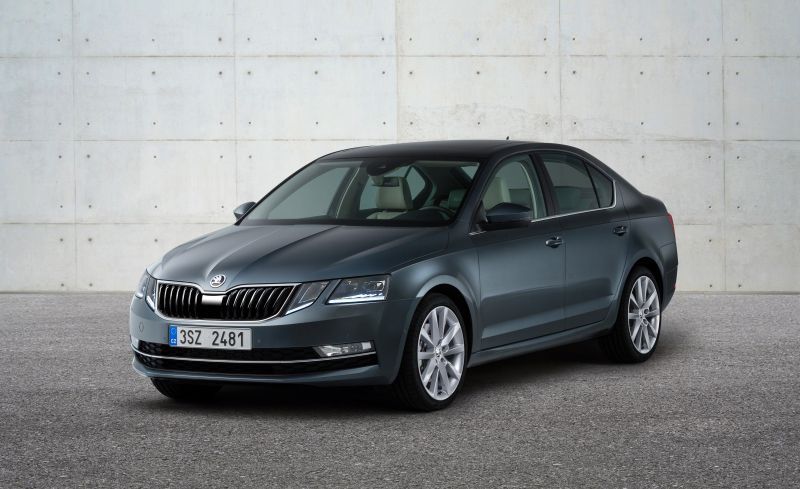
The 2017 facelift brought several notable exterior design changes to the Octavia III, most prominently the redesigned front fascia featuring distinctive split headlights that gave it a more assertive, if somewhat polarizing, look. Beyond the refreshed aesthetics, the Octavia maintained its reputation for practical and thoughtful design. As a 5-door hatchback with seating for five, it excels in providing generous interior space, particularly for rear-seat passengers, a common advantage of Skoda models within the VW Group platform sharing strategy.
The Octavia’s dimensions are substantial for its class: 183.86 inches in length, 71.42 inches in width (79.41 inches including mirrors), and 57.52 inches in height, all riding on a 105.75-inch wheelbase. These proportions contribute to a commanding road presence and a stable ride. The drag coefficient (Cd) of 0.294 is commendable for a family hatchback, aiding both fuel economy and reducing wind noise at higher speeds.
One of the Octavia’s most compelling features is its cargo capacity. The hatchback body offers a cavernous trunk space of 590 liters (20.84 cu. ft.) with the rear seats in place. Folding down the rear seats expands this volume to an enormous 1580 liters (55.8 cu. ft.), making it exceptionally versatile for hauling luggage, sports equipment, or even small furniture. This practicality is further enhanced by a maximum payload capacity of 1377.89 lbs. and a permissible trailer load of 3527.4 lbs. with brakes, showcasing its utility.
Underneath, the Octavia employs a well-proven suspension setup: independent McPherson struts with coil springs and an anti-roll bar at the front, and a coil spring torsion beam at the rear. This configuration provides a balanced ride, offering a good compromise between comfort and handling. Braking is handled by ventilated discs at the front and solid discs at the rear, complemented by an Anti-lock Braking System (ABS) for enhanced safety. Electric power steering, a rack and pinion system, ensures light and precise steering, making maneuvering in tight urban spaces or on highways a pleasant experience. Various tire and wheel size options, from 205/55 R16 to 225/40 R18, allowed customers to tailor the car’s appearance and handling characteristics.
Technical Specifications: Skoda Octavia III (facelift 2017) 2.0 TDI (150 Hp) 6 DSG
| Category | Specification | Value |
|---|---|---|
| General Information | ||
| Brand | Skoda | |
| Model | Octavia | |
| Generation | Octavia III (facelift 2017) | |
| Type (Engine) | 2.0 TDI (150 Hp) 6 DSG | |
| Start of Production | 2017 year | |
| End of Production | 2018 year | |
| Powertrain Architecture | Internal Combustion engine | |
| Body type | Hatchback | |
| Seats | 5 | |
| Doors | 5 | |
| Performance Specs | ||
| Fuel Consumption (Urban, NEDC) | 5.2-5.3 l/100 km | 45.2 – 44.4 US mpg |
| Fuel Consumption (Extra Urban, NEDC) | 4.1-4.2 l/100 km | 57.4 – 56 US mpg |
| Fuel Consumption (Combined, NEDC) | 4.5-4.6 l/100 km | 52.3 – 51.1 US mpg |
| CO2 Emissions (NEDC) | 117-119 g/km | |
| Fuel Type | Diesel | |
| Acceleration 0 – 60 mph | 8.1 sec | |
| Acceleration 0 – 100 km/h | 8.5 sec | |
| Maximum Speed | 215 km/h | 133.59 mph |
| Emission Standard | Euro 6 | |
| Weight-to-Power Ratio | 8.5 kg/Hp | 117.5 Hp/tonne |
| Weight-to-Torque Ratio | 3.8 kg/Nm | 266.2 Nm/tonne |
| Engine Specs | ||
| Power | 150 Hp @ 3500-4000 rpm | |
| Power per liter | 76.2 Hp/l | |
| Torque | 340 Nm @ 1750-3000 rpm | 250.77 lb.-ft. @ 1750-3000 rpm |
| Engine Layout | Front, Transverse | |
| Engine Model/Code | EA288 / CKFC, CRMB | |
| Engine Displacement | 1968 cm3 | 120.09 cu. in. |
| Number of Cylinders | 4 | |
| Engine Configuration | Inline | |
| Cylinder Bore | 81 mm | 3.19 in. |
| Piston Stroke | 95.5 mm | 3.76 in. |
| Compression Ratio | 16.2:1 | |
| Number of Valves per Cylinder | 4 | |
| Fuel Injection System | Diesel Commonrail | |
| Engine Aspiration | Turbocharger, Intercooler | |
| Valvetrain | DOHC | |
| Engine Oil Capacity | 4.6 l | 4.86 US qt |
| Engine Oil Specification | Not specified | |
| Engine Systems | Start & Stop System, Particulate filter | |
| Space, Volume and Weights | ||
| Kerb Weight | 1277 kg | 2815.3 lbs. |
| Max. Weight | 1902 kg | 4193.19 lbs. |
| Max Load | 625 kg | 1377.89 lbs. |
| Trunk (boot) Space – Minimum | 590 l | 20.84 cu. ft. |
| Trunk (boot) Space – Maximum | 1580 l | 55.8 cu. ft. |
| Fuel Tank Capacity | 50 l | 13.21 US gal |
| Max. Roof Load | 75 kg | 165.35 lbs. |
| Permitted Trailer Load with Brakes (12%) | 1600 kg | 3527.4 lbs. |
| Permitted Trailer Load without Brakes | 670 kg | 1477.1 lbs. |
| Permitted Towbar Download | 75 kg | 165.35 lbs. |
| Dimensions | ||
| Length | 4670 mm | 183.86 in. |
| Width | 1814 mm | 71.42 in. |
| Width including Mirrors | 2017 mm | 79.41 in. |
| Height | 1461 mm | 57.52 in. |
| Wheelbase | 2686 mm | 105.75 in. |
| Front Track | 1543 mm | 60.75 in. |
| Rear (Back) Track | 1534 mm | 60.39 in. |
| Front Overhang | 890 mm | 35.04 in. |
| Rear Overhang | 1094 mm | 43.07 in. |
| Ride Height (Ground Clearance) | 141 mm | 5.55 in. |
| Drag Coefficient (Cd) | 0.294 | |
| Minimum Turning Circle (Turning Diameter) | 10.61 m | 34.81 ft. |
| Approach Angle | 14° | |
| Departure Angle | 12.1° | |
| Drivetrain, Brakes and Suspension Specs | ||
| Drivetrain Architecture | Internal combustion engine (ICE) drives the front wheels. | |
| Drive Wheel | Front wheel drive | |
| Number of Gears and Type of Gearbox | 6 gears, automatic transmission DSG | |
| Front Suspension | Independent, type McPherson with coil spring and anti-roll bar | |
| Rear Suspension | Coil spring, Torsion | |
| Front Brakes | Ventilated discs | |
| Rear Brakes | Disc | |
| Assisting Systems | ABS (Anti-lock braking system) | |
| Steering Type | Steering rack and pinion | |
| Power Steering | Electric Steering | |
| Tire Sizes | 205/55 R16; 225/45 R17; 225/40 R18 | |
| Wheel Rims Sizes | 6.5J x 16; 7J x 17; 7.5J x 18 | |
Legacy and Market Impact in Europe
The Skoda Octavia III (facelift 2017) 2.0 TDI (150 Hp) 6 DSG, like its predecessors and successors, carved out a significant niche for itself in the highly competitive European automotive landscape. Its success stemmed from a clear strategy: offer Volkswagen Group engineering and quality at a more accessible price point, coupled with an emphasis on practicality and space. This particular diesel variant epitomized the Octavia’s appeal, providing robust performance, exceptional fuel economy, and low running costs, which are crucial considerations for European consumers and businesses.
In its primary markets, the Octavia faced stiff competition from a diverse range of vehicles. Its direct rivals in the compact class included established players like the Volkswagen Golf, Ford Focus, Opel Astra, and Peugeot 308. However, due to its segment-defying size – often offering interior and trunk space comparable to vehicles in the class above – it also indirectly competed with entry-level mid-size sedans and wagons such as the Volkswagen Passat and Ford Mondeo. The Octavia’s ability to punch above its weight class in terms of utility and perceived value was a key differentiator.
The Octavia’s reputation for reliability and durability also contributed to its strong resale value and popularity among fleet buyers, taxis, and police forces across Europe. The 2.0 TDI engine, a proven workhorse within the VW Group, was particularly favored for its longevity and efficiency over high mileage. The DSG transmission further cemented its appeal by offering convenience without sacrificing economy or performance.
The facelifted third-generation Octavia continued to solidify Skoda’s transformation from a budget brand to a respected manufacturer of well-engineered,