Introduction to the Renault Megane III Coupe 2.0 16V (140 Hp) CVT
The Renault Megane III Coupe, specifically the 2.0 16V (140 Hp) CVT variant produced between 2009 and 2012, represents a significant chapter in Renault’s strategy to infuse its popular compact car lineup with a dose of sporting elegance and design flair. Positioned squarely in the highly competitive European C-segment, this generation of the Megane Coupe aimed to capture buyers looking for a more emotive and stylish alternative to the conventional hatchback, while still offering a practical footprint for urban and highway driving. Unlike its sedan and hatchback siblings, the Coupe was engineered with a distinct identity, featuring a lower stance, more aggressive lines, and a focus on driver engagement, albeit balanced with the convenience of an automatic transmission in this particular configuration.
As an international automotive expert, it’s crucial to note that while the Renault Megane was a ubiquitous sight on European roads, it was not officially sold in the United States market. Therefore, its context must be understood within the European automotive landscape, where it competed fiercely against a diverse array of domestic and foreign offerings. The 2.0 16V (140 Hp) CVT model, with its naturally aspirated gasoline engine and continuously variable transmission, was designed to provide a smooth, efficient, and adequately spirited driving experience, catering to a wide range of consumers who valued comfort and ease of use in addition to style. This article delves into the technical specifications, design philosophy, and market impact of the
Renault Megane III Coupe 2.0 16V (140 Hp) CVT
, offering a comprehensive overview of its place in automotive history.
Engine and Performance of the Renault Megane III Coupe
At the heart of the Renault Megane III Coupe 2.0 16V (140 Hp) CVT lies a robust and proven M4R 711 engine, a naturally aspirated inline-four gasoline unit. This powerplant boasts a displacement of 2.0 liters (1997 cm3 or 121.86 cubic inches), featuring a dual overhead camshaft (DOHC) valvetrain with four valves per cylinder, a configuration renowned for its efficiency and smooth power delivery. With a compression ratio of 10.2:1 and a multi-port manifold injection system, the engine was tuned to produce a respectable 140 horsepower at 6000 rpm, yielding a power-per-liter rating of 70.1 HP/l. Torque output stands at 143.82 lb.-ft. (195 Nm) available at a relatively accessible 3750 rpm, providing ample thrust for daily driving scenarios in its segment.
Power is transmitted to the front wheels through a Continuously Variable Transmission (CVT). While some enthusiasts might prefer a manual gearbox for maximum engagement, the CVT in the Megane III Coupe was engineered for seamless acceleration and optimal fuel efficiency, particularly in urban environments. It effectively provides an infinite number of gear ratios, allowing the engine to operate at its most efficient rpm for a given speed. This setup contributes to the car’s combined fuel economy rating of 30.9 US mpg (7.6 l/100 km), with urban figures reaching 23.1 US mpg and extra-urban figures at an impressive 38.6 US mpg. These figures were competitive for its class at the time, underscoring Renault’s commitment to balancing performance with environmental considerations, meeting Euro 5 emission standards with CO2 emissions of 175 g/km.
In terms of raw performance, the Renault Megane III Coupe 2.0 16V (140 Hp) CVT accelerated from 0 to 60 mph in a respectable 9.8 seconds, and 0 to 62 mph (100 km/h) in 10.3 seconds. Its maximum speed was recorded at 121.17 mph (195 km/h). While not a blistering sports car, these figures were more than adequate for spirited driving on European motorways and engaging performance on winding country roads. The engine’s front, transverse layout and front-wheel-drive architecture are typical for the segment, ensuring predictable handling and efficient packaging. The car’s weight-to-power ratio of 9.1 kg/Hp (109.8 Hp/tonne) and weight-to-torque ratio of 6.5 kg/Nm (152.9 Nm/tonne) further highlight its balanced approach to performance and mass.
Design and Features
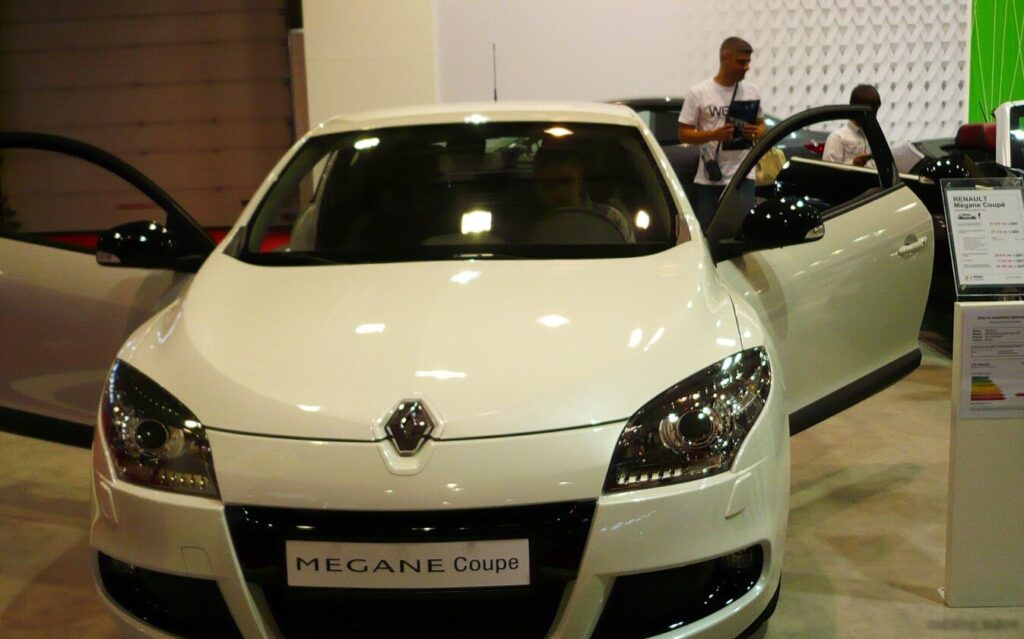
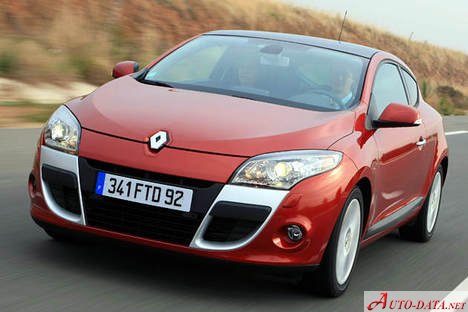
The design of the Renault Megane III Coupe was a significant departure from its more conservative predecessor, showcasing Renault’s evolving design language under Patrick le Quément. This generation embraced a more dynamic and sculpted aesthetic, particularly evident in the 3-door coupe body style. Measuring 169.25 inches in length, 71.02 inches in width (80.2 inches including mirrors), and 56.02 inches in height, the Coupe possessed a distinctive profile characterized by its sleek, flowing lines, pronounced rear haunches, and a sharply raked rear window. The 103.94-inch wheelbase contributed to both stability and interior space, a notable achievement for a compact coupe. The aggressive front fascia, with its distinctive headlamps and grille, gave the car a purposeful and sporty demeanor.
Despite its coupe designation, the Megane III Coupe offered practical seating for five, though the rear seats, as expected in a coupe, were better suited for shorter journeys or children. The interior was designed with a focus on ergonomics and quality materials, aiming to create an inviting and driver-centric cabin. The trunk space was practical for its class, ranging from 12.15 cubic feet (344 liters) to 13.31 cubic feet (377 liters) with the rear seats in place, making it suitable for weekend getaways or grocery runs.
Chassis and suspension systems were tuned for a balance of comfort and agility, a hallmark of European compacts. The front suspension utilized an independent McPherson strut setup, known for its robustness and precise handling, while the rear featured a torsion beam axle, a common and space-efficient solution for front-wheel-drive vehicles. Braking power was provided by ventilated discs at the front and solid discs at the rear, complemented by an Anti-lock Braking System (ABS) for enhanced safety. Electric power steering offered light effort for urban maneuvering and more feedback at higher speeds. The car rode on either 205/55 R16 or 205/50 R17 tires, mounted on 6.5J x 16 or 6.5J x 17 wheel rims, respectively, contributing to its planted stance and grip.
Technical Specifications
| Category | Specification |
|---|---|
| Brand | Renault |
| Model | Megane III Coupe 2.0 16V (140 Hp) CVT |
| Generation | Megane III Coupe |
| Production Years | 2009 – 2012 |
| Body Type | Coupe, 3 Doors, 5 Seats |
| Powertrain Architecture | Internal Combustion Engine (ICE) |
| Engine Model/Code | M4R 711 |
| Engine Layout | Front, Transverse |
| Engine Aspiration | Naturally Aspirated |
| Number of Cylinders | 4, Inline |
| Valvetrain | DOHC, 4 valves per cylinder |
| Engine Displacement | 2.0 Liters (1997 cm3 / 121.86 cu. in.) |
| Cylinder Bore | 3.31 inches (84 mm) |
| Piston Stroke | 3.55 inches (90.1 mm) |
| Compression Ratio | 10.2:1 |
| Fuel Injection System | Multi-port manifold injection |
| Power | 140 HP @ 6000 rpm |
| Power per Liter | 70.1 HP/l |
| Torque | 143.82 lb.-ft. (195 Nm) @ 3750 rpm |
| Drive Wheel | Front Wheel Drive |
| Gearbox Type | Automatic, CVT (1 gear) |
| Acceleration 0-60 mph | 9.8 seconds |
| Acceleration 0-62 mph (0-100 km/h) | 10.3 seconds |
| Maximum Speed | 121.17 mph (195 km/h) |
| Fuel Type | Petrol (Gasoline) |
| Fuel Consumption (Urban) | 23.1 US mpg (10.2 l/100 km) |
| Fuel Consumption (Extra Urban) | 38.6 US mpg (6.1 l/100 km) |
| Fuel Consumption (Combined) | 30.9 US mpg (7.6 l/100 km) |
| CO2 Emissions | 175 g/km |
| Emission Standard | Euro 5 |
| Kerb Weight | 2810.89 lbs. (1275 kg) |
| Max. Weight | 3917.61 lbs. (1777 kg) |
| Max. Load | 1106.72 lbs. (502 kg) |
| Weight-to-Power Ratio | 9.1 kg/Hp (109.8 Hp/tonne) |
| Weight-to-Torque Ratio | 6.5 kg/Nm (152.9 Nm/tonne) |
| Length | 169.25 inches (4299 mm) |
| Width | 71.02 inches (1804 mm) |
| Width (incl. mirrors) | 80.2 inches (2037 mm) |
| Height | 56.02 inches (1423 mm) |
| Wheelbase | 103.94 inches (2640 mm) |
| Front Track | 60.87 inches (1546 mm) |
| Rear Track | 60.91 inches (1547 mm) |
| Front Overhang | 33.94 inches (862 mm) |
| Rear Overhang | 31.38 inches (797 mm) |
| Ride Height (Ground Clearance) | 4.72 inches (120 mm) |
| Minimum Turning Circle | 35.93 feet (10.95 m) |
| Trunk Space (Min) | 12.15 cu. ft. (344 liters) |
| Trunk Space (Max) | 13.31 cu. ft. (377 liters) |
| Fuel Tank Capacity | 15.85 US gallons (60 liters) |
| Max. Roof Load | 176.37 lbs. (80 kg) |
| Permitted Trailer Load (with brakes) | 2866.01 lbs. (1300 kg) |
| Permitted Trailer Load (without brakes) | 1488.12 lbs. (675 kg) |
| Permitted Towbar Download | 165.35 lbs. (75 kg) |
| Front Suspension | Independent type McPherson |
| Rear Suspension | Torsion |
| Front Brakes | Ventilated discs |
| Rear Brakes | Disc |
| Assisting Systems | ABS (Anti-lock braking system) |
| Steering Type | Steering rack and pinion |
| Power Steering | Electric Steering |
| Tires Size | 205/55 R16; 205/50 R17 |
| Wheel Rims Size | 6.5J x 16; 6.5J x 17 |
| Engine Oil Capacity | 3.7 US quarts (3.5 liters) |
| Coolant Capacity | 7.19 US quarts (6.8 liters) |
Legacy and Market Impact
The Renault Megane III Coupe carved out a significant niche for itself in the European automotive market during its production run. Its primary reputation was built on its distinctive styling, which set it apart from the more conservative designs of many rivals. In a segment often dominated by practicality, the Megane Coupe offered an emotional appeal, demonstrating that a compact car could also be genuinely stylish and engaging. It was seen as a bold design statement from Renault, successfully translating concept car aesthetics into a mass-produced vehicle.
In its competitive landscape, the Megane III Coupe faced off against a variety of rivals. Direct competitors included other compact coupes or sporty three-door variants like the Volkswagen Scirocco, Opel Astra GTC, and potentially the Peugeot 308 (depending on specific variants). While the Scirocco might have offered a slightly sportier image and the Astra GTC its own unique styling, the Megane Coupe distinguished itself with its characteristic French flair and a compelling blend of standard features and available options. Its combination of a refined engine, smooth CVT, and well-tuned chassis made it a strong contender for buyers prioritizing comfort and ease of driving in urban settings, coupled with distinctive looks.
Historically, the Megane III Coupe underscored Renault’s commitment to design-led product development. It built upon the success of previous Megane generations, which had consistently been among Europe’s best-selling compact cars, by adding a more aspirational and youthful variant. This particular 2.0 16V (140 Hp) CVT model, while not the most powerful in the lineup, represented a pragmatic choice, offering a good balance between performance, fuel economy, and driving refinement. It played a crucial role in maintaining Renault’s image as an innovator in design and a provider of accessible, stylish vehicles across various segments. Its legacy is one of a well-executed compact coupe that successfully combined everyday usability with a healthy dose of Gallic charm and a truly distinctive presence on the road.