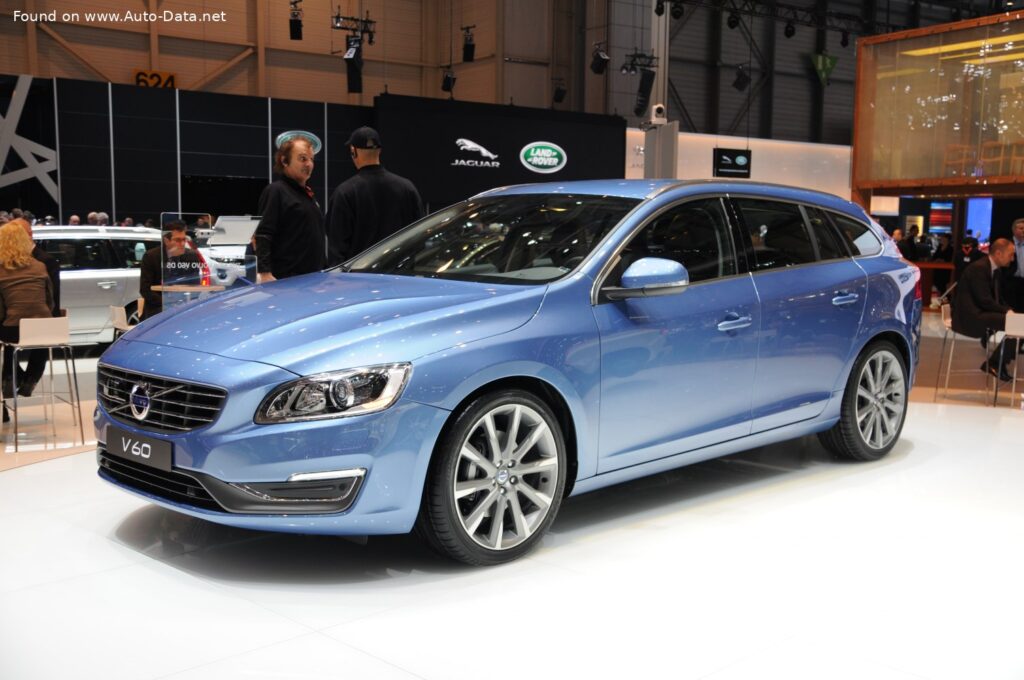
The Volvo V60 I (2013 facelift): A Premium European Diesel Wagon
The Volvo V60 I (2013 facelift) represents a significant iteration of Volvo’s first-generation compact executive wagon, a model that carved out a distinct niche in the European premium segment. Introduced in 2013 as an update to the original V60 launched in 2010, this facelift brought refreshed styling, enhanced technology, and refined powertrains to maintain its competitive edge. While the V60 nameplate itself was available in various markets, including North America, the specific 2.4 D5 (215 Hp) start/stop diesel variant was predominantly a staple in European markets, where diesel engines were highly favored for their efficiency and robust torque delivery. This particular model, produced from 2013 to 2015, embodied Volvo’s commitment to safety, practicality, and sophisticated design, all wrapped in a functional yet elegant station wagon body.
Positioned as a more dynamically styled alternative to the larger V70, the V60 aimed to appeal to a younger, more design-conscious demographic without sacrificing the traditional Volvo virtues of space and safety. The 2013 facelift specifically addressed minor aesthetic tweaks, improved interior materials, and updated infotainment systems, ensuring the car remained current in a fiercely competitive landscape. The 2.4 D5 engine configuration, a hallmark of Volvo’s diesel offerings, provided a compelling blend of performance and fuel economy, making it a popular choice for long-distance drivers and families across Europe.
Engine and Performance: The Potent 2.4 D5 in the Volvo V60 I (2013 facelift)
At the heart of this particular Volvo V60 I (2013 facelift) model lies the venerable 2.4-liter D5 diesel engine, an inline five-cylinder unit known for its distinctive thrum and strong performance characteristics. This powertrain, designated D5244T11, delivers a robust 215 horsepower at 4000 rpm, providing ample power for both urban commuting and high-speed highway cruising. More impressively, the engine generates a substantial 309.78 lb.-ft. of torque, available across a broad rev range from 1500 to 3250 rpm. This wide torque band contributes significantly to the car’s effortless acceleration and flexible driving dynamics, especially when paired with its standard 6-speed manual transmission.
The 2.4 D5 engine is equipped with a turbocharger and intercooler, optimizing air intake for enhanced combustion efficiency and power output. Its fuel injection system utilizes common rail technology, a sophisticated diesel injection method that precisely controls fuel delivery for improved performance, reduced emissions, and better fuel economy. Furthermore, this variant features a Start & Stop system, a technology designed to automatically shut off the engine when the vehicle is stationary and restart it when the driver is ready to move, further contributing to fuel savings and reduced CO2 emissions in city driving.
Performance figures for the Volvo V60 I (2013 facelift) with this engine are commendable for a family wagon. It can accelerate from 0 to 60 mph in a swift 7.1 seconds, demonstrating its capability to merge onto highways or overtake with confidence. Despite its performance, the D5 engine remains remarkably fuel-efficient. The combined fuel economy is rated at an impressive 51.1 US mpg (4.6 l/100 km), with extra-urban consumption reaching 58.8 US mpg (4.0 l/100 km). These figures, combined with CO2 emissions of 120 g/km and compliance with Euro 5 emission standards, highlight its environmental consciousness for its era. The vehicle’s powertrain architecture is front-wheel drive, with the internal combustion engine transversely mounted, driving the front wheels.
Design and Features: Practicality Meets Scandinavian Style
The Volvo V60 I (2013 facelift) maintains the sleek and dynamic profile that characterized the first-generation V60, distinguishing it from more traditional, boxy Volvo wagons of the past. Its station wagon (estate) body type offers a compelling blend of sporty aesthetics and practical utility. With five doors and seating for five occupants, it is designed to cater to families and individuals who require versatility without compromising on style. The facelift subtly refined the exterior, often including updated front fascias, grille designs, and lighting elements that brought it closer in line with Volvo’s evolving design language.
Measuring 182.48 inches in length, 71.85 inches in width, and 58.43 inches in height, the V60 offers a substantial road presence while remaining maneuverable. Its wheelbase of 109.29 inches contributes to a stable ride and a surprisingly agile feel for a wagon of its size. The minimum turning circle of 37.07 feet aids in navigating urban environments and tight parking spaces. Inside, Volvo’s commitment to ergonomic design and high-quality materials is evident. While specific interior features are not detailed in the raw data, models from this era typically included a floating center console, comfortable seating, and a user-friendly infotainment system.
Practicality is a cornerstone of the V60’s design. The trunk space, at 15.19 cubic feet (430 liters), offers sufficient capacity for luggage or groceries, and this can be expanded with the rear seats folded down, though that figure is not provided in the data. Volvo’s legendary focus on safety is inherent in the V60’s structure and features, even if not explicitly listed beyond ABS (Anti-lock braking system). This generation of V60 would have included a comprehensive suite of passive and active safety features, such as multiple airbags, stability control, and potentially advanced driver-assistance systems depending on trim levels, reinforcing its reputation as a secure family vehicle. The steering system is a rack and pinion type, providing precise control and feedback to the driver.
Technical Specifications for the Volvo V60 I (2013 facelift) 2.4 D5 (215 Hp) start/stop
| Category | Specification |
|---|---|
| Brand | Volvo |
| Model | V60 |
| Generation | V60 I (2013 facelift) |
| Type (Engine) | 2.4 D5 (215 Hp) start/stop |
| Start of production | 2013 year |
| End of production | 2015 year |
| Powertrain Architecture | Internal Combustion engine |
| Body type | Station wagon (estate) |
| Seats | 5 |
| Doors | 5 |
| Fuel consumption (economy) – urban | 5.6 l/100 km (42 US mpg) |
| Fuel consumption (economy) – extra urban | 4.0 l/100 km (58.8 US mpg) |
| Fuel consumption (economy) – combined | 4.6 l/100 km (51.1 US mpg) |
| CO2 emissions | 120 g/km |
| Fuel Type | Diesel |
| Acceleration 0 – 60 mph | 7.1 sec |
| Emission standard | Euro 5 |
| Weight-to-power ratio | 8 kg/Hp (125.4 Hp/tonne) |
| Weight-to-torque ratio | 4.1 kg/Nm (245 Nm/tonne) |
| Power | 215 Hp @ 4000 rpm |
| Power per liter | 89.6 Hp/l |
| Torque | 420 Nm (309.78 lb.-ft.) @ 1500-3250 rpm |
| Engine layout | Front, Transverse |
| Engine Model/Code | D5244T11 |
| Engine displacement | 2400 cm3 (146.46 cu. in.) |
| Number of cylinders | 5 |
| Engine configuration | Inline |
| Cylinder Bore | 81 mm (3.19 in.) |
| Piston Stroke | 93.15 mm (3.67 in.) |
| Fuel injection system | Diesel Commonrail |
| Engine aspiration | Turbocharger, Intercooler |
| Engine oil capacity | 5.9 l (6.23 US qt) |
| Engine oil specification | Not specified |
| Coolant capacity | 8.9 l (9.4 US qt) |
| Engine systems | Start & Stop System, Particulate filter |
| Kerb Weight | 1714 kg (3778.72 lbs.) |
| Max. weight | 2180 kg (4806.08 lbs.) |
| Max load | 466 kg (1027.35 lbs.) |
| Trunk (boot) space – minimum | 430 l (15.19 cu. ft.) |
| Fuel tank capacity | 67.5 l (17.83 US gal) |
| Length | 4635 mm (182.48 in.) |
| Width | 1825 mm (71.85 in.) |
| Height | 1484 mm (58.43 in.) |
| Wheelbase | 2776 mm (109.29 in.) |
| Front track | 1588 mm (62.52 in.) |
| Rear (Back) track | 1585 mm (62.4 in.) |
| Minimum turning circle | 11.3 m (37.07 ft.) |
| Drivetrain Architecture | Front wheel drive, Internal Combustion engine |
| Drive wheel | Front wheel drive |
| Number of gears and type of gearbox | 6 gears, manual transmission |
| Assisting systems | ABS (Anti-lock braking system) |
| Steering type | Steering rack and pinion |
Legacy and Market Impact of the Volvo V60 I (2013 facelift)
The Volvo V60 I (2013 facelift) played a crucial role in Volvo’s strategy to expand its appeal beyond its traditional, more conservative customer base. By offering a sleek, dynamically styled wagon, Volvo aimed to compete directly with established German rivals in the premium compact executive segment, such as the BMW 3 Series Touring, Audi A4 Avant, and Mercedes-Benz C-Class Estate. In its primary European market, the V60, especially with the efficient and powerful D5 diesel engine, was highly regarded for its blend of performance, luxury, and outstanding fuel economy. It catered to buyers who sought a sophisticated and practical family vehicle that didn’t compromise on driving enjoyment or environmental considerations.
The V60’s reputation was built on several pillars: Volvo’s unwavering commitment to safety, its distinct Scandinavian design ethos, and the robust engineering of its powertrains. The 2013 facelift helped to keep the model fresh and competitive during its production run. The inclusion of features like the Start & Stop system and compliance with Euro 5 emissions standards underscored Volvo’s ongoing efforts to enhance efficiency and reduce environmental impact, which were increasingly important factors for European consumers.
While the V60 model line did make its way to North America, often with gasoline engines and automatic transmissions, the 2.4 D5 diesel variant remained largely a European phenomenon. This highlights the regional differences in automotive preferences and regulations. In Europe, where diesel technology was refined and widely accepted, the D5 engine offered a compelling proposition of high torque, low running costs, and impressive range, making the V60 a strong contender in the premium D-segment wagon market. Its success contributed to Volvo’s brand image as a producer of sophisticated, safe, and environmentally conscious vehicles, paving the way for future generations of V60 and other models that continued to blend practicality with modern design and technology. The V60 I’s legacy is that of a pivotal model that helped redefine Volvo’s identity in the modern automotive landscape, demonstrating that a wagon could be both stylish and eminently capable.