The Volvo V60 I (2013 facelift) 2.4 D5 Twin Engine: A Pioneer in Diesel Plug-in Hybrid Technology
The Volvo V60 I, particularly its 2013 facelift iteration, represented a significant chapter in the Swedish automaker’s commitment to both practicality and environmental innovation. Among its various powertrain options, the Volvo V60 I (2013 facelift) 2.4 D5 Twin Engine (231 Hp) Plug-in Hybrid AWD Geartronic stood out as a groundbreaking vehicle. Launched in 2015 and produced until 2018, this model was one of the world’s first premium diesel plug-in hybrid electric vehicles (PHEV), offering a unique blend of efficiency, performance, and all-wheel-drive capability. Positioned in the compact executive station wagon segment, it was primarily aimed at the discerning European market, where diesel powertrains and estate cars hold considerable popularity. This sophisticated five-door, five-seat station wagon combined Volvo’s renowned safety standards with advanced hybrid technology, setting a benchmark for sustainable luxury without compromise.
Engine & Performance: The Innovative D5 Twin Engine Powertrain
At the heart of the Volvo V60 I (2013 facelift) 2.4 D5 Twin Engine lies a highly innovative powertrain architecture. This PHEV system ingeniously combines a potent internal combustion engine (ICE) with an electric motor to deliver a compelling driving experience. The primary power source is Volvo’s venerable 2.4-liter D5 inline five-cylinder twin-turbo diesel engine, mounted transversely at the front. This diesel unit is a powerhouse in its own right, producing 163 horsepower at 4000 rpm and a robust 309.78 lb.-ft. (420 Nm) of torque between 1500 and 2500 rpm. Its twin-turbo setup and common rail fuel injection ensure strong, linear acceleration and impressive efficiency for a diesel of its size. The engine is paired with a smooth 6-speed Geartronic automatic transmission that permanently drives the front wheels.
Complementing the diesel engine is an electric motor strategically placed on the rear axle, providing an additional 68 horsepower at 2400 rpm and 147.51 lb.-ft. (200 Nm) of torque from 320 to 1700 rpm. This arrangement creates an effective all-wheel-drive (AWD) system, with the diesel powering the front and the electric motor powering the rear. The combined system output peaks at an impressive 231 horsepower. This synergy allows the V60 D5 Twin Engine to achieve a brisk 0-60 mph acceleration in just 6.6 seconds (0-100 km/h in 6.9 seconds) and a top speed of 130.49 mph (210 km/h). Despite its performance credentials, the vehicle boasts an extraordinary combined fuel consumption figure of 130.7 US mpg (1.8 l/100 km) and exceptionally low CO2 emissions of 48 g/km, meeting stringent Euro 6 emission standards. The 11.2 kWh gross (8 kWh usable) lithium-ion battery, located inside the trunk, provides an all-electric range of approximately 31.07 miles (50 km) and an electric-only top speed of 77.67 mph (125 km/h), making it ideal for urban commuting on pure electric power.
Design & Features: Scandinavian Practicality Meets Modern Technology
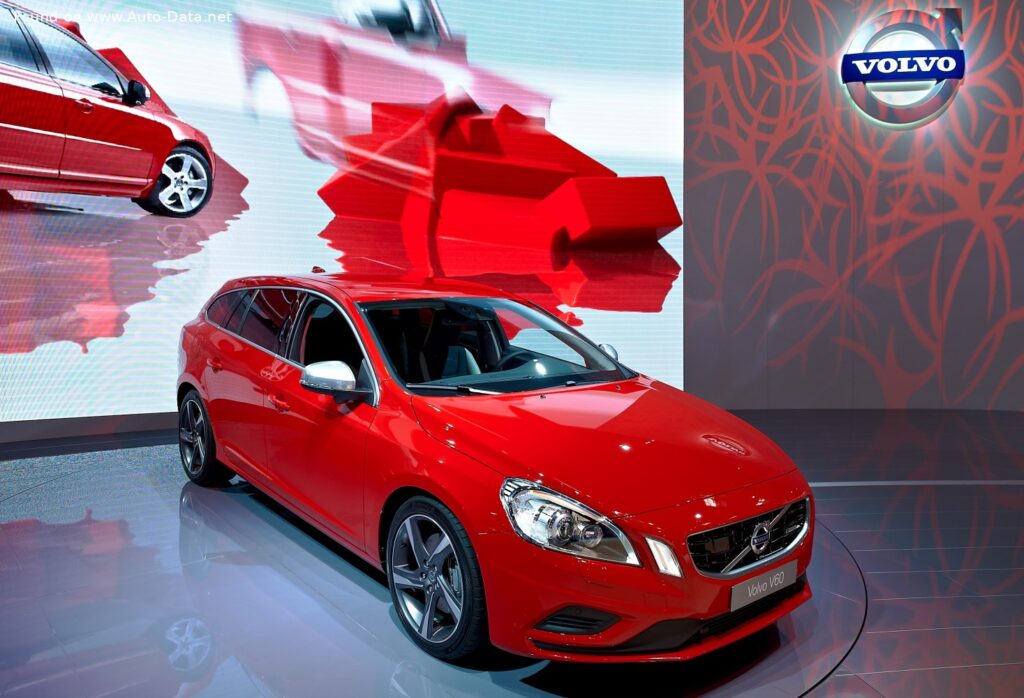
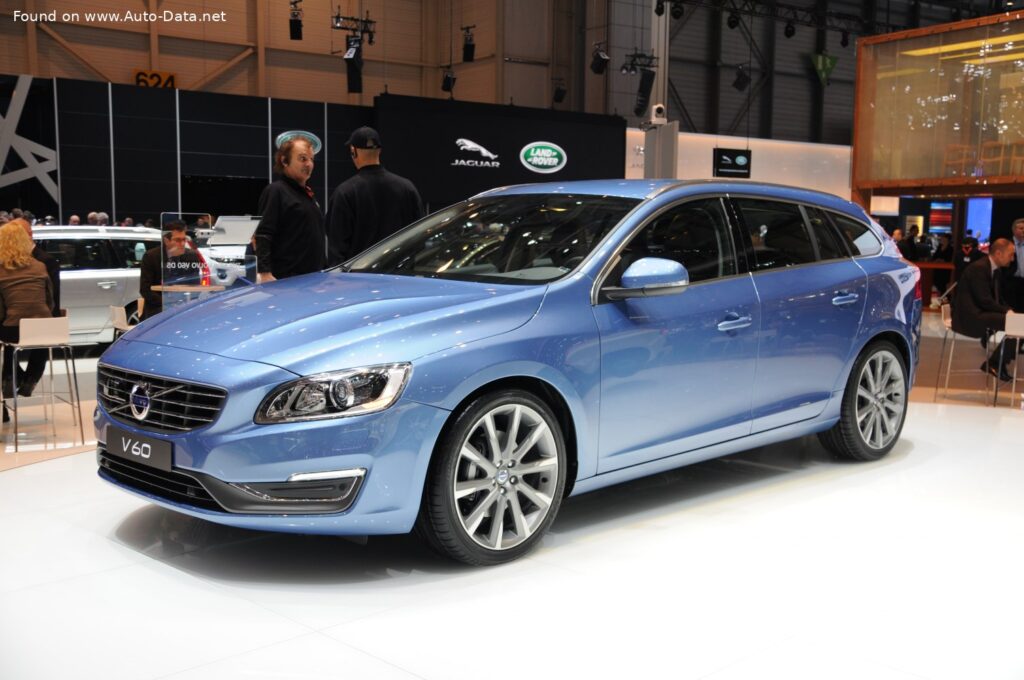
The Volvo V60 I (2013 facelift) retained the elegant and practical station wagon (estate) body type that Volvo is renowned for, while incorporating subtle yet impactful design updates. The facelift introduced a more streamlined front fascia with a wider grille, revised headlights, and a more integrated bumper, giving the V60 a more sophisticated and contemporary appearance. Its five-door configuration and spacious five-seat interior underscore its family-friendly utility, characteristic of Volvo’s design philosophy.
Inside, the V60 D5 Twin Engine offered a cabin that exemplified Scandinavian design principles: minimalist, ergonomic, and built with high-quality materials. Volvo’s commitment to safety was paramount, with the V60 featuring a comprehensive suite of active and passive safety systems for its time, including ABS, and likely advanced driver-assistance systems (ADAS) such as City Safety, blind-spot monitoring, and adaptive cruise control, depending on the trim and market. Practicality was also a strong suit, with a flexible cargo area offering 10.77 cu. ft. (305 liters) of trunk space with the rear seats up, expandable to a generous 39.76 cu. ft. (1126 liters) when folded. The vehicle’s dimensions, with a length of 182.48 inches (4635 mm) and a width of 73.46 inches (1866 mm), provided a substantial road presence while maintaining maneuverability.
Technical Specifications: Volvo V60 I (2013 facelift) 2.4 D5 Twin Engine (231 Hp) Plug-in Hybrid AWD Geartronic
| Category | Specification | US Equivalent / Notes |
|---|---|---|
| General Information | ||
| Brand | Volvo | |
| Model | V60 | |
| Generation | V60 I (2013 facelift) | |
| Type (Engine) | 2.4 D5 Twin Engine (231 Hp) Plug-in Hybrid AWD Geartronic | |
| Production Start | 2015 year | |
| Production End | 2018 year | |
| Powertrain Architecture | PHEV (Plug-in Hybrid Electric Vehicle) | |
| Body type | Station wagon (estate) | |
| Seats | 5 | |
| Doors | 5 | |
| Performance Specs | ||
| Fuel consumption (combined) | 1.8 l/100 km | 130.7 US mpg |
| CO2 emissions | 48 g/km | |
| Fuel Type | Diesel / electricity | |
| Acceleration 0 – 60 mph | 6.6 sec | Calculated |
| Acceleration 0 – 100 km/h | 6.9 sec | |
| Maximum speed | 210 km/h | 130.49 mph |
| Emission standard | Euro 6 | |
| Weight-to-power ratio | 8.6 kg/Hp | 116.5 Hp/tonne |
| Weight-to-torque ratio | 4.7 kg/Nm | 211.8 Nm/tonne |
| Electric Cars and Hybrids Specs | ||
| Gross battery capacity | 11.2 kWh | |
| Net (usable) battery capacity | 8 kWh | |
| Battery voltage | 400 V | |
| Battery technology | Lithium-ion (Li-Ion) | |
| Battery location | Inside the trunk | |
| All-electric range | 50 km | 31.07 mi |
| Max speed (electric) | 125 km/h | 77.67 mph |
| Electric motor 1 power | 68 Hp @ 2400 rpm | |
| Electric motor Torque | 200 Nm @ 320-1700 rpm | 147.51 lb.-ft. @ 320-1700 rpm |
| Electric motor location | Rear axle, Transverse | |
| System power | 231 Hp | |
| Internal Combustion Engine Specs | ||
| Power | 163 Hp @ 4000 rpm | |
| Power per liter | 67.9 Hp/l | |
| Torque | 420 Nm @ 1500-2500 rpm | 309.78 lb.-ft. @ 1500-2500 rpm |
| Maximum engine speed | 5200 rpm | |
| Engine layout | Front, Transverse | |
| Engine Model/Code | D87PHEV | |
| Engine displacement | 2400 cm3 | 2.4 liters / 146.46 cu. in. |
| Number of cylinders | 5 | Inline |
| Cylinder Bore | 81 mm | 3.19 in. |
| Piston Stroke | 93.15 mm | 3.67 in. |
| Compression ratio | 16.5:1 | |
| Number of valves per cylinder | 4 | |
| Fuel injection system | Diesel Commonrail | |
| Engine aspiration | Twin-Turbo, Intercooler | |
| Valvetrain | DOHC | |
| Engine oil capacity | 5.9 l | 6.23 US qt |
| Coolant | 12.9 l | 13.63 US qt |
| Engine systems | Start & Stop System, Particulate filter | |
| Space, Volume and Weights | ||
| Kerb Weight | 1983 kg | 4371.77 lbs. |
| Max. weight | 2505 kg | 5522.58 lbs. |
| Max load | 522 kg | 1150.81 lbs. |
| Trunk (boot) space – minimum | 305 l | 10.77 cu. ft. |
| Trunk (boot) space – maximum | 1126 l | 39.76 cu. ft. |
| Fuel tank capacity | 45 l | 11.89 US gal |
| Max. roof load | 75 kg | 165.35 lbs. |
| Permitted trailer load with brakes (12%) | 1800 kg | 3968.32 lbs. |
| Permitted trailer load without brakes | 750 kg | 1653.47 lbs. |
| Permitted towbar download | 90 kg | 198.42 lbs. |
| Dimensions | ||
| Length | 4635 mm | 182.48 in. |
| Width | 1866 mm | 73.46 in. |
| Width with mirrors folded | 1899 mm | 74.76 in. |
| Width including mirrors | 2097 mm | 82.56 in. |
| Height | 1484 mm | 58.43 in. |
| Wheelbase | 2776 mm | 109.29 in. |
| Front track | 1578 mm | 62.13 in. |
| Rear (Back) track | 1575 mm | 62.01 in. |
| Front overhang | 943 mm | 37.13 in. |
| Rear overhang | 916 mm | 36.06 in. |
| Ride height (ground clearance) | 137 mm | 5.39 in. |
| Drag coefficient (Cd) | 0.29 | |
| Minimum turning circle (turning diameter) | 12.4 m | 40.68 ft. |
| Drivetrain, Brakes and Suspension Specs | ||
| Drivetrain Architecture | ICE drives front wheels, electric motor drives rear wheels; capable of full electric, ICE-only, or mixed mode. | |
| Drive wheel | All wheel drive (4×4) | |
| Number of gears and type of gearbox | 6 gears, automatic transmission Geartronic | |
| Front suspension | Independent type McPherson, Transverse stabilizer | |
| Rear suspension | Transverse stabilizer, Coil spring | |
| Front brakes | Ventilated discs, 336×28 mm | |
| Rear brakes | Ventilated discs, 302×22 mm | |
| Assisting systems | ABS (Anti-lock braking system) | |
| Steering type | Steering rack and pinion | |
| Power steering | Electric Steering | |
| Tires size | 235/45 R17 | |
| Wheel rims size | 8J x 17 |
Legacy & Market Impact of the Volvo V60 I (2013 facelift) 2.4 D5 Twin Engine
The Volvo V60 I (2013 facelift) 2.4 D5 Twin Engine carved out a unique niche in the European automotive landscape. At a time when plug-in hybrids were still a relatively new concept, and diesel powertrains dominated the premium executive segment in many European countries, Volvo’s offering was truly innovative. It provided an attractive proposition for buyers seeking the low running costs and tax benefits associated with ultra-low emissions, combined with the long-distance cruising capability and torque of a diesel engine, plus the added traction of all-wheel drive.
Its primary competitors in the premium executive wagon segment included vehicles like the BMW 3 Series Touring, Audi A4 Avant, and Mercedes-Benz C-Class Estate. While these rivals offered their own efficient diesel engines and increasingly sophisticated hybrid options, the V60 D5 Twin Engine stood apart with its pioneering diesel-electric combination. It demonstrated Volvo’s early commitment to electrification and its ability to blend traditional powertrain strengths with future-forward technology. This model helped establish Volvo as a leader in sustainable mobility, paving the way for its broader electrification strategy and its eventual transition away from pure internal combustion engines.
The V60 D5 Twin Engine’s blend of practicality, safety, performance, and groundbreaking efficiency earned it considerable acclaim, particularly in markets where its specific attributes were highly valued. It served as a testament to Volvo’s engineering prowess and its vision for a more environmentally conscious yet uncompromised driving experience. While never officially sold in the US market in this specific diesel-hybrid configuration, its technological advancements and market success in Europe underscored Volvo’s global influence and its role in shaping the future of automotive powertrains.