Introduction to the Volvo V60 I (2013 facelift) 2.4 D6 Twin Engine (280 Hp) Plug-in Hybrid AWD Geartronic
The Volvo V60 I (2013 facelift) 2.4 D6 Twin Engine (280 Hp) Plug-in Hybrid AWD Geartronic represents a significant milestone in automotive innovation, particularly within the luxury compact executive segment. Launched in April 2013 as part of the refreshed first-generation V60 lineup, this model was a groundbreaking vehicle, being one of the world’s first production diesel plug-in hybrids. Positioned primarily for the European market, where diesel powertrains traditionally held a strong appeal, the V60 D6 Twin Engine seamlessly blended Volvo’s established reputation for safety and practicality with cutting-edge hybrid technology and impressive performance.
This particular variant of the V60 I, produced until April 2015, stood out for its sophisticated powertrain architecture. It combined a potent five-cylinder diesel engine driving the front wheels with an electric motor powering the rear axle, creating a unique all-wheel-drive (AWD) system without a mechanical connection between the two. As a Plug-in Hybrid Electric Vehicle (PHEV), it offered drivers the flexibility of substantial all-electric range for daily commutes, ultra-low emissions, and remarkable fuel efficiency, alongside the long-distance capability of a diesel engine. The V60 D6 Twin Engine solidified Volvo’s commitment to environmental responsibility while refusing to compromise on the driving experience or the utility expected of a premium station wagon.
Engine & Performance of the Volvo V60 I (2013 facelift) 2.4 D6 Twin Engine
At the heart of the Volvo V60 I (2013 facelift) 2.4 D6 Twin Engine’s innovative powertrain lies a formidable combination of traditional internal combustion and advanced electric propulsion. The internal combustion engine (ICE) component is a 2.4-liter (2400 cm³ / 146.46 cu. in.) DOHC inline five-cylinder diesel unit, designated D82PHEV. This engine, featuring Twin-Turbo aspiration with an intercooler and common rail fuel injection, produces a robust 215 horsepower at 4000 rpm and a substantial 324.53 lb.-ft. (440 Nm) of torque across a broad range from 1500 to 3000 rpm. Its power per liter stands at a respectable 89.6 Hp/l, showcasing efficient engineering for a diesel of its era.
Complementing the diesel engine is a potent electric motor positioned on the rear axle. This synchronous electric motor delivers an additional 68 horsepower at 2400 rpm and a significant 147.51 lb.-ft. (200 Nm) of torque available from a very low 320 rpm up to 1700 rpm. The synergy of these two power sources results in an impressive total system output of 280 horsepower at 4200 rpm and a colossal 472.04 lb.-ft. (640 Nm) of system torque at just 1400 rpm. This combined power is managed by a smooth 6-speed Geartronic automatic transmission, sending the diesel power to the front wheels and electric power to the rear, thus creating an intelligent All-Wheel Drive (AWD) system.
The performance figures for the Volvo V60 I (2013 facelift) 2.4 D6 Twin Engine are genuinely impressive for a vehicle of its class and weight. It can accelerate from 0 to 60 mph in a swift 5.8 seconds (0-100 km/h in 6.1 seconds), rivaling many dedicated sports sedans of its time. Top speed is electronically limited to 142.92 mph (230 km/h). Despite its powerful performance, the vehicle boasts extraordinary fuel efficiency, rated at an astonishing 130.7 US mpg (1.8 l/100 km) on the NEDC combined cycle, with CO2 emissions of just 48 g/km, meeting Euro 5 emission standards. The integrated 11.2 kWh gross (8 kWh usable) Lithium-ion battery pack provides an all-electric range of approximately 31.07 miles (50 km) and allows for pure electric driving up to 77.67 mph (125 km/h), making it a highly versatile and environmentally conscious choice.
Design & Features
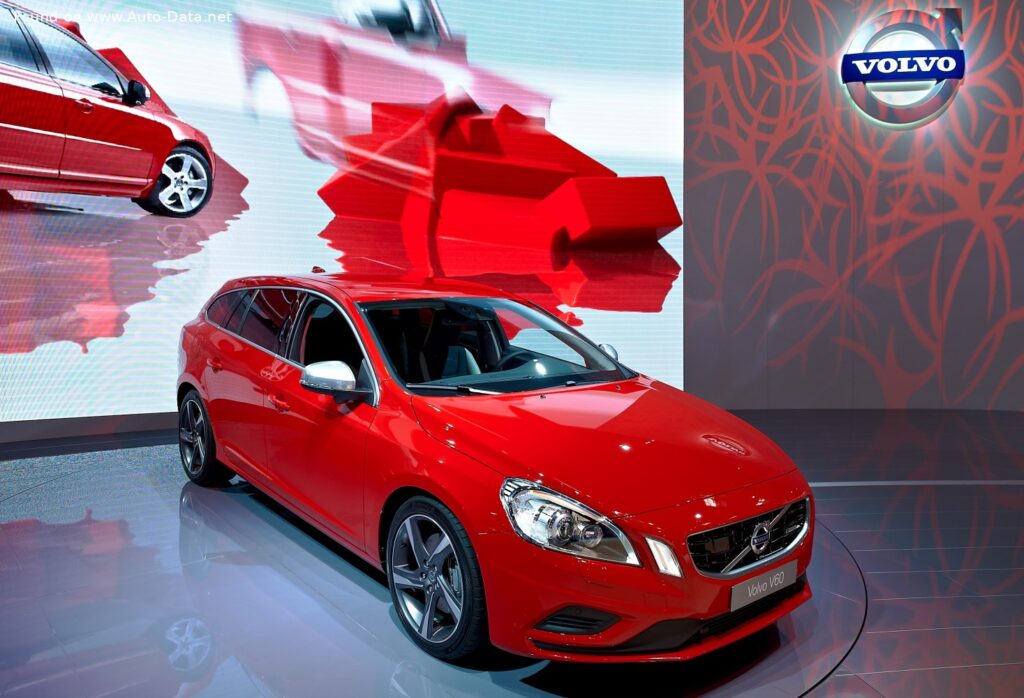
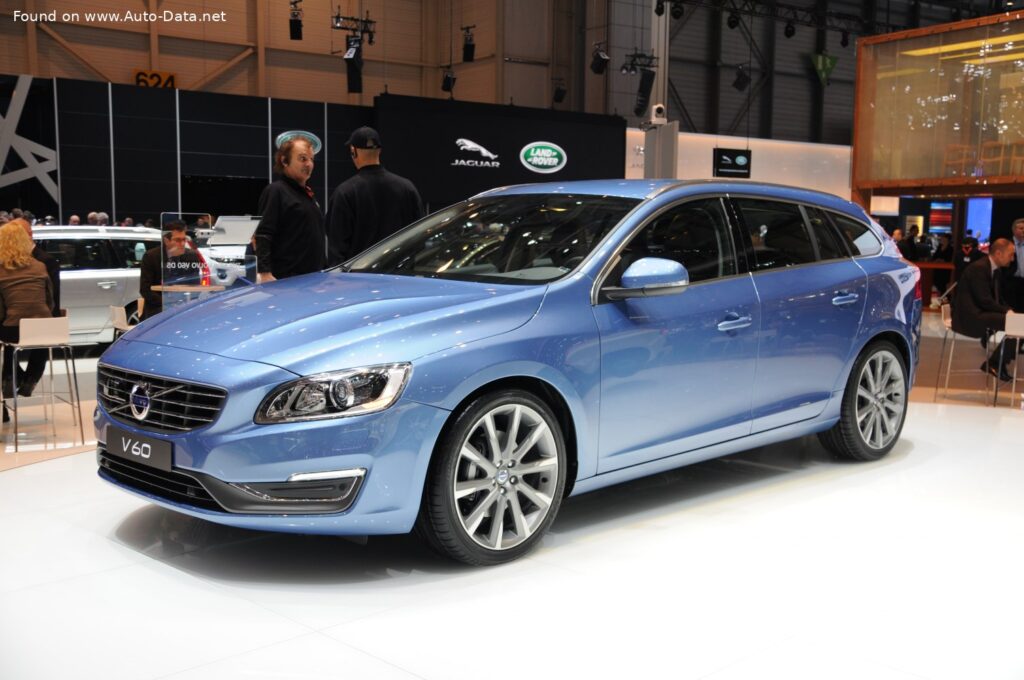
The Volvo V60 I (2013 facelift) retained the elegant and dynamic styling that characterized the first-generation V60, updated with subtle yet effective changes that enhanced its contemporary appeal. As a five-door, five-seat station wagon (or estate, as it’s known in Europe), the V60 perfectly embodied Volvo’s philosophy of combining practicality with sophisticated aesthetics. The facelift introduced revised headlights, a wider grille, and refreshed bumpers, giving the car a more assertive and modern presence.
Measuring 182.48 inches (4635 mm) in length, 73.43 inches (1865 mm) in width (82.56 inches / 2097 mm including mirrors), and 58.43 inches (1484 mm) in height, the V60 presented a sleek profile with a relatively low drag coefficient of 0.29. Its 109.29-inch (2776 mm) wheelbase contributed to a stable ride and comfortable interior space. The standard tire size was 235/45 R17 on 8J x 17 wheel rims, providing a good balance of grip and ride comfort.
Inside, the V60 D6 Twin Engine maintained Volvo’s hallmark ergonomic design and premium material quality. While specific interior features aren’t detailed in the raw data, it’s understood that a car of this caliber and era from Volvo would come equipped with a comprehensive suite of comfort, convenience, and safety features. These would include advanced infotainment systems, premium audio options, and high-quality upholstery. The trunk space offered 10.77 cu. ft. (305 liters) with the rear seats up, expanding to a generous 39.76 cu. ft. (1126 liters) when folded, providing ample cargo capacity for a family or active lifestyle.
A key differentiator for the D6 Twin Engine was its unique powertrain architecture. The diesel engine drove the front wheels, while the electric motor powered the rear, creating an “electric rear axle” AWD system. This innovative setup allowed for various driving modes: pure electric (for zero-emission city driving), diesel-only (for highway efficiency), or a hybrid mode that intelligently blended both for optimal performance and economy. The 11.2 kWh Lithium-ion battery pack was ingeniously located inside the trunk, a clever packaging solution that minimized intrusion into the passenger compartment, though it did reduce the total cargo volume slightly compared to non-hybrid V60 models.
Safety, as always with Volvo, was paramount. The V60 I (2013 facelift) would have incorporated Volvo’s industry-leading safety innovations, including a robust chassis, numerous airbags, and advanced driver-assistance systems (ADAS) that were progressively becoming standard or optional in premium vehicles of this period. Features like ABS (Anti-lock Braking System), ventilated disc brakes (336×28 mm front, 302×22 mm rear), and an electric power steering system contributed to both active and passive safety.
Technical Specifications
| Category | Specification | US/Imperial Conversion |
|---|---|---|
| General Information | ||
| Brand | Volvo | |
| Model | V60 | |
| Generation | V60 I (2013 facelift) | |
| Type (Engine) | 2.4 D6 Twin Engine (280 Hp) Plug-in Hybrid AWD Geartronic | |
| Production Start | April, 2013 | |
| Production End | April, 2015 | |
| Powertrain Architecture | PHEV (Plug-in Hybrid Electric Vehicle) | |
| Body Type | Station wagon (estate) | |
| Seats | 5 | |
| Doors | 5 | |
| Performance Specs | ||
| Fuel Consumption (Combined NEDC) | 1.8 l/100 km | 130.7 US mpg |
| CO2 Emissions (NEDC) | 48 g/km | |
| Fuel Type | Diesel / Electricity | |
| Acceleration 0 – 60 mph | 5.8 sec | |
| Acceleration 0 – 100 km/h | 6.1 sec | |
| Maximum Speed | 230 km/h | 142.92 mph |
| Braking 100 km/h – 0 | 37 m | |
| Emission Standard | Euro 5 | |
| Weight-to-Power Ratio | 7.1 kg/Hp | 141.2 Hp/tonne |
| Weight-to-Torque Ratio | 3.1 kg/Nm | 322.7 Nm/tonne |
| Electric Cars and Hybrids Specs | ||
| Gross Battery Capacity | 11.2 kWh | |
| Net (Usable) Battery Capacity | 8 kWh | |
| Battery Voltage | 400 V | |
| Battery Technology | Lithium-ion (Li-Ion) | |
| Battery Location | Inside the trunk | |
| All-Electric Range (NEDC) | 50 km | 31.07 mi |
| Average Energy Consumption (NEDC) | 13.3 kWh/100 km | 21.4 kWh/100 mi, 157 MPGe |
| Max Speed (Electric) | 125 km/h | 77.67 mph |
| Electric Motor Power | 68 Hp @ 2400 rpm | |
| Electric Motor Torque | 200 Nm @ 320-1700 rpm | 147.51 lb.-ft. @ 320-1700 rpm |
| Electric Motor Location | Rear axle, Transverse | |
| Electric Motor Type | Synchronous | |
| System Power | 280 Hp @ 4200 rpm | |
| System Torque | 640 Nm @ 1400 rpm | 472.04 lb.-ft. @ 1400 rpm |
| Internal Combustion Engine Specs | ||
| Power (ICE) | 215 Hp @ 4000 rpm | |
| Power per Liter (ICE) | 89.6 Hp/l | |
| Torque (ICE) | 440 Nm @ 1500-3000 rpm | 324.53 lb.-ft. @ 1500-3000 rpm |
| Maximum Engine Speed | 5200 rpm | |
| Engine Layout | Front, Transverse | |
| Engine Model/Code | D82PHEV | |
| Engine Displacement | 2400 cm³ | 2.4 l / 146.46 cu. in. |
| Number of Cylinders | 5 | |
| Engine Configuration | Inline | |
| Cylinder Bore | 81 mm | 3.19 in. |
| Piston Stroke | 93.15 mm | 3.67 in. |
| Compression Ratio | 16.5:1 | |
| Valves per Cylinder | 4 | |
| Fuel Injection System | Diesel Commonrail | |
| Engine Aspiration | Twin-Turbo, Intercooler | |
| Valvetrain | DOHC | |
| Engine Oil Capacity | 5.9 l | 6.23 US qt |
| Coolant Capacity | 12.9 l | 13.63 US qt |
| Engine Systems | Particulate filter | |
| Space, Volume and Weights | ||
| Kerb Weight | 1983 kg | 4371.77 lbs. |
| Max. Weight | 2505 kg | 5522.58 lbs. |
| Max Load | 522 kg | 1150.81 lbs. |
| Trunk (Boot) Space – Minimum | 305 l | 10.77 cu. ft. |
| Trunk (Boot) Space – Maximum | 1126 l | 39.76 cu. ft. |
| Fuel Tank Capacity | 45 l | 11.89 US gal |
| Max. Roof Load | 75 kg | 165.35 lbs. |
| Permitted Trailer Load (with brakes 12%) | 1800 kg | 3968.32 lbs. |
| Permitted Trailer Load (without brakes) | 750 kg | 1653.47 lbs. |
| Permitted Towbar Download | 90 kg | 198.42 lbs. |
| Dimensions | ||
| Length | 4635 mm | 182.48 in. |
| Width | 1865 mm | 73.43 in. |
| Width with Mirrors Folded | 1899 mm | 74.76 in. |
| Width Including Mirrors | 2097 mm | 82.56 in. |
| Height | 1484 mm | 58.43 in. |
| Wheelbase | 2776 mm | 109.29 in. |
| Front Track | 1578 mm | 62.13 in. |
| Rear Track | 1575 mm | 62.01 in. |
| Front Overhang | 943 mm | 37.13 in. |
| Rear Overhang | 916 mm | 36.06 in. |
| Ride Height (Ground Clearance) | 137 mm | 5.39 in. |
| Drag Coefficient (Cd) | 0.29 | |
| Minimum Turning Circle (Turning Diameter) | 12.4 m | 40.68 ft. |
| Drivetrain, Brakes and Suspension Specs | ||
| Drivetrain Architecture | ICE drives front wheels, electric motor drives rear wheels; capable of full electric, ICE-only, or mixed mode. | |
| Drive Wheel | All wheel drive (4×4) | |
| Number of Gears and Type of Gearbox | 6 gears, automatic transmission Geartronic | |
| Front Suspension | Independent type McPherson, Transverse stabilizer | |
| Rear Suspension | Transverse stabilizer, Coil spring | |
| Front Brakes | Ventilated discs, 336×28 mm | |
| Rear Brakes | Ventilated discs, 302×22 mm | |
| Assisting Systems | ABS (Anti-lock braking system) | |
| Steering Type | Steering rack and pinion | |
| Power Steering | Electric Steering | |
| Tires Size | 235/45 R17 | |
| Wheel Rims Size | 8J x 17 | |
Legacy & Market Impact of the Volvo V60 I (2013 facelift) 2.4 D6 Twin Engine
The Volvo V60 I (2013 facelift) 2.4 D6 Twin Engine (280 Hp) Plug-in Hybrid AWD Geartronic carved out a unique and significant niche, particularly within the European automotive landscape. As one of the very first production diesel plug-in hybrids globally, its market impact was substantial, positioning Volvo as a pioneer in combining efficient diesel technology with advanced electrification. This vehicle was not sold in the United States, where diesel passenger cars were less prevalent and the focus was shifting more towards gasoline-electric hybrids and eventually pure EVs. However, in its primary European market, it offered a compelling proposition.
The D6 Twin Engine’s reputation was built on its remarkable blend of performance, efficiency, and environmental consciousness. Its combined 280 horsepower and 472.04 lb.-ft. of torque delivered exhilarating acceleration, while its official NEDC fuel consumption figure of 130.7 US mpg (1.8 l/100 km) and ultra-low 48 g/km CO2 emissions set new benchmarks for a premium family car. This efficiency, coupled with a practical 31-mile (50 km) all-electric range, made it an attractive option for environmentally aware buyers seeking to reduce their running costs and carbon footprint