The Suzuki Jimny III (facelift 2005): A Compact Off-Road Icon
The
Suzuki Jimny III (facelift 2005)
represents a significant iteration of Suzuki’s long-running and highly respected compact off-road vehicle series. Launched in 2005 as a refreshed version of the third-generation model, this particular variant, equipped with the 1.3 VVT (85 Hp) 4WD Automatic powertrain, continued the Jimny’s tradition of offering robust, go-anywhere capability in a diminutive package. While not a mainstream offering in the United States, the Jimny carved out a substantial niche in European, Asian, and other international markets, where its blend of affordability, maneuverability, and genuine off-road prowess made it a popular choice for both recreational enthusiasts and utility users. This facelifted model, produced from 2005 to 2011, refined the existing platform with updated aesthetics and mechanical tweaks, ensuring its continued relevance in a rapidly evolving automotive landscape.
The Jimny series, dating back to the late 1960s with the original LJ series, has consistently championed the idea that serious off-roading doesn’t require a full-size SUV. The third generation, introduced in 1998, embraced a more modern design while retaining the crucial body-on-frame construction, rigid axles, and selectable four-wheel drive system that defined its predecessors. The 2005 facelift brought subtle but effective changes, enhancing its appeal and updating its technical specifications to meet contemporary standards, such as the Euro 4 emission requirements.
Engine and Performance of the Jimny III (facelift 2005)
At the heart of the
Suzuki Jimny III (facelift 2005)
1.3 VVT (85 Hp) 4WD Automatic lies the M13A engine, a naturally aspirated 1.3-liter (1328 cm³ or 81.04 cu. in.) inline four-cylinder gasoline unit. This engine features a DOHC (Double Overhead Camshaft) valvetrain with Variable Valve Timing (VVT), a technology designed to optimize valve lift and duration for improved power delivery across the rev range and enhanced fuel efficiency. It generates a respectable 85 horsepower at 6000 rpm, translating to a power-per-liter output of 64 Hp/l, which is quite efficient for its displacement.
Torque output stands at 110 Nm (81.13 lb.-ft.) available at 4100 rpm. While these figures might seem modest by modern standards, they are well-suited to the Jimny’s lightweight construction and intended purpose. The engine is mounted transversely at the front, driving all four wheels through a permanent rear-wheel-drive system that can engage the front wheels via an electrically or mechanically operated clutch when 4WD is required. This particular variant is mated to a 4-speed automatic transmission, offering convenience for urban driving and smooth power delivery during off-road excursions.
Performance figures reflect its utilitarian nature rather than outright speed. The Jimny III (facelift 2005) accelerates from 0 to 60 mph in a calculated 16.3 seconds (or 0-100 km/h in 17.2 seconds) and has a maximum speed of 83.89 mph (135 km/h). Fuel economy, measured under the NEDC cycle, is rated at 24.5 US mpg (9.6 l/100 km) in urban conditions, 36.8 US mpg (6.4 l/100 km) on the extra-urban cycle, and a combined 30.9 US mpg (7.6 l/100 km). CO2 emissions are 181 g/km, meeting the Euro 4 emission standard of its time. Its weight-to-power ratio is 12.6 kg/Hp (79.1 Hp/tonne), and the weight-to-torque ratio is 9.8 kg/Nm (102.3 Nm/tonne), indicating a balanced approach to its powertrain design for its intended use.
Design and Features
The
Suzuki Jimny III (facelift 2005)
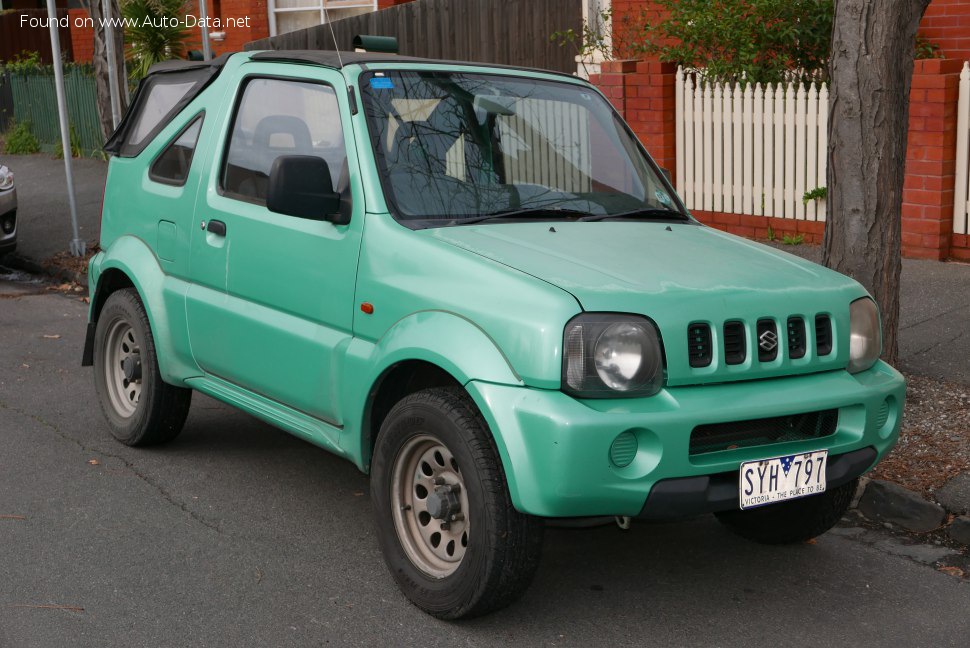
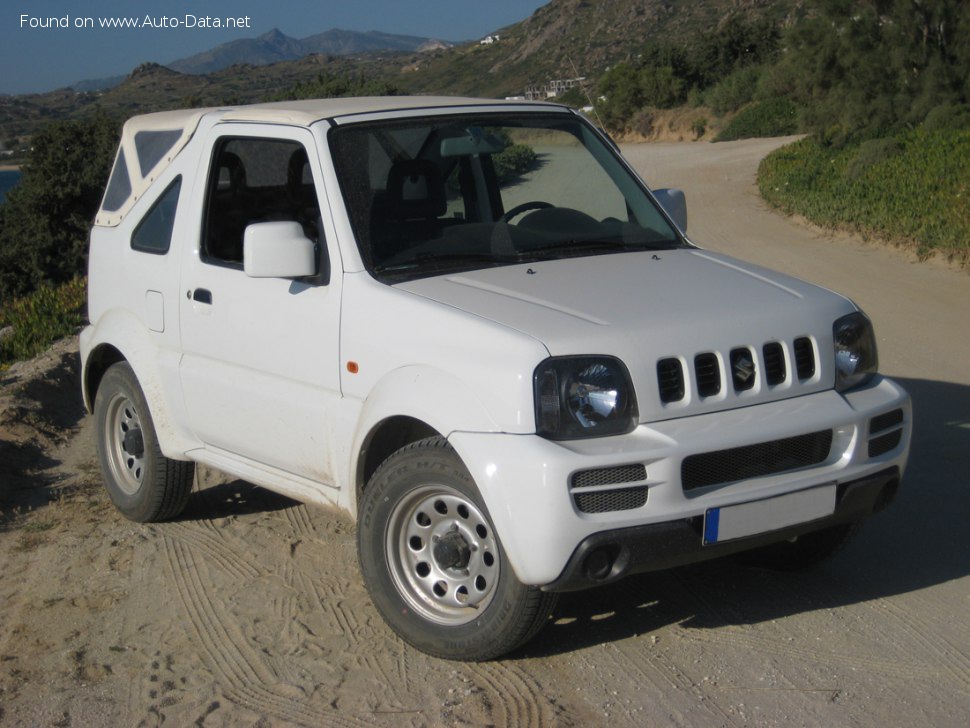
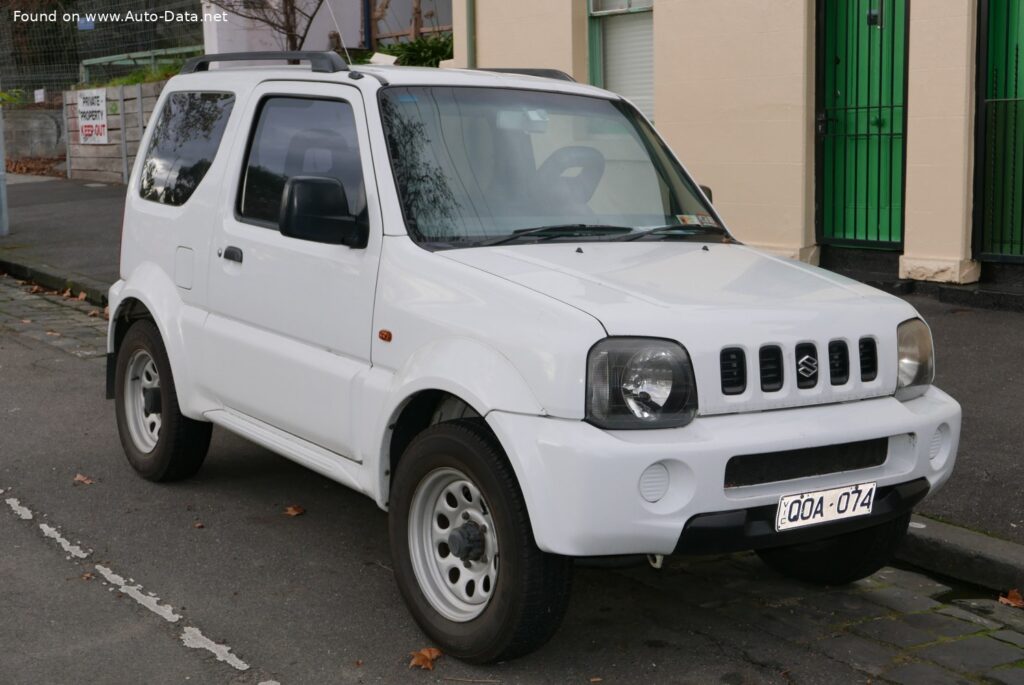
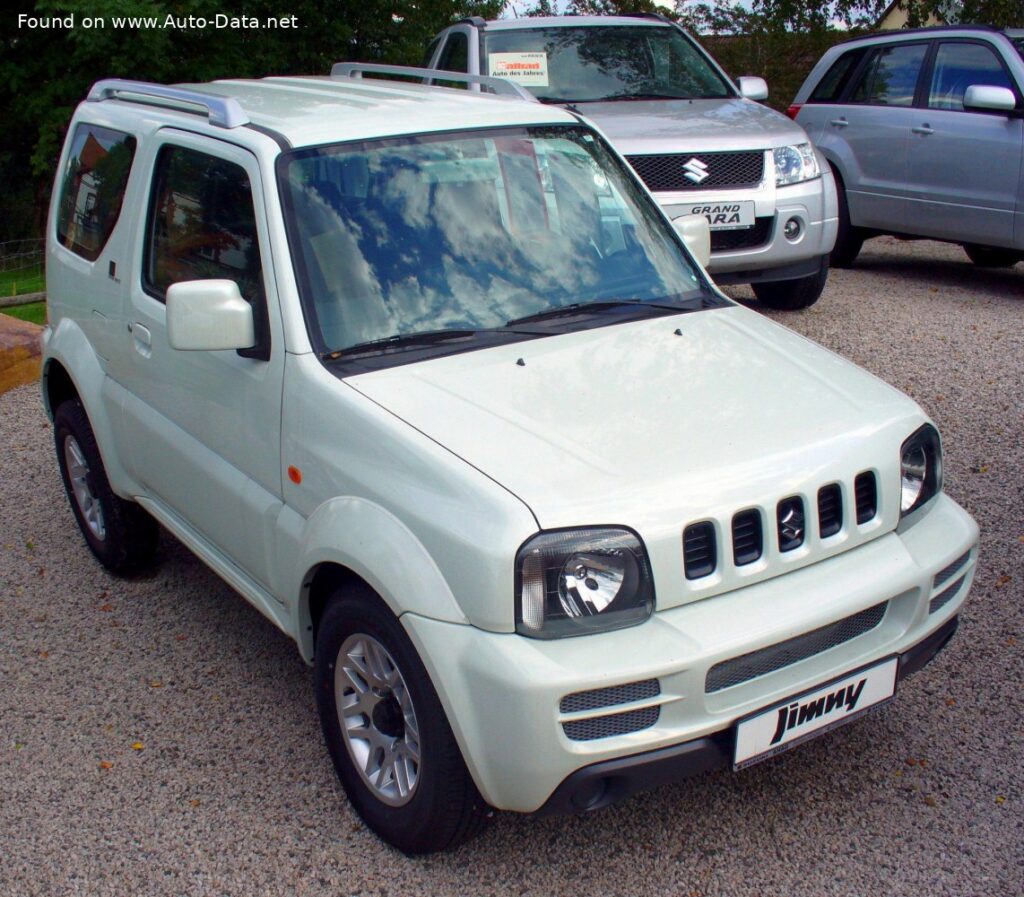
retained the classic, boxy, and functional design that is synonymous with the Jimny lineage. It is classified as a 3-door off-road vehicle, providing seating for four occupants. Its compact dimensions are a key to its agility: a length of 144.29 inches (3665 mm), a width of 62.99 inches (1600 mm, or 70.08 inches including mirrors), and a height of 67.13 inches (1705 mm). The short wheelbase of 88.58 inches (2250 mm) further contributes to its exceptional breakover angle.
Despite its small size, the Jimny boasts impressive off-road geometry, featuring an approach angle of 37°, a departure angle of 46°, and a ramp-over (breakover) angle of 31°. Coupled with a generous ground clearance of 7.48 inches (190 mm), these figures highlight its capability to tackle challenging terrain. The suspension system comprises coil springs and rigid axles both at the front and rear, a robust setup favored for its durability and articulation in off-road conditions. Braking duties are handled by front disc brakes and rear drum brakes, supplemented by an Anti-lock Braking System (ABS) for enhanced safety. The steering system is a cone worm with recirculation balls, assisted by hydraulic power steering, providing a direct feel and durability. The vehicle rides on 205/70 R15 tires mounted on 6J x 15 wheel rims.
Inside, the Jimny offers a no-frills, practical cabin designed for durability and ease of cleaning, rather than luxury. Cargo space is limited due to its compact footprint, with a minimum trunk volume of 3.99 cu. ft. (113 liters), expandable to 11.44 cu. ft. (324 liters) with the rear seats folded. Its curb weight is 2369.97 lbs. (1075 kg), with a maximum permissible weight of 3130.56 lbs. (1420 kg), allowing for a maximum load of 760.59 lbs. (345 kg). The fuel tank capacity is 10.57 US gallons (40 liters), offering a reasonable range for its intended use.
Technical Specifications
| General Information | |
|---|---|
| Brand | Suzuki |
| Model | Jimny |
| Generation | Jimny III (facelift 2005) |
| Type (Engine) | 1.3 VVT (85 Hp) 4WD Automatic |
| Production Start | 2005 |
| Production End | 2011 |
| Powertrain Architecture | Internal Combustion engine |
| Body type | Off-road vehicle |
| Seats | 4 |
| Doors | 3 |
| Performance Specifications | |
| Fuel Consumption – Urban (NEDC) | 9.6 l/100 km (24.5 US mpg) |
| Fuel Consumption – Extra Urban (NEDC) | 6.4 l/100 km (36.8 US mpg) |
| Fuel Consumption – Combined (NEDC) | 7.6 l/100 km (30.9 US mpg) |
| CO2 Emissions (NEDC) | 181 g/km |
| Fuel Type | Petrol (Gasoline) |
| Acceleration 0 – 62 mph (0-100 km/h) | 17.2 sec |
| Acceleration 0 – 60 mph (Calculated) | 16.3 sec |
| Maximum Speed | 135 km/h (83.89 mph) |
| Emission Standard | Euro 4 |
| Weight-to-Power Ratio | 12.6 kg/Hp (79.1 Hp/tonne) |
| Weight-to-Torque Ratio | 9.8 kg/Nm (102.3 Nm/tonne) |
| Engine Specifications | |
| Power | 85 Hp @ 6000 rpm |
| Power per Liter | 64 Hp/l |
| Torque | 110 Nm @ 4100 rpm (81.13 lb.-ft. @ 4100 rpm) |
| Engine Layout | Front, Transverse |
| Engine Model/Code | M13A |
| Engine Displacement | 1328 cm³ (81.04 cu. in.) |
| Number of Cylinders | 4 |
| Engine Configuration | Inline |
| Cylinder Bore | 78 mm (3.07 in.) |
| Piston Stroke | 69.5 mm (2.74 in.) |
| Compression Ratio | 9.5:1 |
| Valves per Cylinder | 4 |
| Fuel Injection System | Multi-port manifold injection |
| Engine Aspiration | Naturally aspirated |
| Valvetrain | DOHC |
| Engine Oil Capacity | 4 l (4.23 US qt) |
| Coolant Capacity | 5.9 l (6.23 US qt) |
| Dimensions, Volume, and Weights | |
| Kerb Weight | 1075 kg (2369.97 lbs.) |
| Max. Weight | 1420 kg (3130.56 lbs.) |
| Max Load | 345 kg (760.59 lbs.) |
| Trunk Space – Minimum | 113 l (3.99 cu. ft.) |
| Trunk Space – Maximum | 324 l (11.44 cu. ft.) |
| Fuel Tank Capacity | 40 l (10.57 US gal) |
| Permitted Trailer Load with Brakes (12%) | 1300 kg (2866.01 lbs.) |
| Permitted Trailer Load without Brakes | 350 kg (771.62 lbs.) |
| Permitted Towbar Download | 75 kg (165.35 lbs.) |
| Length | 3665 mm (144.29 in.) |
| Width | 1600 mm (62.99 in.) |
| Width including Mirrors | 1780 mm (70.08 in.) |
| Height | 1705 mm (67.13 in.) |
| Wheelbase | 2250 mm (88.58 in.) |
| Front Track | 1355 mm (53.35 in.) |
| Rear Track | 1365 mm (53.74 in.) |
| Ride Height (Ground Clearance) | 190 mm (7.48 in.) |
| Minimum Turning Circle | 9.8 m (32.15 ft.) |
| Approach Angle | 37° |
| Departure Angle | 46° |
| Ramp-over (Breakover) Angle | 31° |
| Drivetrain, Brakes, and Suspension | |
| Drivetrain Architecture | Internal combustion engine drives rear wheels permanently; front wheels driven through an electrically or mechanically operated clutch if necessary. |
| Drive Wheel | All-wheel drive (4×4) |
| Number of Gears & Type | 4 gears, automatic transmission |
| Front Suspension | Coil spring, Rigid axle suspension |
| Rear Suspension | Rigid axle suspension, Coil spring |
| Front Brakes | Disc |
| Rear Brakes | Drum |
| Assisting Systems | ABS (Anti-lock braking system) |
| Steering Type | Cone worm with recirculation balls |
| Power Steering | Hydraulic Steering |
| Tire Size | 205/70 R15 |
| Wheel Rims Size | 6J x 15 |
Legacy and Market Impact
The
Suzuki Jimny III (facelift 2005)
cemented the model’s reputation as a unique and highly capable compact off-roader. In markets outside the U.S., particularly in Europe, Asia, and Australia, the Jimny filled a distinct niche. It appealed to buyers who needed genuine 4×4 capability for challenging terrain, often in rural or mountainous regions, but did not require or desire the size, complexity, or fuel consumption of larger SUVs. Its small footprint made it exceptionally agile on narrow trails and in dense urban environments, offering a versatility that few competitors could match.
Competitors in its primary markets included other small, rugged utility vehicles, though true direct rivals with its combination of body-on-frame construction and rigid axles were few. Some might consider models like the Lada Niva (though much older in design) or certain compact pickups in terms of utility, but the Jimny’s dedicated off-road chassis set it apart from the growing segment of car-based compact SUVs and crossovers. Its enduring appeal stemmed from its robust mechanicals, relative simplicity, and low running costs compared to more sophisticated off-roaders.
The Jimny’s legacy is one of practicality, reliability, and an unwavering commitment to its core mission: delivering authentic off-road performance in a small, accessible package. The 2005 facelift helped maintain its competitive edge during its production run, ensuring it remained a relevant choice for those who valued function over fashion. Its influence extends to the current generation Jimny, which continues to uphold these values and enjoys a cult following globally, demonstrating the enduring wisdom of Suzuki’s compact 4×4 philosophy. This particular 1.3 VVT automatic variant provided a convenient and capable option for a broad range of drivers, further solidifying the Jimny’s iconic status in the international automotive landscape.