Introduction to the Volkswagen Transporter (T5) Panel Van 2.5 TDI (130 Hp) Tiptronic L1H2
The Volkswagen Transporter, an iconic nameplate synonymous with reliability and versatility in the light commercial vehicle (LCV) segment, entered its fifth generation (T5) in 2003. This particular iteration, the Volkswagen Transporter (T5) Panel Van 2.5 TDI (130 Hp) Tiptronic L1H2, represented a significant evolution in Volkswagen’s approach to the commercial van market. Designed primarily for the demanding European and international markets, where it served as an indispensable workhorse for countless businesses, the T5 built upon a legacy stretching back to the original Type 2 “Bus.”
The T5 generation brought with it a host of advancements in design, engineering, and onboard technology, setting new benchmarks for comfort, safety, and efficiency within its class. The L1H2 designation in this model name is crucial, indicating a standard wheelbase (L1) combined with a high roof (H2), optimizing cargo volume for a wide array of professional applications. Produced from 2003 to 2006 in this specific powertrain configuration, the 2.5 TDI engine paired with the Tiptronic automatic transmission offered a compelling blend of robust performance and ease of operation, making it a favorite among fleet operators and independent tradespeople alike. While never officially sold in the United States in this commercial panel van guise, the T5 Transporter family continued Volkswagen’s global reputation for engineering excellence in utility vehicles.
Engine and Performance of the Volkswagen Transporter (T5) Panel Van
At the heart of the Volkswagen Transporter (T5) Panel Van 2.5 TDI (130 Hp) Tiptronic L1H2 lies a robust 2.5-liter (2460 cm³ or 150.12 cu. in.) turbocharged direct injection (TDI) diesel engine. This five-cylinder inline powerplant, designated EA153 / AXD, was a hallmark of Volkswagen’s diesel engineering prowess during this period. Known for its torque-rich delivery and impressive fuel efficiency, the engine produced a healthy 130 horsepower at 3500 rpm. More critically for a commercial vehicle, it generated a substantial 250.77 lb.-ft. (340 Nm) of torque, available across a broad and usable range between 2000 and 2300 rpm. This low-end torque was instrumental in enabling the van to effortlessly carry heavy loads and manage steep inclines, crucial attributes for its intended commercial use.
The engine’s advanced design featured a SOHC (Single Overhead Camshaft) valvetrain with two valves per cylinder, and employed Volkswagen’s then-pioneering Pump-nozzle (Unit Injector) fuel injection system. This system delivered highly precise fuel metering, contributing to both power output and fuel economy. Further enhancing its performance and efficiency were the turbocharger and intercooler, ensuring optimal air intake and combustion. With a compression ratio of 18.5:1, the engine was optimized for diesel fuel, which was standard for commercial vehicles in Europe. The powertrain architecture featured a front, transverse engine layout driving the front wheels, providing a balanced and predictable handling characteristic for a vehicle of its size.
Power was delivered to the front wheels through a sophisticated 6-speed Tiptronic automatic transmission. This automatic gearbox was a significant upgrade for commercial operators, offering smoother shifts, reduced driver fatigue in stop-and-go traffic, and the ability to manually select gears when desired for better control under specific load or terrain conditions. While acceleration from 0 to 60 mph in 14.8 seconds and a top speed of 98.8 mph (159 km/h) might not sound sporty, these figures were more than adequate for a panel van focused on utility rather than speed. The T5’s fuel economy was commendable for its class, achieving approximately 35.1 US mpg (6.7 l/100 km) in extra-urban driving, underscoring its efficiency as a long-distance hauler. Adhering to the Euro 3 emission standard, the vehicle also reflected the environmental regulations of its early 2000s production era.
Design, Features, and Utility
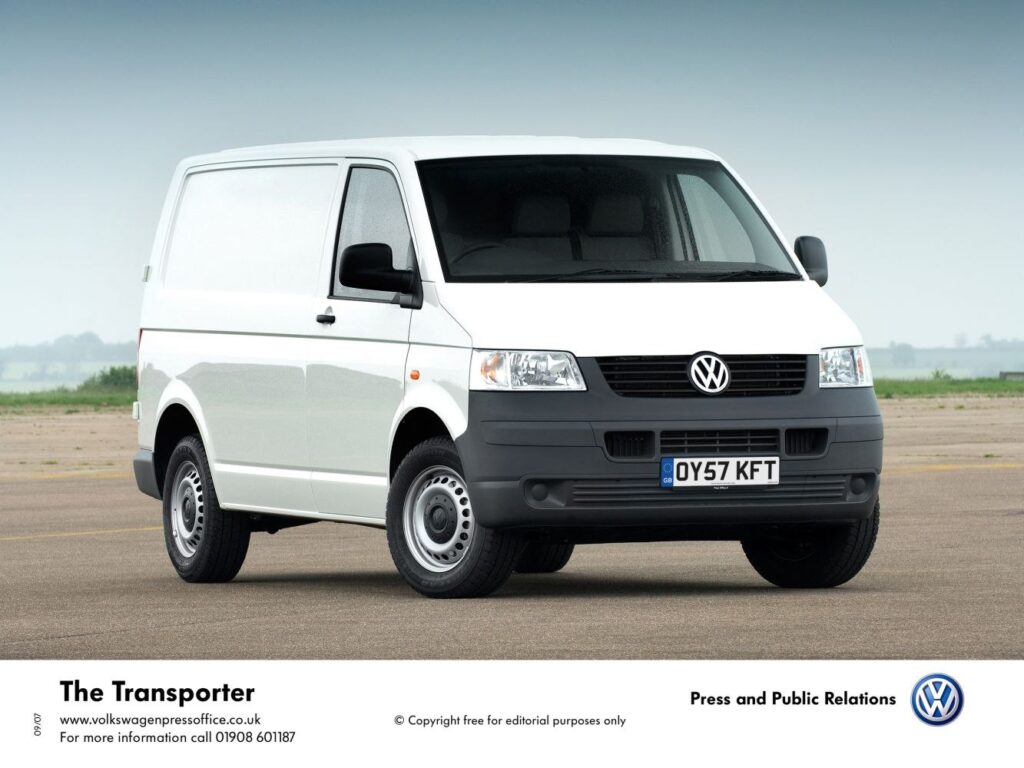
The design of the Volkswagen Transporter (T5) Panel Van was a thoughtful evolution, blending functionality with a more modern aesthetic than its predecessors. As a panel van, its primary purpose was cargo transport, and the L1H2 configuration maximized this utility. The exterior featured clean lines, a robust stance, and Volkswagen’s signature understated elegance. Measuring 192.52 inches (4890 mm) in length, 74.96 inches (1904 mm) in width (88.27 inches or 2242 mm including mirrors), and a significant 85.04 inches (2160 mm) in height, the L1H2 model offered an impressive internal cargo volume. The high roof was particularly advantageous for carrying taller items or allowing tradespeople to stand upright within the cargo area, improving workflow.
Inside, the Transporter T5 was designed with the working professional in mind. The cabin typically accommodated 2-3 seats, providing comfortable seating for the driver and often one or two passengers. Ergonomics were a priority, with controls intuitively placed and durable materials used throughout to withstand the rigors of daily commercial use. The four to five doors included large sliding side doors and rear barn doors (or a tailgate, depending on specification), ensuring easy access to the cavernous cargo bay. With a maximum trunk (boot) space of 6700 liters (236.61 cu. ft.), the T5 L1H2 was capable of swallowing substantial loads, making it highly versatile for various trades, from plumbing and electrical work to parcel delivery and mobile workshops.
Beyond sheer volume, the T5’s utility was further enhanced by its impressive load-carrying capabilities. It boasted a maximum payload of 1973.14 lbs (895 kg) and a maximum gross weight of 6172.94 – 6613.87 lbs (2800-3000 kg). The kerb weight ranged from 4199.81 – 4640.73 lbs (1905-2105 kg), reflecting its solid construction. Furthermore, the Transporter was a capable hauler, with a permitted trailer load of 5511.56 lbs (2500 kg) with brakes, and 1653.47 lbs (750 kg) without brakes, making it suitable for towing various equipment or additional cargo. Safety features for the era included ABS (Anti-lock Braking System), complemented by ventilated disc brakes on both the front (308×29.5 mm) and rear (294×22 mm) axles for reliable stopping power. The independent McPherson front suspension and independent coil spring, trailing arm rear suspension, along with a transverse stabilizer, contributed to a stable and relatively comfortable ride, even when fully loaded. Hydraulic power steering made maneuvering the van, especially in urban environments, less strenuous for the driver, further solidifying its reputation as a practical and user-friendly commercial vehicle.
Technical Specifications
| Category | Specification |
|---|---|
| Brand | Volkswagen |
| Model | Transporter |
| Generation | Transporter (T5) Panel Van |
| Type (Engine) | 2.5 TDI (130 Hp) Tiptronic L1H2 |
| Start of Production | 2003 year |
| End of Production | 2006 year |
| Powertrain Architecture | Internal Combustion Engine, Front Wheel Drive |
| Body Type | Van |
| Seats | 2-3 |
| Doors | 4-5 |
| Performance Specs | |
| Fuel Consumption (Extra Urban) | 35.1 US mpg (6.7 l/100 km) |
| Fuel Type | Diesel |
| Acceleration 0 – 60 mph | 14.8 sec |
| Maximum Speed | 98.8 mph (159 km/h) |
| Emission Standard | Euro 3 |
| Weight-to-Power Ratio | 14.7 kg/Hp, 68.2 Hp/tonne |
| Weight-to-Torque Ratio | 5.6 kg/Nm, 178.5 Nm/tonne |
| Engine Specs | |
| Power | 130 Hp @ 3500 rpm |
| Power per Liter | 52.8 Hp/l |
| Torque | 250.77 lb.-ft. (340 Nm) @ 2000-2300 rpm |
| Engine Layout | Front, Transverse |
| Engine Model/Code | EA153 / AXD |
| Engine Displacement | 2460 cm³ (2.5 liters / 150.12 cu. in.) |
| Number of Cylinders | 5 |
| Engine Configuration | Inline |
| Cylinder Bore | 3.19 in. (81 mm) |
| Piston Stroke | 3.76 in. (95.5 mm) |
| Compression Ratio | 18.5:1 |
| Number of Valves per Cylinder | 2 |
| Fuel Injection System | Pump-nozzle (Unit Injector) |
| Engine Aspiration | Turbocharger, Intercooler |
| Valvetrain | SOHC |
| Engine Oil Capacity | 7.82 US qt (7.4 l) |
| Coolant Capacity | 7.5 US qt (7.1 l) |
| Space, Volume and Weights | |
| Kerb Weight | 4199.81 – 4640.73 lbs (1905-2105 kg) |
| Max. Weight | 6172.94 – 6613.87 lbs (2800-3000 kg) |
| Max Load | 1973.14 lbs (895 kg) |
| Trunk (Boot) Space – Max | 236.61 cu. ft. (6700 l) |
| Fuel Tank Capacity | 21.13 US gal (80 l) |
| Permitted Trailer Load with Brakes (8%) | 5511.56 lbs (2500 kg) |
| Permitted Trailer Load with Brakes (12%) | 5511.56 lbs (2500 kg) |
| Permitted Trailer Load without Brakes | 1653.47 lbs (750 kg) |
| Permitted Towbar Download | 220.46 lbs (100 kg) |
| Dimensions | |
| Length | 192.52 in. (4890 mm) |
| Width | 74.96 in. (1904 mm) |
| Width including Mirrors | 88.27 in. (2242 mm) |
| Height | 85.04 in. (2160 mm) |
| Wheelbase | 118.11 in. (3000 mm) |
| Front Track | 64.09 in. (1628 mm) |
| Rear (Back) Track | 64.09 in. (1628 mm) |
| Front Overhang | 35.2 in. (894 mm) |
| Rear Overhang | 39.21 in. (996 mm) |
| Ride Height (Ground Clearance) | 6.5 in. (165 mm) |
| Minimum Turning Circle (Diameter) | 39.04 ft. (11.9 m) |
| Approach Angle | 22° |
| Departure Angle | 16° |
| Ramp-over (Brakeover) Angle | 14° |
| Wading Depth | 11.81 in. (300 mm) |
| Drivetrain, Brakes and Suspension Specs | |
| Drive Wheel | Front Wheel Drive |
| Number of Gears and Type of Gearbox | 6 gears, Automatic Transmission Tiptronic |
| Front Suspension | Independent, McPherson with coil spring and anti-roll bar |
| Rear Suspension | Independent coil spring, Transverse stabilizer, Trailing arm |
| Front Brakes | Ventilated discs, 308×29.5 mm |
| Rear Brakes | Ventilated discs, 294×22 mm |
| Assisting Systems | ABS (Anti-lock Braking System) |
| Steering Type | Steering rack and pinion |
| Power Steering | Hydraulic Steering |
| Tires Size | 215/65 R16 |
| Wheel Rims Size | 6.5J x 16 |
Legacy and Market Impact
The Volkswagen Transporter (T5) Panel Van, particularly models like the 2.5 TDI (130 Hp) Tiptronic L1H2, cemented its reputation as a segment leader in the European and global light commercial vehicle markets. Its legacy is deeply intertwined with the broader Transporter lineage, a family of vehicles that has consistently delivered robustness, adaptability, and economic efficiency since the 1950s. The T5 generation, produced from 2003 to 2015 (with this specific engine/transmission variant from 2003-2006), represented a significant step forward in terms of refinement, driver comfort, and technological integration, without compromising its core utility.
In its primary markets, the T5 Transporter was a ubiquitous sight, serving as the backbone for countless small businesses, large logistics operations, and public services. Its blend of a potent yet efficient diesel engine, a smooth automatic transmission, and a highly configurable cargo space made it incredibly appealing. The L1H2 configuration, in particular, offered an ideal balance of manageable exterior dimensions and generous internal volume, making it suitable for both urban deliveries and intercity transport. Its build quality and durability translated into strong residual values, further enhancing its appeal to commercial buyers who prioritized long-term operational costs.
Competitors in the fiercely contested European LCV market included formidable rivals such as the Ford Transit, Mercedes-Benz Vito, Renault Trafic, and Opel Vivaro. Against these, the T5 Transporter often stood out for its premium feel, superior driving dynamics (for a van), and the strong brand loyalty Volkswagen commanded. Its independent suspension setup, combined with a car-like interior, provided a level of comfort and refinement that many competitors struggled to match, making long hours behind the wheel less arduous for drivers. The availability of advanced features like ABS and hydraulic power steering, standard on this variant, underscored its modern approach to commercial vehicle design.
The historical significance of the T5 lies in its successful modernization of a commercial icon. It transitioned the Transporter into the 21st century with a focus on efficiency, safety, and driver well-being, paving the way for subsequent generations. While the Transporter has largely remained a European and international phenomenon, with its commercial variants not widely available in the United States, its influence on global LCV design and engineering is undeniable. It continues to be celebrated for its reliability, versatility, and enduring appeal, a testament to Volkswagen’s commitment to building vehicles that truly serve the needs of working professionals.