
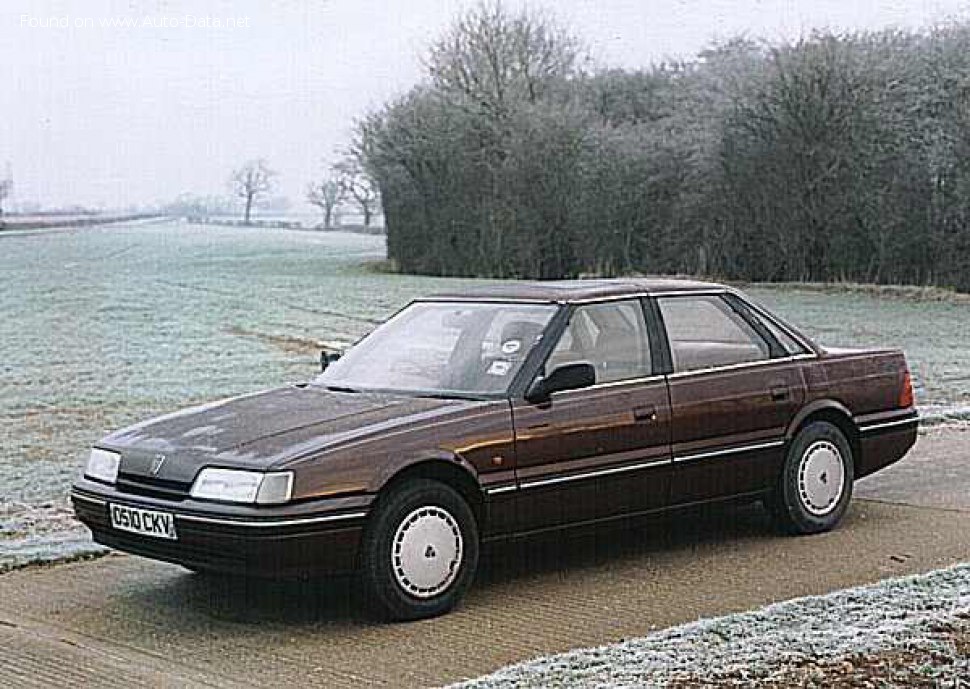
Introduction to the Rover 800 820 16 V I/SI (XS) (140 Hp)
The Rover 800 Series represented a pivotal moment for the British automaker Rover, marking its ambitious return to the executive sedan segment with a truly modern offering. Launched in 1986, the 800 Series, known internally as “Project XX,” was the result of a significant collaborative effort with Honda, sharing its platform and many components with the Honda Legend. This Anglo-Japanese partnership aimed to produce a sophisticated, competitive, and technologically advanced vehicle capable of challenging established European luxury marques.
The first generation of the Rover 800 Series spanned from 1986 to 1991, offering various engine and trim configurations. Among these, the Rover 800 820 16 V I/SI (XS) (140 Hp) was a prominent variant, positioned as a strong performer within the lineup. It combined a responsive four-cylinder engine with a refined sedan body, targeting discerning buyers in its primary European market who sought a blend of British luxury and contemporary engineering. This model, produced between 1986 and 1988, was instrumental in shaping Rover’s image during a critical period of its history, striving to balance traditional British craftsmanship with the reliability and advanced technology brought forth by the collaboration with Honda.
The Rover 800 820 16 V I/SI (XS) (140 Hp): Engineering and Performance
At the heart of the Rover 800 820 16 V I/SI (XS) (140 Hp) lay a robust and relatively advanced powertrain for its time. The vehicle featured a 1996 cubic centimeter (2.0-liter) inline four-cylinder engine, designated by Rover as the M16i, which was a significant evolution of their existing M-series engine line. This unit benefited from a Double Overhead Camshaft (DOHC) valvetrain with four valves per cylinder, a configuration that was becoming increasingly common in performance-oriented engines of the mid-1980s but still represented a modern approach for an executive sedan.
This naturally aspirated gasoline engine delivered a respectable 140 horsepower at 6000 rpm, translating to a power-per-liter output of 70.1 HP/liter. Torque production was equally competitive, peaking at 131.29 lb.-ft. (178 Nm) at 4500 rpm. Power was delivered to the front wheels via a precise 5-speed manual transmission, a setup that underscored the vehicle’s focus on driver engagement and efficiency. The drivetrain architecture, with the internal combustion engine driving the front wheels, provided predictable handling characteristics and optimized interior space.
Performance figures for the 820 16 V I/SI (XS) were quite spirited for an executive sedan of its class and era. The car could accelerate from 0 to 60 mph in an estimated 9.9 seconds, with 0 to 100 km/h taking 10.4 seconds. Its maximum speed was rated at 126.14 mph (203 km/h), allowing it to comfortably cruise on European highways. Fuel economy, while not a primary selling point for executive cars, was reasonable for its segment, with a combined rating of 30.2 US mpg (7.8 l/100 km). Urban consumption stood at 20.8 US mpg (11.3 l/100 km), while extra-urban driving could yield up to 38.6 US mpg (6.1 l/100 km). With a 17.96 US gallon (68-liter) fuel tank, the Rover 820 offered a practical range for long-distance travel.
Design and Features
The Rover 800 Series, including the 820 16 V I/SI (XS) variant, was offered exclusively as a four-door sedan, a body style synonymous with the executive class. Its design, a blend of British elegance and subtle Japanese influences, aimed for a sophisticated and understated aesthetic. The car measured 192.2 inches (4882 mm) in length, 68.11 inches (1730 mm) in width, and 54.84 inches (1393 mm) in height, providing a substantial road presence. A generous wheelbase of 108.9 inches (2766 mm) contributed significantly to both ride comfort and interior spaciousness for its five occupants.
Inside, the Rover 800 pursued a classic British luxury ambiance, often featuring high-quality materials and thoughtful ergonomics. For its era, key features included a comprehensive instrument cluster, power steering (hydraulic), and multi-port manifold fuel injection for optimized engine performance. Safety was also a consideration, with the inclusion of an Anti-lock Braking System (ABS), which was an advanced feature for a mainstream executive car in the mid-1980s. Braking performance was handled by ventilated discs at the front and solid discs at the rear, providing reliable stopping power. The suspension system utilized a double wishbone setup at the front, offering precise handling and a comfortable ride, complemented by a coil spring rear suspension.
The vehicle’s practical attributes included a respectable trunk (boot) space of 15.72 cubic feet (445 liters), sufficient for executive travel or family outings. The curb weight of 2987.26 lbs (1355 kg) indicated a solid, well-built structure, while a maximum load capacity of 1091.29 lbs (495 kg) highlighted its utility. The car rode on 195/ R14 tires, a common size for vehicles of its class, balancing grip and ride comfort.
Technical Specifications: Rover 800 820 16 V I/SI (XS) (140 Hp)
| Category | Specification |
|---|---|
| Brand | Rover |
| Model | 800 |
| Generation | 800 |
| Type (Engine) | 820 16 V I/SI (XS) (140 Hp) |
| Start of Production | 1986 year |
| End of Production | 1988 year |
| Powertrain Architecture | Internal Combustion engine |
| Body type | Sedan |
| Seats | 5 |
| Doors | 4 |
| Performance Specs | |
| Fuel consumption (economy) – urban | 11.3 l/100 km (20.8 US mpg) |
| Fuel consumption (economy) – extra urban | 6.1 l/100 km (38.6 US mpg) |
| Fuel consumption (economy) – combined | 7.8 l/100 km (30.2 US mpg) |
| Fuel Type | Petrol (Gasoline) |
| Acceleration 0 – 60 mph | 9.9 sec |
| Acceleration 0 – 100 km/h | 10.4 sec |
| Maximum speed | 203 km/h (126.14 mph) |
| Weight-to-power ratio | 9.7 kg/Hp (103.3 Hp/tonne) |
| Weight-to-torque ratio | 7.6 kg/Nm (131.4 Nm/tonne) |
| Engine Specs | |
| Power | 140 Hp @ 6000 rpm |
| Power per liter | 70.1 Hp/l |
| Torque | 178 Nm @ 4500 rpm (131.29 lb.-ft.) |
| Engine layout | Front, Transverse |
| Engine Model/Code | M16i |
| Engine displacement | 1996 cm3 (2.0 liters / 121.8 cu. in.) |
| Number of cylinders | 4 |
| Engine configuration | Inline |
| Cylinder Bore | 84.5 mm (3.33 in.) |
| Piston Stroke | 89 mm (3.5 in.) |
| Compression ratio | 10:1 |
| Number of valves per cylinder | 4 |
| Fuel injection system | Multi-port manifold injection |
| Engine aspiration | Naturally aspirated engine |
| Valvetrain | DOHC |
| Engine oil capacity | 4.5 l (4.76 US qt) |
| Coolant capacity | 10 l (10.57 US qt) |
| Space, Volume and Weights | |
| Kerb Weight | 1355 kg (2987.26 lbs) |
| Max. weight | 1850 kg (4078.55 lbs) |
| Max load | 495 kg (1091.29 lbs) |
| Trunk (boot) space – minimum | 445 l (15.72 cu. ft.) |
| Fuel tank capacity | 68 l (17.96 US gal) |
| Dimensions | |
| Length | 4882 mm (192.2 in.) |
| Width | 1730 mm (68.11 in.) |
| Height | 1393 mm (54.84 in.) |
| Wheelbase | 2766 mm (108.9 in.) |
| Front track | 1487 mm (58.54 in.) |
| Rear (Back) track | 1450 mm (57.09 in.) |
| Drivetrain, Brakes and Suspension Specs | |
| Drivetrain Architecture | The Internal combustion engine (ICE) drives the front wheels of the vehicle. |
| Drive wheel | Front wheel drive |
| Number of gears and type of gearbox | 5 gears, manual transmission |
| Front suspension | Double wishbone |
| Rear suspension | Coil spring |
| Front brakes | Ventilated discs |
| Rear brakes | Disc |
| Assisting systems | ABS (Anti-lock braking system) |
| Steering type | Steering rack and pinion |
| Power steering | Hydraulic Steering |
| Tires size | 195/ R14 |
Legacy and Market Impact
The Rover 800 Series, and specifically the 820 16 V I/SI (XS) (140 Hp) variant, played a crucial role in Rover’s strategy to re-establish itself as a credible contender in the competitive European executive car market. It was a successor to the Rover SD1, a car renowned for its groundbreaking design but plagued by quality issues. The 800 series aimed to rectify these perceptions by leveraging Honda’s engineering prowess, particularly in areas of reliability and manufacturing quality.
In its home market and across Europe, the Rover 800 competed against a formidable array of rivals. These included established German luxury sedans like the BMW 5 Series and Mercedes-Benz E-Class, as well as other strong European contenders such as the Audi 100/200, Ford Granada/Scorpio, Vauxhall Carlton/Opel Omega, Saab 9000, and Volvo 740/760. The 800 Series sought to carve out its niche by offering a distinctive blend of traditional British luxury appointments, a comfortable ride, and contemporary performance and features, often at a more accessible price point than some of its German competitors.
The initial reception for the Rover 800 was generally positive, with praise for its styling, spacious interior, and improved build quality compared to previous Rover models. The 820 16 V I/SI (XS) with its 140 HP engine was particularly well-regarded for offering a good balance of performance and fuel efficiency, making it a popular choice for both private buyers and corporate fleets. Its DOHC 16-valve engine was seen as a modern and capable powerplant, contributing to a refined driving experience.
Despite its strengths, the Rover 800 faced an uphill battle against deeply entrenched rivals. Over its production run, the car’s reputation became somewhat mixed, with perceptions of build quality and reliability occasionally varying. However, its historical significance as a product of the Rover-Honda alliance cannot be overstated. It represented Rover’s most serious attempt to compete on a global stage in the executive segment and laid the groundwork for future models. The 800 Series remains a testament to an era of significant international automotive collaboration and a key chapter in the storied history of the Rover brand.
