Introduction to the Renault Espace IV (Phase II, 2006) 2.0 dCi (150 Hp)
The Renault Espace, a name synonymous with the European minivan segment, carved out a unique niche since its inception in the early 1980s. The fourth generation, introduced in 2002, represented a significant evolution in design, technology, and refinement. The model under scrutiny, the Renault Espace IV (Phase II, 2006) equipped with the 2.0 dCi (150 Hp) engine, is a prime example of Renault’s commitment to sophisticated family transportation in the mid-2000s. This particular iteration, produced from 2009 to 2010, marked a refined period within the fourth generation’s lifecycle, offering enhanced efficiency and performance through its advanced diesel powertrain.
While the Espace was never officially sold in the United States, it played a pivotal role in shaping the multi-purpose vehicle (MPV) landscape across Europe and other international markets. It pioneered concepts of modular interior space, comfort, and safety for large families, effectively setting benchmarks that competitors often strove to meet. The Phase II refresh, launched in 2006, brought subtle aesthetic updates and, more importantly, a range of modern diesel engines, including the robust 2.0 dCi, designed to meet the increasingly stringent Euro 4 emission standards while delivering strong performance and impressive fuel economy. This vehicle embodies the European approach to family haulers, prioritizing versatility and driving dynamics alongside practicality.
Powertrain and Performance of the Renault Espace IV (Phase II, 2006)
Engine and Drivetrain
At the heart of this particular Renault Espace IV (Phase II, 2006) model lies the M9R 2.0-liter dCi (Diesel Commonrail) inline-four engine. This powerplant was a significant development for Renault, renowned for its balance of power, refinement, and efficiency. With a displacement of 1995 cubic centimeters (121.74 cubic inches), the engine features a DOHC (Dual Overhead Camshaft) valvetrain with four valves per cylinder, ensuring optimal airflow and combustion. The engine benefits from a sophisticated diesel common rail fuel injection system, which precisely controls fuel delivery to maximize efficiency and minimize emissions.
Further enhancing its performance and economy, the 2.0 dCi engine is equipped with a turbocharger and an intercooler. This forced induction system not only boosts power output but also improves throttle response across the rev range. The engine delivers a respectable 150 horsepower at 4000 rpm, providing ample power for highway cruising and city driving, even when fully loaded. Torque is a crucial aspect for a family vehicle, and the Espace excels here, generating a healthy 250.77 pound-feet (340 Nm) at a low 2000 rpm. This substantial low-end torque ensures strong acceleration from a standstill and effortless overtaking maneuvers.
Power is transmitted to the front wheels via a smooth-shifting 6-speed manual transmission. This combination offers drivers a direct and engaging experience, while also contributing to the vehicle’s excellent fuel efficiency. The front-wheel-drive architecture is typical for minivans in this segment, providing predictable handling and maximizing interior space.
Performance Metrics and Efficiency
Despite its considerable size and capacity for seven passengers, the Renault Espace IV (Phase II, 2006) 2.0 dCi delivers competitive performance figures for its class. It can accelerate from 0 to 60 mph in approximately 10.1 seconds, making it agile enough for everyday traffic. The top speed is rated at 120.55 mph (194 km/h), demonstrating its capability for sustained high-speed travel on European autobahns.
Fuel economy was a major selling point for diesel engines in Europe, and this Espace variant is no exception. It achieves an impressive combined fuel economy of 33.1 US mpg (7.1 liters per 100 km). Urban driving yields around 27.7 US mpg (8.5 l/100 km), while extra-urban (highway) driving can see figures as high as 37.3 US mpg (6.3 l/100 km). These figures highlight the inherent efficiency of modern diesel technology, especially when paired with a manual gearbox. With CO2 emissions of 188 g/km, the vehicle met the Euro 4 emission standard, a testament to its relatively clean operation for its era. The large 21.93 US gallon (83 liter) fuel tank provides an excellent cruising range, making long family trips less frequent stops at the pump.
Design and Features
Exterior and Interior Design
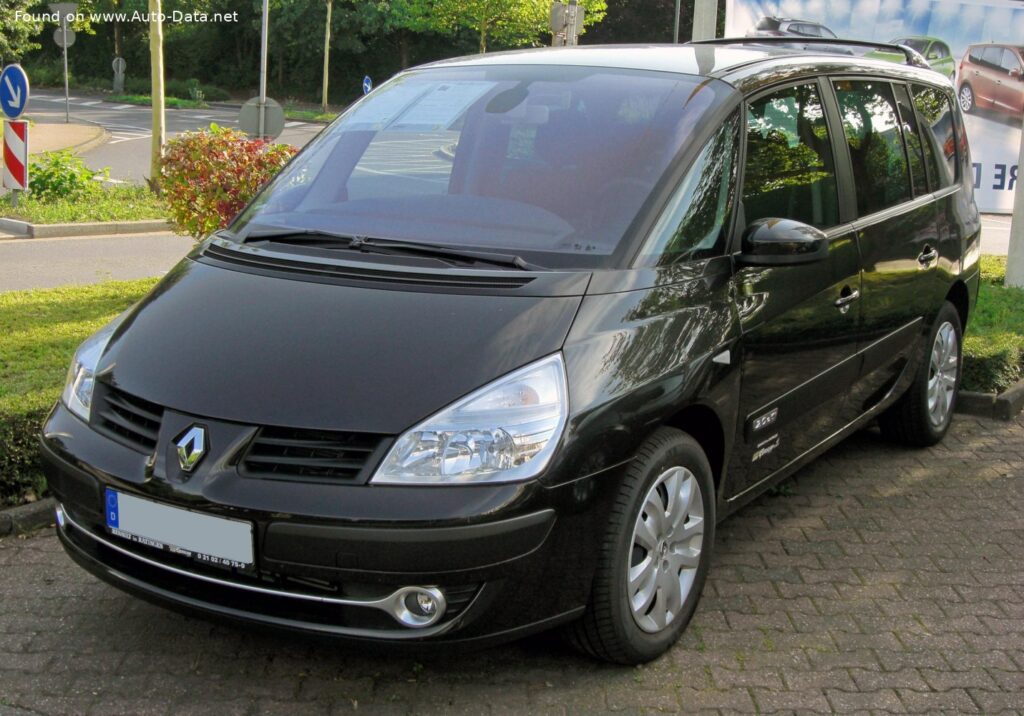
The Renault Espace IV (Phase II, 2006) retains the distinctive, futuristic styling that characterized the fourth-generation model. Its silhouette is unmistakably a minivan, yet Renault managed to imbue it with a sense of sophistication and dynamism. The Phase II refresh brought subtle refinements, including revised front fascias, lighting clusters, and wheel designs, keeping the Espace looking fresh and contemporary. With a length of 183.31 inches, a width of 73.23 inches (74.57 inches including mirrors), and a height of 68.03 inches, the Espace presents a substantial road presence, emphasizing its capacity and comfort. The 110.35-inch wheelbase contributes significantly to interior roominess and ride stability.
Inside, the Espace was renowned for its innovative and highly modular cabin. Designed to accommodate up to seven occupants, the seating arrangement could be configured in numerous ways, allowing owners to prioritize passenger space or cargo capacity as needed. The individual rear seats could slide, recline, fold, or even be removed entirely, transforming the minivan from a comfortable people-carrier into a cavernous cargo hauler. Minimum trunk space starts at 10.28 cubic feet (291 liters), but with the rear seats removed, it expands to an enormous 101 cubic feet (2860 liters), rivaling many full-size SUVs.
The interior aesthetic was modern and airy, often featuring a centrally mounted digital instrument cluster that freed up the dashboard for a more open feel. High-quality materials and thoughtful ergonomics were hallmarks of the Espace, reflecting its positioning as a more premium offering in the minivan segment.
Comfort, Convenience, and Safety
Comfort features in the Espace typically included climate control, power windows, and a comprehensive infotainment system for the time. The elevated driving position provided excellent visibility, a boon in both urban environments and on long journeys. Ride quality was generally praised for its plushness, thanks to its independent McPherson front suspension and semi-independent rear suspension with coil springs, soaking up road imperfections effectively.
Safety was a paramount concern for Renault, especially for a family vehicle like the Espace. Standard safety features included an Anti-lock Braking System (ABS) with ventilated discs at the front and disc brakes at the rear, ensuring strong and consistent stopping power. While not explicitly detailed in the provided data, a vehicle of this caliber and vintage in the European market would typically include a full complement of airbags (front, side, and curtain), electronic stability control (ESC), and traction control, all designed to protect occupants and assist the driver in maintaining control. The robust body structure and high seating position also contributed to a sense of security. The 17-inch wheels, fitted with 225/55 R17 tires, provided a good balance of grip and ride comfort.
Technical Specifications
| Category | Specification |
|---|---|
| Brand | Renault |
| Model | Espace |
| Generation | Espace IV (Phase II, 2006) |
| Engine Type | 2.0 dCi (150 Hp) |
| Start of Production | 2009 year |
| End of Production | 2010 year |
| Body Type | Minivan, MPV |
| Seats | 7 |
| Doors | 5 |
| Performance Specs | |
| Fuel Consumption (Urban) | 8.5 l/100 km (27.7 US mpg) |
| Fuel Consumption (Extra Urban) | 6.3 l/100 km (37.3 US mpg) |
| Fuel Consumption (Combined) | 7.1 l/100 km (33.1 US mpg) |
| CO2 Emissions | 188 g/km |
| Fuel Type | Diesel |
| Acceleration 0 – 60 mph | 10.1 seconds |
| Acceleration 0 – 100 km/h | 10.6 seconds |
| Maximum Speed | 120.55 mph (194 km/h) |
| Emission Standard | Euro 4 |
| Weight-to-Power Ratio | 12.4 kg/Hp, 80.9 Hp/tonne |
| Weight-to-Torque Ratio | 5.5 kg/Nm, 183.3 Nm/tonne |
| Engine Specs | |
| Power | 150 Hp @ 4000 rpm |
| Power per liter | 75.2 Hp/l |
| Torque | 250.77 lb.-ft. (340 Nm) @ 2000 rpm |
| Engine Layout | Front, Transverse |
| Engine Model/Code | M9R |
| Engine Displacement | 2.0 Liters (1995 cm3 / 121.74 cu. in.) |
| Number of Cylinders | 4 |
| Engine Configuration | Inline |
| Cylinder Bore | 3.31 inches (84 mm) |
| Piston Stroke | 3.54 inches (90 mm) |
| Compression Ratio | 16:1 |
| Number of Valves per Cylinder | 4 |
| Fuel Injection System | Diesel Commonrail |
| Engine Aspiration | Turbocharger, Intercooler |
| Valvetrain | DOHC |
| Engine Oil Capacity | 6.97 US qt (6.6 l) |
| Space, Volume and Weights | |
| Kerb Weight | 4089.57 lbs (1855 kg) |
| Max. Weight | 5632.81 lbs (2555 kg) |
| Max. Load | 1543.24 lbs (700 kg) |
| Trunk (boot) Space – Minimum | 10.28 cu. ft. (291 l) |
| Trunk (boot) Space – Maximum | 101 cu. ft. (2860 l) |
| Fuel Tank Capacity | 21.93 US gal (83 l) |
| Max. Roof Load | 176.37 lbs (80 kg) |
| Permitted Trailer Load with Brakes (12%) | 4409.25 lbs (2000 kg) |
| Permitted Trailer Load without Brakes | 1653.47 lbs (750 kg) |
| Permitted Towbar Download | 176.37 lbs (80 kg) |
| Dimensions | |
| Length | 183.31 inches (4656 mm) |
| Width | 73.23 inches (1860 mm) |
| Width including mirrors | 74.57 inches (1894 mm) |
| Height | 68.03 inches (1728 mm) |
| Wheelbase | 110.35 inches (2803 mm) |
| Front Track | 61.97 inches (1574 mm) |
| Rear Track | 61.26 inches (1556 mm) |
| Ride Height (Ground Clearance) | 4.72 inches (120 mm) |
| Minimum Turning Circle (Diameter) | 37.07 ft (11.3 m) |
| Drivetrain, Brakes and Suspension Specs | |
| Drivetrain Architecture | Internal Combustion engine drives the front wheels. |
| Drive Wheel | Front wheel drive |
| Number of Gears and Type of Gearbox | 6 gears, manual transmission |
| Front Suspension | Independent type McPherson |
| Rear Suspension | Semi-independent, coil spring |
| Front Brakes | Ventilated discs |
| Rear Brakes | Disc |
| Assisting Systems | ABS (Anti-lock braking system) |
| Steering Type | Steering rack and pinion |
| Tires Size | 225/55 R17 |
| Wheel Rims Size | 17 inches |
Legacy and Market Impact
The Renault Espace has a storied history as one of the pioneers of the European minivan segment, often credited with popularizing the concept of a multi-purpose vehicle designed for family comfort and versatility. The fourth generation, and particularly the Phase II models like the 2.0 dCi (150 Hp) from 2009-2010, continued this legacy by offering a compelling package of sophisticated design, advanced diesel technology, and unparalleled interior flexibility.
In its primary European market, the Espace faced stiff competition from a variety of rivals, including the Ford Galaxy, Volkswagen Sharan/SEAT Alhambra twins, Citroën C8, Peugeot 807, and Opel Zafira (though the Zafira was a slightly smaller compact MPV). What set the Espace apart was often its more avant-garde styling, its emphasis on passenger comfort, and its innovative interior modularity, which felt more premium and thoughtfully designed compared to some of its more utilitarian competitors. The Espace was often perceived as a more upmarket choice within the segment, appealing to families who valued style and refinement alongside practicality.
The adoption of modern diesel engines like the 2.0 dCi was crucial for its market success. These engines offered the high fuel efficiency and strong torque that European consumers desired, especially given the higher fuel prices and long-distance driving habits prevalent on the continent. The Euro 4 compliance of this engine also highlighted Renault’s commitment to meeting environmental standards, which became increasingly important during this period.
The Espace IV, including this 2.0 dCi variant, solidified Renault’s reputation as a leader in family vehicle innovation. Its influence can be seen in the subsequent development of other large MPVs and even the current trend towards crossover SUVs that attempt to blend family practicality with more dynamic styling. While the minivan segment has seen a decline in popularity in favor of SUVs in recent years, the Renault Espace IV remains a significant chapter in automotive history, embodying a period when spacious, versatile, and efficient family transport was at the forefront of European automotive design. Its blend of comfort, safety, and performance, particularly with the efficient 2.0 dCi engine, ensured its enduring appeal to families seeking a capable and refined vehicle for their diverse needs.