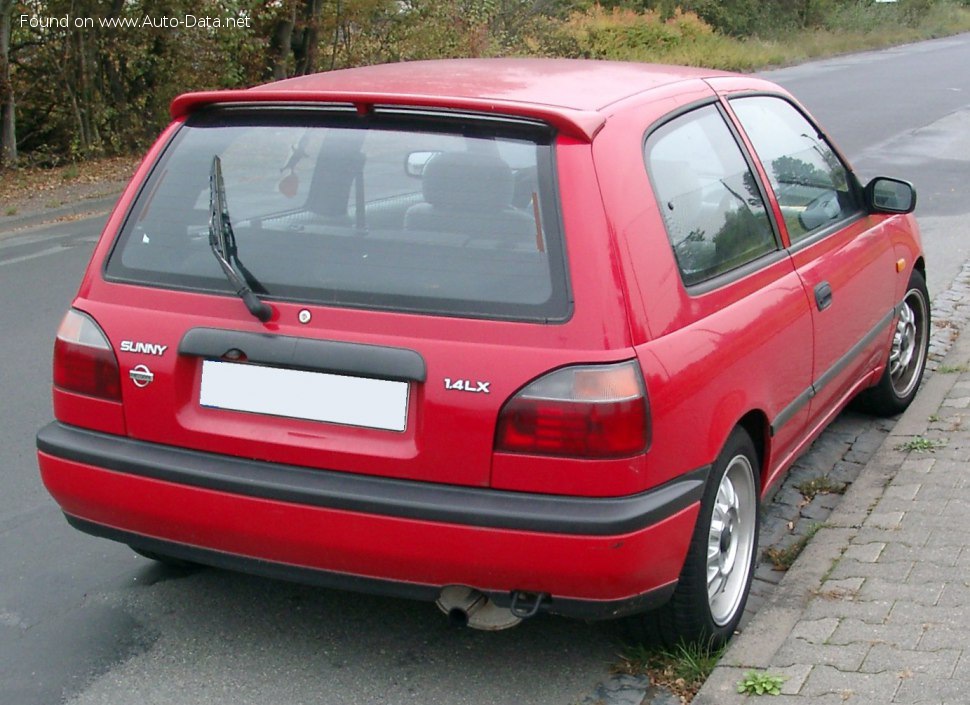
The Nissan Sunny III Hatch (N14) represents the third generation of the popular Nissan Sunny hatchback series, a compact vehicle primarily marketed in Europe and Asia. Produced between 1990 and 1995, the N14 generation continued Nissan’s tradition of offering reliable and economical transportation in the fiercely competitive compact car segment. This particular variant, the 3-door 1.4 16V with 75 horsepower, was a common sight on European roads, prized for its balance of practicality, fuel efficiency, and a sprightly, multi-valve engine that was relatively advanced for its class at the time. While the Nissan Sentra served as the North American counterpart, the Sunny N14 hatchback carved out its own niche in international markets, offering a versatile and accessible option for families and individual commuters alike.
ENGINE & PERFORMANCE
The heart of the Nissan Sunny III Hatch (N14) 1.4 16V is its GA14DE engine, a naturally aspirated, inline four-cylinder powerplant positioned transversely at the front of the vehicle. With an engine displacement of 1392 cubic centimeters (approximately 1.4 liters or 84.95 cubic inches), this unit was notable for its DOHC (Double Overhead Camshaft) 16-valve configuration, which allowed for improved breathing and efficiency compared to older 8-valve designs. Fuel delivery was handled by a multi-port manifold injection system, further contributing to its refined operation and fuel economy.
This 1.4-liter engine produced a respectable 75 horsepower at 6000 rpm, delivering a power-to-liter ratio of 53.9 HP/l. Torque output stood at 85.56 lb-ft (116 Nm) at a lower 4000 rpm, providing adequate low-end grunt for city driving. Paired with a standard 5-speed manual transmission driving the front wheels, the Sunny III Hatch offered a competent performance package for its segment. Acceleration from 0 to 60 mph was achieved in a reasonable 11.9 seconds, with a top speed of 106.25 mph (171 km/h). These figures positioned the 1.4 16V as a capable performer for everyday driving, whether navigating urban streets or cruising on highways.
One of the key selling points for the Nissan Sunny III Hatch (N14) was its fuel efficiency. The combined fuel consumption was rated at an impressive 36.2 US miles per gallon (6.5 liters per 100 km), making it an economical choice for budget-conscious buyers. The engine’s design, including its 9.5:1 compression ratio and efficient valvetrain, contributed significantly to this economy, cementing its reputation as a practical and cost-effective vehicle to own and operate.
DESIGN & FEATURES
The Nissan Sunny III Hatch (N14) 3-door variant presented a clean, functional design characteristic of early 1990s Japanese compact cars. Its hatchback body style offered a blend of sporty aesthetics and practical utility, appealing to a wide demographic. With three doors, it emphasized a more youthful or single-person appeal, though its five-seat configuration still allowed for family use. The exterior dimensions were compact, measuring 156.5 inches in length, 66.54 inches in width, and 54.92 inches in height, with a wheelbase of 95.67 inches, making it agile and easy to maneuver in congested urban environments.
Inside, the N14 Sunny was designed for practicality and comfort. The 5-seat layout provided adequate space for its class, and the hatchback body offered considerable cargo versatility. Minimum trunk space started at 9.89 cubic feet (280 liters), which could be expanded to a generous 34.96 cubic feet (990 liters) with the rear seats folded down, making it highly adaptable for carrying groceries, luggage, or larger items. The kerb weight of the vehicle was 2226.67 pounds (1010 kg), contributing to its nimble handling and efficiency.
In terms of chassis and assisting systems, the N14 Sunny employed a robust setup for its time. The front suspension utilized a wishbone design, while the rear featured a spring strut system, providing a comfortable ride and predictable handling. Braking power came from ventilated discs at the front and traditional drum brakes at the rear, a common and effective combination for vehicles in this class. An important safety feature for the era was the availability of ABS (Anti-lock Braking System), which enhanced braking stability, particularly in adverse conditions. Steering was a hydraulic rack and pinion system, offering direct and responsive feedback to the driver. The car rode on 175/70 R13 tires, a standard size that balanced grip, ride comfort, and cost-effectiveness.
TECHNICAL SPECIFICATIONS
| General Information | |
| Brand | Nissan |
| Model | Sunny |
| Generation | Sunny III Hatch (N14) 3 doors |
| Type (Engine) | 1.4 16V (75 Hp) |
| Start of Production | 1990 year |
| End of Production | 1995 year |
| Powertrain Architecture | Internal Combustion Engine |
| Body type | Hatchback |
| Seats | 5 |
| Doors | 3 |
| Performance Specs | |
| Fuel consumption (combined) | 6.5 l/100 km (36.2 US mpg, 43.5 UK mpg) |
| Fuel Type | Petrol (Gasoline) |
| Acceleration 0 – 60 mph | 11.9 sec |
| Acceleration 0 – 100 km/h | 12.5 sec |
| Maximum speed | 106.25 mph (171 km/h) |
| Weight-to-power ratio | 13.5 kg/Hp (74.3 Hp/tonne) |
| Weight-to-torque ratio | 8.7 kg/Nm (114.9 Nm/tonne) |
| Engine Specs | |
| Power | 75 Hp @ 6000 rpm |
| Power per liter | 53.9 Hp/l |
| Torque | 85.56 lb-ft (116 Nm) @ 4000 rpm |
| Engine layout | Front, Transverse |
| Engine Model/Code | GA14DE |
| Engine displacement | 1392 cm3 (84.95 cu. in.) |
| Number of cylinders | 4 |
| Engine configuration | Inline |
| Cylinder Bore | 2.9 in (73.6 mm) |
| Piston Stroke | 3.22 in (81.8 mm) |
| Compression ratio | 9.5:1 |
| Number of valves per cylinder | 4 |
| Fuel injection system | Multi-port manifold injection |
| Engine aspiration | Naturally aspirated engine |
| Valvetrain | DOHC |
| Engine oil capacity | 3.38 US qt (3.2 l) |
| Coolant capacity | 6.02 US qt (5.7 l) |
| Space, Volume and Weights | |
| Kerb Weight | 2226.67 lbs (1010 kg) |
| Max. weight | 3406.14 lbs (1545 kg) |
| Max load | 1179.47 lbs (535 kg) |
| Trunk (boot) space – minimum | 9.89 cu. ft (280 l) |
| Trunk (boot) space – maximum | 34.96 cu. ft (990 l) |
| Fuel tank capacity | 13.21 US gal (50 l) |
| Dimensions | |
| Length | 156.5 in (3975 mm) |
| Width | 66.54 in (1690 mm) |
| Height | 54.92 in (1395 mm) |
| Wheelbase | 95.67 in (2430 mm) |
| Front track | 56.5 in (1435 mm) |
| Rear (Back) track | 55.91 in (1420 mm) |
| Drivetrain, Brakes and Suspension Specs | |
| Drivetrain Architecture | Front-wheel drive, Internal Combustion Engine |
| Drive wheel | Front wheel drive |
| Number of gears and type of gearbox | 5 gears, manual transmission |
| Front suspension | Wishbone |
| Rear suspension | Spring Strut |
| Front brakes | Ventilated discs |
| Rear brakes | Drum |
| Assisting systems | ABS (Anti-lock braking system) |
| Steering type | Steering rack and pinion |
| Power steering | Hydraulic Steering |
| Tires size | 175/70 R13 |
LEGACY & MARKET IMPACT of the Nissan Sunny III Hatch (N14)
The Nissan Sunny III Hatch (N14), particularly the 1.4 16V variant, played a significant role in Nissan’s global strategy during the early to mid-1990s. While not sold as the Sunny hatchback in the United States (where the closely related Sentra sedan and coupe were offered), the N14 hatchback was a cornerstone of Nissan’s presence in European, Asian, and other international markets. It competed in a highly contested compact segment against formidable rivals such as the Volkswagen Golf, Ford Escort, Opel Astra (Vauxhall Astra in the UK), Honda Civic, and Toyota Corolla.
The N14 Sunny’s legacy is primarily built on its reputation for reliability, practicality, and affordability. Nissan’s engineering during this period was well-regarded for producing durable vehicles, and the Sunny N14 was no exception. Its GA14DE engine, with its modern 16-valve DOHC design, offered a good balance of performance and excellent fuel economy, appealing to a broad spectrum of buyers looking for economical daily transportation. The availability of features like ABS, while not standard on all trims, showcased Nissan’s commitment to integrating modern safety technology into its mainstream models.
The 3-door hatchback configuration, in particular, was popular among younger drivers and small families who valued its compact size, ease of parking, and versatile cargo space. Its understated yet contemporary styling ensured it didn’t look out of place next to its European competitors. The Sunny N14 contributed to Nissan’s image as a producer of dependable, no-nonsense vehicles that offered strong value for money. Although it might not have been as dynamically exciting as some rivals, its strengths lay in its solid construction, low running costs, and user-friendly nature, securing its place as a popular choice in its respective markets and reinforcing Nissan’s global footprint in the compact car segment.