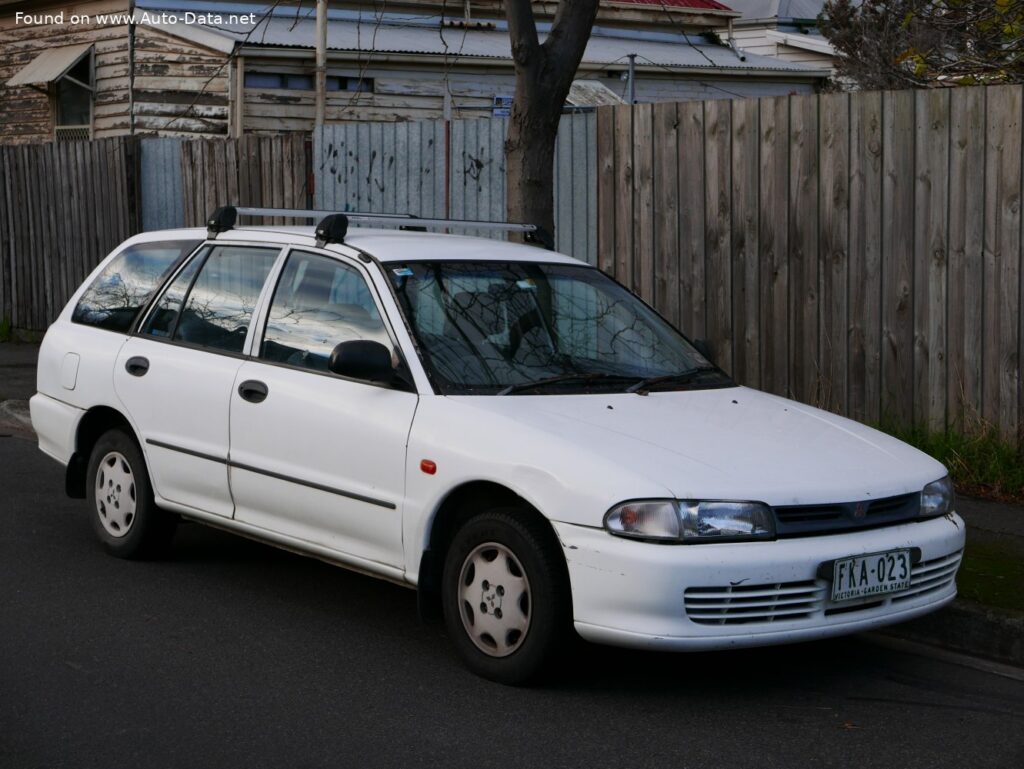
The Mitsubishi Lancer V Wagon 1.6 16V (113 Hp) 4WD represents a practical and robust offering from the Japanese automaker during the 1990s. As part of the fifth generation of the Lancer lineage, produced from 1992 to 2000, this particular variant stood out in its segment for its combination of a versatile station wagon body style with a sophisticated all-wheel-drive (4WD) system. While the Lancer sedan and coupe were marketed globally, often under names like Mirage in the North American market, the Lancer Wagon, especially with a 4WD option, found particular favor in markets where practicality, all-weather capability, and fuel efficiency were highly valued, such as Europe, Japan, and other Asian regions. It offered a compelling blend of family-friendly utility and enhanced traction, distinguishing it from many of its front-wheel-drive competitors.
This generation of Lancer, internally designated as the CB/CD/CE series, built upon Mitsubishi’s reputation for reliable and well-engineered vehicles. The 1.6 16V (113 Hp) 4WD model specifically targeted buyers who needed more than just basic transportation, providing a capable powertrain and a flexible interior layout. Its design ethos balanced compact exterior dimensions with a surprisingly spacious cabin and cargo area, making it a suitable choice for a variety of lifestyles, from daily commuting to weekend adventures. The inclusion of a 4WD system, which was somewhat uncommon in compact wagons of its time, underscored Mitsubishi’s engineering prowess and commitment to providing diverse vehicle options to meet specific market demands.
Engine and Performance of the Mitsubishi Lancer V Wagon
At the heart of the Mitsubishi Lancer V Wagon 1.6 16V (113 Hp) 4WD was a naturally aspirated 1.6-liter (1597 cm3 or 97.45 cu. in.) inline-four-cylinder engine, designated by Mitsubishi as the 4G92. This powerplant featured a Single Overhead Camshaft (SOHC) valvetrain with four valves per cylinder, resulting in a total of 16 valves. This configuration, coupled with a multi-port manifold injection fuel system, allowed the engine to produce a respectable 113 horsepower at 6000 rpm. The specific power output was 70.8 HP per liter, indicating a fairly efficient design for its era.
Torque output for this engine was 137 Nm (101.05 lb.-ft.) at 5000 rpm, providing adequate pulling power for a vehicle of its size and class. Power was delivered to all four wheels via a 5-speed manual transmission, a setup that maximized driver engagement and control, particularly beneficial when navigating varied road conditions or light off-road terrain. The all-wheel-drive system ensured enhanced traction and stability, a significant advantage over two-wheel-drive counterparts, especially in adverse weather conditions like rain or snow.
In terms of performance, the Lancer V Wagon 1.6 16V (113 Hp) 4WD was capable of accelerating from 0 to 60 mph in an estimated 10.9 seconds (0-100 km/h in 11.5 seconds), a competitive figure for a compact wagon with a 1.6-liter engine in the 1990s. Its maximum speed was rated at 108.74 mph (175 km/h). Fuel economy was also a strong point, with a combined consumption figure of 28.7 US mpg (8.2 liters per 100 km), demonstrating a good balance between performance and efficiency for a 4WD vehicle of its time. The engine’s layout was front, transverse, contributing to efficient packaging and interior space.
Design and Features
The Mitsubishi Lancer V Wagon adopted a classic station wagon (estate) body type, characterized by its extended roofline and rear cargo area, offering practical utility. With five doors and seating for five occupants, it was designed as a versatile family vehicle. Its dimensions were compact, measuring 168.31 inches (4275 mm) in length, 66.54 inches (1690 mm) in width, and 57.68 inches (1465 mm) in height. The wheelbase of 98.62 inches (2505 mm) provided a stable ride while maintaining maneuverability in urban environments.
Inside, the Lancer V Wagon prioritized functionality. The minimum trunk space was a generous 16.6 cubic feet (470 liters), which could be expanded to a substantial 26.13 cubic feet (740 liters) with the rear seats folded down, making it highly capable for carrying luggage, groceries, or sports equipment. The vehicle’s curb weight was 2667.59 pounds (1210 kg), with a maximum permissible weight of 3703.77 pounds (1680 kg), allowing for a maximum load of 1036.17 pounds (470 kg).
In terms of chassis and braking, the front suspension utilized a wishbone design, while the rear featured a coil spring setup, providing a comfortable yet stable ride. Braking was handled by ventilated discs at the front and drum brakes at the rear, a common and effective combination for vehicles of this class. An important safety feature for its era was the inclusion of ABS (Anti-lock Braking System), which enhanced braking control during emergency stops. The steering system was a hydraulic rack and pinion setup, offering direct feedback to the driver. The vehicle rode on 185/70 R14 tires mounted on 14-inch wheel rims, providing a good balance of comfort and grip.
Technical Specifications
| Category | Specification |
|---|---|
| Brand | Mitsubishi |
| Model | Lancer |
| Generation | Lancer V Wagon |
| Type (Engine) | 1.6 16V (113 Hp) 4WD |
| Start of production | 1992 year |
| End of production | 2000 year |
| Powertrain Architecture | Internal Combustion engine |
| Body type | Station wagon (estate) |
| Seats | 5 |
| Doors | 5 |
| Performance Specs | |
| Fuel consumption (economy) – combined | 8.2 l/100 km (28.7 US mpg) |
| Fuel Type | Petrol (Gasoline) |
| Acceleration 0 – 60 mph | 10.9 sec |
| Acceleration 0 – 100 km/h | 11.5 sec |
| Maximum speed | 175 km/h (108.74 mph) |
| Weight-to-power ratio | 10.7 kg/Hp, 93.4 Hp/tonne |
| Weight-to-torque ratio | 8.8 kg/Nm, 113.2 Nm/tonne |
| Engine Specs | |
| Power | 113 Hp @ 6000 rpm. |
| Power per liter | 70.8 Hp/l |
| Torque | 137 Nm @ 5000 rpm. (101.05 lb.-ft. @ 5000 rpm.) |
| Engine layout | Front, Transverse |
| Engine Model/Code | 4G92 |
| Engine displacement | 1597 cm3 (97.45 cu. in.) |
| Number of cylinders | 4 |
| Engine configuration | Inline |
| Cylinder Bore | 81 mm (3.19 in.) |
| Piston Stroke | 77.5 mm (3.05 in.) |
| Compression ratio | 10:1 |
| Number of valves per cylinder | 4 |
| Fuel injection system | Multi-port manifold injection |
| Engine aspiration | Naturally aspirated engine |
| Valvetrain | SOHC |
| Space, Volume and Weights | |
| Kerb Weight | 1210 kg (2667.59 lbs.) |
| Max. weight | 1680 kg (3703.77 lbs.) |
| Max load | 470 kg (1036.17 lbs.) |
| Trunk (boot) space – minimum | 470 l (16.6 cu. ft.) |
| Trunk (boot) space – maximum | 740 l (26.13 cu. ft.) |
| Fuel tank capacity | 50 l (13.21 US gal) |
| Dimensions | |
| Length | 4275 mm (168.31 in.) |
| Width | 1690 mm (66.54 in.) |
| Height | 1465 mm (57.68 in.) |
| Wheelbase | 2505 mm (98.62 in.) |
| Front track | 1465 mm (57.68 in.) |
| Rear (Back) track | 1430 mm (56.3 in.) |
| Drivetrain, Brakes and Suspension Specs | |
| Drive wheel | All wheel drive (4×4) |
| Number of gears and type of gearbox | 5 gears, manual transmission |
| Front suspension | Wishbone |
| Rear suspension | Coil spring |
| Front brakes | Ventilated discs |
| Rear brakes | Drum |
| Assisting systems | ABS (Anti-lock braking system) |
| Steering type | Steering rack and pinion |
| Power steering | Hydraulic Steering |
| Tires size | 185/70 R14 |
| Wheel rims size | 14 |
Legacy and Market Impact
The Mitsubishi Lancer V Wagon, particularly the 1.6 16V (113 Hp) 4WD variant, carved out a niche for itself as a highly practical and reliable vehicle during its production run from 1992 to 2000. In its primary markets, which included Japan, Europe, and parts of Asia, it was lauded for its versatility and robust engineering. While the Lancer nameplate is perhaps most famously associated with its high-performance Evolution models, the standard Lancer, especially in wagon form, played a crucial role as a workhorse family car.
Its reputation was built on Mitsubishi’s consistent delivery of dependable powertrains and durable chassis. The 4WD system was a significant differentiator, offering enhanced grip and confidence in challenging driving conditions, a feature highly valued in regions with varied climates. This capability allowed it to compete effectively against other compact wagons that were predominantly front-wheel-drive, such as the Toyota Corolla Wagon, Honda Civic Wagon (though less common in 4WD), and various European offerings like the Volkswagen Golf Variant or Opel Astra Caravan.
The Lancer V Wagon’s market impact stemmed from its ability to offer a compelling package of space, efficiency, and all-weather capability at an accessible price point. It appealed to a demographic seeking a no-nonsense vehicle that could handle daily commutes, family trips, and light utility tasks without complaint. Its relatively simple mechanicals also contributed to its longevity and ease of maintenance, further cementing its reputation for reliability in the used car market years after its production ceased.
Historically, the Lancer V Wagon 1.6 16V (113 Hp) 4WD represents a period when Mitsubishi was a global player offering a wide range of vehicles that balanced innovation with practicality. While it may not have garnered the same enthusiast following as its rally-bred siblings, its contribution to Mitsubishi’s sales and brand image as a producer of dependable, versatile, and capable vehicles, particularly in markets outside of North America, was undeniable. It stands as a testament to the era’s focus on functional design and engineering robustness in the compact segment.