In the early 2000s, as the automotive landscape buzzed with renewed interest in two-seater roadsters, Mercedes-Benz continued to carve out its unique niche with the second-generation SLK. Building on the groundbreaking success of its predecessor, the R171 generation, launched in late 2003, brought a sharper design, enhanced performance, and a refined driving experience to a segment hungry for accessible luxury and open-air thrills. While North American enthusiasts primarily knew variants like the SLK 350 or the potent SLK 55 AMG, the Mercedes-Benz SLK (R171) SLK 200 Kompressor represented a compelling entry point into this sophisticated world, particularly in European markets, showcasing Mercedes-Benz’s engineering prowess in a more compact and efficient package. This model offered a blend of elegant styling, innovative technology, and a spirited yet economical powertrain, making it a popular choice for those seeking the prestige of a Mercedes-Benz roadster without the larger engine displacements.
The Mercedes-Benz SLK (R171) SLK 200 Kompressor: Engineering and Elegance
Engine and Performance
At the heart of the Mercedes-Benz SLK (R171) SLK 200 Kompressor was a sophisticated 1.8-liter (1796 cc) inline-four engine, designated as the M271. Unlike many naturally aspirated four-cylinders of its time, this engine featured a supercharger, or “Kompressor” in Mercedes-Benz parlance, which provided immediate and linear power delivery across the rev range. This forced induction system helped the relatively small displacement engine produce a respectable 163 horsepower (HP) at 5,500 revolutions per minute (RPM) and a robust 177 pound-feet (lb-ft) of torque, available from a low 3,000 RPM. This torque characteristic was particularly beneficial for everyday driving, offering eager acceleration from a standstill and strong passing power.
The SLK 200 Kompressor was predominantly paired with a smooth-shifting 5-speed automatic transmission, which was a hallmark of Mercedes-Benz’s commitment to refinement and comfort. This transmission was adept at maximizing the engine’s power band while ensuring a relaxed driving experience. Performance figures for the automatic variant typically saw a 0 to 60 miles per hour (mph) acceleration time in approximately 8.3 seconds, with a top speed electronically limited to around 140 mph (225 km/h). While not a track-focused machine like its AMG siblings, the SLK 200 Kompressor delivered a satisfyingly brisk performance for a luxury roadster, balancing spirited driving with commendable fuel efficiency for its class. Its refined powertrain ensured that the journey was as enjoyable as the destination, whether cruising along coastal roads or navigating urban landscapes.
Design and Features
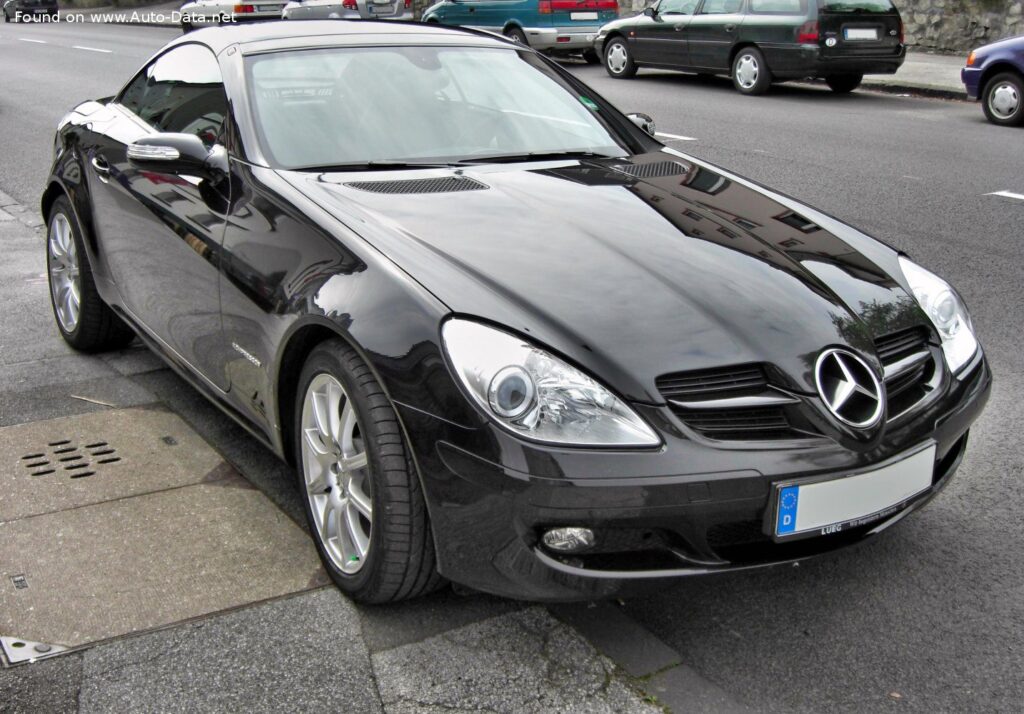
The R171 generation of the SLK marked a significant aesthetic departure from the softer, more rounded lines of the original R170. Mercedes-Benz designers infused the new model with a sharper, more aggressive stance, drawing inspiration from the brand’s Formula 1 racing heritage. The distinctive “arrowhead” nose, prominent grille, and swept-back headlights gave the SLK a dynamic, forward-leaning appearance that was both modern and unmistakably Mercedes-Benz. Its compact dimensions – a length of 160.98 inches and a width of 69.96 inches – made it agile and perfectly suited for spirited drives on winding roads or navigating urban environments.
A defining feature, inherited and refined from its predecessor, was the innovative Vario-Roof – a retractable hardtop that transformed the SLK from a secure, insulated coupe into an exhilarating open-top roadster in a mere 22 seconds. This engineering marvel offered the best of both worlds, providing weather protection and security akin to a fixed-roof car, alongside the unadulterated joy of top-down motoring. For the R171, the mechanism was further optimized for smoother, quieter operation. The integration of this feature was seamless, maintaining the car’s sleek lines whether the roof was up or down.
Inside, the SLK 200 Kompressor offered a driver-focused cockpit with premium materials and ergonomic design. While not equipped with the advanced driver-assistance systems (ADAS) or extensive infotainment connectivity of modern 2020s vehicles, for its time (2003-2007), it featured a well-appointed audio system, automatic climate control, and available navigation. The cabin exuded typical Mercedes-Benz luxury, with high-quality leather or MB-Tex upholstery, brushed aluminum or wood trim accents, and clear, analog instrumentation. A notable innovation, often an option on the R171 and a Mercedes-Benz first, was AIRSCARF, a neck-level heating system integrated into the seats. This ingenious feature allowed for comfortable top-down driving even in cooler temperatures, effectively extending the roadster season and enhancing the open-air experience. Safety features, standard for the era, included multiple airbags, anti-lock brakes (ABS), and Electronic Stability Program (ESP), underscoring Mercedes-Benz’s commitment to occupant protection.
Technical Specifications
| Feature | Specification |
|---|---|
| Model | Mercedes-Benz SLK (R171) SLK 200 Kompressor |
| Years of Production | 2004 – 2007 |
| Engine Type | M271 Inline-4, Supercharged (Kompressor) |
| Displacement | 1.8 Liters (1796 cc) |
| Horsepower | 163 HP @ 5500 RPM |
| Torque | 177 lb-ft (240 Nm) @ 3000 RPM |
| Transmission | 5-speed Automatic |
| 0-60 mph Acceleration | Approx. 8.3 seconds |
| Top Speed | Approx. 140 mph (225 km/h) |
| Fuel Economy (Combined) | Approx. 27 mpg US (8.7 L/100km) |
| Body Type | 2-door Roadster with Retractable Hardtop (Vario-Roof) |
| Seating Capacity | 2 |
| Length | 160.98 inches (4089 mm) |
| Width | 69.96 inches (1777 mm) |
| Height | 51.02 inches (1296 mm) |
| Wheelbase | 95.67 inches (2430 mm) |
| Curb Weight | Approx. 3064 lbs (1390 kg) |
Legacy and Market Impact
The Mercedes-Benz SLK (R171) SLK 200 Kompressor carved out a significant niche in the European luxury roadster market, offering an accessible entry point into the Mercedes-Benz open-top experience. Its reputation was built on its sophisticated design, the engineering marvel of its Vario-Roof, and a driving experience that blended comfort with engaging dynamics. While not the most powerful variant, the 200 Kompressor was lauded for its balance, providing sufficient performance for most drivers while benefiting from better fuel economy and lower ownership costs compared to its V6 and V8 counterparts.
In its primary markets, the SLK 200 Kompressor faced stiff competition from other premium roadsters. Key rivals included the BMW Z4, which offered a more overtly sporty driving character, and the Audi TT Roadster, known for its distinctive design and quattro all-wheel drive option. The Porsche Boxster represented a higher echelon of performance and driving purity, while the more budget-friendly Mazda MX-5 Miata offered a purist’s take on the lightweight roadster. The SLK 200 Kompressor differentiated itself with its unique retractable hardtop, which provided superior refinement and security over soft-top rivals, and its unmistakable Mercedes-Benz prestige and build quality.
The R171 generation, including the 200 Kompressor, played a crucial role in solidifying Mercedes-Benz’s position in the compact luxury roadster segment. It built upon the R170’s success, further popularizing the retractable hardtop concept and influencing subsequent designs across the automotive industry. Its blend of style, innovation, and brand heritage ensured strong sales and a lasting appeal. Today, the SLK (R171) models, particularly the well-maintained 200 Kompressor variants, are regarded as desirable used cars, offering a taste of premium open-top motoring at an accessible price point, and continuing to uphold the legacy of Mercedes-Benz engineering and design.