Mitsubishi Lancer VI 1.3 12V GL,GLX (75 Hp): A Global Compact Sedan Standard
The Mitsubishi Lancer VI, produced from 1995 to 2000, represents the sixth generation of Mitsubishi’s long-running compact car nameplate. While perhaps not as widely recognized in the United States in this specific guise as its performance-oriented Evolution variants or later generations, the Mitsubishi Lancer VI 1.3 12V GL,GLX (75 Hp) was a cornerstone model in numerous international markets, particularly across Europe and Asia. It carved out a significant niche as a dependable, economical, and practical four-door sedan, catering to families and individuals seeking reliable transportation without unnecessary frills. This generation of Lancer embodied Mitsubishi’s commitment to building robust, value-for-money vehicles that could withstand diverse driving conditions and provide years of trouble-free ownership. It competed fiercely in the highly competitive C-segment, offering a compelling blend of affordability, efficiency, and a surprisingly spacious interior for its class.
Powertrain and Performance: The Heart of the Mitsubishi Lancer VI 1.3 12V GL,GLX (75 Hp)
Under the hood, the Mitsubishi Lancer VI 1.3 12V GL,GLX featured a modest yet efficient 1.3-liter (1299 cm3 or 79.27 cu. in.) inline-four gasoline engine. This powerplant, designated with 12 valves, employed an OHC (Overhead Camshaft) valvetrain, a common and reliable configuration for the era. Power output stood at a practical 75 horsepower, delivered at 6000 rpm, translating to a power-per-liter figure of 57.7 HP/l. Torque was rated at 108 Nm (or 79.66 lb.-ft.), reaching its peak at a relatively low 3000 rpm. This low-end torque characteristic was designed to provide accessible pulling power in everyday driving scenarios, making the vehicle feel responsive around town despite its modest horsepower.
The engine’s layout was front, transverse, driving the front wheels through a standard 5-speed manual transmission. This front-wheel-drive architecture was typical for compact cars of the period, chosen for its packaging efficiency, cost-effectiveness, and predictable handling characteristics. The fuel injection system was a multi-port manifold injection setup, ensuring efficient fuel delivery and combustion, while the engine remained naturally aspirated, favoring simplicity and reliability over forced induction complexity.
In terms of performance, the Mitsubishi Lancer VI 1.3 12V GL,GLX (75 Hp) delivered exactly what was expected from an economical compact sedan of its time. Acceleration from 0 to 60 mph was achieved in a calculated 11.9 seconds, with 0 to 62 mph (100 km/h) taking 12.5 seconds. The maximum speed topped out at 105.63 mph (170 km/h). While these figures might not excite performance enthusiasts, they were perfectly adequate for daily commuting and longer journeys on highways, especially in regions where speed limits were more conservative.
Fuel efficiency was a strong suit for this Lancer variant. In urban driving, it achieved approximately 25.6 US mpg (9.2 l/100 km), while extra-urban consumption figures were impressive at around 42.8 US mpg (5.5 l/100 km). With a 13.21 US gallon (50-liter) fuel tank, the Lancer offered a respectable cruising range, further cementing its appeal as an economical choice. The compression ratio of 9.5:1 was well-suited for regular unleaded gasoline, making it a cost-effective vehicle to operate.
Design and Features: Practicality and Enduring Form
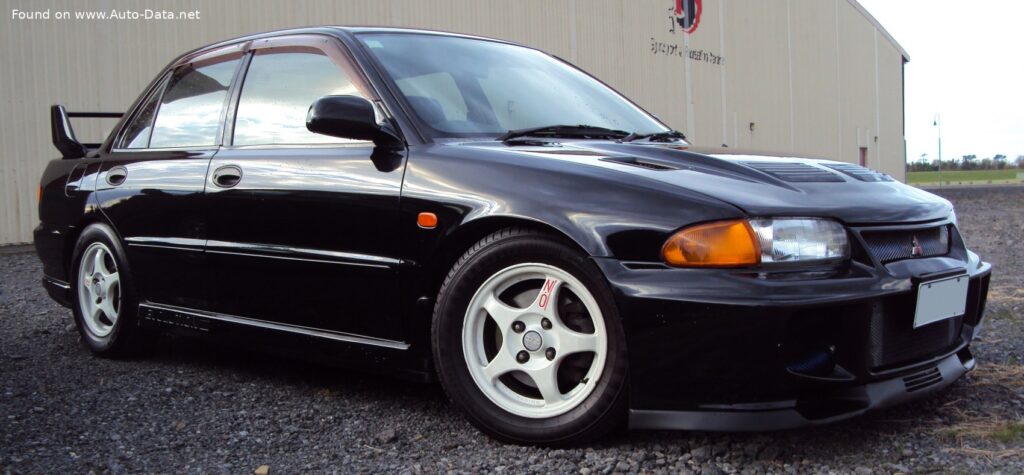
The Mitsubishi Lancer VI adopted a clean, unpretentious design aesthetic that prioritized practicality and aerodynamic efficiency over ostentation. It was offered primarily as a four-door sedan, a body type that remained immensely popular in its target markets. The exterior dimensions were compact, with a length of 169.09 inches (4295 mm), a width of 66.54 inches (1690 mm), and a height of 54.92 inches (1395 mm). A wheelbase of 98.43 inches (2500 mm) provided a stable ride and contributed to a surprisingly roomy cabin for a car of its size. The front and rear tracks, at 57.09 inches (1450 mm) and 57.48 inches (1460 mm) respectively, ensured a balanced stance.
Inside, the Lancer VI offered seating for five occupants, designed for comfort and durability rather than luxury. The GL and GLX trims typically offered basic but functional amenities, focusing on ease of use and low maintenance. The trunk space was generous for its class, providing 14.83 cubic feet (420 liters) of cargo capacity, making it suitable for family errands, grocery runs, or weekend trips.
The chassis and suspension setup were engineered for comfort and predictable handling. The front suspension utilized a wishbone design, known for its ability to provide good ride quality and precise steering. The rear suspension featured a spring strut arrangement, a cost-effective and space-efficient solution that offered a good balance of comfort and stability. Braking was handled by disc brakes at the front and drum brakes at the rear, a common and effective combination for a vehicle of this weight and performance level. Steering was a rack and pinion system, aided by hydraulic power steering, ensuring light and effortless maneuverability, particularly at lower speeds for parking and city driving. The car was fitted with 175/70 R13 tires, providing a comfortable ride and adequate grip for its intended use. With a kerb weight of 2193.6 lbs (995 kg), the Lancer VI was a relatively light vehicle, which further contributed to its fuel efficiency and nimble feel.
Technical Specifications: Mitsubishi Lancer VI 1.3 12V GL,GLX (75 Hp)
| Category | Specification |
|---|---|
| General Information | |
| Brand | Mitsubishi |
| Model | Lancer |
| Generation | Lancer VI |
| Type (Engine) | 1.3 12V GL,GLX (75 Hp) |
| Production Start | 1995 year |
| Production End | 2000 year |
| Powertrain Architecture | Internal Combustion engine |
| Body Type | Sedan |
| Seats | 5 |
| Doors | 4 |
| Performance Specs | |
| Fuel Consumption (Urban) | 9.2 l/100 km | 25.6 US mpg |
| Fuel Consumption (Extra Urban) | 5.5 l/100 km | 42.8 US mpg |
| Fuel Type | Petrol (Gasoline) |
| Acceleration 0 – 60 mph | 11.9 sec |
| Acceleration 0 – 62 mph (0 – 100 km/h) | 12.5 sec |
| Maximum Speed | 170 km/h | 105.63 mph |
| Weight-to-Power Ratio | 13.3 kg/Hp (75.4 Hp/tonne) |
| Weight-to-Torque Ratio | 9.2 kg/Nm (108.5 Nm/tonne) |
| Engine Specs | |
| Power | 75 Hp @ 6000 rpm |
| Power per Liter | 57.7 Hp/l |
| Torque | 108 Nm @ 3000 rpm | 79.66 lb.-ft. @ 3000 rpm |
| Engine Layout | Front, Transverse |
| Engine Displacement | 1299 cm3 | 79.27 cu. in. |
| Number of Cylinders | 4 |
| Engine Configuration | Inline |
| Cylinder Bore | 71 mm | 2.8 in. |
| Piston Stroke | 82 mm | 3.23 in. |
| Compression Ratio | 9.5:1 |
| Valves per Cylinder | 3 |
| Fuel Injection System | Multi-port manifold injection |
| Engine Aspiration | Naturally aspirated engine |
| Valvetrain | OHC |
| Space, Volume and Weights | |
| Kerb Weight | 995 kg | 2193.6 lbs. |
| Max. Weight | 1485 kg | 3273.86 lbs. |
| Max Load | 490 kg | 1080.27 lbs. |
| Trunk (Boot) Space – Minimum | 420 l | 14.83 cu. ft. |
| Fuel Tank Capacity | 50 l | 13.21 US gal |
| Dimensions | |
| Length | 4295 mm | 169.09 in. |
| Width | 1690 mm | 66.54 in. |
| Height | 1395 mm | 54.92 in. |
| Wheelbase | 2500 mm | 98.43 in. |
| Front Track | 1450 mm | 57.09 in. |
| Rear (Back) Track | 1460 mm | 57.48 in. |
| Drivetrain, Brakes and Suspension Specs | |
| Drivetrain Architecture | The Internal combustion engine (ICE) drives the front wheels of the vehicle. |
| Drive Wheel | Front wheel drive |
| Number of Gears and Type of Gearbox | 5 gears, manual transmission |
| Front Suspension | Wishbone |
| Rear Suspension | Spring Strut |
| Front Brakes | Disc |
| Rear Brakes | Drum |
| Steering Type | Steering rack and pinion |
| Power Steering | Hydraulic Steering |
| Tires Size | 175/70 R13 |
Legacy and Market Impact of the Mitsubishi Lancer VI
The Mitsubishi Lancer VI, particularly in its economical 1.3-liter guise, forged a formidable reputation for reliability and cost-effectiveness across its primary markets in Europe, Asia, and other developing regions. It was a no-nonsense vehicle designed to provide dependable transportation with minimal fuss. This generation of Lancer was a direct competitor to other popular compact sedans of the mid-to-late 1990s, such as the Honda Civic, Toyota Corolla, Nissan Sentra (known as Sunny in some markets), Ford Escort, Opel Astra, and Volkswagen Jetta. In this highly competitive segment, the Lancer distinguished itself with its robust build quality and a reputation for being mechanically sound, often outlasting many of its contemporaries.
While the higher-performance Lancer Evolution models of this era garnered significant attention from enthusiasts and in motorsport, the bread-and-butter models like the 1.3 12V GL,GLX were the true volume sellers, forming the backbone of Mitsubishi’s global sales. These models were critical in establishing and maintaining Mitsubishi’s brand presence as a manufacturer of durable and affordable cars. The Lancer VI’s enduring design, coupled with its practical features and efficient powertrain, ensured a strong resale value and a loyal customer base in many countries.
The model’s historical significance lies in its role as a global workhorse. It represented a period when Japanese manufacturers were perfecting the art of building economical, front-wheel-drive compact cars that could appeal to a wide array of international buyers. The Lancer VI’s simplicity, ease of maintenance, and respectable fuel economy made it an ideal choice for first-time car buyers, small families, and fleet operators. Its mechanical robustness meant that many examples continued to serve faithfully for well over a decade after their production ceased, a testament to Mitsubishi’s engineering principles of the time. The Mitsubishi Lancer VI 1.3 12V GL,GLX (75 Hp) may not have been a trendsetter in terms of design or performance, but its unwavering commitment to utility and reliability secured its place as a significant and successful model in Mitsubishi’s illustrious history.