The automotive landscape is replete with vehicles that masterfully blend practicality with performance, and few do so with the understated competence of the Skoda Octavia. The Skoda Octavia III (facelift 2017) RS 2.0 TDI (184 Hp) 6 DSG represents a particularly compelling iteration of this philosophy. While the Skoda brand might not be a familiar sight on American roads, having primarily focused on European and Asian markets, its Octavia model has consistently been a cornerstone of its success, lauded for its spaciousness, robust engineering, and exceptional value. The third-generation Octavia, especially after its 2017 facelift, further refined these attributes, with the RS variant standing out as the performance-oriented choice. In its diesel guise, the RS 2.0 TDI offered a unique proposition: a “hot” hatchback/sedan with impressive fuel efficiency, making it a favorite among enthusiasts seeking a daily driver that could also deliver a thrill.
The Evolution of the Skoda Octavia III (facelift 2017) RS 2.0 TDI
The Skoda Octavia has a rich history, tracing its roots back to the late 1950s. However, its modern era began in 1996 under Volkswagen Group ownership, transforming it into a highly competitive C-segment (compact) car. The third generation, introduced in 2012, utilized the Volkswagen Group’s versatile MQB platform, sharing foundations with popular models like the VW Golf and Audi A3. The 2017 facelift brought a series of aesthetic and technological updates, most notably the distinctive split headlight design that became a polarizing but memorable feature. For the RS models, these updates were complemented by sportier styling cues and enhanced driving dynamics, reinforcing its position as a performance flagship within the Octavia range. The RS 2.0 TDI, specifically, catered to a segment of buyers who desired strong acceleration and handling without compromising on long-distance economy – a characteristic highly valued in European markets.
Engine & Performance: The Heart of the Skoda Octavia RS 2.0 TDI
Under the hood of the Skoda Octavia III (facelift 2017) RS 2.0 TDI (184 Hp) 6 DSG lies a formidable powertrain designed for both spirited driving and efficient cruising. This variant is powered by the EA288 / CUNA, CUPA, DJGA code 2.0-liter (1968 cm³ or 120.09 cu. in.) inline four-cylinder diesel engine. Equipped with a common rail fuel injection system, a turbocharger, and an intercooler, this DOHC engine generates a robust 184 horsepower at 3500-4000 rpm. More impressively, it delivers a substantial 280.27 lb.-ft. of torque across a broad and accessible rev range, from 1750 to 3250 rpm. This ample torque is crucial for the car’s strong mid-range acceleration and effortless overtaking capabilities.
The power is seamlessly channeled to the front wheels via a sophisticated 6-speed automatic DSG (Direct-Shift Gearbox) transmission. This dual-clutch unit is renowned for its rapid and smooth gear changes, contributing significantly to the car’s dynamic character. Performance figures are impressive for a practical family hatchback: the Octavia RS 2.0 TDI accelerates from 0 to 60 mph in a swift 7.5 seconds and can reach a top speed of 142.92 mph. Despite its performance credentials, the diesel engine shines in terms of fuel economy. It achieves an outstanding combined fuel consumption of 48 US mpg (NEDC cycle), with urban figures around 40.6 US mpg and extra-urban figures reaching 53.5 US mpg. Furthermore, its Euro 6 emission standard, coupled with a particulate filter and Start & Stop system, underscores its commitment to environmental responsibility, emitting just 129 g/km of CO2.
Design & Features: Sporty Practicality
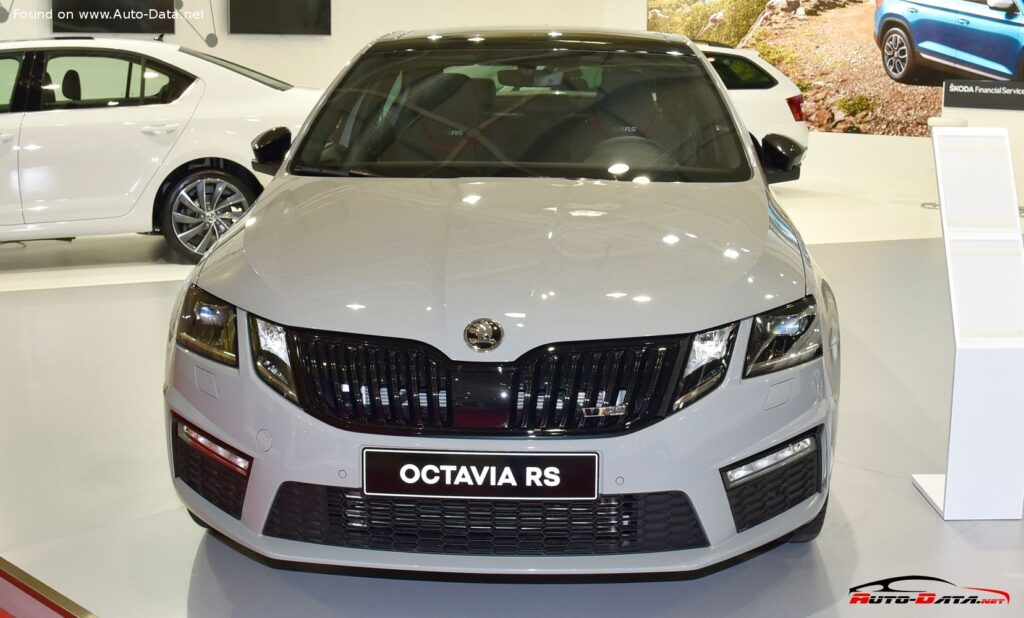
The 2017 facelift bestowed the Octavia RS with a more assertive and modern aesthetic. The body type remains a versatile 5-door hatchback, offering seating for five occupants. Key design elements of the RS variant include sportier bumpers, a distinctive black grille, larger alloy wheels (available in 17-inch, 18-inch, or 19-inch options), and subtle aerodynamic enhancements like a rear spoiler. The most notable exterior change was the adoption of split headlights, giving the car a unique and recognizable front fascia. Dimensions are generous, with a length of 184.61 inches, a width of 71.42 inches (79.41 inches including mirrors), and a height of 57.01 inches, providing ample interior space.
Inside, the RS treatment continues with sport seats, often featuring red stitching and RS branding, a flat-bottom steering wheel, and aluminum pedals. The cabin environment is driver-focused, yet maintains the Octavia’s reputation for high-quality materials and ergonomic layout. For a modern car of its era, technology and connectivity were key. The facelift introduced updated infotainment systems, often with larger touchscreens, smartphone integration (Apple CarPlay and Android Auto), and advanced driver-assistance systems, though specific details like adaptive cruise control or lane-keeping assist are not explicitly listed in the provided data. Safety is paramount, with standard features including ABS (Anti-lock Braking System) and a comprehensive airbag system. Practicality remains a strong suit, with an expansive trunk capacity ranging from 20.84 cu. ft. with all seats up, expanding to a cavernous 55.8 cu. ft. with the rear seats folded, making it exceptionally versatile for families and active lifestyles.
Technical Specifications: Skoda Octavia III (facelift 2017) RS 2.0 TDI (184 Hp) 6 DSG
| Category | Specification |
|---|---|
| Brand | Skoda |
| Model | Octavia |
| Generation | Octavia III (facelift 2017) |
| Type (Engine) | RS 2.0 TDI (184 Hp) 6 DSG |
| Production Start | 2017 |
| Production End | 2018 |
| Body Type | Hatchback |
| Seats | 5 |
| Doors | 5 |
| Performance & Economy | |
| Fuel Consumption (Urban, NEDC) | 5.8 l/100 km (40.6 US mpg) |
| Fuel Consumption (Extra Urban, NEDC) | 4.4 l/100 km (53.5 US mpg) |
| Fuel Consumption (Combined, NEDC) | 4.9 l/100 km (48 US mpg) |
| CO2 Emissions (NEDC) | 129 g/km |
| Fuel Type | Diesel |
| Acceleration 0-60 mph | 7.5 sec |
| Maximum Speed | 230 km/h (142.92 mph) |
| Emission Standard | Euro 6 |
| Weight-to-power ratio | 7.6 kg/Hp (132.4 Hp/tonne) |
| Weight-to-torque ratio | 3.7 kg/Nm (273.4 Nm/tonne) |
| Engine Specifications | |
| Power | 184 Hp @ 3500-4000 rpm |
| Torque | 380 Nm (280.27 lb.-ft.) @ 1750-3250 rpm |
| Engine Layout | Front, Transverse |
| Engine Model/Code | EA288 / CUNA, CUPA, DJGA |
| Engine Displacement | 1968 cm³ (120.09 cu. in.) |
| Number of Cylinders | 4 |
| Engine Configuration | Inline |
| Cylinder Bore | 81 mm (3.19 in.) |
| Piston Stroke | 95.5 mm (3.76 in.) |
| Compression Ratio | 15.8:1 |
| Valves per Cylinder | 4 |
| Fuel Injection System | Diesel Commonrail |
| Engine Aspiration | Turbocharger, Intercooler |
| Valvetrain | DOHC |
| Engine Oil Capacity | 4.6 l (4.86 US qt) |
| Engine Systems | Start & Stop System, Particulate Filter |
| Dimensions, Volume & Weights | |
| Kerb Weight | 1390 kg (3064.43 lbs.) |
| Max. Weight (Gross) | 1932 kg (4259.33 lbs.) |
| Max Load | 542 kg (1194.91 lbs.) |
| Trunk Space (Min/Max) | 590 l (20.84 cu. ft.) / 1580 l (55.8 cu. ft.) |
| Fuel Tank Capacity | 50 l (13.21 US gal) |
| Length | 4689 mm (184.61 in.) |
| Width | 1814 mm (71.42 in.) |
| Width (incl. mirrors) | 2017 mm (79.41 in.) |
| Height | 1448 mm (57.01 in.) |
| Wheelbase | 2680 mm (105.51 in.) |
| Front Track | 1535 mm (60.43 in.) |
| Rear Track | 1544 mm (60.79 in.) |
| Ride Height (Ground Clearance) | 127 mm (5 in.) |
| Turning Circle | 10.59 m (34.74 ft.) |
| Max. Roof Load | 75 kg (165.35 lbs.) |
| Permitted Trailer Load (with brakes) | 1600 kg (3527.4 lbs.) |
| Permitted Trailer Load (without brakes) | 730 kg (1609.37 lbs.) |
| Permitted Towbar Download | 80 kg (176.37 lbs.) |
| Drivetrain, Brakes & Suspension | |
| Drivetrain Architecture | Front-wheel drive (ICE drives front wheels) |
| Drive Wheel | Front-wheel drive |
| Gearbox | 6 gears, automatic transmission DSG |
| Front Suspension | Independent, McPherson with coil spring and anti-roll bar |
| Rear Suspension | Independent multi-link spring suspension with stabilizer |
| Front Brakes | Ventilated discs |
| Rear Brakes | Ventilated discs |
| Assisting Systems | ABS (Anti-lock braking system) |
| Steering Type | Steering rack and pinion |
| Power Steering | Electric Steering |
| Tire Sizes | 225/45 R17; 225/40 R18; 225/35 R19 |
| Wheel Rim Sizes | 7.5J x 17; 7.5J x 18; 7.5J x 19 |
Legacy & Market Impact: A Smart Performance Choice
The Skoda Octavia RS, particularly the diesel variant, carved out a significant niche in the European automotive market. It was consistently praised for its ability to deliver genuine performance and engaging driving dynamics without the premium price tag often associated with its Volkswagen Group siblings. It stood as a direct competitor to vehicles like the Volkswagen Golf GTD, its platform-mate, offering comparable performance and efficiency but with a more spacious interior and often a more attractive price point. Other rivals included models like the Ford Focus ST Diesel (in markets where available) and the SEAT Leon FR TDI, all vying for the attention of buyers seeking a blend of sportiness and everyday usability.
The Octavia RS 2.0 TDI became a symbol of “sensible speed” and “smart performance.” Its high torque output made it an excellent long-distance cruiser, capable of covering vast distances with ease and impressive fuel economy, while still retaining the ability to thrill on winding roads. The RS badge, which Skoda has cultivated since the early 2000s, signifies a commitment to dynamic ability and driver involvement, and the third-generation facelift model upheld this reputation. For many European consumers, the Octavia RS represented the ideal balance: a car that could comfortably accommodate a family and their luggage, perform admirably on the highway, and still offer a sporting edge when desired, all while keeping running costs relatively low due to its diesel efficiency. Its legacy is one of a highly competent, value-driven performance car that proved that practicality and passion could indeed coexist.