
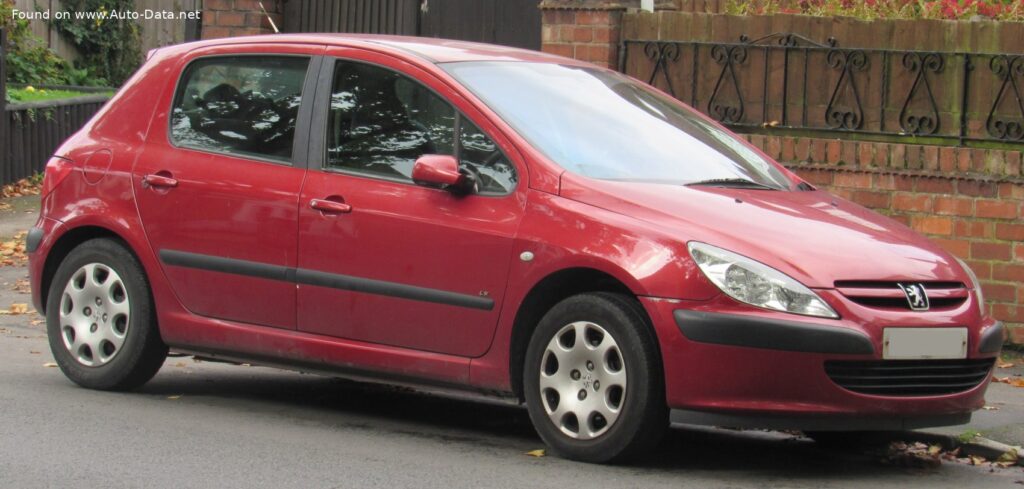
Introduction to the Peugeot 307 1.6 HDi (109 Hp)
The Peugeot 307, a prominent player in the European C-segment (compact car class), represented a significant evolution for the French automaker. Launched in 2001, the 307 quickly gained recognition for its innovative design, spacious interior, and robust engine lineup. The specific variant under review, the Peugeot 307 1.6 HDi (109 Hp), produced between 2004 and 2005, was a particularly important model, embodying Peugeot’s commitment to advanced diesel technology and fuel efficiency during a period of increasing environmental awareness and fluctuating fuel prices in its primary European markets.
This generation of the Peugeot 307, available in various body styles including a 3-door and 5-door hatchback, wagon, and convertible, was designed to compete fiercely with established rivals like the Volkswagen Golf, Ford Focus, and Opel Astra. The 1.6 HDi (High-Pressure Direct Injection) engine, developed in collaboration with Ford, was a cornerstone of its powertrain offerings, providing a compelling blend of performance and economy that resonated strongly with European consumers. While Peugeot exited the North American market in the early 1990s, the 307’s global impact, particularly its engineering and design philosophies, influenced automotive trends worldwide.
Engineering and Performance of the Peugeot 307 1.6 HDi (109 Hp)
At the heart of the Peugeot 307 1.6 HDi (109 Hp) lies a sophisticated 1.6-liter (1560 cm³ or 95.2 cu. in.) inline four-cylinder diesel engine, designated with the code 9HZ DV6TED4. This powerplant was a testament to Peugeot’s expertise in diesel technology, featuring a Double Overhead Camshaft (DOHC) valvetrain with four valves per cylinder, ensuring efficient gas flow and combustion. A critical component in its performance and efficiency was the common rail fuel injection system, which precisely controls fuel delivery to each cylinder, optimizing combustion and reducing emissions.
Further enhancing its capabilities, the engine was equipped with a turbocharger and intercooler. The turbocharger significantly boosts engine power by forcing more air into the cylinders, while the intercooler cools this compressed air, making it denser and further increasing power output. This setup allowed the 1.6 HDi to produce a respectable 109 horsepower at 4000 rpm and a robust 180.7 lb.-ft. (245 Nm) of torque, available at a low 1750 rpm. This characteristic low-end torque is a hallmark of modern diesel engines, providing excellent drivability and making the car feel responsive in everyday driving conditions, particularly in urban environments and when overtaking.
Power was delivered to the front wheels via a smooth-shifting 5-speed manual transmission, offering a direct and engaging driving experience. This powertrain architecture, combined with a relatively low kerb weight of 2766.8 lbs. (1255 kg), resulted in a sprightly performance for a compact diesel hatchback. The 307 1.6 HDi could accelerate from 0 to 60 mph in a competitive 10.6 seconds and reach a top speed of 116.82 mph (188 km/h).
However, where the 1.6 HDi truly shone was in its fuel economy. With a combined fuel consumption rating of 48 US mpg (4.9 l/100 km), it offered exceptional efficiency, making it an economical choice for commuters and long-distance travelers alike. Its CO2 emissions of 129 g/km and compliance with the Euro 4 emission standard further underscored its environmental credentials for the period, demonstrating Peugeot’s commitment to cleaner diesel technology.
Design and Features
The Peugeot 307 adopted a distinctive “tall hatchback” design philosophy, which aimed to maximize interior space and improve visibility, giving it a somewhat MPV-like (Multi-Purpose Vehicle) stance within the compact segment. This design choice resulted in generous headroom and a feeling of airiness inside the cabin. The vehicle was offered as a versatile 3-door or 5-door hatchback, providing seating for five occupants.
Measuring 165.43 inches (4202 mm) in length, 68.11 inches (1730 mm) in width, and 59.53 inches (1512 mm) in height, the 307 had a substantial footprint for its class. Its 102.68-inch (2608 mm) wheelbase contributed to a stable ride and allowed for a surprisingly spacious interior. The trunk space was practical, offering 12.04 cu. ft. (341 liters) with the rear seats up, expandable to a cavernous 46.9 cu. ft. (1328 liters) when the rear seats were folded down, highlighting its versatility for cargo.
The chassis of the 307 featured a double wishbone front suspension and a trailing arm rear suspension, a setup that provided a comfortable ride quality characteristic of French cars, while also offering competent handling. Braking performance was handled by ventilated discs at the front and solid discs at the rear, complemented by an Anti-lock Braking System (ABS) for enhanced safety during emergency stops. This was a standard but crucial safety feature for vehicles of its era.
Other notable features included hydraulic power steering with a rack and pinion system, offering good feedback to the driver. The car rode on 195/65 R15 tires mounted on 15-inch wheel rims, a common size for compact cars that balanced ride comfort with affordability. The drag coefficient (Cd) of 0.31 was respectable, contributing to its fuel efficiency and reduced wind noise at higher speeds.
Technical Specifications: Peugeot 307 1.6 HDi (109 Hp)
| Category | Specification |
|---|---|
General Information |
|
| Brand | Peugeot |
| Model | 307 |
| Generation | 307 |
| Type (Engine) | 1.6 HDi (109 Hp) |
| Start of Production | 2004 year |
| End of Production | 2005 year |
| Powertrain Architecture | Internal Combustion engine |
| Body Type | Hatchback |
| Seats | 5 |
| Doors | 3-5 |
Performance Specifications |
|
| Fuel Consumption (Economy) – Urban | 6.1 l/100 km (38.6 US mpg) |
| Fuel Consumption (Economy) – Extra Urban | 4.3 l/100 km (54.7 US mpg) |
| Fuel Consumption (Economy) – Combined | 4.9 l/100 km (48 US mpg) |
| CO2 Emissions | 129 g/km |
| Fuel Type | Diesel |
| Acceleration 0 – 60 mph | 10.6 sec |
| Acceleration 0 – 62 mph (0-100 km/h) | 11.2 sec |
| Maximum Speed | 116.82 mph (188 km/h) |
| Emission Standard | Euro 4 |
| Weight-to-Power Ratio | 11.5 kg/Hp, 86.9 Hp/tonne |
| Weight-to-Torque Ratio | 5.1 kg/Nm, 195.2 Nm/tonne |
Engine Specifications |
|
| Power | 109 Hp @ 4000 rpm |
| Power per Liter | 69.9 Hp/l |
| Torque | 245 Nm @ 1750 rpm (180.7 lb.-ft. @ 1750 rpm) |
| Engine Layout | Front, Transverse |
| Engine Model/Code | 9HZ DV6TED4 |
| Engine Displacement | 1560 cm³ (1.6 liters, 95.2 cu. in.) |
| Number of Cylinders | 4 |
| Engine Configuration | Inline |
| Cylinder Bore | 75 mm (2.95 in.) |
| Piston Stroke | 88.3 mm (3.48 in.) |
| Compression Ratio | 17.6:1 |
| Number of Valves per Cylinder | 4 |
| Fuel Injection System | Diesel Commonrail |
| Engine Aspiration | Turbocharger, Intercooler |
| Valvetrain | DOHC |
| Engine Oil Capacity | 3.8 l (4.02 US qt) |
| Engine Oil Specification | Not specified in data |
| Coolant Capacity | 6.5 l (6.87 US qt) |
Space, Volume and Weights |
|
| Kerb Weight | 1255 kg (2766.8 lbs.) |
| Max. Weight | 1810 kg (3990.37 lbs.) |
| Max Load | 555 kg (1223.57 lbs.) |
| Trunk (Boot) Space – Minimum | 341 l (12.04 cu. ft.) |
| Trunk (Boot) Space – Maximum | 1328 l (46.9 cu. ft.) |
| Fuel Tank Capacity | 60 l (15.85 US gal) |
| Permitted Trailer Load with Brakes (12%) | 1200 kg (2645.55 lbs.) |
| Permitted Trailer Load without Brakes | 660 kg (1455.05 lbs.) |
Dimensions |
|
| Length | 4202 mm (165.43 in.) |
| Width | 1730 mm (68.11 in.) |
| Height | 1512 mm (59.53 in.) |
| Wheelbase | 2608 mm (102.68 in.) |
| Front Track | 1505 mm (59.25 in.) |
| Rear (Back) Track | 1500 mm (59.06 in.) |
| Ride Height (Ground Clearance) | 120 mm (4.72 in.) |
| Drag Coefficient (Cd) | 0.31 |
| Minimum Turning Circle (Turning Diameter) | 11.13 m (36.52 ft.) |
Drivetrain, Brakes and Suspension Specifications |
|
| Drivetrain Architecture | The Internal combustion engine (ICE) drives the front wheels of the vehicle. |
| Drive Wheel | Front wheel drive |
| Number of Gears and Type of Gearbox | 5 gears, manual transmission |
| Front Suspension | Double wishbone |
| Rear Suspension | Trailing arm |
| Front Brakes | Ventilated discs |
| Rear Brakes | Disc |
| Assisting Systems | ABS (Anti-lock braking system) |
| Steering Type | Steering rack and pinion |
| Power Steering | Hydraulic Steering |
| Tires Size | 195/65 R15 |
| Wheel Rims Size | 15 |
Legacy and Market Impact
The Peugeot 307, particularly with its efficient HDi diesel engines like the 1.6 HDi (109 Hp) variant, carved out a significant niche in the highly competitive European compact car market. It was a critical model for Peugeot, building upon the success of its predecessor, the 306, and establishing a new design direction for the brand. Its “tall car” concept, while initially polarizing, ultimately proved successful in offering enhanced practicality and interior volume, appealing to families and those who prioritized cabin space and ease of entry/exit.
In its primary European markets, the 307 1.6 HDi was lauded for its refined ride quality, comfortable seating, and impressive fuel economy. These attributes made it an attractive proposition against its key competitors, which included the segment-leading Volkswagen Golf, the dynamically acclaimed Ford Focus, the versatile Opel Astra, and its domestic rival, the Renault Mégane. Peugeot’s extensive experience with diesel engines gave the 307 a distinct advantage in markets where diesel power was not only accepted but actively preferred for its efficiency and lower running costs. The 1.6 HDi engine, a joint venture with Ford (also used in models like the Focus and Mini Cooper D), further cemented its reputation for reliability and performance.
The 307 also played a role in popularizing diesel technology during a crucial period. With its Euro 4 compliance, it demonstrated that diesel engines could be powerful, efficient, and meet increasingly stringent emissions standards. While the perception of diesel engines has evolved significantly since the mid-2000s, the 307 1.6 HDi stands as an example of a well-engineered compact car that delivered on its promises of practicality, comfort, and economy. Its success contributed to Peugeot’s strong market share in Europe and highlighted the brand’s ability to innovate within a highly competitive segment. The 307 generation ultimately paved the way for its successor, the 308, carrying forward many of its core strengths while refining its design and technological offerings.
