Volvo V60 I Cross Country 2.0 D4 (190 Hp)
The Volvo V60 I Cross Country 2.0 D4 (190 Hp) represents a unique blend of practicality, rugged capability, and Scandinavian design, firmly establishing itself within the premium mid-size station wagon segment with an adventurous twist. Launched in 2015 as part of the first generation V60 Cross Country lineup, this particular variant, produced until 2018, was a significant offering in its primary European market. It combined the sleek aesthetics and comfortable ride of the standard V60 station wagon with increased ground clearance and a more robust, crossover-inspired appearance, catering to consumers seeking versatility beyond typical paved roads without fully committing to a traditional SUV. With its efficient yet potent 2.0-liter D4 diesel engine, the V60 Cross Country aimed to deliver a compelling balance of performance, fuel economy, and everyday usability, embodying Volvo’s commitment to safety, environmental responsibility, and driver comfort.
The Volvo V60 I Cross Country 2.0 D4 (190 Hp): A European Niche
While the concept of a lifted, all-wheel-drive (AWD) station wagon has gained some traction in the American market, particularly through models like the Subaru Outback and some Audi Allroad variants, the diesel-powered front-wheel-drive (FWD) configuration of this specific Volvo V60 I Cross Country 2.0 D4 (190 Hp) was predominantly tailored for European consumers. In Europe, diesel engines were, and to some extent still are, highly favored for their fuel efficiency and strong low-end torque, making them ideal for long-distance cruising and load-hauling. The Cross Country variant provided an appealing alternative to larger, less fuel-efficient SUVs, offering enhanced utility and a commanding driving position without compromising on the V60’s car-like dynamics. This model was positioned to compete with other premium European offerings that sought to bridge the gap between traditional wagons and more utilitarian SUVs, appealing to an active lifestyle demographic.
Engine and Performance
At the heart of the Volvo V60 I Cross Country 2.0 D4 (190 Hp) lies Volvo’s advanced 2.0-liter D4 inline-four diesel engine, part of their modular Drive-E powertrain family. This powerplant, designated by the engine code D4204T14, is a testament to modern diesel engineering, featuring a sophisticated Twin-Turbo setup with an intercooler and a common rail direct fuel injection system. This configuration allows the engine to produce a robust 190 horsepower at 4250 rpm, providing ample power for both city driving and highway cruising. More impressively, the engine delivers a substantial 295 pound-feet of torque, available across a broad and usable range from 1750 to 2500 rpm. This strong torque output is crucial for the car’s relaxed driving dynamics, enabling effortless acceleration and confident overtaking maneuvers, even when fully loaded or towing.
Paired with a 6-speed manual transmission, this FWD variant of the V60 Cross Country offered an engaging driving experience. Performance figures are respectable for a vehicle of its class and focus on efficiency; it accelerates from 0 to 60 mph in a swift 7.4 seconds, with a top speed rated at 130.49 mph (210 km/h). However, where this D4 engine truly shines is in its fuel economy. Volvo engineered this powertrain for remarkable efficiency, achieving an estimated 56 US miles per gallon in combined driving (4.2 liters per 100 km). Urban consumption stood at an impressive 51.1 US mpg (4.6 l/100 km), while extra-urban driving could yield up to 58.8 US mpg (4.0 l/100 km). These figures, coupled with CO2 emissions of just 111 g/km, underscore the V60 Cross Country 2.0 D4’s commitment to environmental performance, a key selling point in the European market.
Design and Features
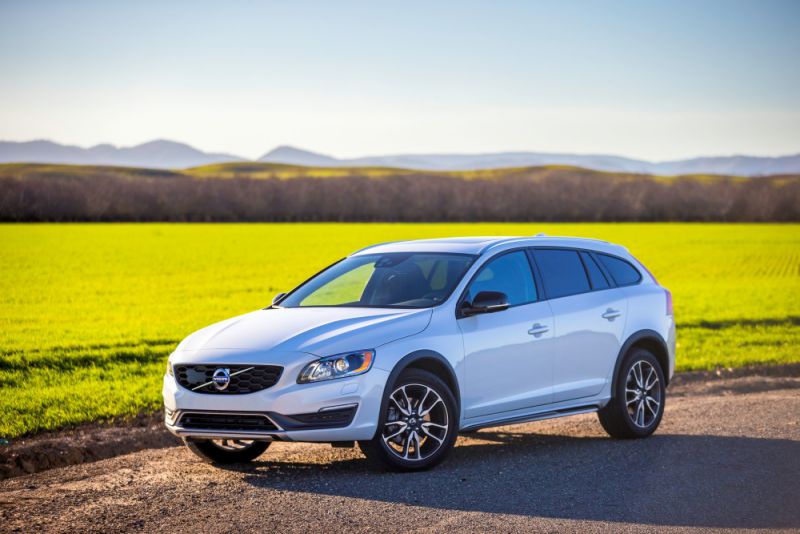
The design of the Volvo V60 I Cross Country skillfully merges the elegant lines of the V60 station wagon with practical, off-road inspired elements. Its body type is officially classified as a station wagon (estate) and a crossover, reflecting its dual nature. Key visual differentiators from the standard V60 included increased ride height, measuring 7.91 inches (201 mm) of ground clearance, which significantly improves its ability to navigate uneven terrain or deep snow. The exterior featured protective body cladding around the wheel arches and lower body, skid plates (or elements mimicking them) at the front and rear, and unique Cross Country badging. These elements not only contributed to a more rugged aesthetic but also offered practical protection against minor scrapes and stone chips.
Inside, the V60 Cross Country maintained Volvo’s reputation for ergonomic design, high-quality materials, and exceptional comfort. It offered seating for five occupants, with supportive seats designed for long journeys. The cabin layout was intuitive, focusing on driver-centric controls and a clean, uncluttered dashboard. While specific infotainment details are not provided in the data, models from this era typically featured Volvo’s Sensus infotainment system, offering navigation, audio, and connectivity options. Safety, a hallmark of the Volvo brand, was paramount, with a comprehensive suite of passive and active safety features expected, though not explicitly detailed in the provided technical specifications. The practical station wagon body style ensured excellent cargo versatility, with a minimum trunk space of 43.83 cubic feet (1241 liters) with the rear seats folded, making it highly suitable for families and individuals with active lifestyles requiring ample storage for gear.
Technical Specifications
| Category | Specification | US Equivalent (where applicable) |
|---|---|---|
| General Information | ||
| Brand | Volvo | |
| Model | V60 | |
| Generation | V60 I Cross Country | |
| Type (Engine) | 2.0 D4 (190 Hp) | |
| Start of Production | 2015 year | |
| End of Production | 2018 year | |
| Powertrain Architecture | Internal Combustion engine | |
| Body type | Station wagon (estate), Crossover | |
| Seats | 5 | |
| Doors | 5 | |
| Performance Specs | ||
| Fuel consumption (economy) – urban | 4.6 l/100 km | 51.1 US mpg |
| Fuel consumption (economy) – extra urban | 4.0 l/100 km | 58.8 US mpg |
| Fuel consumption (economy) – combined | 4.2 l/100 km | 56 US mpg |
| CO2 emissions | 111 g/km | |
| Fuel Type | Diesel | |
| Acceleration 0 – 60 mph | 7.4 sec | |
| Maximum speed | 210 km/h | 130.49 mph |
| Engine Specs | ||
| Power | 190 Hp @ 4250 rpm. | |
| Power per liter | 96.5 Hp/l | |
| Torque | 400 Nm @ 1750-2500 rpm. | 295.02 lb.-ft. @ 1750-2500 rpm. |
| Engine layout | Front, Transverse | |
| Engine Model/Code | D4204T14 | |
| Engine displacement | 1969 cm3 | 120.16 cu. in. (2.0 liters) |
| Number of cylinders | 4 | |
| Engine configuration | Inline | |
| Cylinder Bore | 82 mm | 3.23 in. |
| Piston Stroke | 93.2 mm | 3.67 in. |
| Compression ratio | 15.8:1 | |
| Number of valves per cylinder | 4 | |
| Fuel injection system | Diesel Commonrail | |
| Engine aspiration | Twin-Turbo, Intercooler | |
| Valvetrain | DOHC | |
| Engine oil capacity | 5.2 l | 5.49 US qt |
| Coolant | 8.9 l | 9.4 US qt |
| Space, Volume and Weights | ||
| Trunk (boot) space – minimum | 1241 l | 43.83 cu. ft. |
| Fuel tank capacity | 67.5 l | 17.83 US gal |
| Max. roof load | 75 kg | 165.35 lbs. |
| Permitted trailer load with brakes (8%) | 1900 kg | 4188.78 lbs. |
| Permitted trailer load with brakes (12%) | 1600 kg | 3527.4 lbs. |
| Dimensions | ||
| Length | 4638 mm | 182.6 in. |
| Width | 1825 mm | 71.85 in. |
| Width with mirrors folded | 1866 mm | 73.46 in. |
| Width including mirrors | 2097 mm | 82.56 in. |
| Height | 1545 mm | 60.83 in. |
| Wheelbase | 2774 mm | 109.21 in. |
| Front track | 1619-1609 mm | 63.74 – 63.35 in. |
| Rear (Back) track | 1577-1567 mm | 62.09 – 61.69 in. |
| Ride height (ground clearance) | 201 mm | 7.91 in. |
| Minimum turning circle (turning diameter) | 11.8 m | 38.71 ft. |
| Drivetrain, Brakes and Suspension Specs | ||
| Drivetrain Architecture | The Internal combustion engine (ICE) drives the front wheels of the vehicle. | |
| Drive wheel | Front wheel drive | |
| Number of gears and type of gearbox | 6 gears, manual transmission | |
| Front suspension | Independent, type McPherson with coil spring and anti-roll bar | |
| Rear suspension | Independent coil spring | |
| Front brakes | Ventilated discs | |
| Rear brakes | Disc | |
| Assisting systems | ABS (Anti-lock braking system) | |
| Steering type | Steering rack and pinion | |
Legacy and Market Impact
The Volvo V60 I Cross Country 2.0 D4 (190 Hp) carved out a significant niche in the European automotive landscape during its production run from 2015 to 2018. Its legacy is rooted in its ability to offer a compelling alternative to both traditional SUVs and conventional station wagons. For consumers who appreciated the driving dynamics and fuel efficiency of a car but desired the added ground clearance and rugged aesthetics for light off-road excursions or navigating challenging weather conditions, the Cross Country was an ideal solution. This specific diesel FWD variant further emphasized efficiency, appealing to a segment of the market where running costs and environmental impact were paramount considerations.
In its primary markets, the V60 Cross Country competed with vehicles like the Audi A4 Allroad, Volkswagen Passat Alltrack, and even some smaller premium SUVs. Volvo’s reputation for unparalleled safety, combined with the V60’s elegant interior and robust build quality, ensured its strong standing. The D4 engine’s impressive blend of power and economy underscored Volvo’s engineering prowess, demonstrating that a powerful, versatile vehicle could also be remarkably efficient. While this specific diesel FWD configuration was not offered in the US market, where gasoline engines and AWD were standard for Cross Country models, its success in Europe highlighted a different set of consumer priorities and regulatory landscapes.
Ultimately, the V60 I Cross Country, particularly in its efficient D4 guise, reinforced Volvo’s identity as a leader in practical, safe, and environmentally conscious premium vehicles. It demonstrated the brand’s ability to innovate within established segments, offering a distinct proposition that resonated with a discerning clientele. Its influence can be seen in the continued evolution of the Cross Country lineup, which remains a core part of Volvo’s global strategy, adapting to regional market demands while maintaining its core values of versatility and Scandinavian sophistication.