The Nissan Sunny III Hatch (N14) 3 doors 2.0 GTI-R 4×4 (230 Hp): A Rally Icon’s Street Legal Sibling
The Nissan Sunny III Hatch (N14) 3 doors 2.0 GTI-R 4×4 (230 Hp), often referred to by its Japanese market name, the Nissan Pulsar GTI-R, stands as a formidable testament to Nissan’s engineering prowess during the early 1990s. Produced from 1990 to 1995, this compact, high-performance hatchback was not merely another hot hatch; it was a homologation special, a street-legal variant designed to meet the production requirements for Nissan’s entry into the fiercely competitive Group A class of the World Rally Championship (WRC). While not widely sold in the United States, its legacy as a “baby Godzilla” – a nod to its Skyline GT-R sibling – has resonated with automotive enthusiasts globally, particularly in markets like Europe and Japan where it carved out a niche as an accessible, rally-bred performance machine.
This generation of the Nissan Sunny, internally designated N14, provided the perfect compact platform for Nissan’s rally ambitions. The 3-door hatchback body offered a lightweight and agile chassis, which, when combined with a potent turbocharged engine and an advanced all-wheel-drive system, transformed the humble Sunny into a giant slayer. The GTI-R variant was a no-compromise performance vehicle, engineered from the ground up to excel on rally stages, and its street version offered a raw, unadulterated driving experience that few competitors could match.
Engine & Performance: The Heart of the {Nissan Sunny III Hatch (N14) 3 doors 2.0 GTI-R 4×4 (230 Hp)}
At the core of the Nissan Sunny GTI-R’s formidable reputation was its powertrain, a masterpiece of forced induction and drivetrain engineering. Under the hood resided the legendary SR20DET engine, a 2.0-liter (1998 cm3 or 121.93 cu. in.) inline four-cylinder unit. This particular iteration of the SR20DET was specifically developed for the GTI-R, featuring a large Garrett T28 turbocharger, unique intake manifold, and multi-port manifold injection system. The engine produced an impressive 230 horsepower at 6000 rpm and a robust 202.83 lb.-ft. of torque at 3600 rpm, figures that were exceptionally strong for a compact car of its era.
The engine’s design, with a square bore and stroke of 86 mm (3.39 inches) and a compression ratio of 8.5:1, showcased its robustness and suitability for forced induction. Power was efficiently delivered to all four wheels via a permanent all-wheel-drive system, paired with a precise 5-speed manual transmission. This 4×4 drivetrain was crucial for its rally aspirations, providing exceptional traction and grip in diverse conditions. The car’s relatively low curb weight of 2689.64 lbs. (1220 kg) contributed to an impressive weight-to-power ratio of 5.3 kg/Hp (188.5 Hp/tonne), allowing the GTI-R to achieve a top speed of 149.13 mph (240 km/h).
Fuel economy, as expected for a high-performance, turbocharged all-wheel-drive vehicle from the early 90s, was not its strong suit. Urban consumption stood at an estimated 13.1 US mpg, while extra-urban driving improved to around 24.2 US mpg. However, for the enthusiasts who sought its blistering performance and rally heritage, these figures were a minor consideration.
Design & Features: Form Follows Function
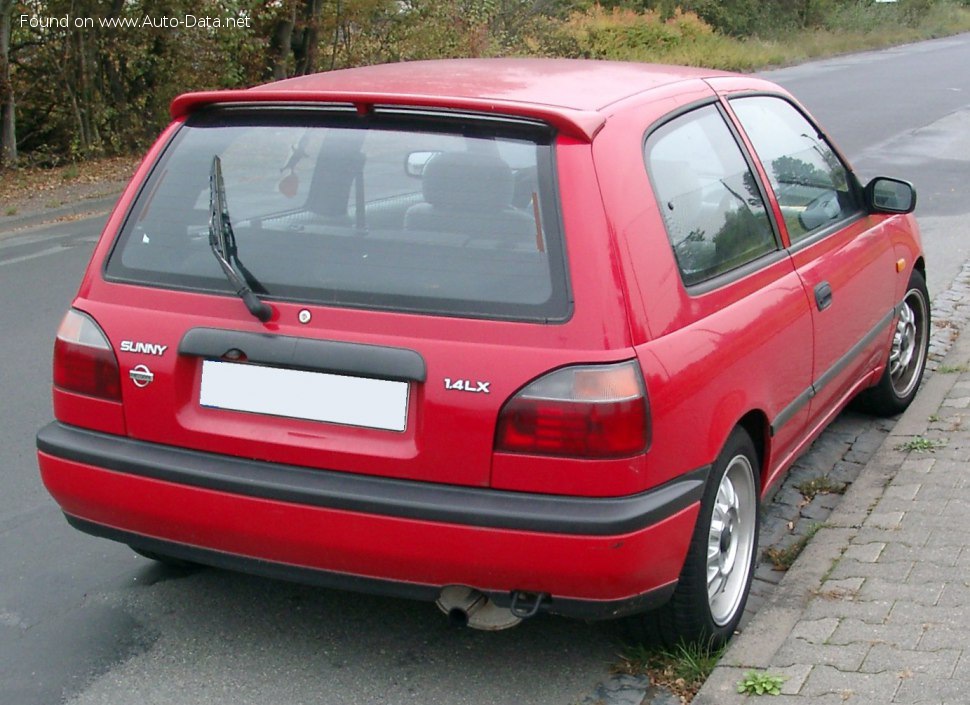
The design of the Nissan Sunny GTI-R was unmistakably performance-oriented, a direct result of its rally homologation requirements. The 3-door hatchback body featured several distinctive elements that set it apart from its more mundane Sunny siblings. The most prominent feature was the large, functional hood scoop, designed to feed cool air directly to the top-mounted intercooler, a critical component for maintaining engine performance under strenuous conditions. At the rear, a prominent spoiler not only added to its aggressive aesthetic but also contributed to aerodynamic stability at high speeds.
Despite its performance focus, the GTI-R offered a practical interior with seating for five, though the rear seats were more suited for occasional use or additional cargo. The trunk space was respectable for a compact car, ranging from 9.89 cu. ft. (280 liters) with the rear seats up to a generous 34.96 cu. ft. (990 liters) with them folded down. The car’s dimensions—156.5 inches long, 66.54 inches wide, and 54.92 inches high—contributed to its nimble handling and compact footprint.
In terms of chassis and safety, the GTI-R was equipped with ventilated disc brakes at the front and disc brakes at the rear, providing strong stopping power. An Anti-lock Braking System (ABS) was also standard, a significant safety feature for its time, enhancing control during hard braking. The suspension setup featured a wishbone design at the front and a spring strut system at the rear, tuned for aggressive driving and rally stages. Hydraulic power steering with a rack and pinion system ensured direct and communicative feedback to the driver, while 195/55 R14 tires provided ample grip.
Technical Specifications
| Category | Specification |
|---|---|
| Brand | Nissan |
| Model | Sunny |
| Generation | Sunny III Hatch (N14) 3 doors |
| Type (Engine) | 2.0 GTI-R 4×4 (230 Hp) |
| Start of Production | 1990 |
| End of Production | 1995 |
| Powertrain Architecture | Internal Combustion Engine |
| Body Type | Hatchback |
| Seats | 5 |
| Doors | 3 |
| Fuel Type | Petrol (Gasoline) |
| Maximum Speed | 149.13 mph (240 km/h) |
| Weight-to-Power Ratio | 5.3 kg/Hp, 188.5 Hp/tonne |
| Weight-to-Torque Ratio | 4.4 kg/Nm, 225.4 Nm/tonne |
| Power | 230 Hp @ 6000 rpm |
| Power per Liter | 115.1 Hp/l |
| Torque | 202.83 lb.-ft. (275 Nm) @ 3600 rpm |
| Engine Layout | Front, Transverse |
| Engine Displacement | 121.93 cu. in. (1998 cm3) |
| Number of Cylinders | 4 |
| Engine Configuration | Inline |
| Cylinder Bore | 3.39 in. (86 mm) |
| Piston Stroke | 3.39 in. (86 mm) |
| Compression Ratio | 8.5:1 |
| Number of Valves per Cylinder | 4 |
| Fuel Injection System | Multi-port manifold injection |
| Engine Aspiration | Turbocharger |
| Kerb Weight | 2689.64 lbs. (1220 kg) |
| Trunk (Boot) Space – Minimum | 9.89 cu. ft. (280 l) |
| Trunk (Boot) Space – Maximum | 34.96 cu. ft. (990 l) |
| Fuel Tank Capacity | 13.21 US gal (50 l) |
| Length | 156.5 in. (3975 mm) |
| Width | 66.54 in. (1690 mm) |
| Height | 54.92 in. (1395 mm) |
| Wheelbase | 95.67 in. (2430 mm) |
| Front Track | 56.5 in. (1435 mm) |
| Rear (Back) Track | 55.91 in. (1420 mm) |
| Drive Wheel | All-wheel drive (4×4) |
| Number of Gears and Type of Gearbox | 5 gears, manual transmission |
| Front Suspension | Wishbone |
| Rear Suspension | Spring Strut |
| Front Brakes | Ventilated discs |
| Rear Brakes | Disc |
| Assisting Systems | ABS (Anti-lock braking system) |
| Steering Type | Steering rack and pinion |
| Power Steering | Hydraulic Steering |
| Tires Size | 195/55 R14 |
| Fuel consumption (economy) – urban | 13.1 US mpg (18 l/100 km) |
| Fuel consumption (economy) – extra urban | 24.2 US mpg (9.7 l/100 km) |
Legacy & Market Impact
The Nissan Sunny GTI-R, or Pulsar GTI-R as it was known in its home market of Japan and other regions, carved out a significant legacy as a raw and focused performance car. Its primary purpose was to serve as Nissan’s weapon for the World Rally Championship, directly challenging established competitors like the Lancia Delta Integrale, Toyota Celica GT-Four, and later, the emerging Subaru Impreza WRX and Ford Escort Cosworth. While its WRC campaign was ultimately short-lived and not as successful as Nissan had hoped, the street-legal homologation special left an indelible mark.
In its primary markets, the GTI-R was celebrated for its aggressive performance, robust SR20DET engine, and capable all-wheel-drive system. It offered a thrilling driving experience, characterized by strong turbo lag followed by an explosive surge of power, combined with tenacious grip. Its compact size and rally-bred suspension made it incredibly agile, particularly on winding roads or in challenging conditions. The car quickly developed a cult following among enthusiasts who appreciated its no-frills, performance-first philosophy.
The GTI-R’s impact extended beyond its immediate sales figures. It showcased Nissan’s ability to produce high-performance, all-wheel-drive vehicles beyond the revered Skyline GT-R, solidifying the brand’s reputation for engineering excellence in motorsports. Today, the Nissan Sunny GTI-R is a highly sought-after classic, particularly by collectors and tuners who value its mechanical integrity, tuning potential of the SR20DET engine, and its historical significance as a true rally homologation special. Its rarity, especially outside of Japan and Europe, only adds to its mystique and desirability among automotive aficionados worldwide.