
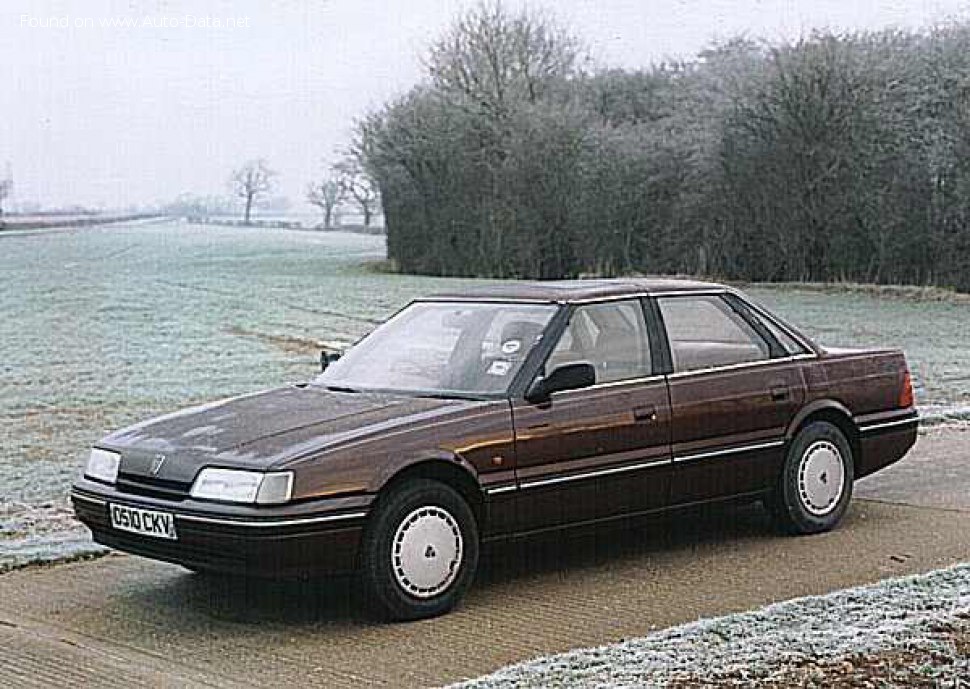
The Rover 800 820e: A British Executive Sedan of the Late 20th Century
The Rover 800 820e represents a pivotal period in the history of the British automotive industry, marking a significant attempt by the Rover Group to re-establish itself in the competitive executive car segment. Launched in 1986, the Rover 800 series, known internally as the “XX” project, was the result of an ambitious collaboration with Honda, which simultaneously produced the first-generation Honda Legend (and its Acura Legend counterpart in North America). This partnership was crucial for Rover, providing access to modern engineering and quality standards that had been challenging for the company to achieve independently.
The 800 series was designed to be a sophisticated, front-wheel-drive sedan (and later a fastback) aimed squarely at the European executive market. The 820e variant, specifically, served as an entry-level offering within the range, powered by Rover’s own M16e engine. While the Rover 800 itself was not sold in the United States, its platform-mate, the Acura Legend, achieved considerable success there, offering a glimpse into the underlying quality and design principles shared by both vehicles. For the European market, the 800 was a direct competitor to established players like the Ford Granada/Scorpio, Vauxhall Carlton/Opel Omega, and even challenged the lower end of the BMW 5 Series and Mercedes-Benz E-Class segments with its blend of traditional British luxury cues and contemporary performance.
Engine and Performance of the Rover 800 820e
At the heart of the Rover 800 820e was the M16e engine, a 2.0-liter, naturally aspirated four-cylinder petrol (gasoline) unit developed by Rover. This engine was a derivative of the established ‘O-series’ engine, updated with a 16-valve cylinder head (hence ‘M16’) and electronic fuel injection (‘e’ for injection). Producing a respectable 120 horsepower, the M16e was designed to offer a balance of efficiency and adequate performance for an executive sedan of its era. Its naturally aspirated nature meant a linear power delivery, characteristic of the technology of the mid-to-late 1980s, prioritizing smooth operation over outright raw power.
The M16e engine was known for its robustness, a quality that Rover aimed to instill across the 800 range. With an engine oil capacity of 4.5 liters (4.76 US quarts) and a cooling system capacity of 10 liters (10.57 US quarts), the powertrain was designed for reliable, long-distance touring, a common expectation for executive vehicles. While not the most powerful engine in the 800 lineup (which also included V6 options derived from Honda), the 820e provided a solid, economical choice for buyers. Its performance was geared towards comfortable cruising rather than sporty acceleration, reflecting the preferences of its target demographic in Europe.
Design and Features of the Rover 800
The Rover 800 series, including the 820e, was initially offered exclusively as a four-door sedan, embodying a classic executive car silhouette. The design, a collaborative effort between Rover and Honda, featured clean lines and a somewhat conservative aesthetic, aiming for an understated elegance that would appeal to professional buyers. Key design elements included a prominent grille, characteristic of Rover’s heritage, flanked by rectangular headlights, and a neatly integrated trunk. The overall stance was purposeful and refined, reflecting its aspirations in the premium segment.
Inside, the Rover 800 820e offered a cabin that blended traditional British luxury with modern ergonomics. High-quality materials, often including wood trim and comfortable cloth or optional leather upholstery, were standard, creating an inviting and well-appointed environment. Features for the 1986-1991 production run would have included power windows, central locking, and a sophisticated heating and ventilation system. Depending on the trim level, amenities like air conditioning, an advanced audio system, and power-adjustable seats would have been available, positioning the 800 competitively against its European rivals. Safety features, while not as advanced as modern vehicles, would have included a robust passenger cell, crumple zones, and three-point seatbelts for all major occupants, reflecting the evolving safety standards of the time.
Technical Specifications: Rover 800 820e (120 Hp)
| General Information | |
|---|---|
| Brand | Rover |
| Model | 800 |
| Generation | 800 |
| Type (Engine) | 820e (120 Hp) |
| Start of production | 1986 year |
| End of production | 1991 year |
| Powertrain Architecture | Internal Combustion engine |
| Body type | Sedan |
| Performance Specifications | |
| Fuel Type | Petrol (Gasoline) |
| Engine Specifications | |
| Power | 120 Hp |
| Engine Model/Code | M16e |
| Engine aspiration | Naturally aspirated engine |
| Engine oil capacity | 4.5 l (4.76 US qt) |
| Coolant capacity | 10 l (10.57 US qt) |
Legacy and Market Impact of the Rover 800
The Rover 800 series, including the 820e, holds a significant place in Rover’s history as its flagship model for a considerable period. Its inception as part of the “XX” project with Honda was a bold move, intended to leverage Japanese engineering prowess to create a competitive executive car. For Rover, the 800 was meant to signal a return to quality and desirability, a stark contrast to some of the brand’s earlier, more troubled offerings. The car was generally well-received upon its launch, praised for its comfortable ride, refined engines (especially the Honda-derived V6), and well-appointed interior. The 820e, as the entry-level gasoline model, provided an accessible point into the executive segment.
In its primary European market, the Rover 800 faced stiff competition. Its main rivals included the Ford Granada/Scorpio, a strong seller known for its space and value; the Vauxhall Carlton/Opel Omega, another popular choice offering robust German engineering; and increasingly, the Japanese challengers like the Mazda 929 and Nissan Maxima. While it often couldn’t quite match the prestige of premium German marques like BMW and Mercedes-Benz, the 800 offered a distinct British alternative, blending traditional styling cues with modern underpinnings. The success of its platform-mate, the Acura Legend, in the North American market also lent a certain credibility to the underlying engineering of the 800, even if the Rover badged version was never sold stateside.
Despite its initial promise, the Rover 800’s legacy is somewhat mixed. While it was a significant step forward for Rover in terms of quality and refinement compared to its predecessors, it also suffered from some of the reliability perceptions that plagued the brand in the late 20th century, especially with its later iterations and non-Honda engines. However, the early 800s, like the 820e from 1986-1991, benefited significantly from the Honda collaboration, offering a relatively dependable and comfortable executive package. It represented a crucial, if ultimately temporary, lifeline for the struggling British marque, showcasing what could be achieved through strategic international partnerships. The Rover 800 820e remains a testament to an era when British manufacturers sought innovative ways to compete on the global stage, leaving behind a car that symbolized both the ambitions and challenges of the time.
