Renault Megane III Coupe (Phase II, 2012) GT 1.2 Energy TCe (115 Hp) Start&Stop: A European Compact Coupe
The Renault Megane III Coupe (Phase II, 2012) GT 1.2 Energy TCe (115 Hp) Start&Stop represents a significant iteration within the third generation of Renault’s popular compact car line. Unveiled as part of the Megane’s Phase II facelift for the 2012 model year, this particular variant showcased Renault’s commitment to combining stylish design with advanced powertrain technology and improved fuel efficiency. Primarily targeted at the European market, where it competed fiercely in the highly contested C-segment, the Megane Coupe offered a sportier, more dynamic alternative to its more practical hatchback and sedan siblings. While never officially sold in the United States, its design language, technological advancements, and market positioning offer valuable insights into the global automotive landscape and European consumer preferences during its production run from 2012 to 2013.
This specific GT 1.2 Energy TCe model highlighted the burgeoning trend of engine downsizing in Europe, where smaller displacement, turbocharged gasoline engines were becoming increasingly prevalent to meet stringent emissions regulations and consumer demand for lower running costs. The integration of “Energy” branding signified Renault’s focus on efficiency, further bolstered by the standard Start&Stop system, a feature designed to reduce fuel consumption and CO2 emissions in urban driving conditions. The Megane III Coupe, particularly in its GT trim with this modern powertrain, aimed to strike a balance between everyday usability, engaging driving dynamics, and environmental responsibility, making it a compelling choice for buyers seeking a distinctive and economical compact coupe.
Engine & Performance of the Renault Megane III Coupe (Phase II, 2012)
At the heart of the Renault Megane III Coupe (Phase II, 2012) GT 1.2 Energy TCe (115 Hp) Start&Stop was a sophisticated 1.2-liter (1198 cm3 or 73.11 cu. in.) inline-four gasoline engine, codenamed H5F 408. This powerplant was a prime example of Renault’s “Energy TCe” family, engineered for optimal efficiency without sacrificing a respectable level of performance for its class. Equipped with a turbocharger and intercooler, it delivered a healthy 115 horsepower at 4500 rpm. More impressively, it produced a robust 140.14 lb.-ft. of torque at a low 2000 rpm, ensuring accessible power and good drivability in varied conditions, from city streets to open highways. This low-end torque was a key advantage of the turbocharged design, providing a responsive feel that belied its small displacement.
Power was transmitted to the front wheels via a precise 6-speed manual transmission, offering drivers a direct and engaging connection to the powertrain. This setup allowed the Megane Coupe to accelerate from 0 to 60 mph in a respectable 10.4 seconds, with a top speed of 118.06 mph (190 km/h). While not a performance powerhouse, these figures were more than adequate for daily driving and occasional spirited excursions, especially considering the engine’s primary focus on efficiency. The weight-to-power ratio stood at 10.5 kg/Hp (95.4 Hp/tonne), indicating a well-balanced power delivery for its curb weight of 2656.57 lbs. (1205 kg).
Fuel economy was a standout feature, a critical selling point in the European market. The Megane Coupe GT 1.2 TCe achieved an impressive combined fuel consumption of 44.4 US mpg (5.3 l/100 km), with urban figures reaching 36.8 US mpg (6.4 l/100 km) and extra-urban cruising yielding an excellent 51.1 US mpg (4.6 l/100 km). These figures were significantly aided by the standard Start&Stop system, which automatically shut off the engine when the vehicle was stationary and restarted it seamlessly when the clutch was engaged, thereby reducing idle consumption and emissions. With CO2 emissions of just 119 g/km, the car met the Euro 5 emission standard, underscoring its environmental credentials. The 15.85 US gallon (60 l) fuel tank provided a substantial cruising range, further enhancing its practicality.
Design & Features
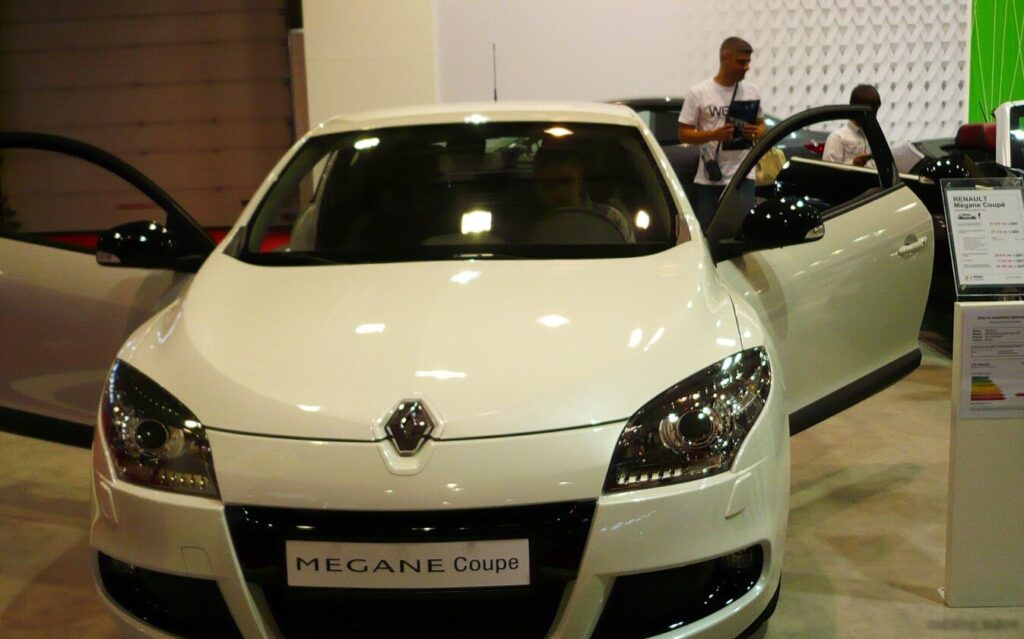
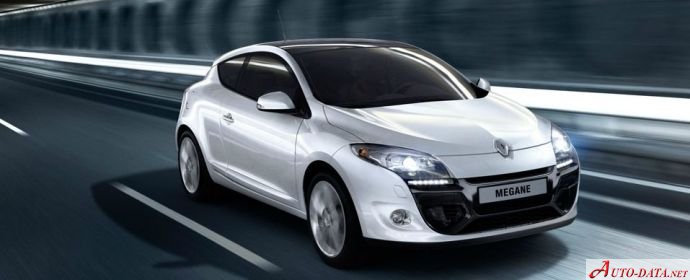
The Renault Megane III Coupe (Phase II, 2012) adopted a sleek and sporty coupe body style, featuring three doors and seating for five occupants, a relatively rare configuration for a compact coupe. Its design was a significant departure from the more conservative styling of its predecessor, characterized by flowing lines, a distinctive front fascia, and a muscular stance. The Phase II facelift introduced subtle but effective updates, typically including revised headlights, grille designs, and potentially LED daytime running lights, which modernized its appearance and brought it in line with Renault’s evolving design language.
Measuring 169.25 inches (4299 mm) in length, 70.28 inches (1785 mm) in width, and 56.02 inches (1423 mm) in height, the Megane Coupe possessed compact dimensions that made it agile in urban environments while maintaining a commanding road presence. The 103.94-inch (2640 mm) wheelbase contributed to a stable ride and allowed for a surprisingly spacious cabin for a coupe. Despite its sporty profile, practicality was not entirely overlooked; the trunk offered a respectable 13.31 cu. ft. (377 liters) of cargo space, expandable to a generous 35 cu. ft. (991 liters) with the rear seats folded, making it suitable for varying cargo needs.
The chassis was engineered for a balance of comfort and dynamic handling. It featured an independent McPherson strut suspension at the front, known for its ability to provide precise steering and good road holding, while a torsion beam rear suspension offered a compact and cost-effective solution without compromising ride quality excessively. Braking performance was handled by ventilated discs at the front and solid discs at the rear, complemented by an Anti-lock Braking System (ABS) for enhanced safety during emergency stops. Electric power steering, a modern feature for its time, offered light and responsive steering at low speeds for easy maneuvering, firming up at higher speeds for better stability. The car rode on 195/65 R15 91H tires mounted on 6.5J x 15-inch wheels, providing a comfortable ride and adequate grip.
Technical Specifications
| Category | Specification |
|---|---|
| General Information | |
| Brand | Renault |
| Model | Megane |
| Generation | Megane III Coupe (Phase II, 2012) |
| Type (Engine) | GT 1.2 Energy TCe (115 Hp) Start&Stop |
| Start of Production | 2012 year |
| End of Production | 2013 year |
| Powertrain Architecture | Internal Combustion engine |
| Body Type | Coupe |
| Seats | 5 |
| Doors | 3 |
| Performance Specs | |
| Fuel Consumption (Urban) | 36.8 US mpg (6.4 l/100 km) |
| Fuel Consumption (Extra Urban) | 51.1 US mpg (4.6 l/100 km) |
| Fuel Consumption (Combined) | 44.4 US mpg (5.3 l/100 km) |
| CO2 Emissions | 119 g/km |
| Fuel Type | Petrol (Gasoline) |
| Acceleration 0 – 60 mph | 10.4 sec |
| Acceleration 0 – 62 mph (0 – 100 km/h) | 10.9 sec |
| Maximum Speed | 118.06 mph (190 km/h) |
| Emission Standard | Euro 5 |
| Weight-to-Power Ratio | 10.5 kg/Hp, 95.4 Hp/tonne |
| Weight-to-Torque Ratio | 6.3 kg/Nm, 157.7 Nm/tonne |
| Engine Specs | |
| Power | 115 Hp @ 4500 rpm |
| Power Per Liter | 96 Hp/l |
| Torque | 140.14 lb.-ft. (190 Nm) @ 2000 rpm |
| Engine Layout | Front, Transverse |
| Engine Model/Code | H5F 408 |
| Engine Displacement | 1.2 liters (1198 cm3, 73.11 cu. in.) |
| Number of Cylinders | 4 |
| Engine Configuration | Inline |
| Cylinder Bore | 2.84 in. (72.2 mm) |
| Piston Stroke | 2.88 in. (73.2 mm) |
| Compression Ratio | 10:1 |
| Valves Per Cylinder | 4 |
| Fuel Injection System | Multi-port manifold injection |
| Engine Aspiration | Turbocharger, Intercooler |
| Engine Oil Capacity | 4.86 US qt (4.6 l) |
| Coolant Capacity | 6.87 US qt (6.5 l) |
| Engine Systems | Start & Stop System |
| Space, Volume and Weights | |
| Kerb Weight | 2656.57 lbs. (1205 kg) |
| Max. Weight | 3911 lbs. (1774 kg) |
| Max Load | 1254.43 lbs. (569 kg) |
| Trunk (Boot) Space – Minimum | 13.31 cu. ft. (377 l) |
| Trunk (Boot) Space – Maximum | 35 cu. ft. (991 l) |
| Fuel Tank Capacity | 15.85 US gal (60 l) |
| Permitted Trailer Load with Brakes (12%) | 2866.01 lbs. (1300 kg) |
| Permitted Trailer Load without Brakes | 1410.96 lbs. (640 kg) |
| Dimensions | |
| Length | 169.25 in. (4299 mm) |
| Width | 70.28 in. (1785 mm) |
| Height | 56.02 in. (1423 mm) |
| Wheelbase | 103.94 in. (2640 mm) |
| Front Track | 60.87 in. (1546 mm) |
| Rear (Back) Track | 60.91 in. (1547 mm) |
| Front Overhang | 33.94 in. (862 mm) |
| Rear Overhang | 31.38 in. (797 mm) |
| Ride Height (Ground Clearance) | 4.72 in. (120 mm) |
| Minimum Turning Circle (Turning Diameter) | 35.93 ft. (10.95 m) |
| Drivetrain, Brakes and Suspension Specs | |
| Drivetrain Architecture | Front-wheel drive (ICE drives front wheels) |
| Drive Wheel | Front wheel drive |
| Number of Gears and Type of Gearbox | 6 gears, manual transmission |
| Front Suspension | Independent type McPherson |
| Rear Suspension | Torsion |
| Front Brakes | Ventilated discs |
| Rear Brakes | Disc |
| Assisting Systems | ABS (Anti-lock braking system) |
| Steering Type | Steering rack and pinion |
| Power Steering | Electric Steering |
| Tires Size | 195/65 R15 91H |
| Wheel Rims Size | 6.5J x 15 |
Legacy & Market Impact
The Renault Megane III Coupe, particularly in its Phase II iteration with the GT 1.2 Energy TCe (115 Hp) Start&Stop powertrain, carved out a distinct niche in the highly competitive European compact car segment. While the broader Megane range faced stiff competition from segment leaders like the Volkswagen Golf, Ford Focus, and Opel Astra, the Coupe variant offered a more emotionally charged, style-conscious alternative. Its primary competitors in the three-door coupe category included models such as the Volkswagen Scirocco, Opel Astra GTC, and potentially sportier versions of the Peugeot 308.
The Megane Coupe’s reputation was built on its striking design, which offered a refreshing departure from the conventional hatchback. It appealed to buyers who desired a blend of practicality and panache, without necessarily needing the ultimate performance of a dedicated sports car. The 1.2 Energy TCe engine played a crucial role in its market positioning, demonstrating Renault’s prowess in developing efficient, downsized turbocharged gasoline engines. This engine family allowed the Megane Coupe to offer lower running costs, reduced taxation in many European countries due to its low CO2 emissions, and a respectable driving experience that was both smooth and responsive. The inclusion of Start&Stop technology further cemented its image as a modern, eco-conscious choice.
Historically, the Megane III Coupe contributed significantly to Renault’s brand image, showcasing its ability to produce stylish, technologically advanced, and environmentally responsible vehicles. It helped maintain Renault’s presence in a segment where design and efficiency were becoming increasingly important. Its legacy lies in embodying the European trend towards combining expressive design with intelligent engineering solutions for everyday driving. While it never reached American shores, its success in its home market highlighted a different automotive philosophy, one where compact dimensions, fuel efficiency, and distinctive styling held paramount importance for a broad demographic of consumers. The Megane III Coupe remains a testament to Renault’s design flair and engineering capabilities in the early 2010s, a period of rapid evolution in automotive technology and environmental consciousness.