Volkswagen Polo III (6N/6KV) 1.3 (55 Hp): A European Supermini Standard
The Volkswagen Polo III (6N/6KV) represents a significant chapter in the evolution of Volkswagen’s popular supermini lineup. Introduced in 1994, this generation marked a notable departure from its predecessors, adopting a more modern and rounded aesthetic that was characteristic of 1990s automotive design. The specific variant under review, the 1.3 (55 Hp) model, served as an entry-level powertrain option, emphasizing economy and practicality for the bustling urban and suburban environments of Europe, its primary market. Unlike some of its larger Volkswagen siblings, the Polo was never officially sold in the United States, cementing its status as a quintessential European compact car. This third-generation Polo built upon the brand’s reputation for robust engineering and sensible design, offering a compelling package in the highly competitive B-segment, often referred to as the supermini or subcompact class. It was available in both 3-door and 5-door hatchback configurations, catering to a broad spectrum of buyers seeking an affordable, reliable, and space-efficient vehicle.
Engineering and Performance of the Volkswagen Polo III (6N/6KV) 1.3 (55 Hp)
At the heart of the Volkswagen Polo III (6N/6KV) 1.3 (55 Hp) model lay a modest yet efficient internal combustion engine designed for everyday usability rather than outright speed. This powertrain architecture featured a front, transverse-mounted 1.3-liter (1296 cm3 or 79.09 cu. in.) inline four-cylinder engine. Codenamed ADX, this unit was naturally aspirated and utilized a single-point fuel injection system, a common technology for its era that balanced cost-effectiveness with reasonable fuel delivery precision. The engine’s valvetrain was an Overhead Camshaft (OHC) design, contributing to its relatively simple and reliable operation.
Outputting 55 horsepower (Hp) at 5200 rpm and 73.76 lb.-ft. (100 Nm) of torque at a lower 2800 rpm, the engine was tuned for accessible low-end torque, which proved beneficial for city driving and navigating traffic. This power delivery was coupled with a 5-speed manual transmission, driving the front wheels – a standard and efficient setup for a vehicle of this class. While not a performance powerhouse, the Polo 1.3 (55 Hp) was perfectly adequate for its intended purpose. It achieved an acceleration from 0 to 60 mph in a calculated 16.3 seconds (0-62 mph or 0-100 km/h in 17.2 seconds) and reached a maximum speed of 96.31 mph (155 km/h).
Fuel economy was a key selling point for the Polo, with the 1.3-liter variant achieving a combined fuel consumption of approximately 36.2 US mpg (6.5 l/100 km). This efficiency, combined with a 11.89 US gallon (45 liter) fuel tank, provided a respectable cruising range, making it an economical choice for both daily commutes and longer European road trips. The vehicle’s lightweight construction, with a curb weight of just 2105.41 lbs (955 kg), contributed significantly to its agility and fuel efficiency, resulting in a weight-to-power ratio of 17.4 kg/Hp.
Design and Features of the Volkswagen Polo III (6N/6KV)
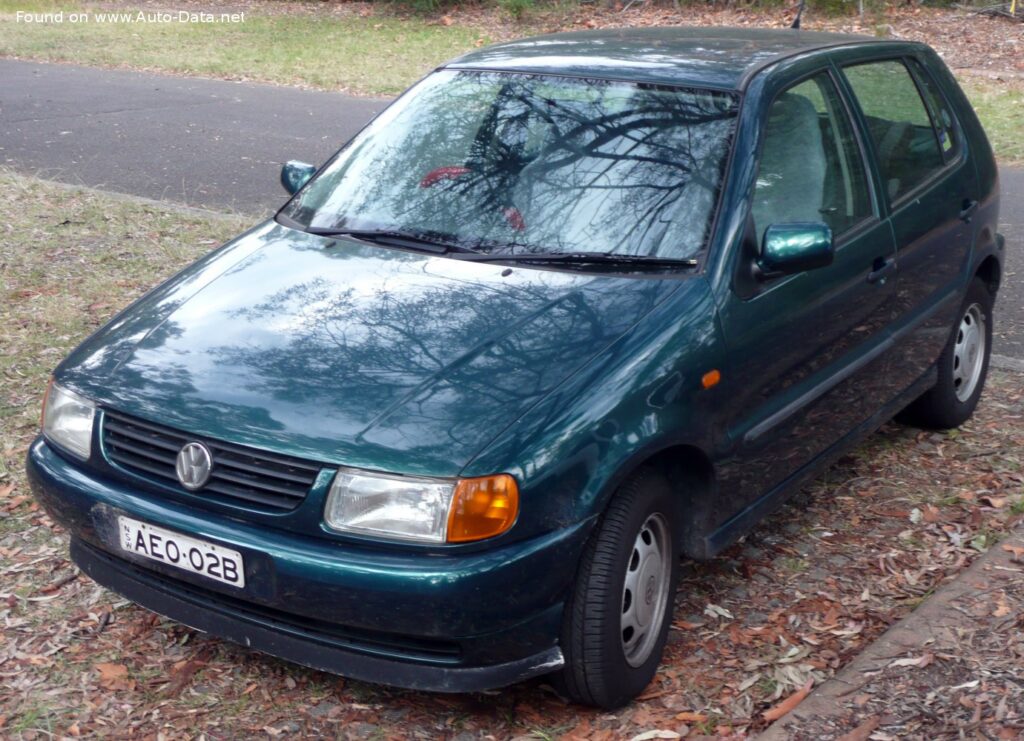
The design of the Volkswagen Polo III (6N/6KV) marked a substantial aesthetic evolution from the more angular styling of the Polo II (86C). The third-generation Polo embraced a softer, more contemporary look with rounded edges and a cohesive body-colored bumper integration, aligning it with Volkswagen’s evolving design language seen in models like the contemporary Golf III. Available as a 3-door or 5-door hatchback, the Polo offered practical access for passengers and cargo alike. With seating for five occupants, it provided a surprisingly spacious interior for its compact footprint, measuring 146.26 inches (3715 mm) in length, 65.16 inches (1655 mm) in width, and 55.91 inches (1420 mm) in height. The 94.49-inch (2400 mm) wheelbase contributed to a stable ride and maximized interior volume.
Inside, the Polo’s cabin was characterized by Volkswagen’s typical no-nonsense approach: durable materials, clear instrumentation, and intuitive controls. While not luxurious, the interior was built to withstand the rigors of daily use, a hallmark of German engineering. Cargo versatility was a strong suit, with a minimum trunk space of 8.65 cu. ft. (245 liters) that could expand to a generous 34.43 cu. ft. (975 liters) with the rear seats folded down, making it highly adaptable for various hauling needs.
In terms of chassis and safety, the Polo III featured a conventional yet effective setup. It utilized coil springs for both front and rear suspension, providing a comfortable and predictable ride. Braking was handled by disc brakes at the front and drum brakes at the rear, a common configuration for economy cars of the era. Importantly, the Volkswagen Polo III (6N/6KV) also offered an Anti-lock Braking System (ABS) as an assisting system, a crucial safety feature that was becoming more prevalent in mainstream vehicles during the mid-1990s, enhancing driver control during emergency braking. Steering was managed by a hydraulic rack and pinion system, offering direct feedback to the driver. The car rode on 13-inch wheels fitted with 175/65 R13 T tires, a size optimized for comfort and low rolling resistance.
Technical Specifications: Volkswagen Polo III (6N/6KV) 1.3 (55 Hp)
| Category | Specification | Metric (Original) | US (Converted) |
|---|---|---|---|
| General Information | |||
| Brand | Volkswagen | ||
| Model | Polo | ||
| Generation | Polo III (6N/6KV) | ||
| Type (Engine) | 1.3 (55 Hp) | ||
| Start of production | 1994 year | ||
| End of production | 1995 year | ||
| Powertrain Architecture | Internal Combustion engine | ||
| Body type | Hatchback | ||
| Seats | 5 | ||
| Doors | 3-5 | ||
| Performance Specs | |||
| Fuel consumption (economy) – combined | 6.5 l/100 km | 36.2 US mpg | |
| Fuel Type | Petrol (Gasoline) | ||
| Acceleration 0 – 62 mph (0-100 km/h) | 17.2 sec | 17.2 sec | |
| Acceleration 0 – 60 mph (Calculated) | 16.3 sec | ||
| Maximum speed | 155 km/h | 96.31 mph | |
| Weight-to-power ratio | 17.4 kg/Hp | ||
| Weight-to-torque ratio | 9.6 kg/Nm | ||
| Engine Specs | |||
| Power | 55 Hp @ 5200 rpm | 55 Hp @ 5200 rpm | |
| Power per liter | 42.4 Hp/l | ||
| Torque | 100 Nm @ 2800 rpm | 73.76 lb.-ft. @ 2800 rpm | |
| Engine layout | Front, Transverse | ||
| Engine Model/Code | ADX | ||
| Engine displacement | 1296 cm3 | 79.09 cu. in. | |
| Number of cylinders | 4 | ||
| Engine configuration | Inline | ||
| Cylinder Bore | 76.5 mm | 3.01 in. | |
| Piston Stroke | 70.5 mm | 2.78 in. | |
| Compression ratio | 10:1 | ||
| Number of valves per cylinder | 2 | ||
| Fuel injection system | Single-point injection | ||
| Engine aspiration | Naturally aspirated engine | ||
| Valvetrain | OHC | ||
| Engine oil capacity | 3.5 l | 3.7 US qt | |
| Engine oil specification | Not specified in data provided | ||
| Coolant | 6 l | 6.34 US qt | |
| Space, Volume and Weights | |||
| Kerb Weight | 955 kg | 2105.41 lbs. | |
| Max. weight | 1375 kg | 3031.36 lbs. | |
| Max load | 420 kg | 925.94 lbs. | |
| Trunk (boot) space – minimum | 245 l | 8.65 cu. ft. | |
| Trunk (boot) space – maximum | 975 l | 34.43 cu. ft. | |
| Fuel tank capacity | 45 l | 11.89 US gal | |
| Dimensions | |||
| Length | 3715 mm | 146.26 in. | |
| Width | 1655 mm | 65.16 in. | |
| Height | 1420 mm | 55.91 in. | |
| Wheelbase | 2400 mm | 94.49 in. | |
| Front track | 1351 mm | 53.19 in. | |
| Rear (Back) track | 1384 mm | 54.49 in. | |
| Drivetrain, Brakes and Suspension Specs | |||
| Drivetrain Architecture | The Internal combustion engine (ICE) drives the front wheels of the vehicle. | ||
| Drive wheel | Front wheel drive | ||
| Number of gears and type of gearbox | 5 gears, manual transmission | ||
| Front suspension | Coil spring | ||
| Rear suspension | Coil spring | ||
| Front brakes | Disc | ||
| Rear brakes | Drum | ||
| Assisting systems | ABS (Anti-lock braking system) | ||
| Steering type | Steering rack and pinion | ||
| Power steering | Hydraulic Steering | ||
| Tires size | 175/65 R13 T | ||
| Wheel rims size | 13 | ||
Legacy and Market Impact
The Volkswagen Polo III (6N/6KV) cemented the Polo’s reputation as a cornerstone of the European supermini segment. Produced from 1994 to 1999 (with the 1.3-liter engine specifically offered from 1994-1995), this generation was a sales success for Volkswagen, consistently ranking among the best-selling cars in its class across various European markets. Its appeal stemmed from a carefully balanced blend of attributes: compact dimensions ideal for urban maneuverability, surprising interior space for its size, robust build quality, and Volkswagen’s strong brand image for reliability.
In its competitive landscape, the Polo III faced formidable rivals such as the Ford Fiesta, Opel Corsa (Vauxhall Corsa in the UK), Renault Clio, and Peugeot 206. What allowed the Polo to stand out was its perceived quality and a more mature, refined driving experience compared to some of its more utilitarian competitors. While the 1.3 (55 Hp) variant was positioned at the economical end of the spectrum, it played a crucial role in making the Polo accessible to a wider audience, from first-time car buyers to families seeking a dependable second car.
The introduction of modern features like optional ABS, hydraulic power steering, and a choice of practical body styles ensured the Polo remained competitive through the mid-to-late 1990s. Its enduring popularity also contributed to strong resale values, further enhancing its appeal as a sensible purchase. The Volkswagen Polo III (6N/6KV), particularly in its economical 1.3-liter guise, is remembered as a highly significant model that reinforced Volkswagen’s mastery of the small car segment. It laid much of the groundwork for future generations of the Polo, which continued to evolve while retaining the core values of practicality, efficiency, and solid German engineering that made the 6N/6KV so successful. For many Europeans, this generation of the Polo was a familiar and trusted presence on their roads, embodying the ideal of an affordable yet well-engineered compact vehicle.