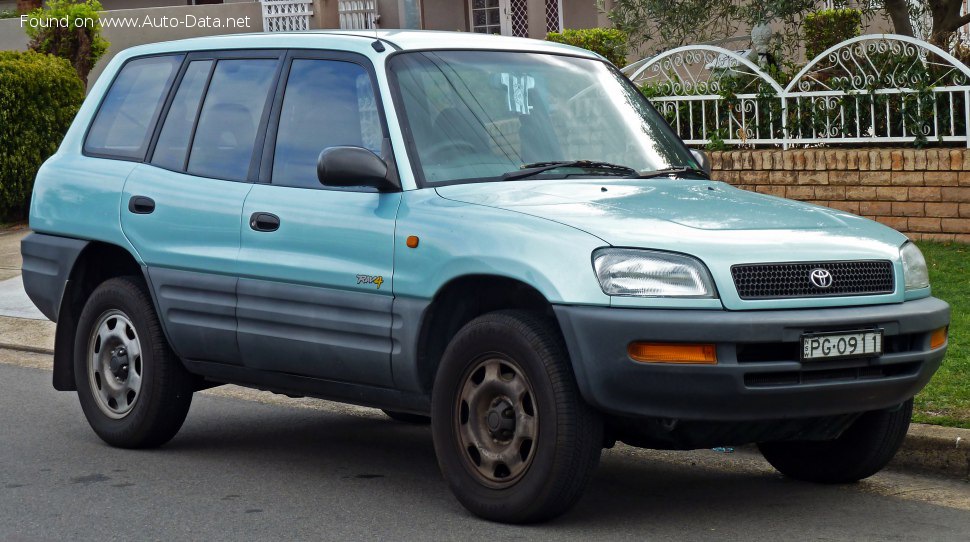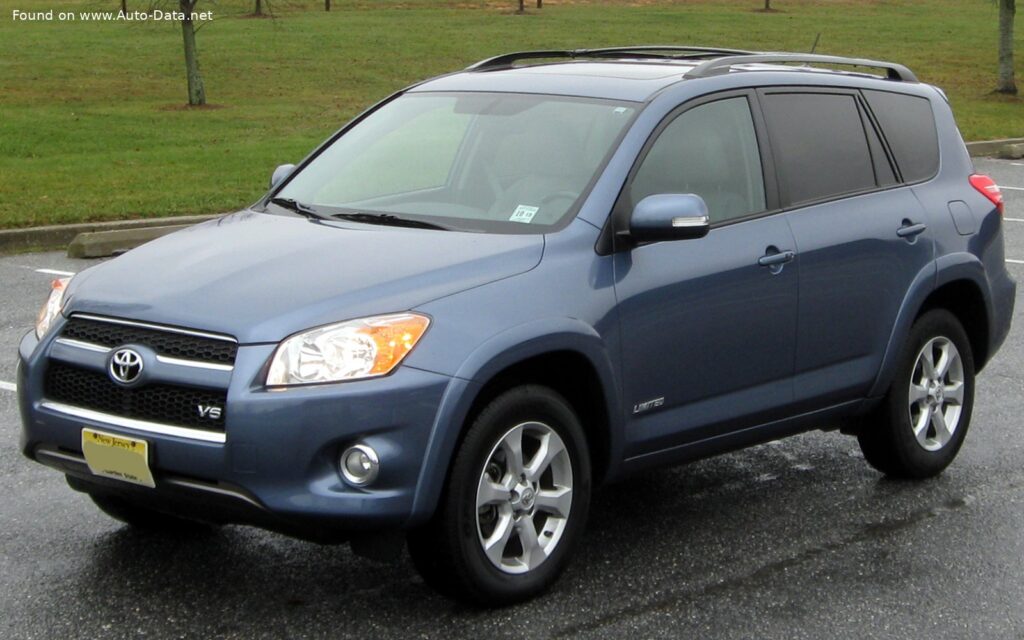
The Toyota RAV4 III (XA30, facelift 2008) Long 3.5 V6 (269 Hp) ECT: A Powerful Contender in the Compact SUV Segment
The Toyota RAV4 III, specifically the XA30 generation that received a facelift in 2008, represented a significant evolution for Toyota’s trailblazing compact SUV. Launched originally in 1994, the RAV4 (Recreational Activity Vehicle: 4-wheel drive) pioneered the crossover SUV segment. The third generation, introduced in 2005, saw the RAV4 grow considerably in size, moving away from its more car-like roots toward a more traditional SUV stance, albeit still built on a unibody platform. The 2008 facelift brought subtle styling updates and, importantly for the North American market, solidified the availability of a potent 3.5-liter V6 engine, transforming its performance profile. This particular variant, the Toyota RAV4 III (XA30, facelift 2008) Long 3.5 V6 (269 Hp) ECT, stood out for its unexpected power and refinement in a segment typically dominated by four-cylinder engines, offering a compelling blend of utility, reliability, and spirited driving dynamics.
Engine and Performance: The Heart of the Toyota RAV4 III (XA30, facelift 2008) Long
Under the hood of this particular Toyota RAV4 III (XA30, facelift 2008) Long variant resided the formidable 2GR-FE engine, a 3.5-liter V6 gasoline unit renowned for its smoothness, reliability, and impressive power output. This naturally aspirated engine delivered a robust 269 horsepower at 6200 rpm, a figure that was exceptionally high for a compact SUV of its era. With a power-per-liter rating of 77.8 Hp/l, it demonstrated Toyota’s engineering prowess in extracting significant performance from a relatively modest displacement.
Torque production was equally impressive, peaking at 333 Nm (245.61 lb.-ft.) at 4700 rpm, providing ample thrust for acceleration, merging onto highways, and confident passing maneuvers. The V6 engine layout, with its six cylinders configured in a ‘V’ shape, contributed to its inherent balance and low vibration. It featured a double overhead camshaft (DOHC) valvetrain with Toyota’s intelligent Variable Valve Timing (VVT-i) system, optimizing valve overlap for improved power delivery across the rev range and enhanced fuel efficiency. The engine boasted a compression ratio of 10.8:1 and utilized a multi-port manifold injection system for precise fuel delivery.
Power was channeled through a 5-speed Electronically Controlled Transmission (ECT), an automatic gearbox designed for smooth and seamless shifts. While some competitors were beginning to adopt 6-speed automatics or continuously variable transmissions (CVTs), Toyota’s 5-speed unit was well-matched to the V6’s power band, providing a responsive and enjoyable driving experience. The powertrain architecture for this specific variant specified front-wheel drive, though all-wheel drive was also available for the V6 RAV4 in other configurations, further enhancing its versatility and traction in various conditions.
Despite its powerful engine, the V6 RAV4 offered respectable, though not class-leading, fuel economy for its performance capabilities. Urban consumption was rated at 12.3 l/100 km (19.1 US mpg), while extra-urban driving saw figures improve to 8.7 l/100 km (27 US mpg). Its weight-to-power ratio of 5.9 kg/Hp (168.1 Hp/tonne) underscored its lively performance, making it one of the quickest compact SUVs on the market at the time.
Design and Features of the XA30 RAV4 Facelift
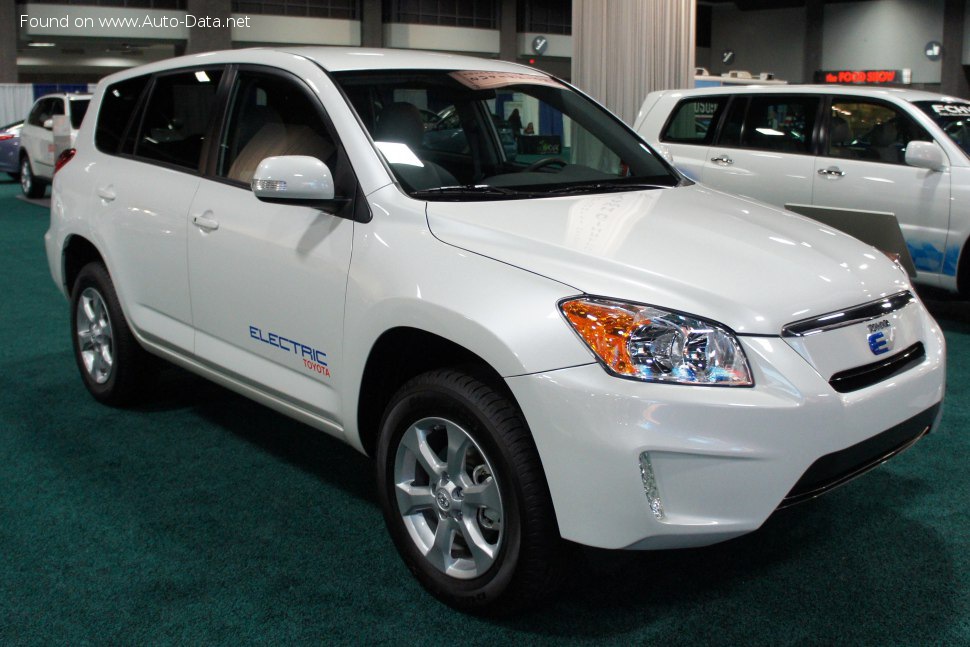
The Toyota RAV4 III (XA30, facelift 2008) Long maintained the core design philosophy of the third generation, presenting a more mature and substantial appearance than its predecessors. As an SUV with 5 doors and seating for 5 occupants (a longer wheelbase version with optional third-row seating was also available in some markets, though not specifically detailed for this “Long” variant), it offered a practical and family-friendly package. The 2008 facelift introduced subtle revisions to the front grille, bumper, and headlights, giving it a slightly fresher and more refined look. The taillights also received minor updates.
Dimensions for this variant were generous for the compact segment: a length of 181.89 inches (4620 mm), a width ranging from 71.5 to 72.99 inches (1816-1854 mm), and a height between 66.3 and 68.7 inches (1684-1745 mm). A wheelbase of 104.72 inches (2660 mm) contributed to a stable ride and a spacious interior. The ground clearance of 7.48 inches (190 mm) provided decent capability for light off-road excursions or navigating rougher terrain.
Inside, the RAV4 offered a well-appointed cabin with a focus on ergonomics and utility. Material quality was typical for Toyota, leaning towards durability and practicality. Key features included power windows, air conditioning, and a competent audio system. Safety was a strong point for the RAV4, equipped with standard features like Anti-lock Braking System (ABS), front and side airbags, and electronic stability control (VSC) in many configurations, reflecting Toyota’s commitment to occupant protection. The trunk space was highly versatile, offering a minimum of 12.29 cu. ft. (348 liters) with all seats in place, expanding to an impressive 73 cu. ft. (2067 liters) with the rear seats folded down, making it highly capable for cargo hauling.
The suspension setup featured an independent McPherson strut system with coil springs and an anti-roll bar at the front, paired with a double wishbone rear suspension. This configuration provided a comfortable ride while maintaining competent handling characteristics. Braking duties were handled by ventilated discs at the front (300 mm) and solid discs at the rear (284 mm), ensuring confident stopping power. Standard tire sizes ranged from 225/65 R17 to 235/55 R18, mounted on 7J x 17 or 7.5J x 18 wheel rims, respectively.
Technical Specifications for the Toyota RAV4 III (XA30, facelift 2008) Long 3.5 V6 (269 Hp) ECT
| Category | Specification |
|---|---|
| General Information | |
| Brand | Toyota |
| Model | RAV4 |
| Generation | RAV4 III (XA30, facelift 2008) Long |
| Type (Engine) | 3.5 V6 (269 Hp) ECT |
| Start of Production | 2008 year |
| End of Production | 2012 year |
| Powertrain Architecture | Internal Combustion Engine |
| Body Type | SUV |
| Seats | 5 |
| Doors | 5 |
| Performance Specs | |
| Fuel Consumption (Urban) | 12.3 l/100 km (19.1 US mpg) |
| Fuel Consumption (Extra Urban) | 8.7 l/100 km (27 US mpg) |
| Fuel Type | Petrol (Gasoline) |
| Weight-to-Power Ratio | 5.9 kg/Hp (168.1 Hp/tonne) |
| Weight-to-Torque Ratio | 4.8 kg/Nm (208.1 Nm/tonne) |
| Engine Specs | |
| Power | 269 Hp @ 6200 rpm |
| Power per Liter | 77.8 Hp/l |
| Torque | 333 Nm @ 4700 rpm (245.61 lb.-ft. @ 4700 rpm) |
| Engine Layout | Front, Transverse |
| Engine Model/Code | 2GR-FE |
| Engine Displacement | 3456 cm3 (210.9 cu. in.) |
| Number of Cylinders | 6 |
| Engine Configuration | V-engine |
| Cylinder Bore | 94 mm (3.7 in.) |
| Piston Stroke | 83 mm (3.27 in.) |
| Compression Ratio | 10.8:1 |
| Number of Valves per Cylinder | 4 |
| Fuel Injection System | Multi-port manifold injection |
| Engine Aspiration | Naturally aspirated engine |
| Valvetrain | DOHC, VVT-i |
| Engine Oil Capacity | 6.1 l (6.45 US qt) |
| Coolant Capacity | 8.9 l (9.4 US qt) |
| Space, Volume and Weights | |
| Kerb Weight | 1600-1615 kg (3527.4 – 3560.47 lbs.) |
| Max. Weight (Gross Vehicle Weight) | 2220 kg (4894.26 lbs.) |
| Max Load | 605-620 kg (1333.8 – 1366.87 lbs.) |
| Trunk (Boot) Space – Minimum | 348 l (12.29 cu. ft.) |
| Trunk (Boot) Space – Maximum | 2067 l (73 cu. ft.) |
| Fuel Tank Capacity | 60 l (15.85 US gal) |
| Permitted Trailer Load without Brakes | 907 kg (1999.59 lbs.) |
| Dimensions | |
| Length | 4620 mm (181.89 in.) |
| Width | 1816-1854 mm (71.5 – 72.99 in.) |
| Height | 1684-1745 mm (66.3 – 68.7 in.) |
| Wheelbase | 2660 mm (104.72 in.) |
| Front Track | 1560 mm (61.42 in.) |
| Rear (Back) Track | 1560 mm (61.42 in.) |
| Ride Height (Ground Clearance) | 190 mm (7.48 in.) |
| Minimum Turning Circle (Turning Diameter) | 10.6-11.2 m (34.78 – 36.75 ft.) |
| Approach Angle | 29° |
| Departure Angle | 25° |
| Drivetrain, Brakes and Suspension Specs | |
| Drivetrain Architecture | Internal combustion engine (ICE) drives the front wheels. |
| Drive Wheel | Front wheel drive |
| Number of Gears and Type of Gearbox | 5 gears, automatic transmission ECT |
| Front Suspension | Independent, type McPherson with coil spring and anti-roll bar |
| Rear Suspension | Double wishbone |
| Front Brakes | Ventilated discs, 300 mm |
| Rear Brakes | Disc, 284 mm |
| Assisting Systems | ABS (Anti-lock Braking System) |
| Steering Type | Steering rack and pinion |
| Tires Size | 225/65 R17; 235/55 R18 |
| Wheel Rims Size | 7J x 17; 7.5J x 18 |
Legacy and Market Impact of the Toyota RAV4 III (XA30, facelift 2008) Long
The third-generation Toyota RAV4, particularly with the inclusion of the powerful 3.5-liter V6 engine, carved out a unique and highly successful niche in the competitive compact SUV market. In the United States, where the RAV4 was a perennial best-seller, the V6 option differentiated it significantly from its primary rivals. While competitors like the Honda CR-V, Ford Escape, Nissan Rogue, and Hyundai Tucson offered competent four-cylinder powertrains, none could match the sheer acceleration and effortless cruising capability of the RAV4 V6. This made the Toyota RAV4 III (XA30, facelift 2008) Long 3.5 V6 (269 Hp) ECT an attractive proposition for buyers who desired the utility and fuel economy of a compact SUV but were unwilling to compromise on performance.
Its impact was substantial: it demonstrated that a compact crossover could deliver performance typically associated with larger, more expensive SUVs, often with better fuel economy than those larger, V8-powered vehicles. The V6 RAV4 effectively bridged the gap between compact and mid-size SUVs, appealing to a broader audience. It was praised for its robust acceleration, smooth power delivery, and Toyota’s hallmark reliability. This combination contributed to its strong resale values and enduring popularity in the used car market.
The RAV4’s reputation for reliability and low ownership costs further solidified its position. The 2GR-FE engine itself gained a reputation as one of Toyota’s most durable and well-engineered powerplants, finding its way into numerous other Toyota and Lexus models. This shared engineering instilled confidence in consumers. While the fuel economy of the V6 was not as stellar as its four-cylinder counterpart, it was deemed acceptable by many given the significant performance boost.
In terms of competition, the RAV4 V6 really had no direct peer in the compact segment offering comparable power. Its closest rivals in performance were often larger, less efficient mid-size SUVs, or premium crossovers that came with a significantly higher price tag. This unique positioning allowed the RAV4 to capture a segment of buyers who might otherwise have considered vehicles like the Nissan Murano or even entry-level luxury SUVs. The XA30 generation, especially post-facelift, remained a strong seller for Toyota until its replacement in 2012, cementing its legacy as a pivotal model in the evolution of the modern compact SUV. Its blend of practicality, reliability, and unexpected performance, particularly in the V6 variant, made it a standout vehicle that continues to be highly regarded.