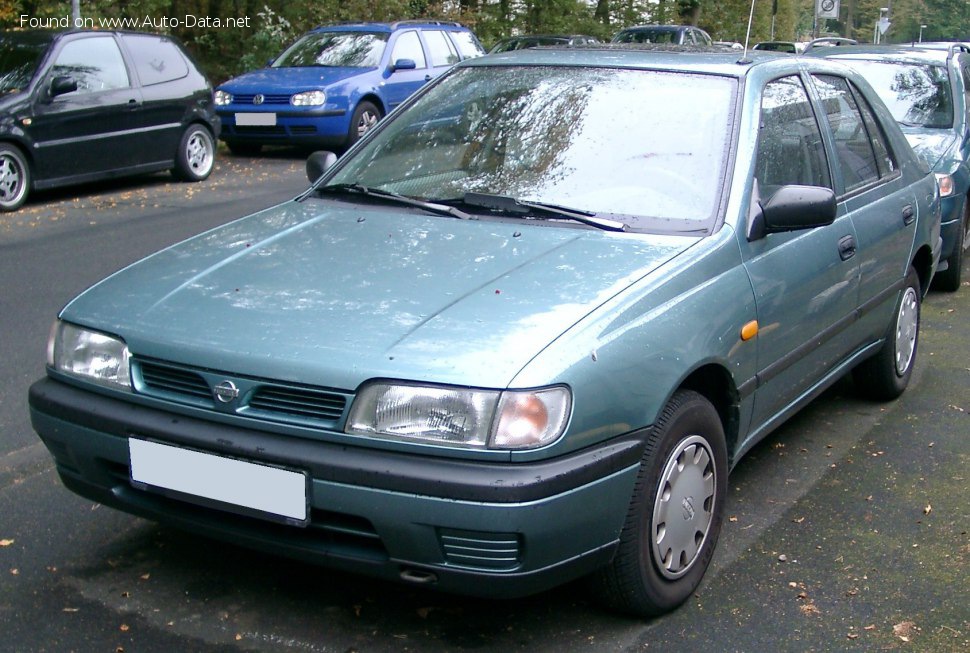
Introduction: The Nissan Sunny III Hatch (N14) 5 doors 1.4 16V (75 Hp)
The Nissan Sunny, a nameplate synonymous with reliable and economical compact transportation for decades, saw its third generation, internally designated N14, launched in 1990. While in the United States, this platform was primarily known as the Nissan Sentra, the Nissan Sunny III Hatch (N14) 5 doors played a pivotal role in European, Asian, and other international markets. This particular variant, equipped with the 1.4-liter 16V engine producing 75 horsepower, represented the pragmatic core of Nissan’s global compact offering during the early 1990s. It was designed to offer practicality, fuel efficiency, and a comfortable ride within a competitive segment, appealing to a broad demographic seeking dependable daily transport. Manufactured from 1990 to 1992, this iteration of the Sunny hatchback embodied the design philosophies and engineering priorities of its era, emphasizing robustness and value.
Engine and Performance: The GA14DS Powertrain in the Nissan Sunny III Hatch (N14)
Powering this specific variant of the Nissan Sunny III Hatch (N14) 5 doors was the GA14DS engine, a naturally aspirated, inline four-cylinder unit with a displacement of 1392 cubic centimeters, or approximately 1.4 liters (84.95 cubic inches). This engine featured a relatively advanced (for its time and segment) 16-valve cylinder head, allowing for improved breathing and efficiency compared to older 8-valve designs. Despite its multi-valve architecture, the GA14DS utilized a carburetor-based fuel injection system, a common setup in the early 1990s before electronic fuel injection became ubiquitous across all market segments.
The engine delivered a modest but entirely adequate 75 horsepower at 6000 revolutions per minute (rpm). Torque output stood at 112 Newton-meters (82.61 lb.-ft.) peaking at 4000 rpm. These figures, while not indicative of a performance car, were well-suited for the Sunny’s role as a commuter and family vehicle. The power-to-weight ratio was 12.4 kilograms per horsepower (80.6 Hp per tonne), reflecting its lightweight construction and focus on economical operation rather than outright speed. Power was sent to the front wheels via a standard 5-speed manual transmission, a setup chosen for its reliability, efficiency, and driver engagement. The front-wheel-drive architecture was typical for compact cars of this period, offering predictable handling and maximizing interior space. The engine’s OHC (Overhead Camshaft) valvetrain design contributed to its smooth operation and straightforward maintenance.
Design and Features of the Nissan Sunny III Hatch (N14) 5 doors
The N14 generation of the Nissan Sunny adopted a more rounded, aerodynamic aesthetic compared to its squarer predecessors, a trend prevalent across the automotive industry in the early 1990s. The 5-door hatchback body style emphasized practicality and versatility, offering easy access to both the passenger compartment and the cargo area. With an overall length of 163.19 inches (4145 mm), a width of 66.54 inches (1690 mm), and a height of 54.92 inches (1395 mm), the Sunny N14 was a true compact, making it agile in urban environments and easy to park. Its wheelbase of 95.67 inches (2430 mm) contributed to a stable ride for its class.
Inside, the Sunny N14 was configured for five occupants, offering a functional and durable interior designed to withstand the rigors of daily use. Cargo capacity was a significant strong point for the hatchback, boasting a minimum trunk space of 15.22 cubic feet (431 liters), which could be expanded to a cavernous 45.56 cubic feet (1290 liters) with the rear seats folded down. This flexibility made it a popular choice for small families and individuals needing ample utility.
Suspension consisted of a wishbone setup at the front and a spring strut system at the rear, a common and effective arrangement for compact cars of the era, balancing ride comfort with handling stability. Braking was handled by ventilated discs at the front, offering better heat dissipation for consistent performance, while the rear utilized drum brakes, a cost-effective and adequate solution for the vehicle’s size and performance. An important safety feature for its time, the Anti-lock Braking System (ABS), was available, enhancing control during emergency braking. Steering was managed by a rack and pinion system, aided by hydraulic power steering, providing a comfortable and responsive driving experience. The vehicle rode on relatively small 155/80 R13 tires, prioritizing fuel economy and a comfortable ride over aggressive handling.
Technical Specifications: Nissan Sunny III Hatch (N14) 5 doors 1.4 16V (75 Hp)
General Information |
|
| Brand | Nissan |
| Model | Sunny |
| Generation | Sunny III Hatch (N14) 5 doors |
| Type (Engine) | 1.4 16V (75 Hp) |
| Start of Production | 1990 year |
| End of Production | 1992 year |
| Powertrain Architecture | Internal Combustion engine |
| Body type | Hatchback |
| Seats | 5 |
| Doors | 5 |
Performance Specs |
|
| Fuel Type | Petrol (Gasoline) |
| Weight-to-power ratio | 12.4 kg/Hp, 80.6 Hp/tonne |
| Weight-to-torque ratio | 8.3 kg/Nm, 120.4 Nm/tonne |
Engine Specs |
|
| Power | 75 Hp @ 6000 rpm. |
| Power per liter | 53.9 Hp/l |
| Torque | 112 Nm (82.61 lb.-ft.) @ 4000 rpm. |
| Engine layout | Front, Transverse |
| Engine Model/Code | GA14DS |
| Engine displacement | 1392 cm3 (84.95 cu. in.) |
| Number of cylinders | 4 |
| Engine configuration | Inline |
| Cylinder Bore | 73.6 mm (2.9 in.) |
| Piston Stroke | 81.8 mm (3.22 in.) |
| Compression ratio | 9.5:1 |
| Number of valves per cylinder | 4 |
| Fuel injection system | Carburettor |
| Engine aspiration | Naturally aspirated engine |
| Valvetrain | OHC |
| Engine oil capacity | 3.2 l (3.38 US qt) |
| Coolant | 5.7 l (6.02 US qt) |
Space, Volume and Weights |
|
| Kerb Weight | 930 kg (2050.3 lbs.) |
| Max. weight | 1475 kg (3251.82 lbs.) |
| Max load | 545 kg (1201.52 lbs.) |
| Trunk (boot) space – minimum | 431 l (15.22 cu. ft.) |
| Trunk (boot) space – maximum | 1290 l (45.56 cu. ft.) |
| Fuel tank capacity | 50 l (13.21 US gal) |
Dimensions |
|
| Length | 4145 mm (163.19 in.) |
| Width | 1690 mm (66.54 in.) |
| Height | 1395 mm (54.92 in.) |
| Wheelbase | 2430 mm (95.67 in.) |
| Front track | 1445 mm (56.89 in.) |
| Rear (Back) track | 1430 mm (56.3 in.) |
Drivetrain, Brakes and Suspension Specs |
|
| Drivetrain Architecture | The Internal combustion engine (ICE) drives the front wheels of the vehicle. |
| Drive wheel | Front wheel drive |
| Number of gears and type of gearbox | 5 gears, manual transmission |
| Front suspension | Wishbone |
| Rear suspension | Spring Strut |
| Front brakes | Ventilated discs |
| Rear brakes | Drum |
| Assisting systems | ABS (Anti-lock braking system) |
| Steering type | Steering rack and pinion |
| Power steering | Hydraulic Steering |
| Tires size | 155/80 R13 |
Legacy and Market Impact
The Nissan Sunny, particularly the N14 generation, cemented Nissan’s reputation as a manufacturer of highly reliable, practical, and economical vehicles in markets outside of North America. While the US market received the Sentra, which shared the N14 platform, the Sunny nameplate carried significant weight in Europe, Asia, and Oceania. This specific 1.4-liter 16V hatchback variant was a cornerstone of Nissan’s sales in these regions, competing fiercely with established rivals such as the Volkswagen Golf, Ford Escort, Honda Civic, and its perennial nemesis, the Toyota Corolla.
Its legacy is one of unwavering dependability and cost-effectiveness. Owners praised the Sunny for its low running costs, straightforward maintenance, and robust mechanicals. The GA14DS engine, despite its modest output, was known for its longevity and fuel efficiency, a crucial factor for buyers in the compact segment. The generous cargo space of the hatchback further enhanced its appeal to families and individuals who needed a versatile vehicle for various tasks.
The Nissan Sunny III Hatch (N14) 5 doors might not have been a trendsetter in terms of design or performance, but its strength lay in its honest, no-frills approach to motoring. It represented an era when Japanese manufacturers were perfecting the art of building reliable, mass-market cars that simply worked, day in and day out. Its widespread availability and enduring popularity in its primary markets highlight its historical significance as a workhorse of the global compact car segment, laying the groundwork for subsequent Nissan models that continued to prioritize practicality and value. Even today, many N14 Sunnys can still be found on the roads in various countries, a testament to their inherent durability and the engineering integrity of Nissan during this period.