
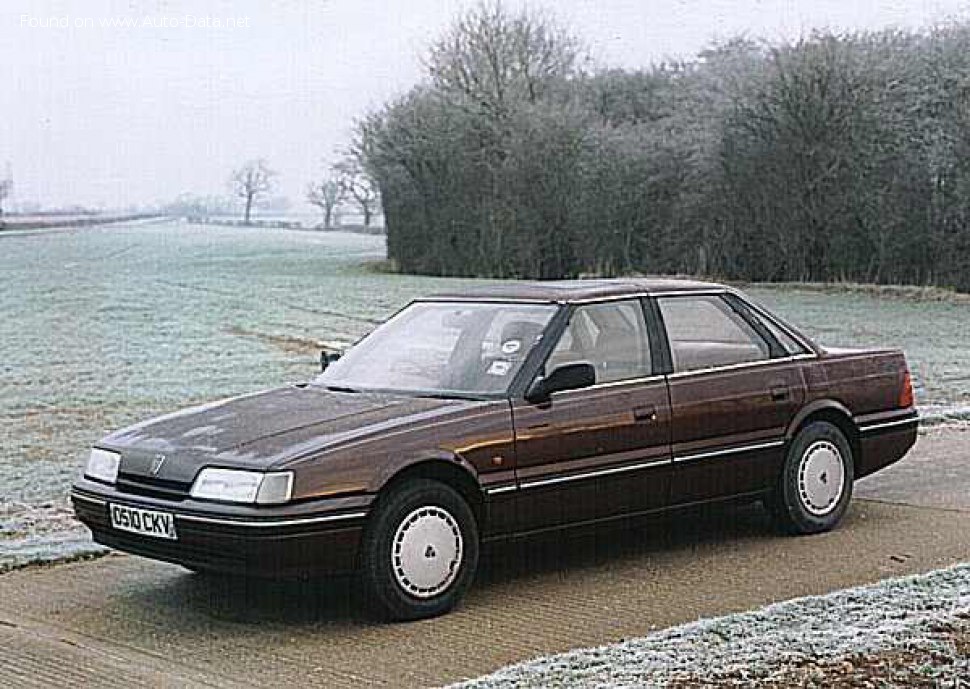
The Rover 800 825 D/SD (XS) (118 Hp): A British Executive Diesel Sedan
The Rover 800 825 D/SD (XS) (118 Hp) represents a significant chapter in the history of the British automotive manufacturer, Rover. Launched in 1990 as part of the executive 800 series, this particular variant was a diesel-powered sedan designed primarily for the European market, where fuel efficiency and robust performance were highly valued in the executive class. The 800 series itself was the product of a strategic alliance between Rover and Honda, initially sharing platforms and components with the Japanese automaker’s Legend model. By 1990, the 800 had evolved, with the 825 D/SD (XS) offering a compelling blend of traditional British luxury aspirations and the pragmatic advantages of a modern diesel powertrain. It sought to compete in a fiercely contested segment dominated by German and Swedish rivals, offering a distinctive British alternative with a focus on comfort and long-distance cruising capability.
The Rover 800 series, often categorized as the “R17” facelift version from 1991 onwards (though the 1990 model year falls into the transition or late ‘XX’ series), aimed to refine the original design and address market feedback. This diesel iteration, produced until 1999, was particularly crucial for fleet buyers and discerning individuals in Europe who prioritized running costs without compromising on the perceived status of an executive sedan. Its durable engine, spacious interior, and refined ride quality made it a noteworthy contender in its segment, even if its market presence in the United States was non-existent, given Rover’s limited direct presence in the North American market at that time.
Engine and Performance of the Rover 800 825 D/SD (XS) (118 Hp)
At the heart of the Rover 800 825 D/SD (XS) (118 Hp) was a robust and efficient diesel engine, a critical component for its success in the European market. This particular powertrain featured a 2.5-liter (2500 cm³) inline four-cylinder engine, designated with the model code 4924 SHI RG. Positioned transversely at the front of the vehicle, the engine was equipped with a turbocharger, a key element in delivering both power and torque that belied its relatively modest displacement for an executive car.
The engine produced 118 horsepower at a conservative 4200 rpm, which was a respectable output for a diesel engine of its era. More importantly for real-world driving, it generated a substantial 197.67 lb.-ft. of torque, peaking at a low 2100 rpm. This ample low-end torque was instrumental in providing strong acceleration from a standstill and effortless cruising, characteristics highly valued in a vehicle of this class. The power density was rated at 47.2 HP per liter, indicating a well-engineered and efficient unit.
Fuel delivery was managed by a precombustion chamber injection system, a common and reliable technology for diesel engines in the 1990s, known for its smoother operation compared to direct injection systems of the time, albeit slightly less efficient than later common-rail designs. The engine featured a high compression ratio of 22.1:1, typical for a diesel, and utilized two valves per cylinder, optimizing the balance between performance and fuel economy. With an engine oil capacity of 6.4 US quarts and a coolant capacity of 8.45 US quarts, the engine was designed for durability and ease of maintenance.
Performance figures for the 825 D/SD (XS) were competitive for a diesel sedan of its time. It could accelerate from 0 to 60 mph in a calculated 10.6 seconds, making it capable of merging onto highways and overtaking with confidence. The maximum speed was rated at 118.06 mph (190 km/h), more than sufficient for European autobahns and motorways. Crucially, its fuel economy was a major selling point, achieving an impressive combined figure of 36.8 US mpg (6.4 liters per 100 km). This efficiency, combined with a generous 17.96 US gallon fuel tank, provided a significant cruising range, ideal for long-distance travel. Power was sent to the front wheels via a smooth-shifting 5-speed manual transmission, offering direct driver engagement and contributing to the overall fuel efficiency.
Design and Features
The Rover 800 825 D/SD (XS) (118 Hp) maintained the dignified and somewhat conservative styling that characterized the 800 series. As a four-door sedan with seating for five, it exuded an air of understated elegance, typical of European executive cars of its era. The design featured clean lines and a commanding presence, reflecting Rover’s aspiration to offer a premium product. Its dimensions were substantial, with an overall length of 192.2 inches, a width of 68.11 inches, and a height of 54.84 inches. A generous wheelbase of 108.9 inches contributed significantly to both the car’s stable ride and its spacious interior.
Inside, the 800 series was known for its comfortable cabin, often trimmed with quality materials that reflected its executive positioning. While specific trim levels varied, the “XS” designation typically implied a higher level of standard equipment and interior refinement. Passengers benefited from ample legroom and headroom, making long journeys more comfortable. The trunk space was practical, offering 15.72 cubic feet (445 liters) of cargo capacity, sufficient for luggage and daily errands.
From a chassis perspective, the Rover 800 825 D/SD (XS) was engineered for a refined driving experience. It featured a double wishbone front suspension, a sophisticated setup that provided precise handling and excellent ride comfort by allowing independent control over wheel movement. The rear suspension employed a coil spring setup, further contributing to the car’s composed demeanor over varied road surfaces. Stopping power was provided by disc brakes on both the front and rear wheels, augmented by an Anti-lock Braking System (ABS) as standard. ABS was a significant safety feature for the time, helping drivers maintain steering control during emergency braking.
Steering was managed by a hydraulic rack and pinion system, offering tactile feedback and ease of maneuverability, particularly at lower speeds, thanks to its power assistance. The vehicle rode on 195/65 R15 V-rated tires, providing a good balance of grip, comfort, and durability. With a kerb weight of 3009.31 pounds (1365 kg) and a maximum permissible weight of 4210.83 pounds (1910 kg), the 800 was a substantial vehicle, designed to offer a solid and secure feel on the road.
Technical Specifications
| Category | Specification | Value |
|---|---|---|
| Brand | Rover | |
| Model | 800 | |
| Generation | 800 | |
| Type (Engine) | 825 D/SD (XS) (118 Hp) | |
| Production Start | 1990 year | |
| Production End | 1999 year | |
| Powertrain Architecture | Internal Combustion engine | |
| Body Type | Sedan | |
| Seats | 5 | |
| Doors | 4 | |
| Performance Specs | ||
| Fuel Consumption (Combined) | 36.8 US mpg (6.4 l/100 km) | |
| Fuel Type | Diesel | |
| Acceleration 0-60 mph | 10.6 sec | |
| Maximum Speed | 118.06 mph (190 km/h) | |
| Weight-to-Power Ratio | 11.6 kg/Hp | |
| Weight-to-Torque Ratio | 5.1 kg/Nm | |
| Engine Specs | ||
| Power | 118 Hp @ 4200 rpm | |
| Power per liter | 47.2 Hp/l | |
| Torque | 197.67 lb.-ft. @ 2100 rpm (268 Nm) | |
| Engine Layout | Front, Transverse | |
| Engine Model/Code | 4924 SHI RG | |
| Engine Displacement | 2.5 Liters (152.56 cu. in.) | |
| Number of Cylinders | 4 | |
| Engine Configuration | Inline | |
| Cylinder Bore | 3.62 in. (92 mm) | |
| Piston Stroke | 3.7 in. (94 mm) | |
| Compression Ratio | 22.1:1 | |
| Number of Valves per Cylinder | 2 | |
| Fuel Injection System | Precombustion chamber injection | |
| Engine Aspiration | Turbocharger | |
| Engine Oil Capacity | 6.76 US qt (6.4 l) | |
| Coolant Capacity | 8.45 US qt (8 l) | |
| Space, Volume, and Weights | ||
| Kerb Weight | 3009.31 lbs. (1365 kg) | |
| Max. Weight (Gross) | 4210.83 lbs. (1910 kg) | |
| Max Load | 1201.52 lbs. (545 kg) | |
| Trunk (Boot) Space – Minimum | 15.72 cu. ft. (445 l) | |
| Fuel Tank Capacity | 17.96 US gal (68 l) | |
| Dimensions | ||
| Length | 192.2 in. (4882 mm) | |
| Width | 68.11 in. (1730 mm) | |
| Height | 54.84 in. (1393 mm) | |
| Wheelbase | 108.9 in. (2766 mm) | |
| Front Track | 58.54 in. (1487 mm) | |
| Rear (Back) Track | 57.09 in. (1450 mm) | |
| Drivetrain, Brakes, and Suspension Specs | ||
| Drivetrain Architecture | The Internal combustion engine (ICE) drives the front wheels of the vehicle. | |
| Drive Wheel | Front wheel drive | |
| Number of Gears and Type of Gearbox | 5 gears, manual transmission | |
| Front Suspension | Double wishbone | |
| Rear Suspension | Coil spring | |
| Front Brakes | Disc | |
| Rear Brakes | Disc | |
| Assisting Systems | ABS (Anti-lock braking system) | |
| Steering Type | Steering rack and pinion | |
| Power Steering | Hydraulic Steering | |
| Tires Size | 195/65 R15 V | |
Legacy and Market Impact
The Rover 800 825 D/SD (XS) (118 Hp) carved out a niche for itself in the European executive car market, particularly among buyers who appreciated its blend of traditional British styling and modern diesel efficiency. While the Rover 800 series as a whole struggled to fully challenge the dominance of German marques like BMW and Mercedes-Benz, it offered a distinctive alternative, often praised for its ride comfort and more understated luxury. The diesel variants, in particular, were vital for Rover’s sales in countries where fuel prices and company car tax structures heavily favored diesel powertrains.
In its primary European markets, the Rover 800 825 D/SD (XS) competed against a formidable array of rivals. These included the BMW 5-Series (E34), Mercedes-Benz E-Class (W124), Audi 100/A6 (C4), Saab 9000, and Volvo 850. While its handling dynamics might not have matched the sportiness of a BMW, and its ultimate build quality might not have reached the legendary standards of a Mercedes, the Rover offered a compelling package of features, comfort, and, with this diesel engine, exceptional fuel economy for its class. Its competitive advantage often lay in its pricing and its unique British character, which appealed to a specific segment of buyers.
The historical significance of the Rover 800 series, and this diesel variant, lies in its representation of Rover’s efforts to remain a viable player in the executive segment during a period of intense change for the British automotive industry. It was a product of a complex era, born from the collaboration with Honda, which provided a solid engineering foundation, but later evolving with more distinct Rover characteristics. The 825 D/SD (XS) showcased Rover’s commitment to adapting to market demands, specifically the growing need for fuel-efficient executive transportation in Europe.
Despite its merits, the Rover 800 series, including its diesel iterations, eventually faced an uphill battle against ever-improving competition and the broader struggles of the Rover brand. The production run from 1990 to 1999 saw the model through various updates, but ultimately, the 800 was phased out, marking the end of Rover’s direct presence in the large executive sedan segment. Today, the Rover 800 825 D/SD (XS) is remembered as a comfortable, efficient, and distinctly British executive car that offered a compelling, if often overlooked, alternative to its more prominent European rivals, showcasing the engineering capabilities and luxury aspirations of Rover in the late 20th century. It stands as a testament to a particular moment in automotive history when British engineering still aimed for the highest echelons of the mainstream market.
