Toyota Harrier IV (XU80): An Overview of Toyota’s Premium Crossover
The Toyota Harrier IV (XU80) represents the fourth generation of Toyota’s revered mid-size luxury crossover SUV. Launched in June 2020, this iteration continues the Harrier’s legacy of blending sophisticated design, a comfortable ride, and practical utility. While the Harrier nameplate is primarily recognized in its home market of Japan and select Asian regions, its platform and core characteristics are closely shared with the Toyota Venza in North America and China, effectively serving as Toyota’s premium, non-Lexus crossover offering. The XU80 generation builds upon a heritage of pioneering the luxury SUV segment, delivering an experience that often blurs the lines between mainstream Toyota and its upscale Lexus division.
Positioned as a stylish and refined alternative to more rugged SUVs, the Harrier IV (XU80) targets consumers seeking a vehicle that excels in urban environments and offers serene highway cruising. With its sleek, coupe-like silhouette, advanced powertrain options, and an emphasis on interior comfort and technology, the XU80 aims to provide a premium ownership experience without the full premium price tag. This particular variant, the 2.0 (171 Hp) 4WD CVT, showcases a balanced approach to performance and efficiency, making it a compelling choice in its competitive segment.
Powertrain and Performance of the Toyota Harrier IV (XU80)
Engine Dynamics
At the heart of the Toyota Harrier IV (XU80) 2.0 (171 Hp) 4WD CVT lies Toyota’s M20A-FKS engine, a naturally aspirated 2.0-liter (1986 cm3 or 121.19 cubic inches) inline-four gasoline unit. This engine is a testament to Toyota’s engineering prowess, delivering a respectable 171 horsepower at 6600 rpm. Its power per liter rating of 86.1 HP/l highlights its efficient design. Torque output stands at 207 Nm (152.68 lb.-ft.) available at 4800 rpm, providing ample thrust for daily driving and highway maneuvers.
The M20A-FKS engine incorporates a sophisticated fuel injection system, combining both direct injection and multi-port manifold injection. This dual-injection strategy optimizes fuel atomization and combustion efficiency across various engine speeds and loads, contributing to both performance and fuel economy. As a naturally aspirated engine, it offers smooth, linear power delivery, a characteristic often favored for its predictability and responsiveness compared to forced induction systems. Furthermore, modern environmental considerations are addressed with the inclusion of a Start & Stop System, which conserves fuel during idling, and a particulate filter, reducing harmful emissions.
Drivetrain and Efficiency
Power is channeled through a Continuously Variable Transmission (CVT), an automatic gearbox designed for seamless acceleration and optimal fuel efficiency. The CVT continuously adjusts gear ratios to keep the engine in its most efficient operating range, resulting in a remarkably smooth and quiet ride, devoid of the noticeable shift points of traditional automatic transmissions. This contributes significantly to the Harrier’s refined character.
The 4WD (All-Wheel Drive) system employed in this Harrier variant is an intelligent on-demand setup. The internal combustion engine primarily drives the front wheels, ensuring efficient operation under normal conditions. However, when traction demands increase, such as on slippery surfaces or during spirited driving, the rear wheels are engaged through an electrically or mechanically operated clutch. This system provides enhanced stability and grip without the constant parasitic losses associated with full-time AWD.
Fuel economy figures for the 2.0-liter 4WD model are commendable, especially for an AWD SUV of its size. The urban consumption is rated at 9.1 l/100 km, translating to an estimated 25.8 US mpg. On the extra-urban cycle, efficiency improves significantly to 5.8 l/100 km, or approximately 40.6 US mpg. These figures underscore the powertrain’s balance of performance and environmental consciousness. The vehicle’s weight-to-power ratio stands at 9.3 kg/Hp (107.5 Hp/tonne), while the weight-to-torque ratio is 7.7 kg/Nm (130.2 Nm/tonne), indicating a well-matched powertrain for its kerb weight range of 3505.35 to 3659.67 lbs.
Design, Comfort, and Technology
Exterior and Interior Design
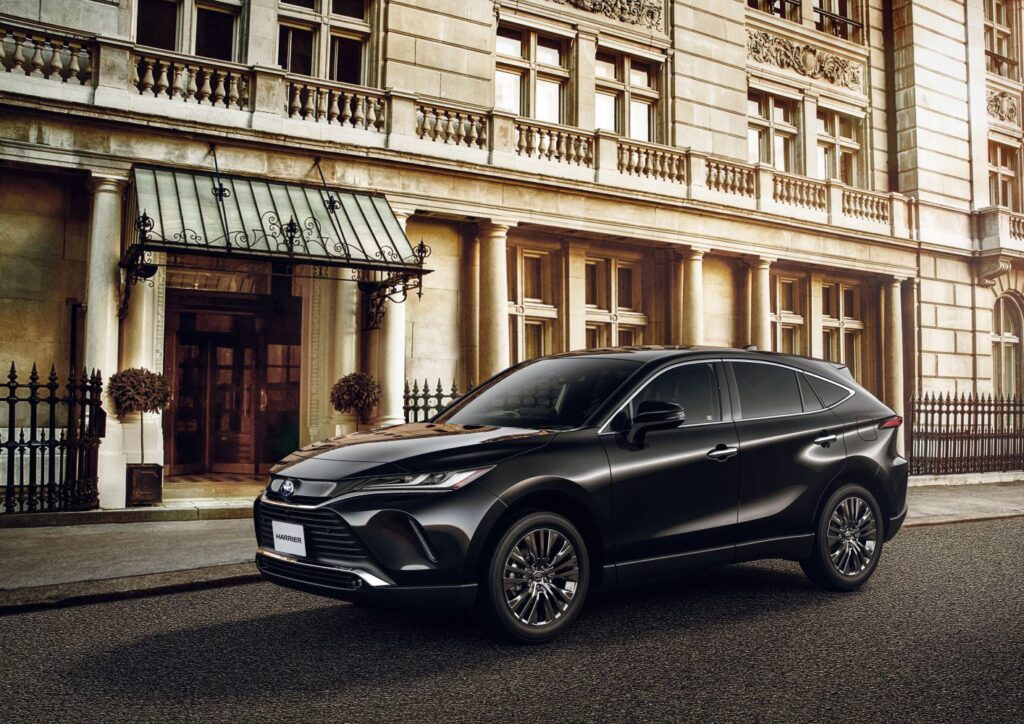
The Toyota Harrier IV (XU80) sets itself apart with a distinctive and elegant design language. Classified as an SUV, its body type features five doors and accommodates five occupants. The exterior boasts a sleek, coupe-like profile, characterized by flowing lines, a sloping roofline, and a sophisticated front fascia. Its dimensions—186.61 inches in length, 73.03 inches in width, and 65.35 inches in height—give it a commanding yet graceful presence on the road. The 105.91-inch wheelbase contributes to a spacious cabin and stable ride. The 19-inch wheels, shod with 225/55 R19 tires, perfectly complement its upscale aesthetic.
Inside, the Harrier IV (XU80) continues its premium theme. While specific interior features are not detailed in the provided data, a modern Toyota SUV of this caliber typically offers a meticulously crafted cabin with high-quality materials, ergonomic controls, and advanced infotainment systems. The five-seat configuration ensures ample space and comfort for all passengers, making it suitable for families and individuals alike. The focus is on creating a serene and luxurious environment, often featuring soft-touch surfaces, ambient lighting, and supportive seating.
Chassis and Safety Features
The XU80’s ride and handling are engineered for comfort and refinement. It utilizes an independent McPherson strut suspension at the front, known for its ability to provide a good balance of ride comfort and handling precision. At the rear, a double wishbone suspension setup further enhances ride quality and stability, particularly when navigating uneven surfaces or taking corners. This sophisticated suspension tuning contributes significantly to the Harrier’s reputation for a smooth and quiet cabin experience.
Braking performance is assured by ventilated discs at the front and solid discs at the rear, complemented by an Anti-lock Braking System (ABS) for enhanced control during emergency stops. The steering system is a rack and pinion type, offering precise and responsive feedback to the driver. While only ABS is explicitly listed, as a modern vehicle launched in 2020, the Harrier IV (XU80) would undoubtedly incorporate a comprehensive suite of advanced safety features and driver-assistance systems, including multiple airbags, stability control, traction control, and potentially advanced driver-assistance systems (ADAS) like adaptive cruise control, lane-keeping assist, and pre-collision systems, aligning with Toyota’s commitment to safety.
Technical Specifications
| Category | Specification |
|---|---|
| General Information | |
| Brand | Toyota |
| Model | Harrier |
| Generation | Harrier IV (XU80) |
| Type (Engine) | 2.0 (171 Hp) 4WD CVT |
| Start of Production | June, 2020 year |
| Powertrain Architecture | Internal Combustion engine |
| Body Type | SUV |
| Seats | 5 |
| Doors | 5 |
| Performance Specs | |
| Fuel Consumption (Urban) | 25.8 US mpg (9.1 l/100 km) |
| Fuel Consumption (Extra Urban) | 40.6 US mpg (5.8 l/100 km) |
| Fuel Type | Petrol (Gasoline) |
| Weight-to-Power Ratio | 9.3 kg/Hp, 107.5 Hp/tonne |
| Weight-to-Torque Ratio | 7.7 kg/Nm, 130.2 Nm/tonne |
| Engine Specs | |
| Power | 171 Hp @ 6600 rpm. |
| Power per Liter | 86.1 Hp/l |
| Torque | 207 Nm @ 4800 rpm (152.68 lb.-ft. @ 4800 rpm) |
| Engine Model/Code | M20A-FKS |
| Engine Displacement | 1986 cm3 (121.19 cu. in.) |
| Number of Cylinders | 4 |
| Engine Configuration | Inline |
| Cylinder Bore | 80.5 mm (3.17 in.) |
| Piston Stroke | 97.6 mm (3.84 in.) |
| Fuel Injection System | Direct injection and Multi-port manifold injection |
| Engine Aspiration | Naturally aspirated engine |
| Engine Oil Capacity | 4.3 l (4.54 US qt) |
| Coolant Capacity | 6.9 l (7.29 US qt) |
| Engine Systems | |
| Start & Stop System | Yes |
| Particulate Filter | Yes |
| Space, Volume and Weights | |
| Kerb Weight | 1590-1660 kg (3505.35 – 3659.67 lbs.) |
| Max. Weight | 1935 kg (4265.94 lbs.) |
| Max Load | 275-345 kg (606.27 – 760.59 lbs.) |
| Fuel Tank Capacity | 55 l (14.53 US gal) |
| Dimensions | |
| Length | 4740 mm (186.61 in.) |
| Width | 1855 mm (73.03 in.) |
| Height | 1660 mm (65.35 in.) |
| Wheelbase | 2690 mm (105.91 in.) |
| Front Track | 1605 mm (63.19 in.) |
| Rear (Back) Track | 1625 mm (63.98 in.) |
| Ride Height (Ground Clearance) | 195 mm (7.68 in.) |
| Minimum Turning Circle | 11-11.4 m (36.09 – 37.4 ft.) |
| Drivetrain, Brakes and Suspension Specs | |
| Drivetrain Architecture | ICE drives front wheels permanently, rear wheels driven through clutch if necessary. |
| Drive Wheel | All-wheel drive (4×4) |
| Number of Gears and Type of Gearbox | Automatic transmission CVT |
| Front Suspension | Independent type McPherson |
| Rear Suspension | Double wishbone |
| Front Brakes | Ventilated discs |
| Rear Brakes | Disc |
| Assisting Systems | ABS (Anti-lock braking system) |
| Steering Type | Steering rack and pinion |
| Tires Size | 225/55 R19 |
| Wheel Rims Size | 19 inches |
Legacy and Market Impact
The Toyota Harrier has carved out a unique niche in the automotive landscape, particularly in Asian markets, long before the proliferation of luxury crossovers. Its inception in the late 1990s as a premium, car-based SUV, effectively predated and influenced the global success of its Lexus RX counterpart. The Toyota Harrier IV (XU80) continues this tradition, maintaining a reputation for exceptional reliability, a remarkably quiet and comfortable cabin, and a refined driving experience that rivals many more expensive luxury vehicles. It is often perceived as a compelling value proposition, offering near-Lexus levels of sophistication and build quality at a more accessible price point in its primary markets.
In Japan and other Asian countries, the Harrier competes fiercely with a range of popular crossovers and SUVs. Its direct rivals include vehicles like the Honda CR-V, Mazda CX-5, Nissan X-Trail (known as Rogue in North America), and Subaru Forester, all of which offer strong competition in terms of features and practicality. However, the Harrier distinguishes itself with a more upscale ambiance and a design that leans heavily into luxury rather than rugged utility. It appeals to buyers who prioritize style, comfort, and a premium feel without necessarily needing the rugged off-road capability of traditional SUVs.
A significant aspect of the XU80 generation’s market impact is its role in Toyota’s global strategy. For the North American market, this iteration of the Harrier was rebadged and introduced as the Toyota Venza, marking the return of that nameplate to the U.S. lineup. This strategic move allowed Toyota to offer a sophisticated, hybrid-only (in the U.S.) crossover that sits above the RAV4 in terms of luxury and styling, without directly competing with Lexus. This demonstrates the Harrier’s inherent premium qualities and its adaptability to different market demands, showcasing Toyota’s ability to leverage its platforms across various regions.
The Harrier’s historical significance lies in its pioneering role as a “luxury SUV” that emphasized on-road refinement and passenger comfort over traditional truck-like attributes. The XU80 generation upholds this legacy, solidifying its position as a benchmark for stylish, comfortable, and efficient crossovers. Its consistent evolution, incorporating modern technology, advanced safety features, and increasingly efficient powertrains like the 2.0-liter 4WD CVT, ensures its continued relevance and appeal. The Toyota Harrier IV (XU80) stands as a testament to Toyota’s mastery in creating vehicles that resonate with a wide audience seeking a blend of practicality, prestige, and peace of mind.