Introduction to the Suzuki Jimny IV (5-door)
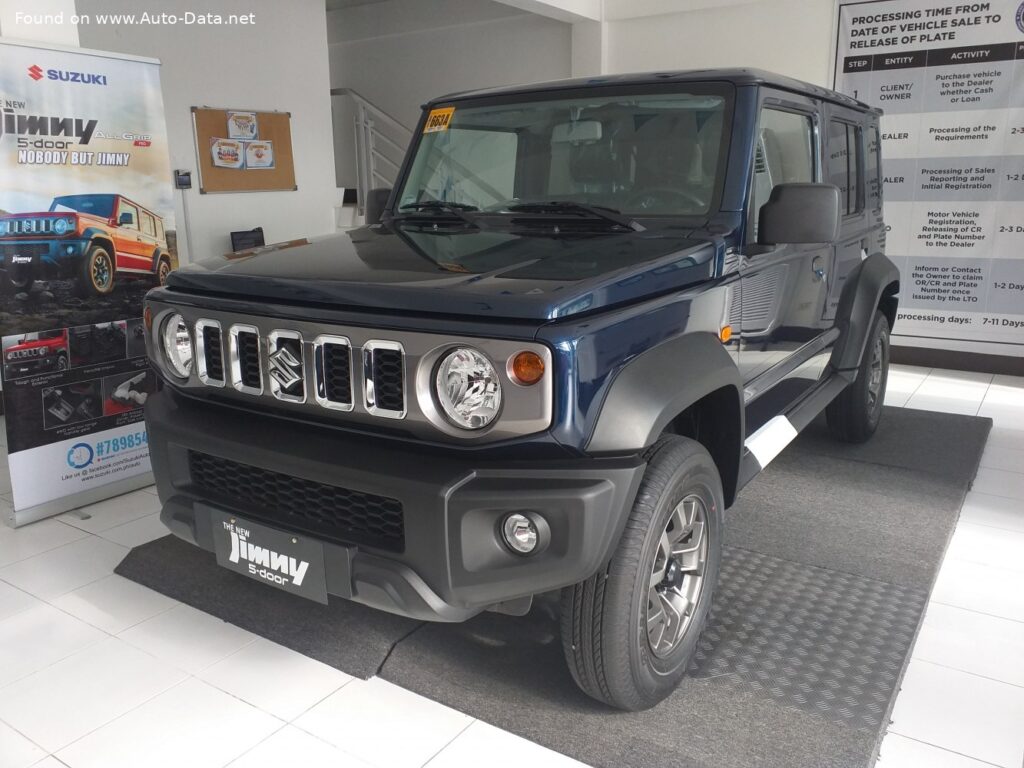
The Suzuki Jimny IV (5-door) 1.5 (102 Hp) ALLGRIP PRO Automatic represents the latest evolution of a venerable and globally revered off-road vehicle lineage. Introduced in 2023, this five-door variant builds upon the immense success and cult following of the fourth-generation Jimny (JB74/JB64), offering enhanced practicality without compromising its legendary ruggedness and off-road prowess. While the Jimny nameplate has a rich history, including its spiritual predecessor, the Suzuki Samurai, which saw sales in the United States, the modern Jimny IV is primarily targeted at markets outside North America, such as India, Australia, and parts of Southeast Asia, as well as select European regions where it often serves as a light commercial vehicle due to stringent emissions regulations for passenger cars.
This iteration of the Jimny retains the iconic, retro-inspired styling and body-on-frame construction that define its character, but stretches the wheelbase and adds two rear doors, transforming it into a more versatile proposition. It aims to broaden its appeal to families or those requiring more cargo and passenger space, while still delivering the uncompromised off-road capability that has made the Jimny a legend among enthusiasts. The focus remains on mechanical simplicity, durability, and extreme maneuverability, making it a distinctive player in a market increasingly dominated by car-based crossovers.
Engineering and Performance of the Suzuki Jimny IV (5-door)
Powertrain and Off-Road Capability of the Suzuki Jimny IV (5-door)
At the heart of the Suzuki Jimny IV (5-door) lies the robust K15B engine, a naturally aspirated 1.5-liter inline-four gasoline (petrol) unit. This engine is engineered for reliability and tractable power delivery, crucial for navigating challenging off-road terrains. It produces a modest but effective 102 horsepower at 6000 rpm and 95.88 lb.-ft. of torque at 4000 rpm. While these figures might seem conservative by modern passenger car standards, they are strategically tuned to provide ample low-end torque for crawling over obstacles and ascending steep grades. The engine features a Double Overhead Camshaft (DOHC) design with Variable Valve Timing (VVT), optimizing efficiency and responsiveness across the rev range. Its multi-port manifold injection system ensures precise fuel delivery, contributing to the engine’s consistent performance.
Power is channeled through a traditional 4-speed automatic transmission, a choice that underscores the Jimny’s focus on durability and ease of use in arduous conditions. This transmission, while not boasting a high number of gears, is well-matched to the engine’s torque curve and provides smooth shifts, simplifying driving both on and off the pavement. The drivetrain architecture is Suzuki’s renowned ALLGRIP PRO system, a part-time four-wheel-drive (4×4) setup. This system primarily drives the rear wheels, with the front wheels engaging via an electrically or mechanically operated clutch when needed. Crucially, it incorporates a low-range transfer case, providing significant torque multiplication for severe off-road situations, such as steep climbs or navigating deep mud.
Driving Dynamics and Fuel Economy
The Jimny’s off-road prowess is further bolstered by its fundamental mechanical design. It utilizes a rigid axle suspension with coil springs at both the front and rear, complemented by a transverse stabilizer at the front and trailing arms. This robust suspension setup, combined with a ladder frame chassis, provides exceptional wheel articulation and durability, allowing the Jimny to maintain traction over uneven surfaces. The steering system is a cone worm with recirculating balls, assisted by electric power steering, offering a balance of feedback and ease of maneuverability, particularly important for precise control in tight off-road scenarios.
Despite its off-road focus, the Suzuki Jimny IV (5-door) offers reasonable fuel economy for its class, especially considering its all-terrain capabilities. According to WLTP standards, combined fuel consumption is rated at 7.7 liters per 100 kilometers, which translates to approximately 30.5 US miles per gallon. Urban consumption (WLTC) is 8.6 liters per 100 kilometers (27.4 US mpg), while extra-urban (WLTC) improves to 7.0 liters per 100 kilometers (33.6 US mpg). CO2 emissions are 179 g/km (WLTP), reflecting its internal combustion engine architecture. The vehicle’s curb weight ranges from 2623.5 to 2678.62 pounds, giving it a weight-to-power ratio of 11.7 kg/Hp, or 85.7 Hp per tonne, underscoring its lightweight and nimble character.
Design and Features of the Suzuki Jimny IV (5-door)
Exterior and Interior Aesthetics
The design of the Suzuki Jimny IV (5-door) is an unmistakable nod to its heritage, embracing a retro-futuristic aesthetic that blends classic utilitarianism with modern touches. Its iconic boxy silhouette, flat hood, and vertical grille slots are instantly recognizable, evoking the spirit of classic off-roaders. The round headlights and separate turn signals further enhance its nostalgic appeal. Despite its rugged appearance, the Jimny’s compact dimensions are key to its agility: it measures 156.1 inches in length, 64.76 inches in width, and 67.91 inches in height. The wheelbase has been stretched to 101.97 inches for the 5-door model, significantly improving rear passenger legroom and cargo capacity compared to its three-door sibling.
Crucially for off-road performance, the Jimny boasts an impressive ground clearance of 8.27 inches, coupled with outstanding approach (36°), departure (47°), and ramp-over (24°) angles. These figures are typically found on much larger and more expensive dedicated off-road vehicles, making the Jimny exceptionally capable in challenging terrain. The robust construction is evident in every detail, from its durable body panels to the 195/80 R15 tires mounted on 5.5J x 15 wheel rims, designed for optimal traction and puncture resistance.
Practicality and Technology
Inside, the Suzuki Jimny IV (5-door) prioritizes functionality and durability. The cabin is designed to be straightforward and easy to clean, catering to its adventurous audience. Hard-wearing plastics and robust upholstery are chosen to withstand the rigors of off-road excursions. The addition of two extra doors dramatically enhances accessibility to the rear seats, making it a genuine four-seater vehicle. The trunk (boot) space is also significantly improved, offering a minimum of 7.45 cubic feet (211 liters) with all seats in place, expanding to a maximum of 11.72 cubic feet (332 liters) when the rear seats are folded. This makes the 5-door Jimny a much more practical option for daily use, family trips, or carrying camping gear.
While the Jimny doesn’t overwhelm with cutting-edge infotainment, it includes essential modern conveniences. Safety features include an Anti-lock Braking System (ABS) to ensure controlled stops, particularly on loose surfaces. The front brakes are ventilated discs for effective stopping power, while the rear utilizes durable drum brakes, a common and reliable choice for utility vehicles. The engine also incorporates a Start & Stop System, contributing to slight improvements in fuel efficiency, especially in urban driving conditions. Its 10.57 US gallon fuel tank provides a decent range for its size, further enhancing its utility for extended adventures.
Technical Specifications
| Category | Specification |
|---|---|
| General Information | |
| Brand | Suzuki |
| Model | Jimny |
| Generation | Jimny IV (5-door) |
| Type (Engine) | 1.5 (102 Hp) ALLGRIP PRO Automatic |
| Start of Production | 2023 year |
| Powertrain Architecture | Internal Combustion engine |
| Body Type | Off-road vehicle |
| Seats | 4 |
| Doors | 5 |
| Performance Specs | |
| Combined Fuel Consumption (WLTP) | 7.7 l/100 km (30.5 US mpg) |
| CO2 Emissions (WLTP) | 179 g/km |
| Fuel Consumption (Economy) – Urban (WLTC) | 8.6 l/100 km (27.4 US mpg) |
| Fuel Consumption (Economy) – Extra Urban (WLTC) | 7.0 l/100 km (33.6 US mpg) |
| Fuel Consumption (Economy) – Combined (WLTC) | 7.4 l/100 km (31.8 US mpg) |
| CO2 Emissions (WLTC) | 171 g/km |
| Fuel Type | Petrol (Gasoline) |
| Weight-to-Power Ratio | 11.7 kg/Hp (85.7 Hp/tonne) |
| Weight-to-Torque Ratio | 9.2 kg/Nm (109.2 Nm/tonne) |
| Engine Specs | |
| Power | 102 Hp @ 6000 rpm |
| Power per Liter | 69.8 Hp/l |
| Torque | 130 Nm @ 4000 rpm (95.88 lb.-ft. @ 4000 rpm) |
| Engine Layout | Front, Longitudinal |
| Engine Model/Code | K15B |
| Engine Displacement | 1462 cm3 (89.22 cu. in.) |
| Number of Cylinders | 4 |
| Engine Configuration | Inline |
| Cylinder Bore | 74 mm (2.91 in.) |
| Piston Stroke | 85 mm (3.35 in.) |
| Compression Ratio | 10:1 |
| Number of Valves per Cylinder | 4 |
| Fuel Injection System | Multi-port manifold injection |
| Engine Aspiration | Naturally aspirated engine |
| Valvetrain | DOHC, VVT |
| Engine Oil Capacity | 3.6 l (3.8 US qt) |
| Coolant Capacity | 4.9 l (5.18 US qt) |
| Engine Systems | Start & Stop System |
| Space, Volume and Weights | |
| Kerb Weight | 1190-1215 kg (2623.5 – 2678.62 lbs.) |
| Max. Weight | 1545 kg (3406.14 lbs.) |
| Max Load | 330-355 kg (727.53 – 782.64 lbs.) |
| Trunk (Boot) Space – Minimum | 211 l (7.45 cu. ft.) |
| Trunk (Boot) Space – Maximum | 332 l (11.72 cu. ft.) |
| Fuel Tank Capacity | 40 l (10.57 US gal) |
| Permitted Trailer Load with Brakes (12%) | 1300 kg (2866.01 lbs.) |
| Permitted Trailer Load without Brakes | 350 kg (771.62 lbs.) |
| Dimensions | |
| Length | 3965 mm (156.1 in.) |
| Width | 1645 mm (64.76 in.) |
| Height | 1725 mm (67.91 in.) |
| Wheelbase | 2590 mm (101.97 in.) |
| Front Track | 1395 mm (54.92 in.) |
| Rear (Back) Track | 1405 mm (55.31 in.) |
| Ride Height (Ground Clearance) | 210 mm (8.27 in.) |
| Minimum Turning Circle (Turning Diameter) | 11.4 m (37.4 ft.) |
| Approach Angle | 36° |
| Departure Angle | 47° |
| Ramp-over (Brakeover) Angle | 24° |
| Drivetrain, Brakes and Suspension Specs | |
| Drivetrain Architecture | Internal combustion engine (ICE) drives rear wheels permanently, front wheels driven through electrically or mechanically operated clutch if necessary. |
| Drive Wheel | All-wheel drive (4×4) |
| Number of Gears and Type of Gearbox | 4 gears, automatic transmission |
| Front Suspension | Coil spring, Rigid axle suspension, Transverse stabilizer, Trailing arm |
| Rear Suspension | Rigid axle suspension, Trailing arm, Coil spring |
| Front Brakes | Ventilated discs |
| Rear Brakes | Drum |
| Assisting Systems | ABS (Anti-lock braking system) |
| Steering Type | Cone worm with recirculation balls |
| Power Steering | Electric Steering |
| Tires Size | 195/80 R15 |
| Wheel Rims Size | 5.5J x 15 |
Legacy and Market Impact of the Suzuki Jimny IV (5-door)
Global Positioning and Competitors
The Suzuki Jimny IV (5-door) continues the Jimny’s legacy as a unique and influential player in the global automotive landscape. Its position is particularly strong in markets where compact, affordable, and highly capable off-road vehicles are highly valued. In regions such as India, where it is manufactured and sold as the Jimny Sierra, it offers a compelling alternative to larger, more expensive SUVs. In Australia, it has garnered a loyal following among adventurers and those seeking a reliable vehicle for challenging conditions. Even in some European countries, where the three-door model was often reclassified as a commercial vehicle to circumvent emissions regulations for passenger cars, the 5-door variant could see similar strategic deployment or cater to specific niche demands.
Direct competitors to the Jimny are few and far between. Most vehicles offering comparable off-road prowess, such as the Jeep Wrangler or Land Rover Defender, are significantly larger, heavier, and more expensive. In its specific segment of compact, ladder-frame, solid-axle off-roaders, the Jimny stands almost unrivaled. The Mahindra Thar, primarily sold in India, is perhaps its closest conceptual rival, sharing a similar ethos of rugged simplicity. This lack of direct competition allows the Jimny to carve out a distinct niche, appealing to a dedicated demographic that prioritizes genuine off-road capability over on-road refinement or lavish interior features.
Cultural Significance and Future Outlook
The Jimny has developed a significant cult following worldwide, celebrated for its “go-anywhere” attitude, exceptional reliability, and surprisingly robust construction. Its compact size makes it highly maneuverable on tight trails, while its traditional off-road hardware ensures it can tackle obstacles that would defeat many modern SUVs. The 5-door model extends this appeal by adding a layer of practicality, making it more suitable for families, overland adventures, or commercial use where extra space is beneficial. This blend of heritage, capability, and newfound versatility is key to its continued relevance.
For the North American market, the Jimny’s absence as a passenger vehicle is a point of contention for many enthusiasts. Regulatory hurdles, particularly regarding emissions and safety standards, have prevented its official sale in the United States, although its spiritual predecessor, the Suzuki Samurai, holds a cherished place in the memories of many American off-roaders. The Jimny’s unique blend of characteristics, however, suggests a strong demand for such a vehicle. The 5-door variant, with its improved practicality, might even have a stronger case for broader appeal if market conditions or regulations were to shift. As the automotive industry continues its pivot towards electrification and increasingly complex technologies, the Jimny stands as a refreshing counterpoint