The Renault Megane III Coupe (Phase II, 2012) GT 2.0 TCe (180 Hp): A European Performance Compact
The Renault Megane III Coupe (Phase II, 2012) GT 2.0 TCe (180 Hp) represents a compelling chapter in the history of compact performance vehicles from the French automaker. Launched as part of the Megane’s third generation, specifically its mid-cycle refresh (Phase II) in 2012, this particular variant carved out a distinct niche in the highly competitive European C-segment. While the Renault Megane line, including its sporty coupe iterations, was a familiar sight across Europe and other international markets, it was never officially sold in the United States, making it a relatively unknown entity to American consumers. The Megane III Coupe was designed to offer a more dynamic and stylish alternative to its five-door hatchback sibling, blending everyday usability with a sportier aesthetic and driving experience. The GT 2.0 TCe (180 Hp) model, in particular, sat comfortably below the extreme performance of the full-blown Megane RS, offering a potent blend of power, efficiency, and refined handling for enthusiasts seeking a spirited yet practical daily driver. Its brief production run within the 2012 model year marked a specific point in Renault’s strategy to cater to diverse segments of the European market with tailored offerings.
Engine and Performance of the Renault Megane III Coupe (Phase II, 2012) GT 2.0 TCe (180 Hp)
At the heart of the Renault Megane III Coupe (Phase II, 2012) GT 2.0 TCe (180 Hp) was a robust and responsive turbocharged gasoline engine, designated with the internal code F4R 870. This 2.0-liter (1998 cm3 or 121.93 cu. in.) inline-four powerplant was engineered to deliver an engaging driving experience. Equipped with a turbocharger and intercooler, the engine generated a healthy 180 horsepower at 5500 rpm. This power output, combined with a specific power per liter of 90.1 Hp/l, ensured brisk acceleration and confident overtaking maneuvers.
Crucially for a sporty compact, the engine also produced a substantial 300 Nm (221.27 lb.-ft.) of torque, which peaked at a relatively low 2250 rpm. This broad torque band contributed significantly to the car’s real-world drivability, providing strong pull from low engine speeds and reducing the need for constant gear changes. Power was sent to the front wheels via a slick-shifting 6-speed manual transmission, offering drivers direct control over the powertrain.
Performance figures for the GT 2.0 TCe (180 Hp) were respectable for its class. The coupe could accelerate from 0 to 60 mph in an estimated 8.1 seconds (0-100 km/h in 8.5 seconds), with a top speed of 133.59 mph (215 km/h). These figures positioned it as a genuinely quick car, capable of holding its own against many of its segment rivals. Despite its performance aspirations, Renault also paid attention to efficiency for its era. The combined fuel consumption was rated at 7.7 liters per 100 kilometers, equating to approximately 30.5 US miles per gallon. CO2 emissions stood at 178 g/km, adhering to the Euro 5 emission standard, which was a significant consideration in European markets. The engine’s layout was front, transverse, driving the front wheels, a common and effective configuration for compact cars balancing space and dynamic properties.
Design and Features
Exterior Design and Body Type
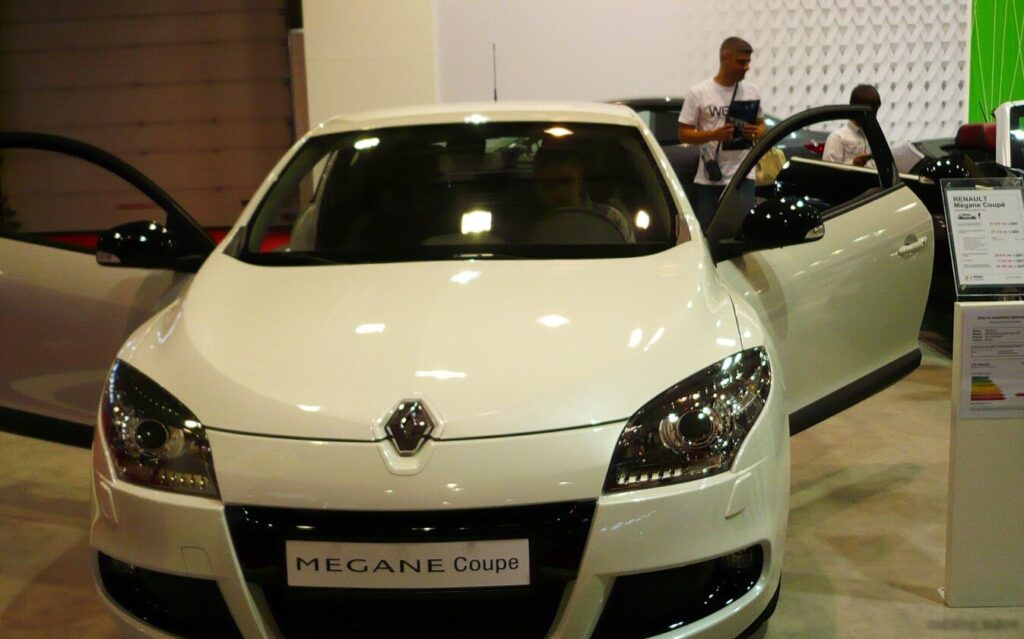
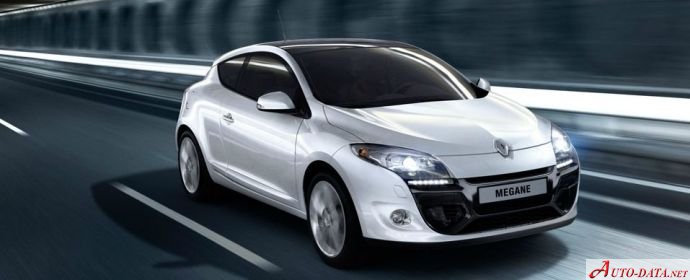
The Megane III Coupe, especially in its Phase II iteration, was renowned for its sleek and dynamic styling, a significant departure from the more conservative lines of its hatchback counterpart. As a 3-door coupe, it featured a lower, more aggressive stance, sculpted flanks, and a tapering roofline that flowed gracefully into the rear. The Phase II refresh brought subtle but impactful changes, including revised front fascias, new headlight designs, and updated LED daytime running lights that gave the car a more modern and assertive look. The GT trim amplified this sporty aesthetic with specific bumpers, side skirts, and distinct alloy wheel designs, emphasizing its performance credentials. The specified 18-inch wheels (8.0J x 18) with 225/40 R18 tires further enhanced its visual appeal and road presence. With a length of 169.25 inches (4299 mm), a width of 70.28 inches (1785 mm), and a height of 56.02 inches (1423 mm), the Megane Coupe maintained compact dimensions suitable for urban environments while still offering a substantial road footprint.
Interior and Practicality
Despite its coupe designation, the Megane III Coupe was designed to be a practical 5-seater, although rear-seat access and legroom were naturally more constrained than in the five-door model. The interior of the GT variant typically featured sport seats, unique trim accents, and a focus on driver engagement. For its time, the Megane offered a respectable level of comfort and technology, including features like electric power steering, which provided ease of maneuverability at low speeds and improved feedback at higher velocities.
Practicality was also a strong suit, with a minimum trunk capacity of 13.31 cubic feet (377 liters), which could be expanded to a generous 36.16 cubic feet (1024 liters) with the rear seats folded, making it surprisingly versatile for a coupe. Safety was addressed with standard features like ABS (Anti-lock Braking System), and given its production year, it would have included multiple airbags and electronic stability control, though specific details beyond ABS are not provided in the technical data. The car’s suspension system, featuring an independent McPherson type at the front and a torsion beam at the rear, provided a good balance between sporty handling and ride comfort, tuned specifically for the GT model to offer a more engaging driving experience.
Technical Specifications: Renault Megane III Coupe (Phase II, 2012) GT 2.0 TCe (180 Hp)
| Category | Specification |
|---|---|
| Brand | Renault |
| Model | Megane |
| Generation | Megane III Coupe (Phase II, 2012) |
| Type (Engine) | GT 2.0 TCe (180 Hp) |
| Start of Production | 2012 year |
| End of Production | 2012 year |
| Powertrain Architecture | Internal Combustion engine |
| Body type | Coupe |
| Seats | 5 |
| Doors | 3 |
| Performance Specifications | |
| Fuel consumption (economy) – urban | 10.9 l/100 km (21.6 US mpg) |
| Fuel consumption (economy) – extra urban | 5.9 l/100 km (39.9 US mpg) |
| Fuel consumption (economy) – combined | 7.7 l/100 km (30.5 US mpg) |
| CO2 emissions | 178 g/km |
| Fuel Type | Petrol (Gasoline) |
| Acceleration 0 – 60 mph | 8.1 sec |
| Acceleration 0 – 100 km/h | 8.5 sec |
| Maximum speed | 215 km/h (133.59 mph) |
| Emission standard | Euro 5 |
| Weight-to-power ratio | 7.3 kg/Hp (136.4 Hp/tonne) |
| Weight-to-torque ratio | 4.4 kg/Nm (227.3 Nm/tonne) |
| Engine Specifications | |
| Power | 180 Hp @ 5500 rpm |
| Power per liter | 90.1 Hp/l |
| Torque | 300 Nm @ 2250 rpm (221.27 lb.-ft. @ 2250 rpm) |
| Engine layout | Front, Transverse |
| Engine Model/Code | F4R 870 |
| Engine displacement | 1998 cm3 (121.93 cu. in.) |
| Number of cylinders | 4 |
| Engine configuration | Inline |
| Cylinder Bore | 82.7 mm (3.26 in.) |
| Piston Stroke | 93 mm (3.66 in.) |
| Compression ratio | 9.3:1 |
| Number of valves per cylinder | 4 |
| Fuel injection system | Multi-port manifold injection |
| Engine aspiration | Turbocharger, Intercooler |
| Engine oil capacity | 5.4 l (5.71 US qt) |
| Engine oil specification | Not specified in data |
| Coolant capacity | 6.5 l (6.87 US qt) |
| Space, Volume and Weights | |
| Kerb Weight | 1320 kg (2910.1 lbs.) |
| Max. weight | 1854 kg (4087.37 lbs.) |
| Max load | 534 kg (1177.27 lbs.) |
| Trunk (boot) space – minimum | 377 l (13.31 cu. ft.) |
| Trunk (boot) space – maximum | 1024 l (36.16 cu. ft.) |
| Fuel tank capacity | 60 l (15.85 US gal) |
| Permitted trailer load with brakes (12%) | 1300 kg (2866.01 lbs.) |
| Permitted trailer load without brakes | 695 kg (1532.21 lbs.) |
| Dimensions | |
| Length | 4299 mm (169.25 in.) |
| Width | 1785 mm (70.28 in.) |
| Height | 1423 mm (56.02 in.) |
| Wheelbase | 2640 mm (103.94 in.) |
| Front track | 1546 mm (60.87 in.) |
| Rear (Back) track | 1547 mm (60.91 in.) |
| Front overhang | 862 mm (33.94 in.) |
| Rear overhang | 797 mm (31.38 in.) |
| Ride height (ground clearance) | 120 mm (4.72 in.) |
| Minimum turning circle (turning diameter) | 10.95 m (35.93 ft.) |
| Drivetrain, Brakes and Suspension Specifications | |
| Drivetrain Architecture | The Internal combustion engine (ICE) drives the front wheels of the vehicle. |
| Drive wheel | Front wheel drive |
| Number of gears and type of gearbox | 6 gears, manual transmission |
| Front suspension | Independent type McPherson |
| Rear suspension | Torsion |
| Front brakes | Ventilated discs |
| Rear brakes | Disc |
| Assisting systems | ABS (Anti-lock braking system) |
| Steering type | Steering rack and pinion |
| Power steering | Electric Steering |
| Tires size | 225/40 R18 92 Y |
| Wheel rims size | 8.0J x 18 |
Legacy and Market Impact
The Renault Megane III Coupe, particularly the GT 2.0 TCe (180 Hp) variant, played a significant role in Renault’s strategy to offer a diverse and appealing product lineup in the European compact segment. While it did not reach the iconic status of its more extreme sibling, the Megane RS, the GT model successfully carved out a niche for itself. It appealed to buyers who desired the sporty aesthetics and dynamic capabilities of a performance coupe but perhaps found the full-fat RS too uncompromising, or too expensive, for daily use.
In its primary European market, the Megane III Coupe GT competed against a host of formidable rivals. Key competitors included the Volkswagen Scirocco, particularly in its 1.4 TSI or 2.0 TSI 180-210 Hp forms, which offered a similar blend of style and performance. Other contenders might have included the Opel Astra GTC, Ford Focus ST (though typically more powerful), and even some entry-level premium coupes from brands like Audi or BMW, though the Megane offered a distinct value proposition.
The Megane GT’s reputation was built on its combination of stylish design, a lively and efficient turbocharged engine, and a chassis tuned for engaging handling. The 6-speed manual transmission was praised for its direct feel, enhancing the driver’s connection with the car. Its ability to offer a respectable 0-60 mph sprint in just over 8 seconds, coupled with good fuel economy for a performance model, made it a compelling package. The GT designation signified a step up in performance and styling from standard Megane models, bridging the gap between mainstream offerings and the hardcore RS variant.
Historically, the Megane III Coupe GT 2.0 TCe (180 Hp) stands as an example of Renault’s commitment to offering a range of performance levels within its mainstream models. It showcased the brand’s engineering prowess in developing efficient yet powerful turbocharged engines and demonstrated a keen understanding of market demands for stylish and fun-to-drive compact cars. While its time in production for this specific phase and engine variant was relatively brief, it contributed to the Megane III’s overall success and reinforced Renault’s image as a manufacturer capable of producing vehicles that blend emotion with practicality. For enthusiasts of European hot hatches and compact coupes, the Megane III Coupe GT 2.0 TCe remains a respected and capable entry, remembered for its distinctive French flair and enjoyable driving dynamics.