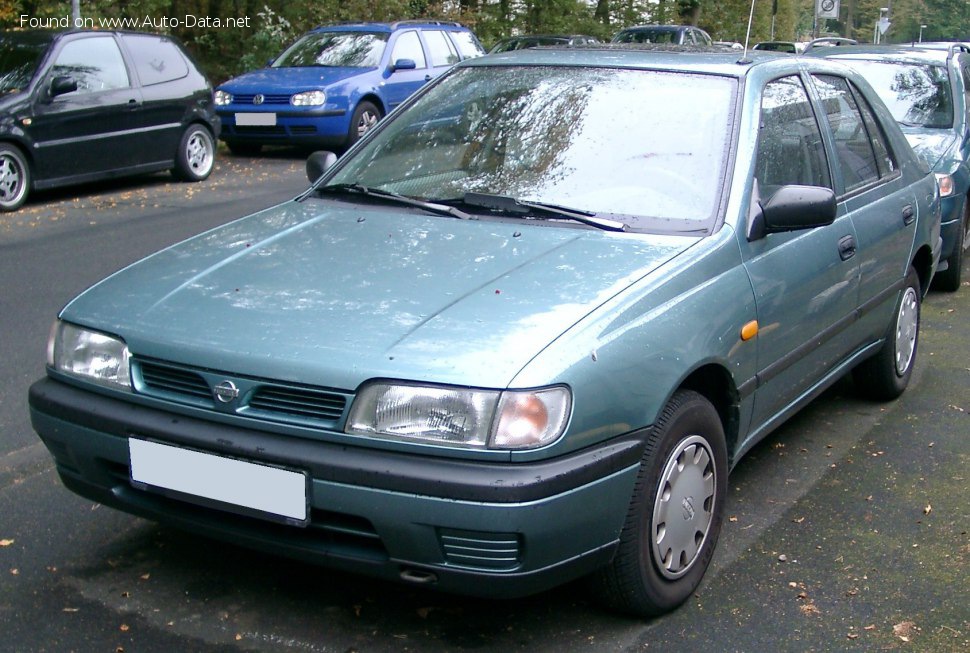
Introduction to the Nissan Sunny III Hatch (N14) 5 doors 1.6 i 16V (90 Hp)
The Nissan Sunny III Hatch (N14) 5 doors 1.6 i 16V (90 Hp) represents a significant chapter in Nissan’s global compact car strategy during the early to mid-1990s. Produced from 1992 to 1995, this specific variant of the N14 generation Sunny hatchback was a versatile and practical offering tailored primarily for the European and Asian markets, where compact hatchbacks enjoyed immense popularity. While the “Sunny” moniker was less prevalent in the United States by this era, where the Nissan Sentra served as the brand’s primary compact sedan and coupe offering, the N14 platform itself was a global architecture that underpinned various models, including the Pulsar in some regions. This particular 5-door hatchback model, equipped with the 1.6-liter 16-valve engine, was designed to strike a balance between economical operation, reliable performance, and everyday utility, making it a highly competitive contender in its segment. It embodied Nissan’s philosophy of delivering dependable, well-engineered vehicles to a broad international audience.
The Global Compact: Nissan Sunny III Hatch (N14) 5 doors 1.6 i 16V (90 Hp)
The Nissan Sunny, in its various iterations, has historically been a cornerstone of Nissan’s global sales, celebrated for its robust engineering and cost-effectiveness. The N14 generation built upon this legacy, introducing a more modern design and improved powertrain options. The 5-door hatchback configuration of the Sunny III (N14) was particularly crucial for markets outside North America, offering superior practicality and cargo flexibility compared to its sedan counterparts. In an era where European and Asian consumers highly valued such attributes, the N14 hatchback was positioned as an accessible family car, a reliable commuter, and a capable long-distance cruiser, all wrapped in a relatively compact footprint. Its design aimed for universal appeal, blending understated aesthetics with functional efficiency, hallmarks of Nissan’s approach to mass-market vehicles during this period.
Engine and Performance Characteristics
Powering the Nissan Sunny III Hatch (N14) 5 doors 1.6 i 16V (90 Hp) was the venerable GA16DE engine, a 1.6-liter (1597 cubic centimeters or 97.45 cubic inches) DOHC (Double Overhead Camshaft) 16-valve inline-four unit. This engine was a staple in many Nissan models of the era, known for its smooth operation and impressive durability. It delivered a respectable 90 horsepower at 6000 rpm and 100.31 lb.-ft. of torque at 4000 rpm. For a naturally aspirated engine of its size in the early 1990s, these figures were quite competitive, allowing the Sunny N14 to offer a lively driving experience without sacrificing fuel efficiency.
The powertrain architecture featured a front, transverse engine layout, driving the front wheels through a 5-speed manual transmission. This setup was standard for compact cars of the time, optimizing interior space and manufacturing cost while providing predictable handling characteristics. Performance figures included an acceleration from 0 to 60 mph in a brisk 10.2 seconds and a top speed of 111.85 mph. These metrics positioned the Sunny N14 as a competent performer in its class, capable of keeping pace with urban traffic and comfortable on highways.
Fuel economy was a strong suit for the 1.6 i 16V model, boasting a combined consumption of 34.1 US mpg (6.9 liters per 100 km). This efficiency was crucial for its target markets, where fuel costs were a significant consideration for car buyers. The multi-port manifold injection system ensured precise fuel delivery, contributing to both performance and economy, while the DOHC valvetrain allowed for better breathing and higher revving capability compared to single overhead camshaft designs. With a 9.8:1 compression ratio, the engine was designed for optimal combustion using regular unleaded gasoline.
Design, Features, and Practicality
The design of the Nissan Sunny III Hatch (N14) 5 doors was characterized by its clean, unpretentious lines, reflecting the prevalent automotive aesthetic of the early 1990s. The 5-door hatchback body type emphasized practicality, offering easy access to both front and rear passengers and a highly versatile cargo area. Measuring 163.19 inches in length, 66.54 inches in width, and 54.92 inches in height, with a wheelbase of 95.67 inches, the N14 was a true compact car, adept at navigating crowded city streets and fitting into tight parking spaces.
Inside, the Sunny N14 provided seating for five occupants. The hatchback design was a major asset for utility, offering a minimum trunk space of 15.22 cubic feet (431 liters), which could expand significantly to an impressive 45.56 cubic feet (1290 liters) with the rear seats folded down. This flexibility made it an ideal choice for families, shoppers, or anyone needing to transport larger items.
Key features for the era included a hydraulic power steering system, ensuring ease of maneuverability at low speeds. Braking was handled by ventilated discs at the front, providing effective stopping power, complemented by drum brakes at the rear. An Anti-lock Braking System (ABS) was available as an assisting system, a notable safety feature for a compact car of its time, enhancing control during emergency braking situations. The suspension setup, featuring a wishbone design at the front and spring struts at the rear, provided a comfortable ride quality balanced with stable handling. The vehicle rode on 175/65 R14 tires, a common size for compacts, balancing grip with ride comfort and cost-effectiveness. With a curb weight of 2330.29 lbs. (1057 kg), the Sunny N14 was relatively light, contributing to its agile feel and fuel efficiency.
Technical Specifications
| Category | Specification |
|---|---|
| General Information | |
| Brand | Nissan |
| Model | Sunny |
| Generation | Sunny III Hatch (N14) 5 doors |
| Type (Engine) | 1.6 i 16V (90 Hp) |
| Production Start | 1992 year |
| Production End | 1995 year |
| Powertrain Architecture | Internal Combustion engine |
| Body Type | Hatchback |
| Seats | 5 |
| Doors | 5 |
| Performance Specifications | |
| Fuel Consumption (Combined) | 34.1 US mpg (6.9 l/100 km) |
| Fuel Type | Petrol (Gasoline) |
| Acceleration 0 – 60 mph | 10.2 sec |
| Maximum Speed | 111.85 mph (180 km/h) |
| Weight-to-Power Ratio | 11.7 kg/Hp, 85.1 Hp/tonne |
| Weight-to-Torque Ratio | 7.8 kg/Nm, 128.7 Nm/tonne |
| Engine Specifications | |
| Power | 90 Hp @ 6000 rpm |
| Power per Liter | 56.4 Hp/l |
| Torque | 100.31 lb.-ft. @ 4000 rpm (136 Nm @ 4000 rpm) |
| Engine Layout | Front, Transverse |
| Engine Model/Code | GA16DE |
| Engine Displacement | 1.6 liters (1597 cm3, 97.45 cu. in.) |
| Number of Cylinders | 4 |
| Engine Configuration | Inline |
| Cylinder Bore | 2.99 in. (76 mm) |
| Piston Stroke | 3.46 in. (88 mm) |
| Compression Ratio | 9.8:1 |
| Valves per Cylinder | 4 |
| Fuel Injection System | Multi-port manifold injection |
| Engine Aspiration | Naturally aspirated engine |
| Valvetrain | DOHC |
| Engine Oil Capacity | 3.38 US qt (3.2 l) |
| Coolant Capacity | 6.02 US qt (5.7 l) |
| Space, Volume, and Weights | |
| Curb Weight | 2330.29 lbs. (1057 kg) |
| Max. Weight (GVWR) | 3406.14 lbs. (1545 kg) |
| Max Load | 1075.86 lbs. (488 kg) |
| Trunk (Boot) Space – Minimum | 15.22 cu. ft. (431 l) |
| Trunk (Boot) Space – Maximum | 45.56 cu. ft. (1290 l) |
| Fuel Tank Capacity | 13.21 US gal (50 l) |
| Dimensions | |
| Length | 163.19 in. (4145 mm) |
| Width | 66.54 in. (1690 mm) |
| Height | 54.92 in. (1395 mm) |
| Wheelbase | 95.67 in. (2430 mm) |
| Front Track | 56.5 in. (1435 mm) |
| Rear Track | 55.91 in. (1420 mm) |
| Drivetrain, Brakes, and Suspension Specifications | |
| Drivetrain Architecture | Front-wheel drive (Internal Combustion engine drives the front wheels) |
| Drive Wheel | Front wheel drive |
| Number of Gears and Type of Gearbox | 5 gears, manual transmission |
| Front Suspension | Wishbone |
| Rear Suspension | Spring Strut |
| Front Brakes | Ventilated discs |
| Rear Brakes | Drum |
| Assisting Systems | ABS (Anti-lock braking system) |
| Steering Type | Steering rack and pinion |
| Power Steering | Hydraulic Steering |
| Tires Size | 175/65 R14 |
Legacy and Market Impact
The Nissan Sunny III Hatch (N14) 5 doors 1.6 i 16V (90 Hp) solidified Nissan’s reputation for producing reliable, economical, and practical compact cars across various international markets. While it wasn’t a performance icon, its enduring appeal stemmed from its robust build quality, low running costs, and impressive versatility. It was a car designed for the masses, offering a no-nonsense approach to daily transportation that resonated with a wide demographic.
In its primary markets, the Sunny N14 faced stiff competition from European and Japanese rivals. Key competitors included the popular Volkswagen Golf, the Ford Escort, the Opel Astra (Vauxhall Astra in the UK), the Honda Civic hatchback, and the Toyota Corolla hatchback. The Sunny N14 held its own by offering a compelling package that often undercut some rivals on price while matching or exceeding them in terms of reliability and interior space. Its GA16DE engine, in particular, was widely praised for its longevity and efficiency, contributing to the car’s strong residual values in many regions.
The N14 generation, and this specific 1.6-liter hatchback variant, played a crucial role in maintaining Nissan’s market share in the fiercely competitive compact segment throughout the early 1990s. It was a testament to Nissan’s engineering prowess, demonstrating how to combine affordability with solid performance and practicality. Its legacy is that of a dependable workhorse, a car that quietly served millions of owners around the world, contributing significantly to Nissan’s global brand image as a manufacturer of trustworthy and accessible vehicles. The Sunny N14 paved the way for future Nissan compacts, influencing the design and engineering principles of subsequent models that continued to prioritize efficiency, reliability, and user-friendly design.