Introduction to the Mitsubishi Lancer VIII 1.6i 16V (98 Hp) Automatic
The Mitsubishi Lancer is a nameplate synonymous with accessible performance and robust reliability, a global compact car that has spanned many generations and catered to diverse markets. The eighth generation, often referred to as the Lancer VIII or Lancer EX in some regions, debuted in 2007, marking a significant evolution in design and engineering for the venerable sedan. This particular variant, the Mitsubishi Lancer VIII 1.6i 16V (98 Hp) Automatic, represented an entry-level offering primarily targeted at markets outside of North America, where fuel efficiency, lower displacement engines, and ease of urban driving were paramount considerations. While North American markets typically received larger 2.0-liter or 2.4-liter engines paired with more advanced transmissions, this 1.6-liter automatic model was a common sight in Europe, Asia, and other international territories, serving as a practical and economical family sedan. Produced between 2007 and 2009, this iteration of the Lancer continued Mitsubishi’s tradition of offering a dependable and well-equipped vehicle in the highly competitive compact segment.
Engine and Performance of the Mitsubishi Lancer VIII 1.6i 16V (98 Hp) Automatic
Under the hood of the Mitsubishi Lancer VIII 1.6i 16V (98 Hp) Automatic lies a naturally aspirated 1.6-liter (1584 cm3 or 96.66 cu. in.) inline-four engine, designated as the 4G18. This powertrain was engineered for a balance of economy and adequate performance for daily commuting, rather than outright speed. It features a single overhead camshaft (OHC) valvetrain with four valves per cylinder, a common and reliable configuration for its era, ensuring efficient breathing and good low-end torque. Fuel is delivered via a multi-port manifold injection system, a tried-and-true method that offers precise fuel metering.
The engine produces a modest 98 horsepower at 5000 revolutions per minute (rpm) and 110.63 lb.-ft. of torque at 4000 rpm. These figures, while not groundbreaking, are well-suited for its intended purpose. Power is sent to the front wheels through a conventional four-speed automatic transmission. This gearbox, while perhaps not as sophisticated as continuously variable transmissions (CVTs) or multi-speed automatics found in some competitors, provided smooth and predictable shifts, contributing to a relaxed driving experience.
In terms of performance, the Lancer VIII 1.6i 16V automatic accelerates from 0 to 60 mph in a calculated 12.9 seconds, with a top speed of 109.36 mph (176 km/h). These numbers firmly place it in the realm of practical family transportation, prioritizing efficiency and comfort over sporty dynamics. Fuel economy was a strong suit for this variant, with a combined rating of 29.8 US mpg (7.9 l/100 km). In urban settings, it achieved 22.8 US mpg (10.3 l/100 km), while extra-urban driving saw a more impressive 36.8 US mpg (6.4 l/100 km). This efficiency, combined with a 13.21 US gallon (50 l) fuel tank, provided a decent cruising range, making it an attractive option in markets sensitive to fuel costs.
Design and Features
Exterior and Interior Design
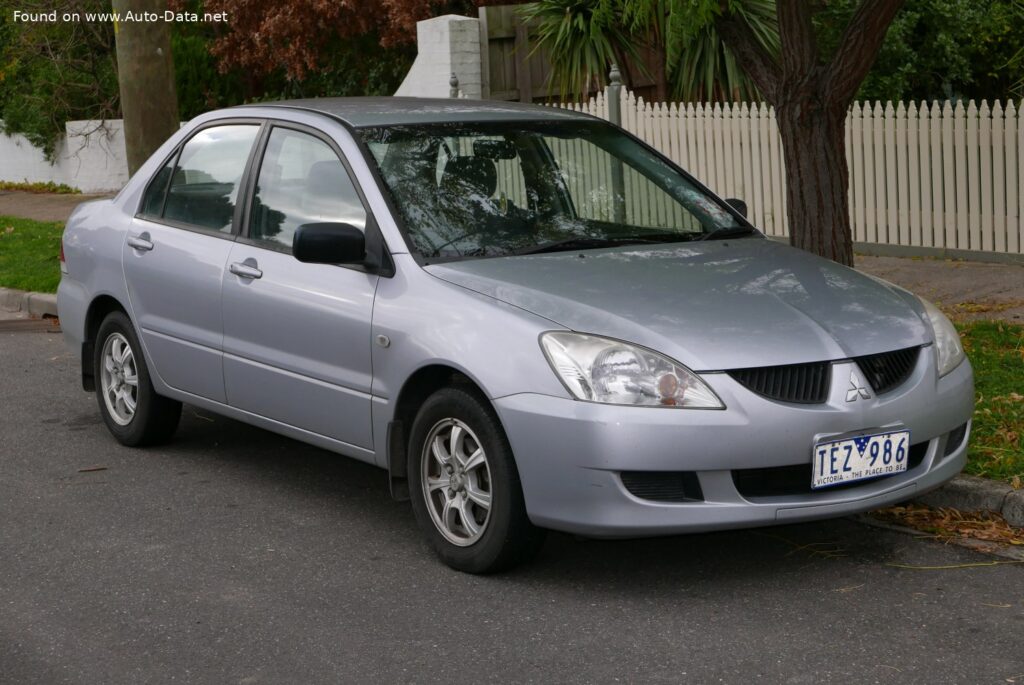
The eighth-generation Mitsubishi Lancer represented a significant stylistic departure from its predecessor. It adopted a more aggressive and contemporary design language, heavily influenced by the Mitsubishi Concept-X show car. The sedan body type featured four doors and seating for five occupants. Its exterior was characterized by sharp lines, a prominent grille, and distinctive headlamps, giving it a sporty yet refined appearance that resonated with a younger demographic while maintaining broad appeal. The overall length of 176.38 inches (4480 mm), width of 66.73 inches (1695 mm), and height of 56.89 inches (1445 mm) positioned it squarely within the compact sedan segment, offering a manageable footprint for urban environments. The 102.36-inch (2600 mm) wheelbase contributed to a stable ride and a reasonably spacious cabin for its class.
Inside, the Lancer VIII offered a functional and ergonomic cabin. While this base model might not have featured the premium materials of higher trims, it provided a comfortable and durable environment. The dashboard layout was straightforward, with controls easily accessible to the driver. Practicality was a key consideration, evidenced by a generous trunk space of 15.19 cubic feet (430 liters), making it suitable for family trips or daily errands.
Chassis and Safety Features
The Lancer VIII’s chassis was designed to provide a comfortable yet competent ride. It featured a front spring strut suspension system, a common and cost-effective setup that offered a good balance of handling and ride comfort. The rear suspension incorporated a transverse stabilizer, which helped to reduce body roll and improve stability during cornering. Braking duties were handled by ventilated discs at the front and solid discs at the rear, providing adequate stopping power for the vehicle’s weight and performance capabilities. An Anti-lock Braking System (ABS) was included as a standard assisting system, enhancing safety by preventing wheel lock-up during hard braking.
Steering was managed by a hydraulic rack and pinion system, which delivered a direct and communicative feel, a characteristic often appreciated by drivers. The standard tire size was 195/60 R15, mounted on 6J x 15-inch wheel rims, offering a good compromise between grip, ride comfort, and fuel efficiency. With a kerb weight of 2612.48 lbs (1185 kg) and a maximum permissible weight of 3858.09 lbs (1750 kg), the Lancer VIII 1.6i 16V was a relatively light vehicle for its class, which also contributed to its agility and fuel economy.
Technical Specifications: Mitsubishi Lancer VIII 1.6i 16V (98 Hp) Automatic
| Category | Specification |
|---|---|
| General Information | |
| Brand | Mitsubishi |
| Model | Lancer |
| Generation | Lancer VIII |
| Type (Engine) | 1.6i 16V (98 Hp) Automatic |
| Start of Production | 2007 year |
| End of Production | 2009 year |
| Powertrain Architecture | Internal Combustion Engine |
| Body Type | Sedan |
| Seats | 5 |
| Doors | 4 |
| Performance Specs | |
| Fuel Consumption (Urban) | 10.3 l/100 km (22.8 US mpg) |
| Fuel Consumption (Extra Urban) | 6.4 l/100 km (36.8 US mpg) |
| Fuel Consumption (Combined) | 7.9 l/100 km (29.8 US mpg) |
| Fuel Type | Petrol (Gasoline) |
| Acceleration 0 – 60 mph | 12.9 sec |
| Maximum Speed | 176 km/h (109.36 mph) |
| Weight-to-Power Ratio | 12.1 kg/Hp (82.7 Hp/tonne) |
| Weight-to-Torque Ratio | 7.9 kg/Nm (126.6 Nm/tonne) |
| Engine Specs | |
| Power | 98 Hp @ 5000 rpm |
| Power per Liter | 61.9 Hp/l |
| Torque | 150 Nm @ 4000 rpm (110.63 lb.-ft. @ 4000 rpm) |
| Engine Layout | Front, Transverse |
| Engine Model/Code | 4G18 |
| Engine Displacement | 1584 cm3 (96.66 cu. in.) |
| Number of Cylinders | 4 |
| Engine Configuration | Inline |
| Cylinder Bore | 76 mm (2.99 in.) |
| Piston Stroke | 87.3 mm (3.44 in.) |
| Compression Ratio | 10:1 |
| Number of Valves per Cylinder | 4 |
| Fuel Injection System | Multi-port manifold injection |
| Engine Aspiration | Naturally aspirated engine |
| Valvetrain | OHC |
| Engine Oil Capacity | 3.3 l (3.49 US qt) |
| Coolant Capacity | 5 l (5.28 US qt) |
| Space, Volume and Weights | |
| Kerb Weight | 1185 kg (2612.48 lbs) |
| Max. Weight (Gross Vehicle Weight) | 1750 kg (3858.09 lbs) |
| Max Load | 565 kg (1245.61 lbs) |
| Trunk (Boot) Space – minimum | 430 l (15.19 cu. ft.) |
| Fuel Tank Capacity | 50 l (13.21 US gal) |
| Dimensions | |
| Length | 4480 mm (176.38 in.) |
| Width | 1695 mm (66.73 in.) |
| Height | 1445 mm (56.89 in.) |
| Wheelbase | 2600 mm (102.36 in.) |
| Front Track | 1470 mm (57.87 in.) |
| Rear (Back) Track | 1470 mm (57.87 in.) |
| Drivetrain, Brakes and Suspension Specs | |
| Drivetrain Architecture | Front-wheel drive. Internal Combustion Engine (ICE) drives the front wheels. |
| Drive Wheel | Front wheel drive |
| Number of Gears and Type of Gearbox | 4 gears, automatic transmission |
| Front Suspension | Spring Strut |
| Rear Suspension | Transverse stabilizer |
| Front Brakes | Ventilated discs |
| Rear Brakes | Disc |
| Assisting Systems | ABS (Anti-lock Braking System) |
| Steering Type | Steering rack and pinion |
| Power Steering | Hydraulic Steering |
| Tires Size | 195/60 R15 |
| Wheel Rims Size | 6J x 15 |
Legacy and Market Impact
The Mitsubishi Lancer, particularly its eighth generation, played a crucial role in Mitsubishi’s global portfolio as a volume seller in the compact sedan segment. While the Lancer nameplate often conjures images of the high-performance Evolution models in the minds of American enthusiasts, the more humble Mitsubishi Lancer VIII 1.6i 16V (98 Hp) Automatic was the workhorse that generated significant sales in many international markets. Its legacy is built on a foundation of reliability, practicality, and affordability, qualities that made it a popular choice for families and individual buyers seeking dependable transportation.
In its primary markets, this Lancer variant competed fiercely with other established compact sedans such as the Honda Civic, Toyota Corolla, and Nissan Sentra in Asia and some parts of Europe. In European markets, it also faced rivals like the Ford Focus Sedan, Opel Astra Sedan, and Volkswagen Jetta. Against these competitors, the Lancer offered a distinctive, sporty aesthetic derived from its performance-oriented siblings, coupled with Mitsubishi’s reputation for robust engineering. While it didn’t boast class-leading performance or the most luxurious interior, its straightforward mechanicals and proven durability were significant selling points.
The Lancer VIII, including this 1.6-liter automatic model, helped to maintain Mitsubishi’s presence in a highly competitive global market during a period of significant change for the automotive industry. It served as a practical and economical bridge, offering a comfortable ride and sufficient features for everyday use. Its relatively short production run for this specific configuration (2007-2009) reflects the rapid evolution of engine and transmission technology during that era, with manufacturers quickly moving towards more advanced and efficient powertrains. Nevertheless, the Lancer VIII 1.6i 16V Automatic remains a testament to Mitsubishi’s commitment to providing accessible, reliable, and well-designed compact sedans to a global audience, solidifying its historical significance as a dependable segment player.