Mercedes-Benz SLK (R172) SLK 200 2.0 (184 Hp) 9G-TRONIC
The Mercedes-Benz SLK (R172) SLK 200 2.0 (184 Hp) 9G-TRONIC represents a significant iteration of the German automaker’s compact luxury roadster. Introduced as the third generation of the SLK-Class, the R172 chassis, produced from 2011 to 2016, continued the tradition of a stylish two-seater convertible with a distinctive retractable hardtop. The SLK 200 variant, specifically produced between April 2015 and January 2016, offered a compelling blend of performance, efficiency, and Mercedes-Benz luxury, particularly appealing to markets where smaller displacement engines are favored due to taxation or fuel economy considerations. While the SLK 200 2.0 was not the top-tier performance model, it served as an accessible entry point into the premium roadster segment, delivering a sophisticated driving experience with its turbocharged engine and advanced 9G-TRONIC automatic transmission. This generation marked a maturation of the SLK lineup, bringing more refined styling cues, enhanced technology, and improved dynamic capabilities, cementing its place as a formidable competitor in its class.
Evolution and Positioning of the Mercedes-Benz SLK (R172)
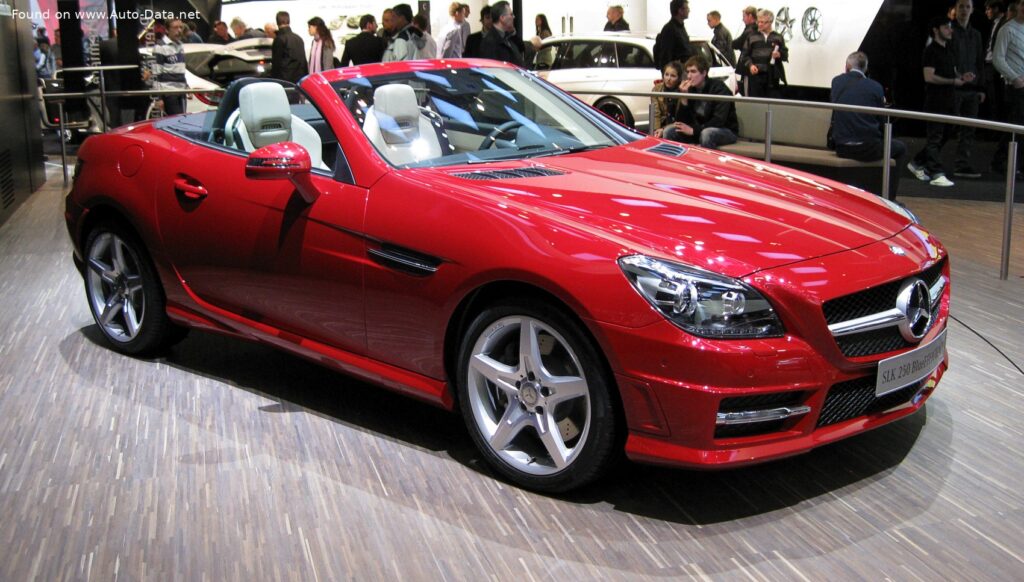
The R172 generation of the Mercedes-Benz SLK, succeeding the R171, brought a more aggressive and muscular design language, drawing inspiration from the iconic SLS AMG. Its front fascia featured a more upright grille and swept-back headlights, giving it a bolder presence. The SLK-Class, an acronym for “Sportlich, Leicht, Kurz” (Sporty, Light, Short), consistently aimed to deliver an engaging driving experience in a compact, stylish package. The R172 generation further refined this philosophy, offering a more comfortable and luxurious interior, coupled with a range of efficient yet powerful engines. The SLK 200 2.0 (184 Hp) 9G-TRONIC model, in particular, was strategically positioned to offer a balance of spirited performance and commendable fuel economy, making it a popular choice in European and Asian markets. It embodied Mercedes-Benz’s commitment to offering diverse powertrain options to cater to various global market demands, all while maintaining the brand’s hallmark standards of engineering and luxury.
Engine and Performance of the SLK 200 2.0 (184 Hp) 9G-TRONIC
At the heart of the Mercedes-Benz SLK (R172) SLK 200 2.0 (184 Hp) 9G-TRONIC lies a sophisticated M 274.920 inline-four gasoline engine. This 2.0-liter (1991 cm³) turbocharged and intercooled unit is a testament to modern engine design, featuring direct fuel injection and a DOHC valvetrain with four valves per cylinder. It produces a robust 184 horsepower at 5500 rpm, which is impressive for its displacement, translating to a power-per-liter output of 92.4 hp/l. More significantly for real-world driving, the engine delivers a healthy 221.27 lb-ft of torque across a broad and accessible rev range, from 1200 to 4000 rpm. This low-end torque ensures brisk acceleration and flexible performance, making the SLK 200 feel responsive whether navigating city streets or cruising on the highway.
Power is sent to the rear wheels via Mercedes-Benz’s advanced 9G-TRONIC automatic transmission. This nine-speed gearbox is a key factor in the vehicle’s efficiency and smooth operation. Its wide gear ratio spread allows for optimal engine speed management, contributing to both quick acceleration and relaxed, fuel-efficient cruising. The SLK 200 2.0 (184 Hp) 9G-TRONIC can accelerate from 0 to 60 mph in a respectable 6.6 seconds, with a top speed electronically limited to 147.26 mph (237 km/h). Despite its performance capabilities, the vehicle maintains impressive fuel economy ratings, achieving a combined 41.3 – 38.6 US mpg (5.7-6.1 l/100 km) and emitting 133-143 g/km of CO2, meeting Euro 6 emission standards. The inclusion of a Start & Stop System further enhances its urban fuel efficiency. This powertrain configuration underscores Mercedes-Benz’s engineering prowess in balancing performance, refinement, and environmental responsibility.
Design and Features
The design of the Mercedes-Benz SLK (R172) is characterized by its elegant yet sporty proportions, a hallmark of the luxury roadster segment. As a two-door, two-seat roadster, its primary appeal lies in its open-air driving experience, facilitated by the signature Vario-roof – a retractable hardtop that seamlessly transforms the car from a sleek coupe to an exhilarating convertible in seconds. The R172 generation refined this mechanism, making it quieter and more efficient. The exterior boasts a dynamic silhouette, with a long hood, short rear deck, and pronounced wheel arches, giving it a powerful stance. The front fascia, with its prominent grille and LED daytime running lights, exudes a modern and sophisticated appeal.
Inside, the SLK 200 offers a driver-focused cockpit crafted with high-quality materials and meticulous attention to detail. Standard features for a Mercedes-Benz of this era would typically include premium upholstery, a multi-function steering wheel, and a sophisticated infotainment system. Safety features are comprehensive, including ABS (Anti-lock Braking System) as standard, along with a robust chassis and multiple airbags to protect occupants. The car’s dimensions – a length of 162.76 inches, a width of 71.26 inches, and a height of 51.22 inches – contribute to its agile handling and compact footprint. The trunk space is practical for a roadster, ranging from 7.95 to 11.83 cubic feet (225-335 liters) depending on whether the roof is stowed. The suspension setup, with an independent McPherson-type front and multi-link rear, provides a comfortable ride while maintaining excellent road holding. Ventilated disc brakes at the front and disc brakes at the rear ensure strong stopping power.
Technical Specifications
| Category | Specification |
|---|---|
| General Information | |
| Brand | Mercedes-Benz |
| Model | SLK |
| Generation | SLK (R172) |
| Type (Engine) | SLK 200 2.0 (184 Hp) 9G-TRONIC |
| Start of Production | April, 2015 |
| End of Production | January, 2016 |
| Powertrain Architecture | Internal Combustion engine |
| Body type | Roadster |
| Seats | 2 |
| Doors | 2 |
| Performance Specs | |
| Fuel consumption (economy) – urban (NEDC) | 31.4 – 29.8 US mpg (7.5-7.9 l/100 km) |
| Fuel consumption (economy) – extra urban (NEDC) | 50 – 45.2 US mpg (4.7-5.2 l/100 km) |
| Fuel consumption (economy) – combined (NEDC) | 41.3 – 38.6 US mpg (5.7-6.1 l/100 km) |
| CO2 emissions (NEDC) | 133-143 g/km |
| Fuel Type | Petrol (Gasoline) |
| Acceleration 0 – 60 mph | 6.6 seconds |
| Acceleration 0 – 62 mph (0-100 km/h) | 6.9 seconds |
| Maximum speed | 147.26 mph (237 km/h) |
| Emission standard | Euro 6 |
| Weight-to-power ratio | 7.6 kg/Hp, 131 Hp/tonne |
| Weight-to-torque ratio | 4.7 kg/Nm, 213.5 Nm/tonne |
| Engine Specs | |
| Power | 184 Hp @ 5500 rpm |
| Power per liter | 92.4 Hp/l |
| Torque | 221.27 lb-ft @ 1200-4000 rpm (300 Nm) |
| Engine layout | Front, Longitudinal |
| Engine Model/Code | M 274.920 |
| Engine displacement | 2.0 liters (1991 cm³, 121.5 cu. in.) |
| Number of cylinders | 4 |
| Engine configuration | Inline |
| Cylinder Bore | 3.27 in. (83 mm) |
| Piston Stroke | 3.62 in. (92 mm) |
| Compression ratio | 9.8:1 |
| Number of valves per cylinder | 4 |
| Fuel injection system | Direct injection |
| Engine aspiration | Turbocharger, Intercooler |
| Valvetrain | DOHC |
| Engine oil capacity | 6.66 US qt (6.3 l) |
| Engine systems | Start & Stop System |
| Space, Volume and Weights | |
| Kerb Weight | 3097.49 lbs. (1405 kg) |
| Max. weight | 3957.3 lbs. (1795 kg) |
| Max load | 859.8 lbs. (390 kg) |
| Trunk (boot) space – minimum | 7.95 cu. ft. (225 l) |
| Trunk (boot) space – maximum | 11.83 cu. ft. (335 l) |
| Fuel tank capacity | 15.85 US gal (60 l) |
| Dimensions | |
| Length | 162.76 in. (4134 mm) |
| Width | 71.26 in. (1810 mm) |
| Width including mirrors | 78.98 in. (2006 mm) |
| Height | 51.22 in. (1301 mm) |
| Wheelbase | 95.67 in. (2430 mm) |
| Front track | 61.38 in. (1559 mm) |
| Rear (Back) track | 61.61 in. (1565 mm) |
| Front overhang | 34.25 in. (870 mm) |
| Rear overhang | 32.83 in. (834 mm) |
| Drag coefficient (Cd) | 0.30 |
| Minimum turning circle (turning diameter) | 34.51 ft. (10.52 m) |
| Drivetrain, Brakes and Suspension Specs | |
| Drivetrain Architecture | The Internal combustion engine (ICE) drives the rear wheels of the vehicle. |
| Drive wheel | Rear wheel drive |
| Number of gears and type of gearbox | 9 gears, automatic transmission G-TRONIC |
| Front suspension | Independent, type McPherson with coil spring and anti-roll bar |
| Rear suspension | Independent multi-link spring suspension with stabilizer |
| Front brakes | Ventilated discs |
| Rear brakes | Disc |
| Assisting systems | ABS (Anti-lock braking system) |
| Steering type | Steering rack and pinion |
| Power steering | Hydraulic Steering |
| Tires size | Front: 205/55 R16; 225/45 R17; 225/40 R18 Rear: 205/55 R16; 225/50 R16; 245/40 R17; 245/35 R18 |
| Wheel rims size | Front: 7J x 16; 7.5J x 17; 7.5J x 18 Rear: 7J x 16; 8J x 16; 8.5J x 17; 8.5J x 18 |
Legacy and Market Impact
The Mercedes-Benz SLK (R172) SLK 200 2.0 (184 Hp) 9G-TRONIC, while a specific variant, played a crucial role in the overall success and legacy of the R172 generation. This model, with its blend of performance and efficiency, allowed Mercedes-Benz to capture a broader market segment, particularly in regions where environmental regulations and fuel costs made larger-engined variants less appealing. It solidified the SLK’s reputation as a practical yet luxurious daily-drivable roadster, distinguishing itself from more hardcore sports cars.
In its competitive landscape, the SLK (R172) faced rivals such as the BMW Z4, Audi TT Roadster, and the Porsche Boxster. The SLK differentiated itself with its unique retractable hardtop, which offered the security and refinement of a coupe with the exhilaration of a convertible. While the Z4 often emphasized a sportier, more direct driving feel, and the Boxster was renowned for its mid-engine balance, the SLK (R172) offered a compelling combination of comfort, luxury, and effortless cruising capability. The SLK 200, in particular, delivered a smooth, refined driving experience that was distinctly Mercedes-Benz. Its advanced 9G-TRONIC transmission and efficient turbocharged engine underscored Mercedes-Benz’s commitment to modern automotive engineering, providing a sophisticated alternative in the premium roadster segment.
The R172 generation also marked a transitional period for the SLK nameplate. Towards the end of its production run, in 2016, Mercedes-Benz rebranded the model as the SLC-Class as part of a new naming convention aligning roadsters with the C-Class sedan. This change, along with updated styling and powertrains, served to refresh the model line. The SLK 200 2.0 (184 Hp) 9G-TRONIC, therefore, represents one of the final iterations of the SLK badge, embodying the pinnacle of its third-generation development. Its legacy is that of a stylish, technologically advanced, and efficient luxury roadster that successfully balanced everyday usability with the joy of open-top driving, leaving a lasting impression on the compact premium convertible market.