
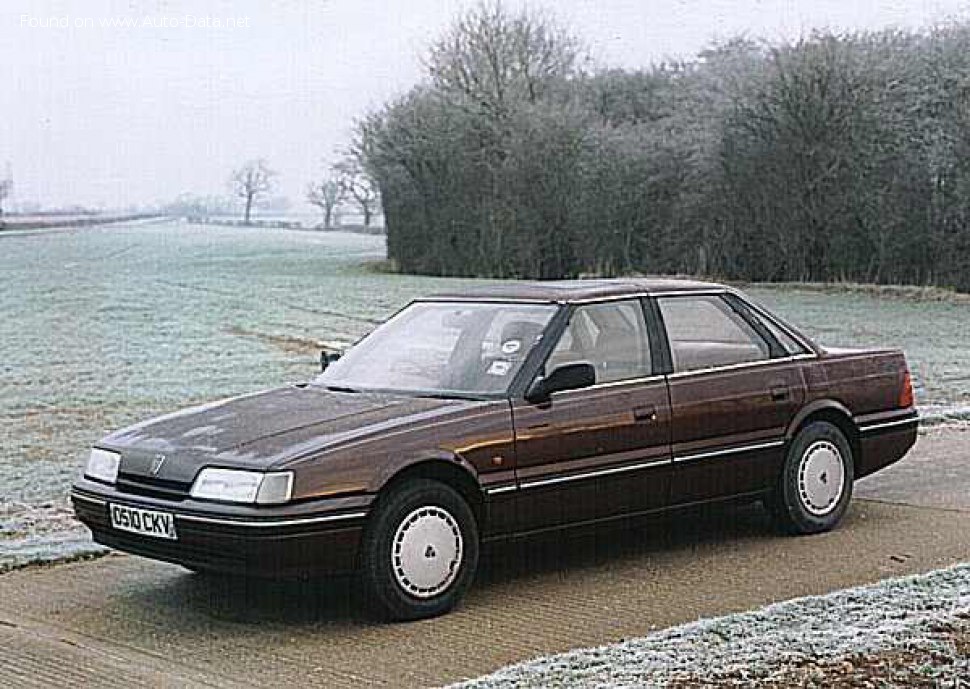
The Rover 800: An Executive Sedan’s Ambition with the 825 SI/Sterling (XS) Variant
The Rover 800 series represents a pivotal chapter in the history of the British automotive manufacturer, Rover Group. Launched in 1986, the 800 was Rover’s ambitious entry into the highly competitive executive car segment, aiming to rival established German and Swedish marques. This front-wheel-drive platform, known internally as the “XX” project, was the result of a significant collaboration with Honda, which also produced its own version, the Honda Legend (known as the Acura Legend in North America). The Rover 800 was designed to replace the aging Rover SD1 and elevate the brand’s image, offering a blend of traditional British luxury and modern engineering. The generation 800, specifically the Rover 800 825 SI/Sterling (XS) variant produced between 1987 and 1991, stood out as a high-performance, luxury-oriented model within the lineup, embodying Rover’s aspirations for sophistication and driving refinement.
While primarily targeted at the European market, where it competed fiercely against premium sedans, the Rover 800 also made a notable, albeit ultimately unsuccessful, foray into the North American market under the Sterling brand. The 825 SI/Sterling (XS) variant, with its potent V6 engine, was a cornerstone of this international strategy, promising a compelling combination of power, comfort, and advanced features for its era.
Engine and Performance: The Heart of the Rover 800
At the core of the Rover 800 825 SI/Sterling (XS)‘s appeal was its sophisticated powertrain. This particular variant was equipped with a 2.5-liter (2494 cc) V6 engine, designated as the C25A. This engine was a direct derivative of Honda’s C-series V6, a testament to the Anglo-Japanese collaboration. The C25A was a naturally aspirated unit, meaning it relied solely on atmospheric pressure to draw air into its cylinders, eschewing turbocharging or supercharging. This design choice contributed to a smooth, linear power delivery characteristic of naturally aspirated V6 engines.
The engine produced a robust 173 horsepower (Hp), a significant output for an executive sedan in the late 1980s. This power, coupled with the V6’s inherent balance, translated into refined performance suitable for long-distance cruising and confident overtaking maneuvers. The C25A engine was praised for its refinement, quiet operation, and reliability, attributes often associated with Honda engineering. Power was routed through a front-wheel-drive architecture, which was a departure from the rear-wheel-drive setup of its predecessor, the SD1, reflecting contemporary trends in executive car design for improved packaging and foul-weather traction.
The 825 SI and Sterling trims represented the upper echelons of the Rover 800 range. The “SI” designation typically denoted a “Sport Injection” or performance-oriented trim, often paired with the more powerful engine options. The “Sterling” badge, on the other hand, was reserved for the absolute top-tier luxury models, featuring the most comprehensive equipment list and premium finishes. Both trims benefited immensely from the C25A V6, providing the necessary grunt to back up their executive pretensions. The engine’s oil capacity was 4.5 liters (4.76 US quarts), and the cooling system held 10 liters (10.57 US quarts) of coolant, indicative of a well-engineered thermal management system for a performance-oriented V6.
Design and Features: British Elegance Meets Modern Functionality
The Rover 800, including the 825 SI/Sterling (XS), was offered exclusively as a four-door sedan during this production period (1987-1991). Its design was a blend of European executive styling cues and subtle Japanese influences, resulting in a sleek, aerodynamic profile that was contemporary for its time. The body featured clean lines, a relatively low hood, and a distinctive Rover grille that projected an image of understated elegance. While not overtly sporty, its proportions conveyed a sense of substantiality and prestige.
Inside, the Rover 800 aimed to deliver a premium experience, especially in the SI and Sterling variants. The Sterling trim, in particular, was lavishly appointed, often featuring Connolly leather upholstery, genuine wood trim on the dashboard and door panels, and deep-pile carpeting. Power-operated features were abundant, including electric windows, power-adjustable heated seats, and a sophisticated climate control system. Audio systems were often cutting-edge for the period, sometimes incorporating multi-disc CD changers. The dashboard layout was ergonomic, with clear instrumentation and logically placed controls, reflecting a focus on driver comfort and convenience.
Safety features, while not as comprehensive as modern vehicles, were respectable for the late 1980s. Anti-lock braking systems (ABS) were typically standard on higher trims like the Sterling, significantly enhancing stopping power and control in adverse conditions. Other standard safety equipment included three-point seatbelts for all occupants and a robust passenger cell design. The blend of luxury materials, advanced (for the time) electronics, and a focus on passenger comfort underscored the 800’s ambition to compete with the best in its class.
Technical Specifications: Rover 800 825 SI/Sterling (XS) (173 Hp)
| Category | Specification |
|---|---|
| Brand | Rover |
| Model | 800 |
| Generation | 800 |
| Type (Engine) | 825 SI/Sterling (XS) (173 Hp) |
| Start of Production | 1987 year |
| End of Production | 1991 year |
| Powertrain Architecture | Internal Combustion engine |
| Body type | Sedan |
| Fuel Type | Petrol (Gasoline) |
| Power | 173 Hp |
| Engine Model/Code | C25A |
| Engine Aspiration | Naturally aspirated engine |
| Engine Oil Capacity | 4.5 l (4.76 US qt | 3.96 UK qt) |
| Engine Oil Specification | Not specified in data |
| Coolant Capacity | 10 l (10.57 US qt | 8.8 UK qt) |
| Drivetrain | Internal Combustion engine |
Legacy and Market Impact: The Rover 800’s Place in Automotive History
The Rover 800 series, and particularly the well-equipped 825 SI/Sterling (XS) models, faced a challenging market landscape. In its primary European market, it competed directly with formidable rivals such as the BMW 5-Series, Mercedes-Benz E-Class, Audi 100/200, Saab 9000, and Volvo 700/900 series. While the Rover 800 offered a competitive package in terms of luxury, performance, and features, especially given its often more attractive price point, it struggled to truly dislodge the established prestige of its German competitors. Its strengths lay in its refined ride, comfortable interior, and the reliable and smooth Honda-derived V6 engine.
The most significant, and perhaps most illustrative, aspect of the 800’s market impact for an American audience was its ill-fated venture into the United States. From 1987 to 1991, the Rover 800 was sold in the U.S. under the separate “Sterling” brand, with models like the Sterling 825 and later 827. The Sterling 825 SI/Sterling (XS) would have been directly analogous to the offerings there. The Sterling brand aimed to position itself as a premium European alternative, leveraging the Rover’s luxurious appointments and Honda’s mechanical underpinnings. However, despite its promising start, the Sterling brand ultimately failed in the U.S. market. This failure was largely attributed to inconsistent build quality and reliability issues, which, ironically, often stemmed from Rover’s own electrical systems and interior trim, rather than the robust Honda engine and gearbox. American consumers, accustomed to the bulletproof reliability of the Acura Legend (the Rover’s Honda twin), were not willing to overlook these shortcomings in a premium vehicle. The brand withdrew from the U.S. market in 1991, leaving a legacy of what could have been.
Despite its struggles, the Rover 800 remains a significant vehicle in Rover’s history. It represented Rover’s most serious attempt to re-establish itself as a major player in the executive car segment and showcased the potential of international automotive collaboration. The 825 SI/Sterling (XS) variant, with its potent 173 Hp V6 engine, was a highlight, offering a compelling blend of performance and luxury that, on paper, rivaled many of its more expensive competitors. Today, the Rover 800 is appreciated by enthusiasts for its comfortable ride, distinctive Anglo-Japanese styling, and as a tangible piece of British automotive heritage from an era of significant change and ambition for the Rover brand. It serves as a reminder of a time when Rover dared to dream big and compete on a global stage.
