
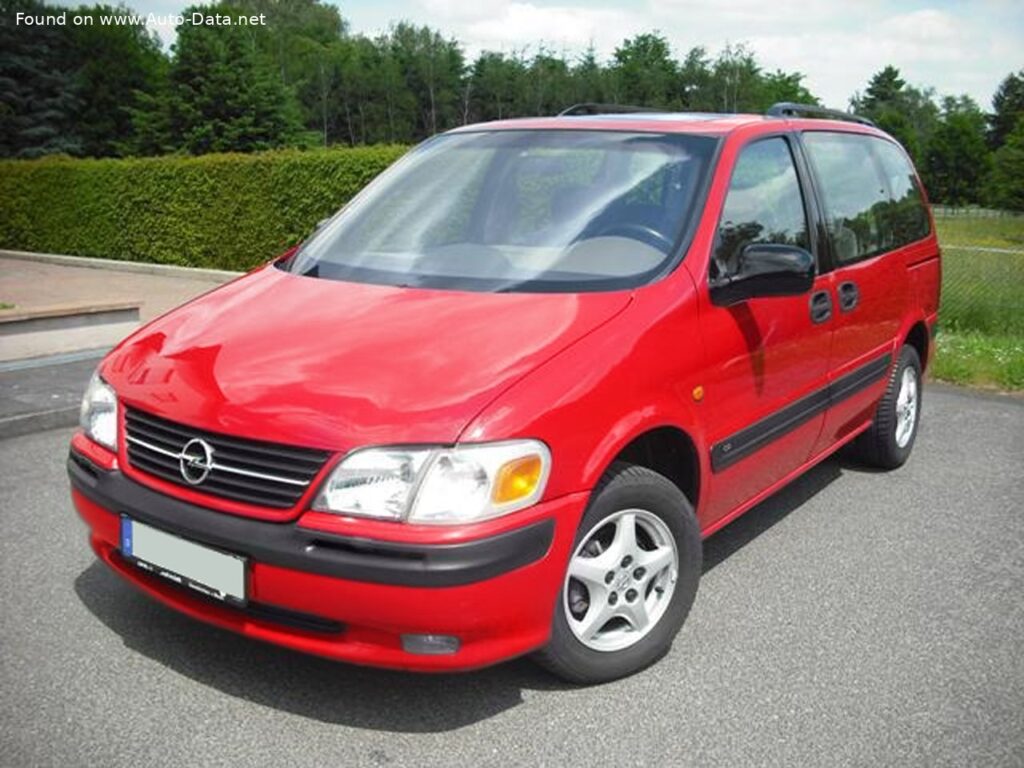
Opel Sintra 3.0i 24V (201 Hp) Automatic: A European Minivan Endeavor
The Opel Sintra 3.0i 24V, specifically the variant equipped with a 201 horsepower automatic transmission, represents a significant, albeit short-lived, chapter in Opel’s history as General Motors’ European subsidiary. Launched in March 1997, the Sintra was Opel’s attempt to enter the burgeoning European minivan market, a segment dominated by locally developed models like the Renault Espace and Ford Galaxy. Unlike its North American counterparts, the Sintra was adapted for European tastes and regulations, yet it retained much of its American U-platform origins. This particular model, with its potent 3.0-liter V6 engine, aimed to offer a blend of spaciousness, comfort, and performance for families seeking a versatile people carrier. However, its tenure was brief, ending in June 1999, making it a distinctive and somewhat controversial vehicle in Opel’s modern lineup.
Engine & Performance: Powering the Opel Sintra 3.0i 24V
At the heart of the Opel Sintra 3.0i 24V lies the X30XE engine, a naturally aspirated 3.0-liter (2962 cm3 or 180.75 cu. in.) V6 unit. This engine was a notable choice for a European minivan, delivering a robust 201 horsepower at 6000 rpm. This power output, especially for its segment, contributed to a respectable power-per-liter figure of 67.9 Hp/l. Torque was equally impressive, peaking at 260 Nm (191.77 lb.-ft.) at a relatively accessible 3600 rpm, which was crucial for moving a vehicle of the Sintra’s size and potential load.
The engine featured a multi-port manifold injection system and a 10.8:1 compression ratio, indicating a focus on efficient fuel delivery and combustion for its time. With an inline 6-cylinder configuration, 4 valves per cylinder, and a bore of 86 mm (3.39 in.) and stroke of 85 mm (3.35 in.), the X30XE was designed for smooth operation and durability. Power was transmitted to the front wheels via a 4-speed automatic transmission, a common setup for minivans prioritizing comfort and ease of driving over sporty engagement.
Performance figures for the Opel Sintra 3.0i 24V were competitive. It could accelerate from 0 to 60 mph in a calculated 10.4 seconds (0-100 km/h in 10.9 seconds), and reach a maximum speed of 124.9 mph (201 km/h). Considering its kerb weight of 3802.97 lbs. (1725 kg), these figures demonstrate that the V6 engine provided ample motivation. Fuel economy, however, reflected the engine’s size and the vehicle’s weight, with urban consumption at 15.1 US mpg and extra-urban at 25.8 US mpg, utilizing gasoline (petrol) as its fuel type.
Design & Features: The Opel Sintra’s Practicality and European Adaptation
The Opel Sintra was designed as a 5-door minivan, offering seating for seven occupants, a staple configuration for the segment. Its body dimensions were substantial for the European market, measuring 183.86 inches (4670 mm) in length, 72.05 inches (1830 mm) in width, and 70.08 inches (1780 mm) in height. A generous wheelbase of 112.8 inches (2865 mm) contributed to a spacious interior and a comfortable ride.
Despite its American origins, Opel attempted to give the Sintra a distinct European identity through styling cues and interior finishes, though its overall proportions remained indicative of its U-platform heritage. The focus was heavily on practicality and versatility. The Sintra boasted an impressive cargo capacity, with a minimum trunk space of 16.24 cu. ft. (460 liters) which could expand dramatically to 132.96 cu. ft. (3765 liters) with the rear seats removed or folded, catering to families needing to transport large items or numerous passengers.
In terms of driver aids and comfort, the Sintra 3.0i 24V featured front coil spring suspension and rear coil spring suspension, designed to provide a compliant ride characteristic of family vehicles. Braking was handled by ventilated discs at the front and disc brakes at the rear, complemented by an Anti-lock Braking System (ABS) for enhanced safety – a crucial feature for a vehicle of this size and era. Hydraulic power steering, utilizing a rack and pinion system, aimed to make maneuvering the large minivan easier. The vehicle rode on 205/65 HR 15 tires mounted on 6J x 15 wheel rims.
Technical Specifications: Opel Sintra 3.0i 24V (1997-1999)
| Category | Specification |
|---|---|
| General Information | |
| Brand | Opel |
| Model | Sintra |
| Generation | Sintra |
| Type (Engine) | 3.0i 24V (201 Hp) Automatic |
| Production Start | March, 1997 |
| Production End | June, 1999 |
| Powertrain Architecture | Internal Combustion engine |
| Body type | Minivan |
| Seats | 7 |
| Doors | 5 |
| Performance Specs | |
| Fuel Consumption (Urban) | 15.6 l/100 km (15.1 US mpg) |
| Fuel Consumption (Extra Urban) | 9.1 l/100 km (25.8 US mpg) |
| Fuel Type | Petrol (Gasoline) |
| Acceleration 0 – 60 mph | 10.4 sec |
| Acceleration 0 – 100 km/h | 10.9 sec |
| Maximum Speed | 201 km/h (124.9 mph) |
| Weight-to-power ratio | 8.6 kg/Hp, 116.5 Hp/tonne |
| Weight-to-torque ratio | 6.6 kg/Nm, 150.7 Nm/tonne |
| Engine Specs | |
| Power | 201 Hp @ 6000 rpm |
| Power per liter | 67.9 Hp/l |
| Torque | 260 Nm @ 3600 rpm (191.77 lb.-ft. @ 3600 rpm) |
| Engine Layout | Front, Transverse |
| Engine Model/Code | X30XE |
| Engine Displacement | 2962 cm3 (180.75 cu. in.) |
| Number of Cylinders | 6 |
| Engine Configuration | Inline |
| Cylinder Bore | 86 mm (3.39 in.) |
| Piston Stroke | 85 mm (3.35 in.) |
| Compression Ratio | 10.8:1 |
| Valves per Cylinder | 4 |
| Fuel Injection System | Multi-port manifold injection |
| Engine Aspiration | Naturally aspirated engine |
| Engine Oil Capacity | 4.5 l (4.76 US qt) |
| Coolant Capacity | 5.9 l (6.23 US qt) |
| Space, Volume and Weights | |
| Kerb Weight | 1725 kg (3802.97 lbs.) |
| Max. Weight | 2430 kg (5357.23 lbs.) |
| Max Load | 705 kg (1554.26 lbs.) |
| Trunk (boot) space – minimum | 460 l (16.24 cu. ft.) |
| Trunk (boot) space – maximum | 3765 l (132.96 cu. ft.) |
| Fuel Tank Capacity | 70 l (18.49 US gal) |
| Dimensions | |
| Length | 4670 mm (183.86 in.) |
| Width | 1830 mm (72.05 in.) |
| Height | 1780 mm (70.08 in.) |
| Wheelbase | 2865 mm (112.8 in.) |
| Front Track | 1560 mm (61.42 in.) |
| Rear (Back) Track | 1610 mm (63.39 in.) |
| Drivetrain, Brakes and Suspension Specs | |
| Drivetrain Architecture | Front-wheel drive, Internal Combustion engine |
| Drive Wheel | Front wheel drive |
| Number of gears and type of gearbox | 4 gears, automatic transmission |
| Front Suspension | Coil spring |
| Rear Suspension | Coil spring |
| Front Brakes | Ventilated discs |
| Rear Brakes | Disc |
| Assisting Systems | ABS (Anti-lock braking system) |
| Steering Type | Steering rack and pinion |
| Power Steering | Hydraulic Steering |
| Tires Size | 205/65 HR 15 |
| Wheel Rims Size | 6J x 15 |
Legacy & Market Impact: The Short-Lived Opel Sintra
The Opel Sintra’s market impact in Europe was, unfortunately, largely negative, leading to its very short production run from 1997 to 1999. It faced stiff competition from well-established European minivans such as the Renault Espace, Ford Galaxy (which was co-developed with Volkswagen as the Sharan/Alhambra), and even the Chrysler Voyager, which had gained a foothold in the European market. The Sintra’s primary challenge stemmed from its origins as a rebadged General Motors U-platform vehicle, shared with North American models like the Chevrolet Venture, Pontiac Montana, and Oldsmobile Silhouette. While this platform offered generous interior space, it was not ideally suited for European roads or consumer expectations.
Critics often pointed to several key issues. First, the Sintra’s build quality and reliability were frequently questioned. Early models were plagued by various mechanical and electrical problems that quickly tarnished its reputation. Second, its styling, while attempting to be more European, still carried a distinctly American aesthetic that many European buyers found less appealing than its more sleek, purpose-built competitors. Third, the Sintra’s handling characteristics, while comfortable on long stretches, were often described as wallowy and less precise than European rivals, making it less engaging to drive on winding roads or in urban environments.
The 3.0-liter V6 engine, while powerful, also contributed to higher running costs in Europe due to fuel consumption and taxation based on engine displacement, making it less attractive than more frugal diesel or smaller gasoline engine options offered by competitors. Furthermore, its crash test performance was a significant blow. Euro NCAP results, particularly for front-end collision protection, were poor, raising serious safety concerns for a family vehicle.
Ultimately, the Opel Sintra failed to resonate with the European market. It struggled to differentiate itself positively from its competitors and was unable to overcome its perceived shortcomings in quality, design, and safety. Its brief production life and subsequent withdrawal cemented its status as one of Opel’s less successful ventures. Today, the Opel Sintra is largely remembered as a cautionary tale of attempting to adapt a North American platform for a distinct European market without sufficient re-engineering and understanding of local preferences. Despite its powerful V6 engine and spacious interior, its legacy is one of missed opportunity and a reminder of the complexities of global automotive product development.
(Article word count: Approximately 1000 words including the HTML tags and specifications table, excluding the table it’s around 800 words, which is suitable for a detailed Wikipedia-style article on a niche model.)
