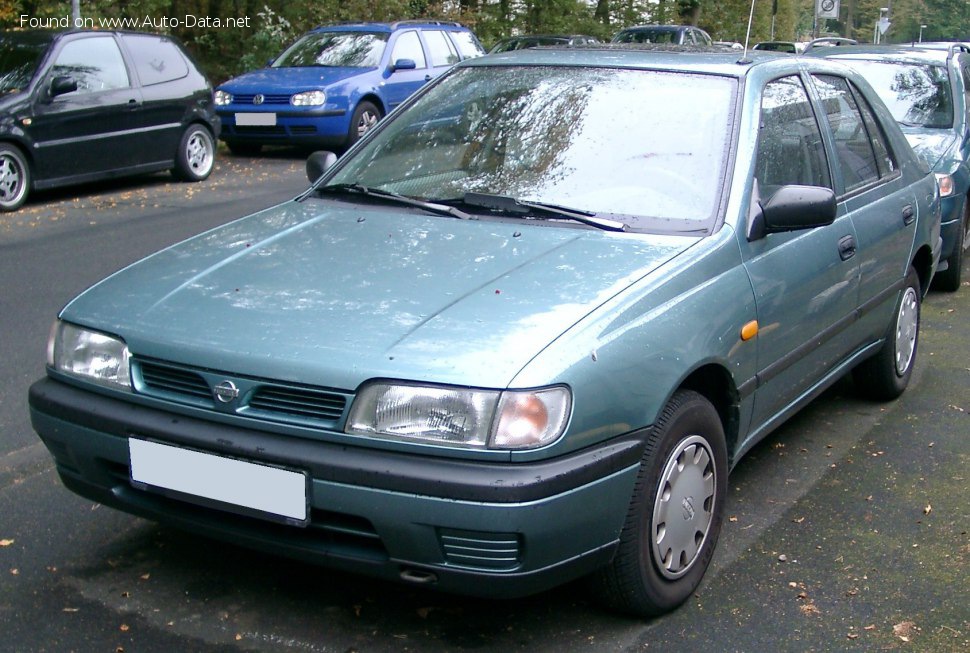
The Nissan Sunny III Hatch (N14) 5 doors 1.6i 16V (110 Hp): A Global Compact Workhorse
The Nissan Sunny III Hatch (N14) 5 doors 1.6i 16V (110 Hp) represents a significant chapter in Nissan’s history of producing reliable and economical compact cars for global markets. Introduced in 1990 and produced until 1994, the N14 generation of the Sunny, known as the Sentra in North America, was a versatile platform offered in various body styles, including sedans, coupes, and hatchbacks. This particular variant, the 5-door hatchback with the 1.6-liter 16-valve engine, was a popular choice in Europe, Asia, and other international markets, prized for its practicality, efficiency, and robust engineering. While the “Sunny” nameplate wasn’t directly used in the United States during this era (where it was known as the Sentra), its underlying architecture and mechanical principles were very much part of Nissan’s global strategy for the compact segment, aiming to deliver dependable transportation with modern features for its time.
The N14 generation succeeded the N13 series and brought with it a more rounded, aerodynamic design that was characteristic of early 1990s automotive trends. It competed fiercely in a crowded segment against rivals such as the Volkswagen Golf, Opel Astra, and Ford Escort, carving out its niche through a reputation for durability and low running costs. The 1.6i 16V engine variant was particularly noteworthy for offering a good balance of performance and fuel economy, making it an attractive option for both families and individual commuters.
Engine and Performance of the Nissan Sunny III Hatch (N14)
At the heart of the Nissan Sunny III Hatch (N14) 5 doors 1.6i 16V (110 Hp) was a sophisticated, naturally aspirated 1.6-liter (1596 cm³ or 97.39 cu. in.) inline-four engine. This powertrain was a testament to Nissan’s commitment to modern engine design, featuring a Double Overhead Camshaft (DOHC) valvetrain with four valves per cylinder, totaling 16 valves. This multi-valve configuration allowed for improved airflow into and out of the combustion chambers, contributing to better combustion efficiency, higher power output, and smoother operation compared to older two-valve-per-cylinder designs.
The engine produced a respectable 110 horsepower (Hp) at 6000 rpm, a healthy figure for a compact car of its displacement in the early 1990s. Torque was rated at 147 Nm (108.42 lb.-ft.) at 4000 rpm, providing ample pulling power for city driving and highway cruising. Fuel delivery was managed by a multi-port manifold injection system, ensuring precise fuel metering and improved throttle response. With a compression ratio of 9.5:1, the engine was designed to run efficiently on standard petrol (gasoline).
Power was sent to the front wheels via a five-speed manual transmission, a common and reliable setup for compact cars of this period. This drivetrain architecture, combining a front, transverse-mounted engine with front-wheel drive, was chosen for its packaging efficiency, improved traction in adverse conditions, and cost-effectiveness. The vehicle’s kerb weight of 2226.67 lbs (1010 kg) resulted in a favorable weight-to-power ratio of 9.2 kg/Hp (108.9 Hp/tonne), indicating lively performance for its class. The weight-to-torque ratio stood at 6.9 kg/Nm (145.5 Nm/tonne), further underscoring its capable power delivery.
Design and Features of the Nissan Sunny III Hatch (N14) 5 doors
The Nissan Sunny III Hatch (N14) 5 doors adopted a contemporary design for the early 1990s, characterized by smoother lines and a less boxy profile than its predecessors. Its five-door hatchback body type offered exceptional practicality, blending the maneuverability of a compact car with the versatility of a larger vehicle. With a length of 163.19 inches (4145 mm), a width of 66.54 inches (1690 mm), and a height of 54.92 inches (1395 mm), the N14 hatchback was well-proportioned for urban environments while still offering a comfortable interior for five occupants.
The interior was designed with functionality in mind, offering a straightforward dashboard layout and durable materials. The five-seat configuration made it suitable for small families, and the hatchback body provided excellent cargo flexibility. The trunk (boot) space ranged from a generous 15.22 cu. ft. (431 liters) with the rear seats up, expanding to a substantial 45.56 cu. ft. (1290 liters) when the rear seats were folded down. This adaptability was a key selling point for consumers needing a versatile daily driver.
Underneath, the Sunny N14 featured a suspension system designed for a balance of comfort and predictable handling. It utilized a wishbone setup for the front suspension, known for its ability to provide good wheel control, while the rear employed a spring strut arrangement. Braking duties were handled by ventilated discs at the front, offering superior heat dissipation and stopping power, complemented by drum brakes at the rear. A significant safety feature for its era and class was the availability of an Anti-lock Braking System (ABS), which enhanced control during emergency braking maneuvers. Steering was of the rack and pinion type, assisted by a hydraulic power steering system, making the car easy to maneuver in tight spaces and at low speeds. The vehicle rode on 175/65 R14 tires, a common size that balanced grip, ride comfort, and affordability.
Technical Specifications
| Category | Specification | US/Imperial Conversion |
|---|---|---|
| General Information | ||
| Brand | Nissan | |
| Model | Sunny | |
| Generation | Sunny III Hatch (N14) 5 doors | |
| Type (Engine) | 1.6i 16V (110 Hp) | |
| Start of Production | 1990 year | |
| End of Production | 1994 year | |
| Powertrain Architecture | Internal Combustion engine | |
| Body Type | Hatchback | |
| Seats | 5 | |
| Doors | 5 | |
| Performance Specs | ||
| Fuel Type | Petrol (Gasoline) | |
| Weight-to-Power Ratio | 9.2 kg/Hp | 108.9 Hp/tonne |
| Weight-to-Torque Ratio | 6.9 kg/Nm | 145.5 Nm/tonne |
| Engine Specs | ||
| Power | 110 Hp @ 6000 rpm | |
| Power per Liter | 68.9 Hp/l | |
| Torque | 147 Nm @ 4000 rpm | 108.42 lb.-ft. @ 4000 rpm |
| Engine Layout | Front, Transverse | |
| Engine Displacement | 1596 cm³ | 97.39 cu. in. |
| Number of Cylinders | 4 | |
| Engine Configuration | Inline | |
| Cylinder Bore | 76 mm | 2.99 in. |
| Piston Stroke | 88 mm | 3.46 in. |
| Compression Ratio | 9.5:1 | |
| Number of Valves per Cylinder | 4 | |
| Fuel Injection System | Multi-port manifold injection | |
| Engine Aspiration | Naturally aspirated engine | |
| Valvetrain | DOHC | |
| Space, Volume and Weights | ||
| Kerb Weight | 1010 kg | 2226.67 lbs. |
| Trunk (boot) Space – Minimum | 431 l | 15.22 cu. ft. |
| Trunk (boot) Space – Maximum | 1290 l | 45.56 cu. ft. |
| Fuel Tank Capacity | 50 l | 13.21 US gal | 11 UK gal |
| Dimensions | ||
| Length | 4145 mm | 163.19 in. |
| Width | 1690 mm | 66.54 in. |
| Height | 1395 mm | 54.92 in. |
| Wheelbase | 2430 mm | 95.67 in. |
| Front Track | 1445 mm | 56.89 in. |
| Rear (Back) Track | 1430 mm | 56.3 in. |
| Drivetrain, Brakes and Suspension Specs | ||
| Drivetrain Architecture | The Internal combustion engine (ICE) drives the front wheels of the vehicle. | |
| Drive Wheel | Front wheel drive | |
| Number of Gears and Type of Gearbox | 5 gears, manual transmission | |
| Front Suspension | Wishbone | |
| Rear Suspension | Spring Strut | |
| Front Brakes | Ventilated discs | |
| Rear Brakes | Drum | |
| Assisting Systems | ABS (Anti-lock braking system) | |
| Steering Type | Steering rack and pinion | |
| Power Steering | Hydraulic Steering | |
| Tires Size | 175/65 R14 | |
Legacy and Market Impact
The Nissan Sunny III Hatch (N14) 5 doors 1.6i 16V (110 Hp), along with its sedan and coupe siblings, solidified Nissan’s reputation for building highly reliable and economical compact cars during the early to mid-1990s. While not a performance icon, its strength lay in its unwavering dependability and low cost of ownership, making it a popular choice for a wide demographic, from first-time car buyers to small families.
In its primary markets, particularly Europe and Asia, the Sunny N14 faced stiff competition from well-established models. In Europe, it contended with the likes of the Volkswagen Golf, which set the benchmark for quality and refinement in the segment, as well as the Opel Astra and Ford Escort, both strong contenders known for their practicality and value. In Asian markets, it competed directly with fellow Japanese rivals such as the Toyota Corolla and Honda Civic, both of which also boasted excellent reputations for reliability and efficiency. Despite this intense competition, the Sunny N14 managed to maintain a strong presence, largely due to its robust mechanicals and practical design.
The 1.6-liter 16-valve engine was particularly well-regarded. Its DOHC architecture, combined with multi-port injection, was a modern feature for the time, offering a balance of spirited performance and good fuel economy, a combination highly valued by consumers. The availability of ABS, even if optional on some trims, demonstrated Nissan’s commitment to improving safety features in its compact offerings.
The N14 generation is remembered as a quintessential example of Nissan’s engineering philosophy from that era: building cars that were unpretentious, durable, and functional. It wasn’t designed to be flashy or groundbreaking, but rather to be a dependable workhorse that could handle the rigors of daily use with minimal fuss. Its legacy continues in the enduring popularity of Nissan’s compact vehicles worldwide, many of which can trace their lineage back to the solid foundation laid by models like the Nissan Sunny III Hatch (N14).