Introduction to the Skoda Octavia III RS 2.0 TSI (220 Hp) DSG
The Skoda Octavia III RS 2.0 TSI (220 Hp) DSG represents a compelling blend of performance, practicality, and value within the European automotive landscape. Produced between 2013 and 2017, this third-generation Octavia variant solidified Skoda’s reputation for offering a more accessible and spacious alternative to traditional “hot hatchbacks” from its Volkswagen Group stablemates. While the Skoda brand is not officially sold in the United States, the Octavia RS is a highly regarded model in its primary markets, particularly across Europe, the UK, and Australia, where it is celebrated for delivering an engaging driving experience without compromising on its core family car competencies.
Positioned as a performance-oriented compact family car, the Octavia III RS carved out a unique niche. It combined the generous interior space and large cargo capacity of a conventional family hatchback with the spirited performance typically associated with smaller, more focused enthusiast vehicles. The “RS” designation, standing for “Rally Sport,” has a rich heritage within Skoda, signaling a commitment to sportiness and dynamic capability. The 2.0 TSI engine, coupled with a responsive DSG automatic transmission, promised an exhilarating ride for drivers while maintaining the everyday usability that the Octavia line is known for. This model showcased Skoda’s maturation under Volkswagen Group ownership, demonstrating its ability to produce vehicles that are not only sensible and reliable but also genuinely exciting to drive.
Powertrain and Performance Dynamics of the Skoda Octavia III RS 2.0 TSI (220 Hp) DSG
At the heart of the performance-oriented Skoda Octavia III RS 2.0 TSI (220 Hp) DSG lies a robust and widely acclaimed powertrain. This model is equipped with the EA888 / CHHB engine code, a 2.0-liter (121.07 cu. in.) turbocharged inline-four gasoline unit, a staple within the Volkswagen Group for its excellent balance of power, efficiency, and tunability. The engine layout is front and transverse, driving the front wheels, a typical configuration for this segment.
Engine Specifications and Output
The 2.0-liter TSI engine is a sophisticated unit featuring a DOHC valvetrain with four valves per cylinder, ensuring optimal airflow for combustion. Its advanced fuel injection system combines both direct injection and multi-port manifold injection, a strategy employed to enhance fuel atomization across various engine loads, leading to improved efficiency and reduced emissions. Coupled with a turbocharger and intercooler, this setup allows the engine to produce a potent 220 horsepower, available across a broad rev range from 4500 to 6200 rpm. This impressive power output translates to a power per liter figure of 110.9 HP/l, underscoring the engine’s efficiency in generating power from its displacement.
Torque delivery is equally impressive, with a substantial 350 Newton-meters (258.15 lb.-ft.) available from a remarkably low 1500 rpm and sustained up to 4400 rpm. This wide torque band contributes significantly to the car’s flexible and responsive nature, providing strong acceleration from virtually any speed. The engine’s compression ratio stands at 9.6:1, indicative of its forced-induction design. Furthermore, modern efficiency features like a Start & Stop System contribute to its overall fuel economy and lower CO2 emissions.
Acceleration and Top Speed
Power is channeled to the front wheels via a quick-shifting 6-speed automatic Direct-Shift Gearbox (DSG). This dual-clutch transmission is renowned for its rapid gear changes, which contribute to the car’s sporty performance and seamless power delivery. The combination of the potent engine and the efficient DSG transmission allows the Octavia III RS 2.0 TSI to accelerate from 0 to 60 mph in a swift 6.6 seconds. Its top speed is rated at 152.24 mph (245 km/h), making it a capable performer on European highways.
Despite its performance capabilities, the Octavia RS also demonstrates commendable fuel efficiency for its class. The combined fuel consumption is rated at 36.8 US mpg (6.4 l/100 km), with urban figures around 29 US mpg (8.1 l/100 km) and extra-urban figures reaching an impressive 43.6 US mpg (5.4 l/100 km). With CO2 emissions of 149 g/km, it meets the stringent Euro 6 emission standard, highlighting its modern environmental compliance. The vehicle’s weight-to-power ratio is 6.2 kg/Hp, or 161.2 Hp/tonne, further emphasizing its performance credentials.
Design, Practicality, and Advanced Features
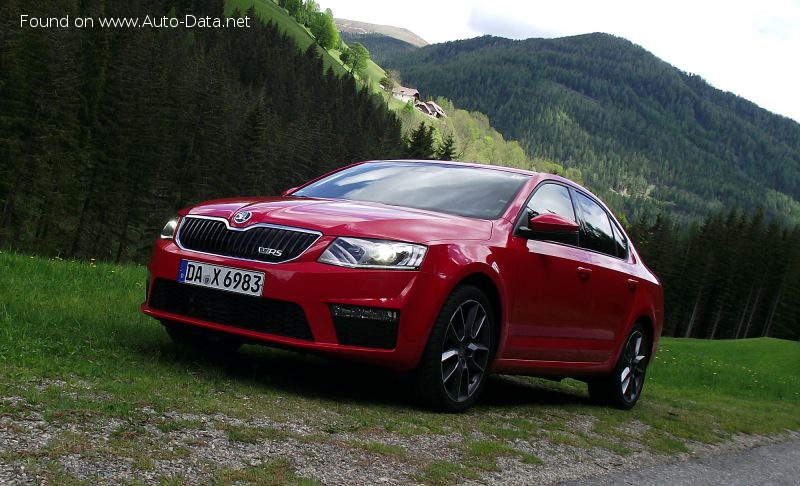
The Skoda Octavia III RS 2.0 TSI (220 Hp) DSG is a 5-door hatchback designed for both spirited driving and everyday utility. Its design language subtly enhances the standard Octavia’s practical silhouette with sporty cues, ensuring it stands out without being overtly aggressive.
Exterior and Interior Design Philosophy
Dimensionally, the Octavia RS measures 184.45 inches in length, 71.42 inches in width (79.41 inches including mirrors), and 57.05 inches in height, with a wheelbase of 105.51 inches. These dimensions contribute to a spacious cabin and a substantial road presence. The RS model features specific design elements such as sportier bumpers, a unique grille, and larger alloy wheels (standard 225/45 R17, optional 225/35 R19) that hint at its performance capabilities. The ride height, at 5.04 inches, is slightly lower than standard Octavia models, contributing to its dynamic handling characteristics.
Inside, the Octavia RS maintains a focus on driver engagement and passenger comfort. The 5-seat configuration offers ample room for occupants, while the robust build quality and ergonomic layout are typical of modern Skoda vehicles. Crucially, the hatchback body style provides exceptional cargo flexibility. With the rear seats in place, the trunk offers a generous 20.84 cubic feet (590 liters) of space. Folding the rear seats expands this to a cavernous 55.8 cubic feet (1580 liters), making the Octavia RS one of the most practical performance cars in its segment. The fuel tank capacity is 13.21 US gallons (50 liters), providing a decent range between fill-ups.
Safety and Driver Assistance
In terms of chassis and safety, the Octavia III RS is well-equipped. It features an independent McPherson front suspension with a coil spring and anti-roll bar, paired with an independent multi-link spring suspension with a stabilizer at the rear. This setup is tuned for a sportier ride while maintaining comfort. Braking is handled by ventilated discs at the front and solid discs at the rear, supported by an Anti-lock Braking System (ABS). The electric power steering system, with its rack and pinion setup, provides precise feedback and effortless maneuverability. As a vehicle from the mid-2010s, it incorporates contemporary safety standards and features, although specific advanced driver-assistance systems (ADAS) beyond ABS would typically be optional for this era.
Comprehensive Technical Specifications
Below is a detailed table of the technical specifications for the Skoda Octavia III RS 2.0 TSI (220 Hp) DSG:
| Specification | Value |
|---|---|
| Brand | Skoda |
| Model | Octavia |
| Generation | Octavia III |
| Type (Engine) | RS 2.0 TSI (220 Hp) DSG |
| Start of Production | 2013 year |
| End of Production | 2017 year |
| Powertrain Architecture | Internal Combustion engine |
| Body Type | Hatchback |
| Seats | 5 |
| Doors | 5 |
| Performance Specifications | |
| Fuel Consumption (Urban) | 8.1 l/100 km (29 US mpg) |
| Fuel Consumption (Extra Urban) | 5.4 l/100 km (43.6 US mpg) |
| Fuel Consumption (Combined) | 6.4 l/100 km (36.8 US mpg) |
| CO2 Emissions | 149 g/km |
| Fuel Type | Petrol (Gasoline) |
| Acceleration 0 – 60 mph | 6.6 sec |
| Maximum Speed | 245 km/h (152.24 mph) |
| Emission Standard | Euro 6 |
| Weight-to-Power Ratio | 6.2 kg/Hp (161.2 Hp/tonne) |
| Weight-to-Torque Ratio | 3.9 kg/Nm (256.4 Nm/tonne) |
| Engine Specifications | |
| Power | 220 Hp @ 4500-6200 rpm |
| Power per Liter | 110.9 Hp/l |
| Torque | 350 Nm (258.15 lb.-ft.) @ 1500-4400 rpm |
| Engine Layout | Front, Transverse |
| Engine Model/Code | EA888 / CHHB |
| Engine Displacement | 1984 cm3 (2.0 Liters / 121.07 cu. in.) |
| Number of Cylinders | 4 |
| Engine Configuration | Inline |
| Cylinder Bore | 82.5 mm (3.25 in.) |
| Piston Stroke | 92.8 mm (3.65 in.) |
| Compression Ratio | 9.6:1 |
| Number of Valves per Cylinder | 4 |
| Fuel Injection System | Direct injection and Multi-port manifold injection |
| Engine Aspiration | Turbocharger, Intercooler |
| Valvetrain | DOHC |
| Engine Oil Capacity | 5.7 l (6.02 US qt) |
| Coolant Capacity | 8.6 l (9.09 US qt) |
| Engine Systems | Start & Stop System |
| Space, Volume, and Weights | |
| Kerb Weight | 1365 kg (3009.31 lbs.) |
| Max. Weight | 1907 kg (4204.22 lbs.) |
| Max Load | 542 kg (1194.91 lbs.) |
| Trunk (Boot) Space – Minimum | 590 l (20.84 cu. ft.) |
| Trunk (Boot) Space – Maximum | 1580 l (55.8 cu. ft.) |
| Fuel Tank Capacity | 50 l (13.21 US gal) |
| Permitted Trailer Load with Brakes (12%) | 1600 kg (3527.4 lbs.) |
| Permitted Trailer Load without Brakes | 720 kg (1587.33 lbs.) |
| Dimensions | |
| Length | 4685 mm (184.45 in.) |
| Width | 1814 mm (71.42 in.) |
| Width including mirrors | 2017 mm (79.41 in.) |
| Height | 1449 mm (57.05 in.) |
| Wheelbase | 2680 mm (105.51 in.) |
| Front Track | 1535 mm (60.43 in.) |
| Rear (Back) Track | 1506 mm (59.29 in.) |
| Front Overhang | 899 mm (35.39 in.) |
| Rear Overhang | 1106 mm (43.54 in.) |
| Ride Height (Ground Clearance) | 128 mm (5.04 in.) |
| Minimum Turning Circle (Diameter) | 11.13 m (36.52 ft.) |
| Approach Angle | 12.9° |
| Departure Angle | 12.4° |
| Drivetrain, Brakes, and Suspension Specifications | |
| Drivetrain Architecture | The Internal combustion engine (ICE) drives the front wheels of the vehicle. |
| Drive Wheel | Front wheel drive |
| Number of Gears and Type of Gearbox | 6 gears, automatic transmission DSG |
| Front Suspension | Independent, type McPherson with coil spring and anti-roll bar |
| Rear Suspension | Independent multi-link spring suspension with stabilizer |
| Front Brakes | Ventilated discs |
| Rear Brakes | Disc |
| Assisting Systems | ABS (Anti-lock braking system) |
| Steering Type | Steering rack and pinion |
| Power Steering | Electric Steering |
| Tires Size | 225/45 R17; 225/35 R19 |
| Wheel Rims Size | 7.5J x 17; 7.5J x 19 |
Legacy and Market Impact in Europe