The Mercedes-Benz SLK (R172) SLK 250 (204 Hp): A Modern Classic Roadster
The Mercedes-Benz SLK, a name synonymous with compact luxury roadsters, entered its third generation with the R172 chassis, produced from 2011 to 2015. This iteration marked a significant evolution for the series, shedding some of the softer styling cues of its predecessors for a more assertive, masculine design inspired by the legendary Mercedes-Benz SLS AMG. Among the various powertrain options offered, the Mercedes-Benz SLK (R172) SLK 250 (204 Hp) emerged as a compelling choice for enthusiasts seeking a blend of performance, efficiency, and the quintessential open-top driving experience. Positioned in the premium compact roadster segment, the SLK 250 aimed to capture a broad audience, offering a sophisticated alternative to its competitors while retaining the signature retractable hardtop that had become a hallmark of the SLK line.
For the US market, the R172 generation, including the SLK 250, was well-received, building on the success of the prior generations. While the SLK 250 variant with its 204 horsepower engine was particularly popular in Europe for its balance of power and fuel economy, it also found a dedicated following in North America. Its role in the market was to provide a more accessible entry point into the Mercedes-Benz roadster lineup compared to the higher-performance SLK 350 or the range-topping SLK 55 AMG, without compromising on luxury or brand prestige. The R172 generation, and specifically the SLK 250, represented Mercedes-Benz’s commitment to delivering a dynamic and elegant two-seat convertible experience, blending advanced technology with timeless design.
Engine & Performance of the Mercedes-Benz SLK (R172) SLK 250
Under the hood of the Mercedes-Benz SLK (R172) SLK 250 (204 Hp) lies a sophisticated M 271.861 inline four-cylinder engine. This 1.8-liter (1796 cm3 or 109.6 cu. in.) powerplant represented a modern approach to performance and efficiency for its era. Unlike the naturally aspirated engines of some rivals, Mercedes-Benz opted for a turbocharger with an intercooler, allowing the relatively small displacement engine to produce impressive figures. It generates a robust 204 horsepower at 5500 rpm and a substantial 228.64 lb.-ft. (310 Nm) of torque, available across a broad rev range from 2000 to 4300 rpm. This wide torque band ensures responsive acceleration and flexible in-gear performance, making it enjoyable for both spirited driving and relaxed cruising.
Power is efficiently delivered to the rear wheels via a standard 6-speed manual transmission, a choice that appealed to driving purists seeking a more engaging experience. This drivetrain architecture, combined with the engine’s output, allows the SLK 250 to achieve a 0-60 mph acceleration time of a brisk 6.2 seconds, with 0-100 km/h achieved in 6.5 seconds. The top speed is electronically limited to 151.61 mph (244 km/h), firmly placing it in the realm of true sports cars.
Beyond raw power, the M 271.861 engine incorporates several technologies aimed at enhancing efficiency and reducing emissions. Direct fuel injection optimizes combustion, while the DOHC (Dual Overhead Camshaft) valvetrain ensures precise valve timing. A notable inclusion for its time was the Start & Stop System, which automatically shuts off the engine when the vehicle is stationary and restarts it instantly when the driver is ready to move. This feature significantly contributed to the SLK 250’s respectable fuel economy figures, achieving a combined rating of 34.1 – 32.2 US mpg (6.9-7.3 l/100 km). CO2 emissions ranging from 160-169 g/km also met the stringent Euro 5 emission standard, reflecting Mercedes-Benz’s commitment to environmental responsibility.
Design & Features of the SLK (R172)
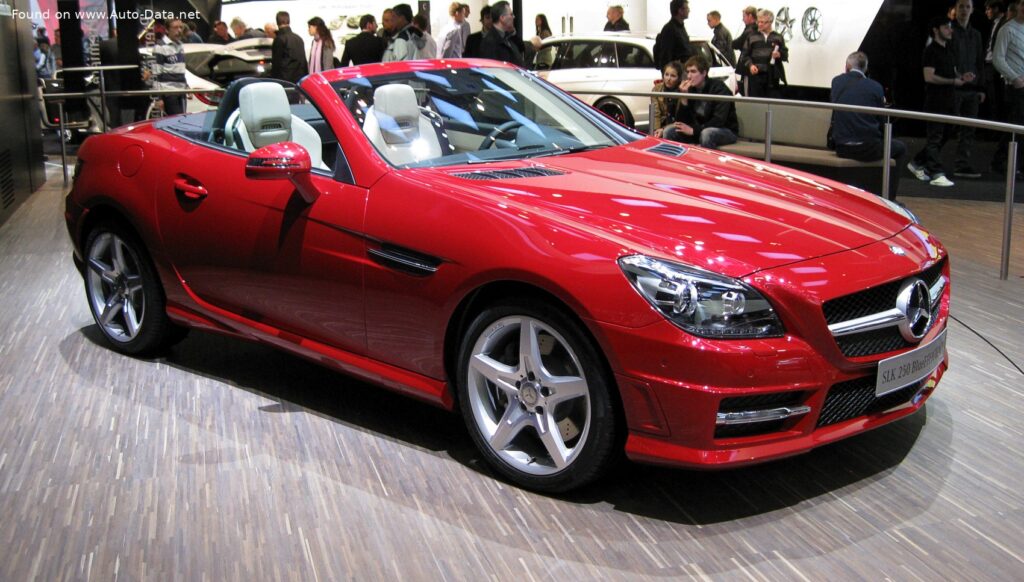
The R172 generation of the SLK marked a significant departure from its predecessors in terms of design philosophy. While retaining the iconic two-door, two-seat roadster body type, its styling became noticeably more aggressive and mature. The front fascia, with its upright grille and prominent three-pointed star, directly echoed the styling of the Mercedes-Benz SLS AMG supercar, giving the SLK a more serious and prestigious demeanor. The headlights were redesigned to be sharper and more angular, contributing to a modern and dynamic appearance.
Measuring 162.76 inches (4134 mm) in length, 71.26 inches (1810 mm) in width, and 51.22 inches (1301 mm) in height, the R172 SLK 250 possessed compact dimensions ideal for a nimble roadster. Its wheelbase of 95.67 inches (2430 mm) contributed to its agile handling characteristics. A low drag coefficient (Cd) of 0.32 underscored the aerodynamic considerations in its design, helping improve both performance and fuel efficiency.
A defining feature of the SLK line, carried over and refined in the R172, was its vario-roof – a retractable hardtop that transformed the car from a sleek coupe to an open-air roadster in mere seconds. While not explicitly detailed in the provided data, this feature was central to the SLK’s appeal, offering the best of both worlds: the security and refinement of a coupe with the exhilaration of a convertible. The trunk space, while modest for a roadster, offered a practical 7.95 cu. ft. (225 l) with the roof down, expanding to 11.83 cu. ft. (335 l) with the roof up, allowing for reasonable luggage capacity for weekend getaways.
The SLK 250 also featured a sophisticated chassis setup designed for both comfort and sporty handling. It utilized an independent McPherson strut front suspension with coil springs and an anti-roll bar, complemented by an independent multi-link spring suspension with a stabilizer at the rear. Braking power was provided by ventilated discs at the front and solid discs at the rear, coupled with an Anti-lock Braking System (ABS) for enhanced safety. Hydraulic rack and pinion steering provided direct feedback, while the staggered tire setup (225/45 R17 front, 245/40 R17 rear) on 17-inch wheels (7.5J x 17 front, 8.5J x 17 rear) ensured optimal grip and visual appeal.
Technical Specifications: Mercedes-Benz SLK (R172) SLK 250 (204 Hp)
| Category | Specification |
|---|---|
| General Information | |
| Brand | Mercedes-Benz |
| Model | SLK |
| Generation | SLK (R172) |
| Type (Engine) | SLK 250 (204 Hp) |
| Start of Production | 2011 year |
| End of Production | 2015 year |
| Powertrain Architecture | Internal Combustion engine |
| Body type | Roadster |
| Seats | 2 |
| Doors | 2 |
| Performance Specs | |
| Fuel consumption (economy) – urban | 9.5-9.8 l/100 km (24.8 – 24 US mpg) |
| Fuel consumption (economy) – extra urban | 5.3-5.8 l/100 km (44.4 – 40.6 US mpg) |
| Fuel consumption (economy) – combined | 6.9-7.3 l/100 km (34.1 – 32.2 US mpg) |
| CO2 emissions | 160-169 g/km |
| Fuel Type | Petrol (Gasoline) |
| Acceleration 0 – 60 mph | 6.2 sec |
| Acceleration 0 – 100 km/h | 6.5 sec |
| Maximum speed | 244 km/h (151.61 mph) |
| Emission standard | Euro 5 |
| Weight-to-power ratio | 6.9 kg/Hp, 145.7 Hp/tonne |
| Weight-to-torque ratio | 4.5 kg/Nm, 221.4 Nm/tonne |
| Engine Specs | |
| Power | 204 Hp @ 5500 rpm. |
| Power per liter | 113.6 Hp/l |
| Torque | 310 Nm @ 2000-4300 rpm (228.64 lb.-ft.) |
| Engine layout | Front, Longitudinal |
| Engine Model/Code | M 271.861 |
| Engine displacement | 1796 cm3 (1.8 l / 109.6 cu. in.) |
| Number of cylinders | 4 |
| Engine configuration | Inline |
| Cylinder Bore | 82 mm (3.23 in.) |
| Piston Stroke | 85 mm (3.35 in.) |
| Compression ratio | 9.3:1 |
| Number of valves per cylinder | 4 |
| Fuel injection system | Direct injection |
| Engine aspiration | Turbocharger, Intercooler |
| Valvetrain | DOHC |
| Engine oil capacity | 5.5 l (5.81 US qt) |
| Coolant | 9.6 l (10.14 US qt) |
| Engine systems | Start & Stop System |
| Space, Volume and Weights | |
| Kerb Weight | 1400 kg (3086.47 lbs.) |
| Max. weight | 1790 kg (3946.27 lbs.) |
| Max load | 390 kg (859.8 lbs.) |
| Trunk (boot) space – minimum | 225 l (7.95 cu. ft.) |
| Trunk (boot) space – maximum | 335 l (11.83 cu. ft.) |
| Fuel tank capacity | 60 l (15.85 US gal) |
| Dimensions | |
| Length | 4134 mm (162.76 in.) |
| Width | 1810 mm (71.26 in.) |
| Width including mirrors | 2006 mm (78.98 in.) |
| Height | 1301 mm (51.22 in.) |
| Wheelbase | 2430 mm (95.67 in.) |
| Front track | 1559 mm (61.38 in.) |
| Rear (Back) track | 1565 mm (61.61 in.) |
| Front overhang | 870 mm (34.25 in.) |
| Rear overhang | 834 mm (32.83 in.) |
| Drag coefficient (Cd) | 0.32 |
| Minimum turning circle (turning diameter) | 10.52 m (34.51 ft.) |
| Drivetrain, Brakes and Suspension Specs | |
| Drivetrain Architecture | Internal combustion engine (ICE) drives the rear wheels. |
| Drive wheel | Rear wheel drive |
| Number of gears and type of gearbox | 6 gears, manual transmission |
| Front suspension | Independent, type McPherson with coil spring and anti-roll bar |
| Rear suspension | Independent multi-link spring suspension with stabilizer |
| Front brakes | Ventilated discs |
| Rear brakes | Disc |
| Assisting systems | ABS (Anti-lock braking system) |
| Steering type | Steering rack and pinion |
| Power steering | Hydraulic Steering |
| Tires size | Front: 225/45 R17, Rear: 245/40 R17 |
| Wheel rims size | Front: 7.5J x 17, Rear: 8.5J x 17 |
Legacy & Market Impact of the Mercedes-Benz SLK (R172)
The Mercedes-Benz SLK (R172) generation, and particularly the SLK 250, played a pivotal role in the compact luxury roadster segment during its production run from 2011 to 2015. It inherited the legacy of the original SLK (R170), which pioneered the retractable hardtop concept, and the R171, which refined it. The R172, however, sought to imbue the SLK with a more substantial and sophisticated character, moving away from the “cute” image of its predecessors towards a miniature grand tourer feel, borrowing styling cues from the larger SL-Class and the exotic SLS AMG. This design shift broadened its appeal, attracting buyers who desired a blend of sporty driving, luxury, and the prestige associated with the Mercedes-Benz brand.
In the highly competitive market, the SLK 250 faced formidable rivals. Its primary competitors included the BMW Z4 (E89), which offered a similar retractable hardtop concept and a focus on driving dynamics; the Audi TT Roadster, known for its distinctive design and advanced Quattro all-wheel-drive (though the SLK was RWD only); and the Porsche Boxster (981), which was often regarded as the benchmark for mid-engine roadster performance. The SLK 250 carved out its niche by offering a compelling combination of Mercedes-Benz luxury, a comfortable ride, and a distinct visual presence, often perceived as more elegant and less overtly aggressive than some of its rivals.
The SLK 250’s engine, with its turbocharged 1.8-liter inline-four, was a strategic move by Mercedes-Benz to balance performance with modern efficiency standards. While some purists might have preferred a larger naturally aspirated engine, the 204 horsepower and 228.64 lb.-ft. of torque delivered by the M 271.861 engine provided ample motivation for the lightweight roadster. Its excellent fuel economy, particularly the combined 34.1 – 32.2 US mpg, was a strong selling point, especially in markets sensitive to fuel costs and emissions. The availability of a 6-speed manual transmission, alongside an optional automatic, further enhanced its appeal to a diverse range of drivers, from those seeking an engaging manual experience to those preferring the convenience of an automatic.
The R172 generation also introduced innovative features such as the “Magic Sky Control” panoramic vario-roof (an option not detailed in the provided data but a significant R172 feature), which could change from dark to transparent at the touch of a button, enhancing the open-air feeling even with the roof up. This focus on technological innovation, combined with the classic roadster formula, contributed to its positive reputation.
Ultimately, the Mercedes-Benz SLK (R172) SLK 250 (204 Hp) left a legacy as a well-rounded and sophisticated compact luxury roadster. It successfully evolved the SLK nameplate, offering a more grown-up and stylish package that appealed to both traditional Mercedes-Benz buyers and those new to the brand. Its blend of modern turbocharged performance, respectable efficiency, a comfortable and luxurious interior, and its distinctive design ensured its place as a desirable vehicle in its segment and a significant chapter in Mercedes-Benz’s history of open-top motoring. The R172 generation was eventually succeeded by the SLC-Class, marking the end of the SLK nomenclature, but its impact on the segment remains notable.