The Peugeot 307 CC 2.0 i 16V (136 Hp) Automatic: A European Convertible for the Masses
The Peugeot 307 CC, introduced in 2003, represented a significant step in the democratization of the coupe-cabriolet segment, a market niche that blended the practicality and security of a hardtop coupe with the open-air exhilaration of a convertible. Building upon the success of its smaller sibling, the 206 CC, the 307 CC offered a more substantial and refined package, aiming to appeal to a broader audience in its primary European market. This particular variant, the Peugeot 307 CC 2.0 i 16V (136 Hp) Automatic, was positioned as a comfortable and accessible cruiser, prioritizing ease of use and everyday drivability over outright performance.
Produced from 2003 to 2005, this generation of the 307 CC played a crucial role in establishing Peugeot as a leader in the then-burgeoning retractable hardtop market. While not officially sold in the United States, its design ethos and mechanical innovations had an indirect influence on global automotive trends, particularly in how manufacturers approached convertible design. It was a vehicle that embodied the French automaker’s flair for design and commitment to offering innovative body styles to a mainstream audience.
Engine and Performance of the Peugeot 307 CC
At the heart of the Peugeot 307 CC 2.0 i 16V (136 Hp) Automatic was a robust and well-proven 2.0-liter (1997 cm3) inline-four engine, codenamed RFN EW10J4. This naturally aspirated unit featured a DOHC (Double Overhead Camshaft) valvetrain with 16 valves, allowing for efficient breathing and a smooth power delivery. With a compression ratio of 10.8:1 and a multi-port manifold injection system, the engine was designed for reliable performance and reasonable fuel efficiency for its class and era.
The powerplant generated a respectable 136 horsepower at 6000 rpm, providing adequate motivation for the 307 CC. Torque output stood at 140.14 lb.-ft. (190 Nm) at 4100 rpm, ensuring decent pulling power, especially in urban environments. Power was transmitted to the front wheels via a 4-speed automatic transmission, a common setup for comfort-oriented vehicles of the period. While not a performance-focused gearbox, it offered smooth shifts and contributed to a relaxed driving experience, particularly suited for cruising.
In terms of acceleration, the Peugeot 307 CC 2.0 i 16V (136 Hp) Automatic could reach 60 mph from a standstill in an estimated 12.1 seconds, with a 0-100 km/h time of 12.7 seconds. Its top speed was rated at 126.76 mph (204 km/h). These figures placed it firmly in the category of a comfortable cruiser rather than a sporty roadster. Fuel economy, measured under European standards, translated to approximately 26.4 US mpg combined, with 18 US mpg in urban driving and an impressive 36.8 US mpg on the highway. The vehicle met the Euro 3 emission standard, with CO2 emissions of 211 g/km.
Design and Features
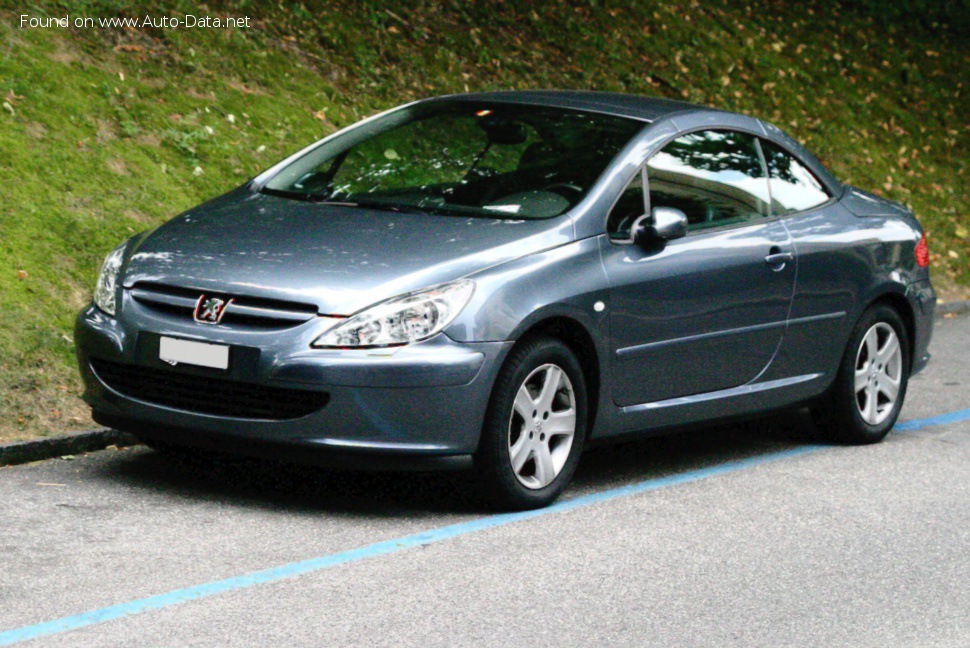
The defining characteristic of the Peugeot 307 CC was its innovative coupe-cabriolet body type, featuring a fully automatic retractable hardtop. This design offered the best of both worlds: the enhanced security, rigidity, and weather protection of a fixed-roof coupe when closed, and the exhilarating open-air freedom of a convertible when the roof was stowed. The transformation from coupe to cabriolet, and vice-versa, was a key selling point, executed with typical French ingenuity and style.
Visually, the 307 CC shared its front-end styling with the regular 307 hatchback, including its distinctive “cat’s eye” headlights and prominent Peugeot grille. However, the profile and rear were entirely unique, redesigned to accommodate the complex roof mechanism. With a length of 171.22 inches, a width of 69.25 inches, and a height of 55.79 inches, the 307 CC presented a substantial and elegant stance. The four-seat configuration, while offering more practicality than a traditional two-seater roadster, meant that rear passenger space was somewhat limited, especially with the roof down. Trunk space varied significantly depending on the roof’s position, offering a minimum of 7.24 cu. ft. with the roof stowed and expanding to 12.36 cu. ft. when closed.
Standard features for the era included power windows, air conditioning, and a respectable audio system. Safety was addressed with the inclusion of ABS (Anti-lock Braking System) and a rigid body structure designed to protect occupants in both coupe and convertible modes. The car rode on 16-inch wheels, fitted with 205/55 R16 tires, providing a comfortable and stable ride. The suspension system featured a Spring Strut setup at the front and a Torsion beam at the rear, a common and cost-effective arrangement for front-wheel-drive vehicles.
Technical Specifications: Peugeot 307 CC 2.0 i 16V (136 Hp) Automatic
| Category | Specification | Value |
|---|---|---|
| Brand | Peugeot | |
| Model | 307 CC | |
| Type (Engine) | 2.0 i 16V (136 Hp) Automatic | |
| Production Start | 2003 year | |
| Production End | 2005 year | |
| Powertrain Architecture | Internal Combustion engine | |
| Body Type | Coupe – Cabriolet | |
| Seats | 4 | |
| Doors | 2 | |
Performance Specs |
||
| Fuel Consumption (Urban) | 13.1 l/100 km (18 US mpg) | |
| Fuel Consumption (Extra Urban) | 6.4 l/100 km (36.8 US mpg) | |
| Fuel Consumption (Combined) | 8.9 l/100 km (26.4 US mpg) | |
| CO2 Emissions | 211 g/km | |
| Fuel Type | Petrol (Gasoline) | |
| Acceleration 0 – 60 mph | 12.1 sec | |
| Acceleration 0 – 100 km/h | 12.7 sec | |
| Maximum Speed | 126.76 mph (204 km/h) | |
| Emission Standard | Euro 3 | |
| Weight-to-power ratio | 11 kg/Hp (91.1 Hp/tonne) | |
| Weight-to-torque ratio | 7.9 kg/Nm (127.3 Nm/tonne) | |
Engine Specs |
||
| Power | 136 Hp @ 6000 rpm | |
| Power per liter | 68.1 Hp/l | |
| Torque | 140.14 lb.-ft. (190 Nm) @ 4100 rpm | |
| Engine Layout | Front, Transverse | |
| Engine Model/Code | RFN EW10J4 | |
| Engine Displacement | 2.0 liters (1997 cm3, 121.86 cu. in.) | |
| Number of Cylinders | 4 | Inline |
| Cylinder Bore | 3.35 in. (85 mm) | |
| Piston Stroke | 3.46 in. (88 mm) | |
| Compression Ratio | 10.8:1 | |
| Valves per Cylinder | 4 | |
| Fuel Injection System | Multi-port manifold injection | |
| Engine Aspiration | Naturally aspirated engine | |
| Valvetrain | DOHC | |
| Engine Oil Capacity | 4.49 US qt (4.25 l) | |
| Coolant Capacity | 7.19 US qt (6.8 l) | |
Space, Volume and Weights |
||
| Kerb Weight | 3291.5 lbs. (1493 kg) | |
| Max. Weight | 4111.62 lbs. (1865 kg) | |
| Max Load | 820.12 lbs. (372 kg) | |
| Trunk (boot) Space – Minimum | 7.24 cu. ft. (205 l) | |
| Trunk (boot) Space – Maximum | 12.36 cu. ft. (350 l) | |
| Fuel Tank Capacity | 15.85 US gal (60 l) | |
| Permitted Trailer Load with brakes (12%) | 2866.01 lbs. (1300 kg) | |
| Permitted Trailer Load without brakes | 1609.37 lbs. (730 kg) | |
Dimensions |
||
| Length | 171.22 in. (4349 mm) | |
| Width | 69.25 in. (1759 mm) | |
| Height | 55.79 in. (1417 mm) | |
| Wheelbase | 102.68 in. (2608 mm) | |
| Front Track | 58.94 in. (1497 mm) | |
| Rear (Back) Track | 59.29 in. (1506 mm) | |
| Ride Height (Ground Clearance) | 4.72 in. (120 mm) | |
| Drag Coefficient (Cd) | 0.31 | |
| Minimum Turning Circle | 36.42 ft. (11.1 m) | |
Drivetrain, Brakes and Suspension Specs |
||
| Drivetrain Architecture | Front-wheel drive, Internal Combustion engine | |
| Drive Wheel | Front wheel drive | |
| Number of gears and type of gearbox | 4 gears, automatic transmission | |
| Front Suspension | Spring Strut | |
| Rear Suspension | Torsion | |
| Front Brakes | Ventilated discs | |
| Rear Brakes | Disc | |
| Assisting Systems | ABS (Anti-lock braking system) | |
| Steering Type | Steering rack and pinion | |
| Tires Size | 205/55 R16 | |
| Wheel Rims Size | 16 | |
Legacy and Market Impact
The Peugeot 307 CC, and specifically the Peugeot 307 CC 2.0 i 16V (136 Hp) Automatic, left a notable mark on the European automotive landscape. It was a key player in the “coupe-cabriolet” phenomenon that swept through Europe in the early 2000s. While Mercedes-Benz had pioneered the modern retractable hardtop with the SLK-Class in the mid-1990s, Peugeot was instrumental in bringing this sophisticated technology to a more affordable, mass-market segment. Following the success of the smaller 206 CC, the 307 CC offered a more mature and spacious alternative, appealing to families or those desiring more comfort and usability from their convertible.
Its primary competitors in Europe included other mass-market retractable hardtops such as the Renault Mégane CC, Opel Astra TwinTop, and later, the Volkswagen Eos and Ford Focus CC. The 307 CC generally held its own in this competitive field, often praised for its distinctive styling, comfortable ride, and the seamless operation of its hardtop. While it was never intended to be a performance car, its emphasis on refinement and versatility resonated with buyers looking for a stylish and practical vehicle that could transform from a quiet coupe to an open-top cruiser at the touch of a button.
The car’s reputation was largely positive, seen as a reliable and fashionable choice for those seeking a convertible experience without the compromises often associated with fabric roofs (such as security, noise, and weather degradation). It helped solidify Peugeot’s image as an innovator in design and engineering, particularly in niche segments. The 307 CC’s success paved the way for subsequent Peugeot CC models and inspired other manufacturers to invest in the retractable hardtop design, influencing the global convertible market for years to come. Today, the 307 CC remains a testament to a specific era of automotive design, offering a blend of European flair and practical ingenuity.