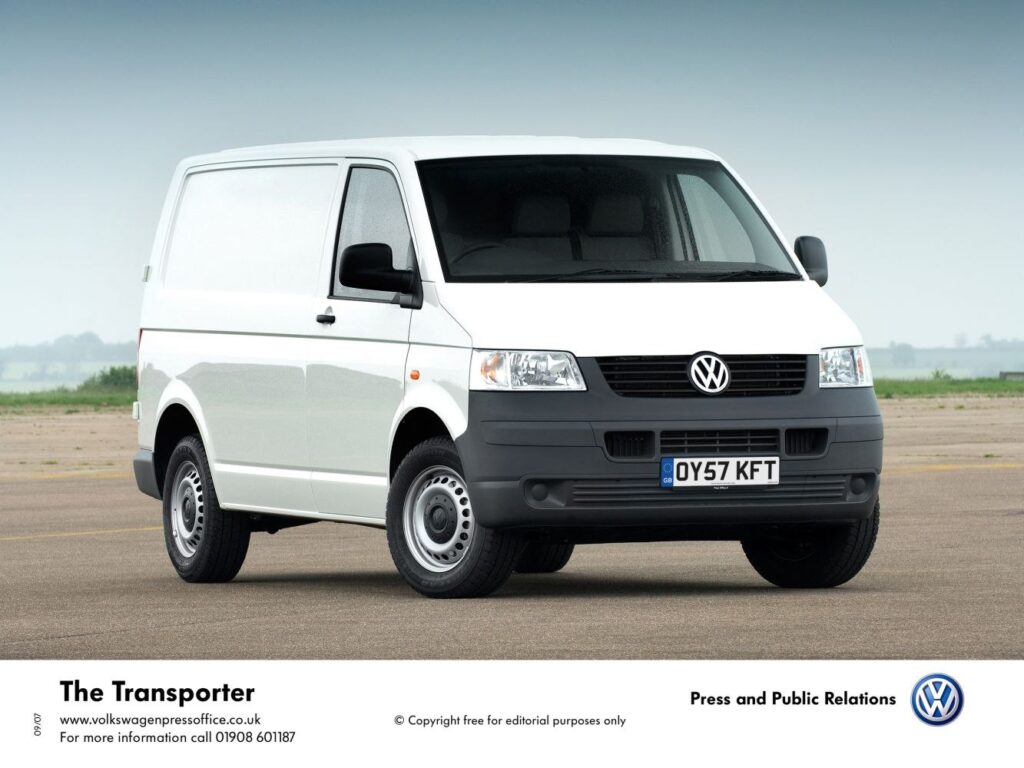
The Volkswagen Transporter (T5) Panel Van 2.5 TDI (174 Hp) L2H3: A European Workhorse
The Volkswagen Transporter, an iconic nameplate in the realm of light commercial vehicles, has a storied history spanning multiple generations. The T5 generation, produced from 2003 to 2015, continued this legacy, offering a versatile and robust platform for businesses across Europe and other international markets. The specific variant under review, the Volkswagen Transporter (T5) Panel Van 2.5 TDI (174 Hp) L2H3, represents a potent and practical configuration from its initial production years (2003-2006), characterized by its powerful diesel engine, extended wheelbase, and high roof. While the Transporter series, often known as the “Bus” or “Microbus” in its passenger van forms, holds a nostalgic place in American culture, the T5 Panel Van was primarily tailored for commercial duties outside the United States, where its blend of Germanic engineering, reliability, and cargo capacity made it a ubiquitous sight on European roads. It firmly established itself as a benchmark for efficiency and utility in the competitive European van segment.
Engine and Performance of the Volkswagen Transporter (T5) Panel Van
At the heart of this particular Volkswagen Transporter (T5) Panel Van variant is a robust 2.5-liter TDI (Turbocharged Direct Injection) diesel engine, designated with the internal code EA153 / AXE. This inline five-cylinder powerplant, mounted transversely at the front, was a significant contributor to the T5’s reputation for strong performance and respectable fuel economy, especially for a commercial vehicle of its size. With a displacement of 2460 cubic centimeters (150.12 cubic inches), it delivered a substantial 174 horsepower at 3500 rpm. Torque was equally impressive, peaking at 400 Nm (295.02 lb-ft) across a broad range from 2000 to 2300 rpm, which is crucial for hauling heavy loads and maintaining momentum on inclines.
The engine’s advanced features for its time included a turbocharger with an intercooler, enhancing both power output and efficiency, and a pump-nozzle (unit injector) fuel injection system. This system, characteristic of Volkswagen’s TDI engines from that era, allowed for precise fuel delivery, contributing to both power and the vehicle’s Euro 3 emission standard compliance. Power was channeled to the front wheels via a six-speed manual transmission, offering drivers precise control and optimal gear ratios for various driving conditions, from city deliveries to highway cruising.
Despite its primary role as a commercial vehicle, the Volkswagen Transporter (T5) Panel Van offered surprisingly agile performance. It could accelerate from 0 to 60 mph in approximately 12 seconds, reaching a maximum speed of 108.12 mph (174 km/h). Fuel economy was a strong suit for a vehicle of its class, with an extra-urban consumption rated at 33.6 US mpg (7 liters per 100 km). With an 80-liter (21.13 US gallon) fuel tank, this provided a commendable range for long-distance commercial operations. The combination of its powerful engine and efficient drivetrain made it a cost-effective choice for businesses needing reliable transportation.
Design and Features: The L2H3 Configuration
The Volkswagen Transporter (T5) Panel Van 2.5 TDI (174 Hp) L2H3 is a highly specialized commercial vehicle, designed from the ground up for practicality and utility. The “Panel Van” designation signifies its enclosed cargo area, devoid of rear passenger windows, optimized for secure goods transport. The “L2H3” suffix is Volkswagen’s internal code for its dimensions: L2 denotes the long wheelbase variant (3400 mm or 133.86 inches), while H3 indicates the highest roof option (2460 mm or 96.85 inches). This combination results in an extraordinarily spacious cargo volume of up to 9300 liters (328.43 cubic feet), making it suitable for bulky items or a significant quantity of smaller packages.
The exterior design of the T5 Transporter, while functional, presented a modern and clean aesthetic for its time. Its overall length of 5290 mm (208.27 inches) and a width of 1904 mm (74.96 inches) provided a substantial road presence, yet its minimum turning circle of 43.31 feet (13.2 meters) ensured reasonable maneuverability in urban environments. With 4 to 5 doors, typically including a sliding side door and rear barn doors or a tailgate, access to the cargo area was highly flexible. The cabin was configured for 2-3 seats, prioritizing driver and crew efficiency.
Underneath its sturdy body, the T5 featured an independent suspension system both front and rear, with McPherson struts and an anti-roll bar at the front, and coil springs with a transverse stabilizer and trailing arms at the rear. This setup provided a comfortable ride for a commercial vehicle and stable handling, even when fully loaded. Braking performance was handled by ventilated discs at both the front (308×29.5 mm) and rear (294×22 mm), complemented by an Anti-lock Braking System (ABS) for enhanced safety. The hydraulic power steering system, with a rack and pinion setup, offered responsive control. Standard tire size was 215/65 R16 on 6.5J x 16 wheel rims, providing a good balance of load-carrying capacity and comfort. The robust construction also allowed for impressive towing capabilities, rated at 5511.56 lbs (2500 kg) with brakes.
Technical Specifications
| Category | Specification |
|---|---|
| Brand | Volkswagen |
| Model | Transporter |
| Generation | Transporter (T5) Panel Van |
| Type (Engine) | 2.5 TDI (174 Hp) L2H3 |
| Production Years | 2003 – 2006 |
| Powertrain Architecture | Internal Combustion engine |
| Body type | Van |
| Seats | 2-3 |
| Doors | 4-5 |
| Performance Specs | |
| Fuel Consumption (Extra Urban) | 33.6 US mpg (7 l/100 km) |
| Fuel Type | Diesel |
| Acceleration 0-60 mph | 12 seconds |
| Maximum Speed | 108.12 mph (174 km/h) |
| Emission Standard | Euro 3 |
| Weight-to-power ratio | 11.2 kg/Hp, 89 Hp/tonne |
| Weight-to-torque ratio | 4.9 kg/Nm, 204.6 Nm/tonne |
| Engine Specs | |
| Power | 174 Hp @ 3500 rpm |
| Power per liter | 70.7 Hp/l |
| Torque | 295.02 lb-ft (400 Nm) @ 2000-2300 rpm |
| Engine layout | Front, Transverse |
| Engine Model/Code | EA153 / AXE |
| Engine displacement | 150.12 cu. in. (2460 cm3) |
| Number of cylinders | 5 |
| Engine configuration | Inline |
| Cylinder Bore | 3.19 in. (81 mm) |
| Piston Stroke | 3.76 in. (95.5 mm) |
| Compression ratio | 18.5:1 |
| Number of valves per cylinder | 2 |
| Fuel injection system | Pump-nozzle (Unit Injector) |
| Engine aspiration | Turbocharger, Intercooler |
| Valvetrain | SOHC |
| Engine oil capacity | 7.82 US qt (7.4 l) |
| Coolant capacity | 7.5 US qt (7.1 l) |
| Space, Volume and Weights | |
| Kerb Weight | 4310.04 – 4821.51 lbs (1955-2187 kg) |
| Max. weight (GVWR) | 6172.94 – 7054.79 lbs (2800-3200 kg) |
| Max load capacity | 1862.91 – 2233.28 lbs (845-1013 kg) |
| Trunk (boot) space – maximum | 328.43 cu. ft. (9300 l) |
| Fuel tank capacity | 21.13 US gal (80 l) |
| Permitted trailer load with brakes (8%) | 5511.56 lbs (2500 kg) |
| Permitted trailer load with brakes (12%) | 5511.56 lbs (2500 kg) |
| Permitted trailer load without brakes | 1653.47 lbs (750 kg) |
| Permitted towbar download | 220.46 lbs (100 kg) |
| Dimensions | |
| Length | 208.27 in. (5290 mm) |
| Width | 74.96 in. (1904 mm) |
| Width including mirrors | 88.27 in. (2242 mm) |
| Height | 96.85 in. (2460 mm) |
| Wheelbase | 133.86 in. (3400 mm) |
| Front track | 64.09 in. (1628 mm) |
| Rear (Back) track | 64.09 in. (1628 mm) |
| Front overhang | 35.2 in. (894 mm) |
| Rear overhang | 39.21 in. (996 mm) |
| Ride height (ground clearance) | 6.5 in. (165 mm) |
| Minimum turning circle (diameter) | 43.31 ft. (13.2 m) |
| Approach angle | 22° |
| Departure angle | 16° |
| Wading depth | 11.81 in. (300 mm) |
| Drivetrain, Brakes and Suspension Specs | |
| Drivetrain Architecture | Front-wheel drive, Internal Combustion engine |
| Drive wheel | Front wheel drive |
| Number of gears and type of gearbox | 6 gears, manual transmission |
| Front suspension | Independent, McPherson with coil spring and anti-roll bar |
| Rear suspension | Independent coil spring, Transverse stabilizer, Trailing arm |
| Front brakes | Ventilated discs, 308×29.5 mm |
| Rear brakes | Ventilated discs, 294×22 mm |
| Assisting systems | ABS (Anti-lock braking system) |
| Steering type | Steering rack and pinion |
| Power steering | Hydraulic Steering |
| Tires size | 215/65 R16 |
| Wheel rims size | 6.5J x 16 |
Legacy and Market Impact
The Volkswagen Transporter T5, and particularly the Panel Van variants like the Volkswagen Transporter (T5) Panel Van 2.5 TDI (174 Hp) L2H3, carved out a significant niche in the global commercial vehicle market, particularly in Europe, Australia, and parts of Asia. Building on the formidable reputation of its predecessors, the T5 continued to be a top seller for Volkswagen Commercial Vehicles. Its robust construction, efficient diesel powertrains, and versatile configurations made it an indispensable tool for countless businesses, from small independent contractors to large logistics companies.
In its primary markets, the T5 competed fiercely with other established players such as the Ford Transit, Mercedes-Benz Vito, Renault Trafic, and Opel Vivaro. What often set the Transporter apart was its car-like driving dynamics, refined engines, and the perception of superior build quality and durability. The 2.5 TDI engine, with its impressive power and torque, was particularly lauded for its ability to handle heavy loads without feeling sluggish, a critical factor for commercial operators. Its long wheelbase and high roof (L2H3) configuration offered class-leading cargo volume, making it a highly practical choice for businesses requiring maximum load space.
The T5 generation also marked a shift towards greater comfort and safety features in commercial vans. While the primary focus remained utility, the Transporter offered a more ergonomic cabin, improved ride quality, and standard safety features like ABS, which were becoming increasingly important. Its enduring popularity is evident in the strong resale values it commands and the sheer number of T5s still actively working on roads today. It played a crucial role in maintaining Volkswagen’s dominance in the light commercial vehicle segment, embodying the brand’s commitment to engineering excellence and practical design. The Volkswagen Transporter (T5) Panel Van 2.5 TDI (174 Hp) L2H3 stands as a testament to this legacy, representing a golden era of powerful, efficient, and highly capable diesel workhorses.