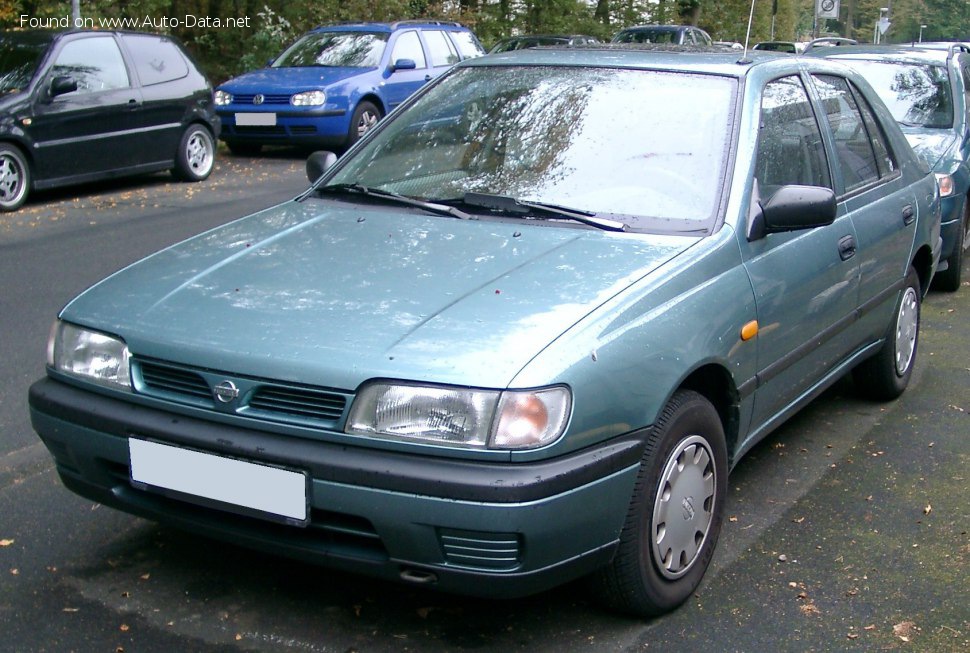
Nissan Sunny III Hatch (N14) 5 doors 2.0 i 16V (143 Hp)
The Nissan Sunny III Hatch, internally designated N14, represents a significant chapter in Nissan’s compact car history, produced from 1990 to 1995. While the Sunny nameplate had a long-standing global presence, often appearing as the Sentra in North America, the specific variant of the N14 generation, particularly the 5-door hatchback equipped with the potent 2.0 i 16V (143 Hp) engine, carved out a distinct niche in European and Asian markets. This model was a compelling offering for buyers seeking a practical yet spirited compact vehicle, blending everyday usability with an unexpected level of performance, a characteristic that earned it a reputation as a “hot hatch” in its segment.
Positioned within the competitive C-segment, the N14 Sunny hatchback was designed to appeal to a broad demographic, from young families to performance enthusiasts. This particular 2.0-liter variant stood out from its more pedestrian siblings, offering a blend of Nissan’s engineering prowess, reliability, and an engaging driving experience. Its powertrain architecture, featuring an internal combustion engine driving the front wheels, was typical for the segment, but the engine itself, the renowned SR20DE, elevated its status considerably.
Engine and Performance: The Heart of the Nissan Sunny III Hatch (N14) 5 doors 2.0 i 16V (143 Hp)
At the core of the Nissan Sunny III Hatch (N14) 5 doors 2.0 i 16V (143 Hp) lies one of Nissan’s most celebrated four-cylinder engines: the SR20DE. This 1998 cm³ (121.93 cu. in.) naturally aspirated inline-four engine was a marvel of its time, known for its robust construction, smooth power delivery, and remarkable durability. With a dual overhead camshaft (DOHC) valvetrain and four valves per cylinder, the engine was designed for efficient breathing and high-revving performance.
The SR20DE in this application produced a healthy 143 horsepower at 6400 rpm, translating to an impressive power per liter figure of 71.6 Hp/l. Torque output was equally competitive, peaking at 178 Nm (131.29 lb.-ft.) at 4800 rpm. This combination of power and torque, coupled with a relatively light curb weight of 2314.85 lbs (1050 kg), resulted in an excellent power-to-weight ratio of 7.3 kg/Hp (136.2 Hp/tonne).
Performance figures for the Sunny III Hatch 2.0 i 16V were genuinely impressive for a compact car of its era. It could accelerate from 0 to 60 mph in a brisk 7.8 seconds (0-100 km/h in 8.2 seconds) and achieve a top speed of 130.49 mph (210 km/h). Such statistics placed it firmly in contention with European hot hatches like the Volkswagen Golf GTI and Honda Civic Si models available in various markets, often surprising competitors with its understated demeanor. Power was sent to the front wheels via a precise 5-speed manual transmission, offering direct driver engagement. The engine’s compression ratio of 10:1 further contributed to its efficiency and responsiveness, utilizing multi-port manifold injection for optimal fuel delivery.
Design and Features: Practicality Meets Subtle Sportiness
The Nissan Sunny III Hatch (N14) 5 doors adopted a contemporary design for the early 1990s, characterized by its clean lines and practical hatchback form factor. Measuring 163.19 inches (4145 mm) in length, 66.54 inches (1690 mm) in width, and 54.92 inches (1395 mm) in height, it presented a compact footprint that was easy to maneuver in urban environments, yet offered surprising interior volume. The 5-door configuration emphasized accessibility and utility, making it a versatile choice for a range of buyers.
Inside, the Sunny N14 provided seating for five occupants. While not opulent, the cabin was ergonomically designed, with controls logically placed and materials chosen for durability. The hatchback body style was a key selling point, offering exceptional cargo flexibility. With the rear seats in place, the trunk provided a generous 15.22 cu. ft. (431 liters) of space, which could expand to a substantial 45.56 cu. ft. (1290 liters) with the rear seats folded down, rivaling some larger wagons in terms of hauling capacity. This made it an ideal choice for daily errands, weekend trips, or transporting bulkier items.
From a chassis perspective, the N14 featured a straightforward but effective setup. It utilized a wishbone front suspension and a spring strut rear suspension, providing a balanced ride and handling characteristics suitable for both comfort and spirited driving. Braking duties were handled by ventilated discs at the front and disc brakes at the rear, a capable setup for the car’s performance. Furthermore, the inclusion of ABS (Anti-lock Braking System) as an assisting system was a significant safety feature for the early 1990s, enhancing control during emergency braking scenarios. The hydraulic power steering, a rack and pinion system, offered good feedback and ease of use, while 185/60 R14 tires provided adequate grip and a comfortable ride.
Technical Specifications
| Category | Specification | US Equivalent / Notes |
|---|---|---|
| General Information | ||
| Brand | Nissan | |
| Model | Sunny | |
| Generation | Sunny III Hatch (N14) 5 doors | |
| Type (Engine) | 2.0 i 16V (143 Hp) | |
| Start of Production | 1990 year | |
| End of Production | 1995 year | |
| Powertrain Architecture | Internal Combustion engine | |
| Body Type | Hatchback | |
| Seats | 5 | |
| Doors | 5 | |
| Performance Specs | ||
| Fuel Type | Petrol (Gasoline) | |
| Acceleration 0 – 60 mph | 7.8 sec | (Calculated by Auto-Data.net) |
| Acceleration 0 – 100 km/h | 8.2 sec | |
| Maximum Speed | 210 km/h | 130.49 mph |
| Emission Standard | Euro 2 | |
| Weight-to-Power Ratio | 7.3 kg/Hp | 136.2 Hp/tonne |
| Weight-to-Torque Ratio | 5.9 kg/Nm | 169.5 Nm/tonne |
| Engine Specs | ||
| Power | 143 Hp @ 6400 rpm | |
| Power per liter | 71.6 Hp/l | |
| Torque | 178 Nm @ 4800 rpm | 131.29 lb.-ft. @ 4800 rpm |
| Engine Layout | Front, Transverse | |
| Engine Model/Code | SR20DE | |
| Engine Displacement | 1998 cm³ | 121.93 cu. in. |
| Number of Cylinders | 4 | |
| Engine Configuration | Inline | |
| Cylinder Bore | 86 mm | 3.39 in. |
| Piston Stroke | 86 mm | 3.39 in. |
| Compression Ratio | 10:1 | |
| Number of Valves per Cylinder | 4 | |
| Fuel Injection System | Multi-port manifold injection | |
| Engine Aspiration | Naturally aspirated engine | |
| Valvetrain | DOHC | |
| Engine Oil Capacity | 3.4 l | 3.59 US qt |
| Coolant Capacity | 5.7 l | 6.02 US qt |
| Space, Volume and Weights | ||
| Kerb Weight | 1050 kg | 2314.85 lbs. |
| Max. Weight | 1565 kg | 3450.23 lbs. |
| Max Load | 515 kg | 1135.38 lbs. |
| Trunk (boot) Space – Minimum | 431 l | 15.22 cu. ft. |
| Trunk (boot) Space – Maximum | 1290 l | 45.56 cu. ft. |
| Fuel Tank Capacity | 50 l | 13.21 US gal |
| Dimensions | ||
| Length | 4145 mm | 163.19 in. |
| Width | 1690 mm | 66.54 in. |
| Height | 1395 mm | 54.92 in. |
| Wheelbase | 2430 mm | 95.67 in. |
| Front Track | 1445 mm | 56.89 in. |
| Rear (Back) Track | 1430 mm | 56.30 in. |
| Drivetrain, Brakes and Suspension Specs | ||
| Drivetrain Architecture | The Internal combustion engine (ICE) drives the front wheels of the vehicle. | |
| Drive Wheel | Front wheel drive | |
| Number of Gears and Type of Gearbox | 5 gears, manual transmission | |
| Front Suspension | Wishbone | |
| Rear Suspension | Spring Strut | |
| Front Brakes | Ventilated discs | |
| Rear Brakes | Disc | |
| Assisting Systems | ABS (Anti-lock braking system) | |
| Steering Type | Steering rack and pinion | |
| Power Steering | Hydraulic Steering | |
| Tires Size | 185/60 R14 |
Legacy and Market Impact
The Nissan Sunny III Hatch (N14) 5 doors 2.0 i 16V (143 Hp) holds a unique place in automotive history, particularly in the markets where it was sold as a performance-oriented compact. While the Sunny nameplate often translated to the Sentra in North America, this specific 2.0-liter hatchback variant was more commonly found in Europe, Japan (where it was often known as the Pulsar GTi or GTi-R for the AWD turbo version), and other Asian markets. In these regions, it competed fiercely with established hot hatches such as the Volkswagen Golf GTI, Opel Astra GSi, and various Honda Civic Si/VTi models, offering a distinct Japanese alternative characterized by its reliability and a potent, naturally aspirated engine.
Its primary market impact was to offer a practical, unassuming hatchback with an exciting performance edge. The inclusion of the SR20DE engine, an engine renowned for its tunability and robust nature, cemented its reputation among enthusiasts. This engine family would go on to power numerous Nissan performance cars, including the iconic Silvia/240SX, further enhancing the Sunny 2.0’s mechanical credibility. For many, the N14 2.0 i 16V was a “sleeper”—a car that looked relatively pedestrian but possessed the power to surprise many on the road.
The N14 Sunny was praised for its balanced handling, comfortable ride for a performance-oriented car, and Nissan’s characteristic build quality. Its compliance with the Euro 2 emission standard reflected a growing environmental consciousness in the early to mid-1990s, showcasing Nissan’s commitment to evolving automotive regulations. Today, these 2.0-liter N14 Sunny hatchbacks are sought after by collectors and enthusiasts who appreciate their analogue driving feel, the legendary SR20DE engine, and their unique position as a capable and often overlooked hot hatch of the era. Its legacy is one of a practical, well-engineered compact car that offered more performance than its humble exterior suggested, contributing to Nissan’s reputation for producing engaging and durable vehicles.