
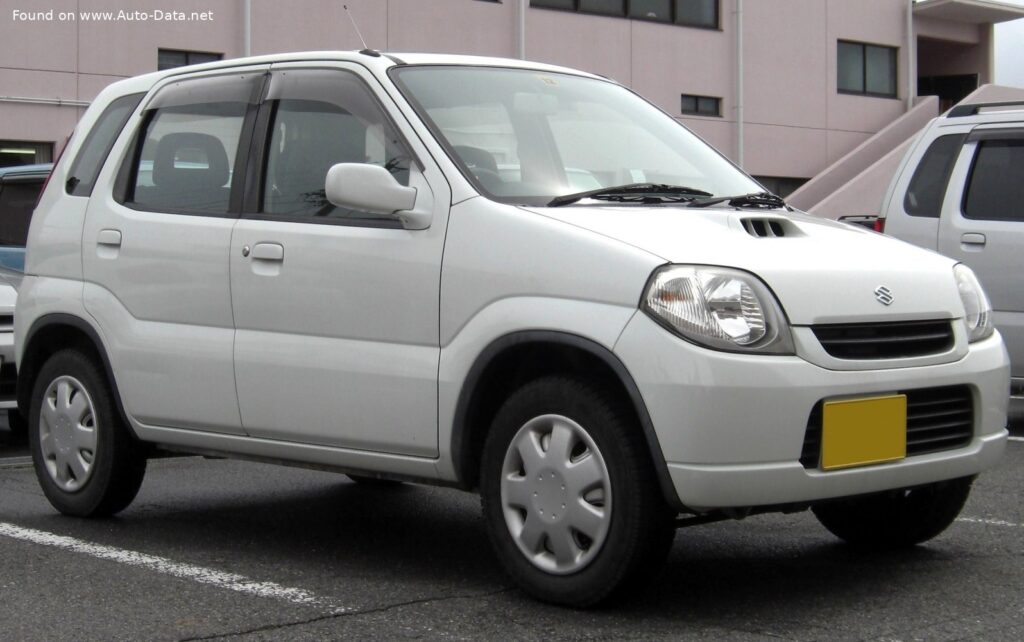
The Suzuki Kei (HN) 0.7 i 12V Sport (64 Hp): A Japanese Kei Car Icon
The Suzuki Kei (HN) 0.7 i 12V Sport (64 Hp) represents a significant entry in the highly specialized and culturally unique Japanese Kei car segment. Produced by Suzuki Motor Corporation from 1999 to 2009, the Kei (HN) generation embodied the core principles of the Kei jidosha (light automobile) category: ultra-compact dimensions, fuel efficiency, and affordability, all designed to navigate Japan’s densely populated urban landscapes and comply with stringent vehicle regulations. While never officially sold in the United States, the Suzuki Kei played a crucial role in its domestic market, offering practical, nimble, and surprisingly peppy transportation, especially in its 0.7 i 12V Sport (64 Hp) turbocharged guise.
This particular variant, with its “Sport” designation, aimed to inject a degree of driving enjoyment into the utilitarian Kei car formula. It combined a robust, turbocharged three-cylinder engine with a lightweight body and a responsive manual transmission, making it a favorite among those who sought a bit more verve from their daily commuter without sacrificing the inherent benefits of the Kei car class. Its longevity in production, spanning a full decade, is a testament to its enduring appeal and functional design within the competitive Japanese automotive landscape.
Engine and Performance of the Suzuki Kei (HN)
At the heart of the Suzuki Kei (HN) 0.7 i 12V Sport (64 Hp) was Suzuki’s acclaimed K6A engine. This powerplant was a marvel of compact engineering, specifically designed to meet the strict displacement limits of the Kei car category, which capped engine size at 660 cubic centimeters (0.66 liters). The K6A, with an exact displacement of 658 cubic centimeters (40.15 cubic inches), was an inline three-cylinder unit, featuring a Double Overhead Camshaft (DOHC) valvetrain with 12 valves (four per cylinder). This sophisticated setup, combined with multi-port manifold injection, ensured efficient fuel delivery and combustion.
What truly set the “Sport” variant apart was its turbocharger. Forced induction was a common strategy in Kei cars to extract maximum power from minimal displacement, and in the Kei Sport, it delivered impressive results. The engine produced a respectable 64 horsepower at 6500 revolutions per minute (rpm), pushing the boundaries of the gentlemen’s agreement among Japanese manufacturers regarding Kei car power output. Torque figures were equally compelling for its size, with 106 Newton-meters (78.18 lb.-ft.) available at a relatively low 3500 rpm. This broad torque band ensured lively acceleration and good drivability in urban environments, making the car feel more capable than its displacement might suggest.
Power was sent to the front wheels via a precise 5-speed manual transmission, offering the driver full control over the engine’s output and contributing to the “Sport” driving experience. The engine’s front, longitudinal layout was somewhat unusual for a front-wheel-drive Kei car, often favoring better weight distribution. With a kerb weight of just 1697.56 pounds (770 kg), the Kei Sport boasted an excellent weight-to-power ratio of 12 kg/Hp (83.1 Hp/tonne) and a weight-to-torque ratio of 7.3 kg/Nm (137.7 Nm/tonne), translating into surprisingly agile performance for its class. The 3-liter (3.17 US quarts) engine oil capacity was typical for such a small engine, emphasizing its compact and efficient design.
Design and Features
The Suzuki Kei (HN) was offered exclusively as a 5-door hatchback, a body style that maximized interior space and practicality within its diminutive footprint. Its design was characterized by a tall, boxy profile, a common trait among Kei cars designed to enhance headroom and cargo volume despite minimal length and width. With a length of 133.66 inches (3395 mm), a width of 58.07 inches (1475 mm), and a height of 60.24 inches (1530 mm), the Kei was incredibly compact, allowing for effortless maneuvering and parking in Japan’s tight city streets. The wheelbase measured 92.91 inches (2360 mm), providing a stable platform for its size.
Despite its compact exterior, the interior of the Kei (HN) was designed to comfortably accommodate five occupants, though it was certainly a snug fit. The elevated roofline contributed to a sense of spaciousness, and the large windows offered excellent visibility. Features for the era included a rack-and-pinion steering system with hydraulic power steering, making low-speed maneuvers exceptionally easy. The suspension system utilized coil springs at both the front and rear, providing a balanced ride quality suitable for urban commuting.
In terms of safety, the Suzuki Kei (HN) 0.7 i 12V Sport was equipped with an Anti-lock Braking System (ABS), a crucial feature for enhanced stopping power and control, especially in adverse conditions. Braking duties were handled by ventilated discs at the front for improved heat dissipation and traditional drum brakes at the rear. The car rode on 165/60 R15 tires mounted on 15-inch wheel rims, a relatively sporty setup for a Kei car, contributing to its nimble handling. The minimum turning circle of 30.18 feet (9.2 meters) further underscored its exceptional urban agility. The fuel tank capacity of 7.93 US gallons (30 liters) provided a decent range for a car designed primarily for short-distance travel.
Technical Specifications
| Category | Specification | US Equivalent |
|---|---|---|
| General Information | ||
| Brand | Suzuki | |
| Model | Kei | |
| Generation | Kei (HN) | |
| Type (Engine) | 0.7 i 12V Sport (64 Hp) | |
| Start of production | 1999 year | |
| End of production | 2009 year | |
| Powertrain Architecture | Internal Combustion engine | |
| Body type | Hatchback | |
| Seats | 5 | |
| Doors | 5 | |
| Performance Specs | ||
| Fuel Type | Petrol (Gasoline) | |
| Weight-to-power ratio | 12 kg/Hp | 83.1 Hp/tonne |
| Weight-to-torque ratio | 7.3 kg/Nm | 137.7 Nm/tonne |
| Engine Specs | ||
| Power | 64 Hp @ 6500 rpm. | |
| Power per liter | 97.3 Hp/l | |
| Torque | 106 Nm @ 3500 rpm. | 78.18 lb.-ft. @ 3500 rpm. |
| Engine layout | Front, Longitudinal | |
| Engine Model/Code | K6A | |
| Engine displacement | 658 cm3 | 40.15 cu. in. |
| Number of cylinders | 3 | |
| Engine configuration | Inline | |
| Cylinder Bore | 68 mm | 2.68 in. |
| Piston Stroke | 60.4 mm | 2.38 in. |
| Compression ratio | 8.4:1 | |
| Number of valves per cylinder | 4 | |
| Fuel injection system | Multi-port manifold injection | |
| Engine aspiration | Turbocharger | |
| Valvetrain | DOHC | |
| Engine oil capacity | 3 l | 3.17 US qt |
| Space, Volume and Weights | ||
| Kerb Weight | 770 kg | 1697.56 lbs. |
| Max. weight | 990 kg | 2182.58 lbs. |
| Max load | 220 kg | 485.02 lbs. |
| Fuel tank capacity | 30 l | 7.93 US gal |
| Dimensions | ||
| Length | 3395 mm | 133.66 in. |
| Width | 1475 mm | 58.07 in. |
| Height | 1530 mm | 60.24 in. |
| Wheelbase | 2360 mm | 92.91 in. |
| Front track | 1290 mm | 50.79 in. |
| Rear (Back) track | 1280 mm | 50.39 in. |
| Minimum turning circle (turning diameter) | 9.2 m | 30.18 ft. |
| Drivetrain, Brakes and Suspension Specs | ||
| Drivetrain Architecture | The Internal combustion engine (ICE) drives the front wheels of the vehicle. | |
| Drive wheel | Front wheel drive | |
| Number of gears and type of gearbox | 5 gears, manual transmission | |
| Front suspension | Coil spring | |
| Rear suspension | Coil spring | |
| Front brakes | Ventilated discs | |
| Rear brakes | Drum | |
| Assisting systems | ABS (Anti-lock braking system) | |
| Steering type | Steering rack and pinion | |
| Power steering | Hydraulic Steering | |
| Tires size | 165/60 R15 | |
| Wheel rims size | 15 | |
Legacy and Market Impact of the Suzuki Kei (HN)
The Suzuki Kei (HN) holds a significant place in the history of the Japanese Kei car segment. Its decade-long production run, from 1999 to 2009, underscores its success and adaptability in a market driven by ever-evolving regulations and fierce competition. The Kei was renowned for its robust mechanicals, economical operation, and surprisingly spacious interior given its exterior dimensions. It built a reputation as a reliable and practical urban commuter, perfectly suited for the narrow streets and limited parking of Japanese cities.
In its primary market, the Suzuki Kei faced stiff competition from other domestic manufacturers, all vying for dominance in the lucrative Kei car category. Key rivals included the Daihatsu Mira, Honda Life, Mitsubishi eK, and the Subaru R2, each offering their unique blend of style, features, and powertrain options. What allowed the Suzuki Kei (HN) 0.7 i 12V Sport to carve out its niche was its emphasis on a slightly more engaging driving experience. While practicality remained paramount, the turbocharged K6A engine and manual transmission appealed to drivers who appreciated a bit more responsiveness and fun behind the wheel, differentiating it from more purely utilitarian offerings.
Beyond its immediate competition, the Suzuki Kei contributed to the broader legacy of the Kei car. These vehicles are not merely small cars; they are a cultural phenomenon in Japan, incentivized by tax breaks and less restrictive parking regulations. They represent ingenuity in design and engineering, demonstrating how to maximize utility and performance within severe constraints. The Kei (HN) generation, particularly its “Sport” variant, showcased how these small cars could still offer character and a hint of dynamism, defying the perception of them as purely appliance-like vehicles. Its influence can be seen in subsequent generations of Suzuki’s compact offerings and in the continued evolution of the Kei car segment, which remains a vital part of the Japanese automotive landscape. The Suzuki Kei (HN) stands as a testament to Suzuki’s expertise in building compact, efficient, and ultimately enjoyable vehicles for specific market needs.
