The Renault Espace IV (Phase III, 2010) 2.0 dCi (173 Hp) Automatic: A European Minivan Icon
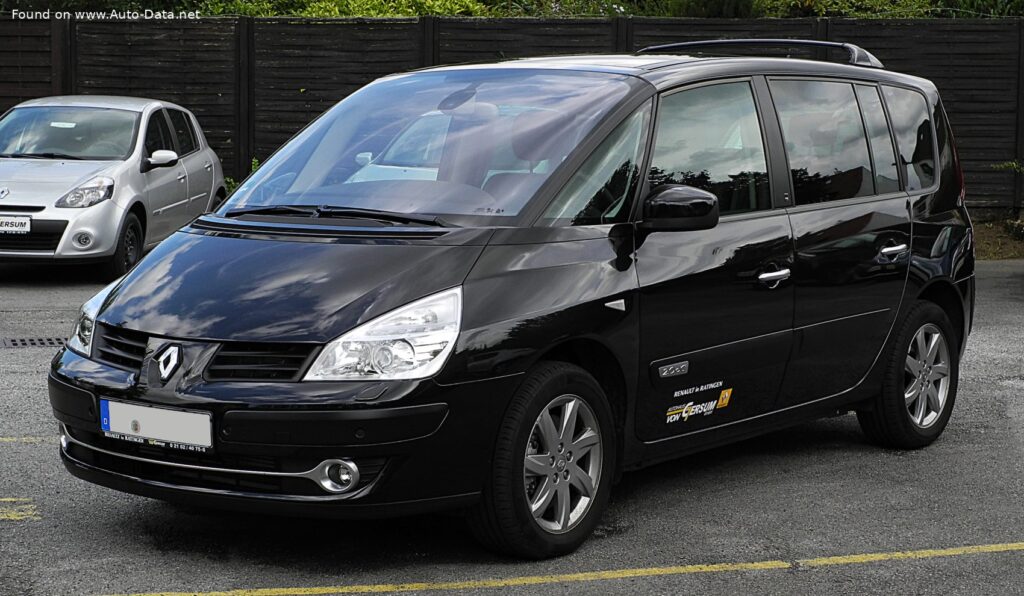
The Renault Espace IV (Phase III, 2010) 2.0 dCi (173 Hp) Automatic represents a significant iteration of a vehicle that pioneered the multi-purpose vehicle (MPV) segment in Europe. Launched in 2010 as part of the fourth-generation Espace’s final facelift, this model continued Renault’s tradition of offering spacious, versatile, and comfortable family transport. While never officially sold in the United States, the Espace carved out a dominant niche in European markets, defining the concept of a large, family-friendly vehicle designed for practicality and long-distance comfort. This specific variant, produced until 2012, combined a robust diesel powertrain with an automatic transmission, catering to the demands of European consumers who valued fuel efficiency, torque, and ease of driving in a sizable package.
The Espace IV, initially introduced in 2002, was a departure from its predecessors in terms of design and engineering, moving towards a more contemporary and sophisticated aesthetic. The Phase III update in 2010 brought subtle but effective refinements, ensuring the model remained competitive in an evolving market. It maintained its core identity as a large minivan, offering a flexible interior capable of seating up to seven passengers comfortably, making it an ideal choice for large families or those requiring substantial cargo capacity.
Engine and Performance: The 2.0 dCi (173 Hp) Powerplant
At the heart of the Renault Espace IV (Phase III, 2010) 2.0 dCi (173 Hp) Automatic lies a sophisticated 2.0-liter (1995 cm3 or 121.74 cu. in.) M9R inline-four common rail turbo-diesel engine. This powerplant was engineered for a blend of performance and fuel economy, a critical balance for the European market. It produced a healthy 173 horsepower (Hp) at 3750 rpm, providing ample motivation for the large minivan. More notably, the engine delivered a substantial 265.52 lb.-ft. (360 Nm) of torque from a low 1750 rpm, ensuring strong acceleration and effortless cruising, even when fully loaded.
Paired with a smooth 6-speed automatic transmission, the Espace 2.0 dCi offered a refined driving experience. The powertrain architecture featured a front, transverse engine layout driving the front wheels. Performance figures included an acceleration from 0 to 60 mph in a respectable 10.5 seconds, with a top speed reaching 123.03 mph (198 km/h). These figures underscored its capability as a comfortable highway cruiser rather than a performance-oriented vehicle.
Fuel efficiency was a key selling point for this diesel variant. The combined fuel consumption was rated at 32.7 US mpg (7.2 l/100 km), with extra-urban driving achieving an impressive 38.6 US mpg (6.1 l/100 km). Urban consumption stood at 25.3 US mpg (9.3 l/100 km). These figures, combined with a large 21.93 US gallon (83 l) fuel tank, translated to an excellent driving range, a desirable trait for long-distance family travel. The engine also met the Euro 5 emission standard, producing 189 g/km of CO2, reflecting its relatively modern environmental compliance for its time. The inclusion of a particulate filter was standard, further reducing emissions.
Design and Features: Practicality Meets European Style
The Renault Espace IV (Phase III, 2010) retained the distinctive minivan, or MPV, body type that made it a segment leader. Its design emphasized interior space and versatility. Measuring 183.5 inches (4661 mm) in length, 74.57 inches (1894 mm) in width (including mirrors), and 70.91 inches (1801 mm) in height, the Espace presented a substantial yet elegant profile. The long 110.35-inch (2803 mm) wheelbase contributed significantly to interior room and ride comfort.
The vehicle offered a 5-door configuration and was typically equipped with seven seats, allowing for various seating and cargo arrangements. The interior was a testament to modularity, with seats that could be easily removed or reconfigured to maximize cargo space. Minimum trunk space started at 10.28 cu. ft. (291 l), expanding dramatically to a cavernous 101 cu. ft. (2860 l) with the rear seats removed, making it exceptionally practical for hauling luggage, sports equipment, or even furniture.
Suspension-wise, the Espace featured an independent McPherson strut setup with coil springs and an anti-roll bar at the front, providing a comfortable and stable ride. The rear utilized a semi-independent setup with coil springs. Braking was handled by ventilated discs at the front and disc brakes at the rear, complemented by an Anti-lock Braking System (ABS) for enhanced safety. The steering system was a rack and pinion type, offering precise control for a vehicle of its size. Standard tire size was 225/55 R17 on 17-inch wheel rims, balancing ride comfort with adequate grip.
Technical Specifications: Renault Espace IV (Phase III, 2010) 2.0 dCi (173 Hp) Automatic
| Category | Specification |
|---|---|
| General Information | |
| Brand | Renault |
| Model | Espace |
| Generation | Espace IV (Phase III, 2010) |
| Type (Engine) | 2.0 dCi (173 Hp) Automatic |
| Start of Production | 2010 |
| End of Production | 2012 |
| Powertrain Architecture | Internal Combustion engine |
| Body type | Minivan, MPV |
| Seats | 7 |
| Doors | 5 |
| Performance Specs | |
| Fuel Consumption (economy) – Urban | 25.3 US mpg (9.3 l/100 km) |
| Fuel Consumption (economy) – Extra Urban | 38.6 US mpg (6.1 l/100 km) |
| Fuel Consumption (economy) – Combined | 32.7 US mpg (7.2 l/100 km) |
| CO2 Emissions | 189 g/km |
| Fuel Type | Diesel |
| Acceleration 0 – 60 mph | 10.5 seconds |
| Maximum Speed | 123.03 mph (198 km/h) |
| Emission Standard | Euro 5 |
| Weight-to-power ratio | 11.6 kg/Hp, 86.2 Hp/tonne |
| Weight-to-torque ratio | 5.6 kg/Nm, 179.3 Nm/tonne |
| Engine Specs | |
| Power | 173 Hp @ 3750 rpm |
| Power per liter | 86.7 Hp/l |
| Torque | 265.52 lb.-ft. (360 Nm) @ 1750 rpm |
| Engine Layout | Front, Transverse |
| Engine Model/Code | M9R |
| Engine Displacement | 121.74 cu. in. (1995 cm3) |
| Number of Cylinders | 4 |
| Engine Configuration | Inline |
| Cylinder Bore | 3.31 in. (84 mm) |
| Piston Stroke | 3.54 in. (90 mm) |
| Compression Ratio | 16:1 |
| Number of Valves per Cylinder | 4 |
| Fuel Injection System | Diesel Commonrail |
| Engine Aspiration | Turbocharger, Intercooler |
| Valvetrain | DOHC |
| Engine Oil Capacity | 6.97 US qt (6.6 l) |
| Engine Oil Specification | Not specified |
| Engine Systems | Particulate filter |
| Space, Volume and Weights | |
| Kerb Weight | 4426.88 lbs. (2008 kg) |
| Max. Weight | 5820.2 lbs. (2640 kg) |
| Max Load | 1393.32 lbs. (632 kg) |
| Trunk (boot) Space – Minimum | 10.28 cu. ft. (291 l) |
| Trunk (boot) Space – Maximum | 101 cu. ft. (2860 l) |
| Fuel Tank Capacity | 21.93 US gal (83 l) |
| Max. Roof Load | 176.37 lbs. (80 kg) |
| Permitted Trailer Load with Brakes (12%) | 4409.25 lbs. (2000 kg) |
| Permitted Trailer Load without Brakes | 1653.47 lbs. (750 kg) |
| Permitted Towbar Download | 176.37 lbs. (80 kg) |
| Dimensions | |
| Length | 183.5 in. (4661 mm) |
| Width including mirrors | 74.57 in. (1894 mm) |
| Height | 70.91 in. (1801 mm) |
| Wheelbase | 110.35 in. (2803 mm) |
| Front Track | 61.97 in. (1574 mm) |
| Rear (Back) Track | 61.26 in. (1556 mm) |
| Front Overhang | 40.39 in. (1026 mm) |
| Rear Overhang | 32.76 in. (832 mm) |
| Ride Height (ground clearance) | 6.89 in. (175 mm) |
| Minimum Turning Circle (turning diameter) | 36.09 ft. (11 m) |
| Drivetrain, Brakes and Suspension Specs | |
| Drivetrain Architecture | The Internal combustion engine (ICE) drives the front wheels of the vehicle. |
| Drive Wheel | Front wheel drive |
| Number of Gears and Type of Gearbox | 6 gears, automatic transmission |
| Front Suspension | Independent, type McPherson with coil spring and anti-roll bar |
| Rear Suspension | Semi-independent, coil spring |
| Front Brakes | Ventilated discs |
| Rear Brakes | Disc |
| Assisting Systems | ABS (Anti-lock braking system) |
| Steering Type | Steering rack and pinion |
| Tires Size | 225/55 R17 |
| Wheel Rims Size | 17 inches |
Legacy and Market Impact
The Renault Espace holds a significant place in automotive history, particularly in Europe, as one of the original and most influential MPVs. The fourth generation, including the Phase III model from 2010 to 2012, continued this legacy, adapting to contemporary demands for efficiency and technology while retaining its core strengths of space and versatility. Its role in the European market was paramount, providing a compelling alternative to traditional sedans and station wagons for growing families.
During its production run, the Espace IV (Phase III) faced stiff competition from other European and Asian manufacturers. Key rivals included the Ford Galaxy/S-Max, Volkswagen Sharan, SEAT Alhambra, Citroën C8, and Peugeot 807. Each competitor offered its own blend of space, features, and driving dynamics, but the Espace maintained a strong reputation for its innovative interior design, comfort, and a certain French flair. Its modular seating, airy cabin, and comfortable ride made it a favorite for long-distance family trips across the continent.
The 2.0 dCi (173 Hp) Automatic variant specifically showcased Renault’s commitment to modern diesel technology, offering impressive fuel economy and robust performance that appealed to a broad segment of buyers. The automatic transmission further enhanced its appeal, making urban driving and highway cruising more relaxed. Despite the rising popularity of SUVs towards the end of its production cycle, the Espace continued to be a strong contender in the dedicated MPV segment, valued for its uncompromised practicality and passenger comfort that SUVs often struggled to match.
The Espace IV’s historical significance lies in its evolution of the MPV concept. It demonstrated how a family vehicle could be both highly functional and stylish, moving beyond purely utilitarian designs. While the Espace nameplate eventually transitioned into a crossover SUV in later generations, the Espace IV (Phase III) stands as a testament to the golden era of the European minivan, a vehicle expertly designed for the specific needs and preferences of its primary market. Its blend of power, efficiency, and unparalleled interior flexibility cemented its status as a benchmark in its class.