
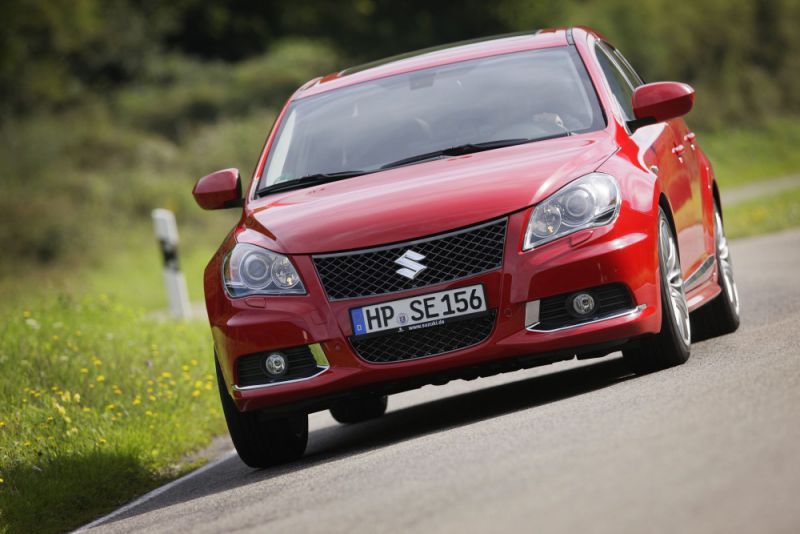
The Suzuki Kizashi 2.4 (178 Hp): Suzuki’s Ambitious Mid-Size Sedan
The Suzuki Kizashi, whose name translates from Japanese as “a sign of great things to come” or “omen,” represented a significant and ambitious foray for Suzuki into the highly competitive mid-size sedan segment. Launched in 2009 for the 2010 model year, the first and only generation of the Suzuki Kizashi 2.4 (178 Hp) aimed to challenge established players with a unique blend of sporty driving dynamics, distinctive styling, and a focus on quality. Positioned above the compact SX4, the Kizashi was Suzuki’s largest and most premium passenger car offered in markets like North America, Europe, and Australia, marking a departure from the brand’s traditional focus on subcompacts, SUVs, and motorcycles.
Produced from 2009 to 2016, the Kizashi was an earnest attempt by Suzuki to broaden its appeal and demonstrate its engineering prowess beyond its core strengths. It was designed from the ground up to offer a more engaging driving experience than many of its segment rivals, emphasizing a firm but compliant ride and agile handling. While it ultimately struggled to gain significant market share against entrenched competitors, the Kizashi earned critical praise for its build quality, sophisticated suspension, and overall refinement, solidifying its reputation as a hidden gem for enthusiasts.
Engine and Performance of the Suzuki Kizashi
At the heart of the Suzuki Kizashi 2.4 (178 Hp) model was a robust 2.4-liter (2393 cm3 or 146.03 cu. in.) J24B inline-four engine. This naturally aspirated powerplant was engineered to deliver a balance of everyday usability and spirited performance. Utilizing a Double Overhead Camshaft (DOHC) valvetrain with Variable Valve Timing (VVT-i), the engine produced a respectable 178 horsepower at 6500 rpm. This power output, combined with the engine’s 74.4 horsepower per liter efficiency, was competitive for its class at the time.
Torque delivery was equally impressive, with 230 Nm (169.64 lb.-ft.) available at 4000 rpm, providing ample thrust for highway cruising and confident acceleration. Power was sent to the front wheels via a precise 6-speed manual transmission, a choice that further underscored the Kizashi’s sporting intentions. The combination of a relatively lightweight kerb weight of 3293.71 lbs. (1494 kg) and the capable engine allowed the Kizashi 2.4 (178 Hp) to achieve a calculated 0 to 60 mph acceleration time of 7.4 seconds (0 to 100 km/h in 7.8 seconds). This positioned it as one of the quicker options in the non-performance mid-size sedan segment.
Fuel efficiency for the Kizashi 2.4 (178 Hp) was rated at 29.8 US mpg combined (7.9 l/100 km), with urban consumption at 22.2 US mpg (10.6 l/100 km) and extra-urban at 37.3 US mpg (6.3 l/100 km). These figures, alongside CO2 emissions of 183 g/km and an Euro 5 emission standard compliance, demonstrated Suzuki’s commitment to modern powertrain efficiency while maintaining performance. The engine’s multi-port manifold injection system ensured reliable fuel delivery, contributing to its smooth operation and responsiveness.
Design and Features: The Suzuki Kizashi’s Distinctive Appeal
The Suzuki Kizashi adopted a sleek, athletic design that stood out in a segment often criticized for conservative styling. As a four-door sedan with seating for five, its dimensions were well-proportioned, measuring 183.07 inches (4650 mm) in length, 71.65 inches (1820 mm) in width, and 57.87 inches (1470 mm) in height. The 106.3-inch (2700 mm) wheelbase contributed to both a stable ride and a spacious cabin, while a minimum turning circle of 36.09 ft (11 m) made it maneuverable in urban environments.
The exterior featured sharp lines, a bold front grille, and prominent wheel arches, giving it a muscular yet refined appearance. Standard 235/45 R18 94W tires mounted on 8J x 18-inch wheel rims further enhanced its sporty stance. Inside, the Kizashi offered a well-appointed cabin with quality materials and a straightforward, ergonomic layout. The trunk space was a practical 16.28 cu. ft. (461 liters), suitable for daily errands or weekend trips.
From a chassis perspective, the Kizashi was engineered for dynamic handling. It featured an independent McPherson strut front suspension with coil springs and an anti-roll bar, paired with an independent multi-link rear suspension. This sophisticated setup provided excellent road holding and ride comfort, distinguishing it from many competitors that often prioritized softness over agility. Braking performance was handled by ventilated discs at the front and solid discs at the rear, complemented by an Anti-lock Braking System (ABS) for enhanced safety and control. The steering system utilized a rack and pinion setup, offering direct and responsive feedback to the driver.
Technical Specifications
| General Information | |
|---|---|
| Brand | Suzuki |
| Model | Kizashi |
| Generation | Kizashi |
| Type (Engine) | 2.4 (178 Hp) |
| Start of Production | 2009 year |
| End of Production | 2016 year |
| Powertrain Architecture | Internal Combustion engine |
| Body type | Sedan |
| Seats | 5 |
| Doors | 4 |
| Performance Specifications | |
| Fuel Consumption (Urban) | 10.6 l/100 km (22.2 US mpg) |
| Fuel Consumption (Extra Urban) | 6.3 l/100 km (37.3 US mpg) |
| Fuel Consumption (Combined) | 7.9 l/100 km (29.8 US mpg) |
| CO2 Emissions | 183 g/km |
| Fuel Type | Petrol (Gasoline) |
| Acceleration 0 – 60 mph | 7.4 sec |
| Acceleration 0 – 100 km/h | 7.8 sec |
| Maximum Speed | 215 km/h (133.59 mph) |
| Emission Standard | Euro 5 |
| Weight-to-Power Ratio | 8.4 kg/Hp (119.1 Hp/tonne) |
| Weight-to-Torque Ratio | 6.5 kg/Nm (153.9 Nm/tonne) |
| Engine Specifications | |
| Power | 178 Hp @ 6500 rpm |
| Power per liter | 74.4 Hp/l |
| Torque | 230 Nm @ 4000 rpm (169.64 lb.-ft. @ 4000 rpm) |
| Engine Layout | Front, Transverse |
| Engine Model/Code | J24B |
| Engine Displacement | 2393 cm3 (146.03 cu. in.) |
| Number of Cylinders | 4 |
| Engine Configuration | Inline |
| Cylinder Bore | 92 mm (3.62 in.) |
| Piston Stroke | 90 mm (3.54 in.) |
| Compression Ratio | 10:1 |
| Number of Valves per Cylinder | 4 |
| Fuel Injection System | Multi-port manifold injection |
| Engine Aspiration | Naturally aspirated engine |
| Valvetrain | DOHC – VVT-i |
| Engine Oil Capacity | 4.5 l (4.76 US qt) |
| Coolant Capacity | 6.6 l (6.97 US qt) |
| Space, Volume and Weights | |
| Kerb Weight | 1494 kg (3293.71 lbs.) |
| Max. Weight | 2000 kg (4409.25 lbs.) |
| Max. Load | 506 kg (1115.54 lbs.) |
| Trunk (Boot) Space – Maximum | 461 l (16.28 cu. ft.) |
| Fuel Tank Capacity | 63 l (16.64 US gal) |
| Dimensions | |
| Length | 4650 mm (183.07 in.) |
| Width | 1820 mm (71.65 in.) |
| Height | 1470 mm (57.87 in.) |
| Wheelbase | 2700 mm (106.3 in.) |
| Front Track | 1565 mm (61.61 in.) |
| Rear (Back) Track | 1575 mm (62.01 in.) |
| Ride Height (Ground Clearance) | 135 mm (5.31 in.) |
| Minimum Turning Circle (Turning Diameter) | 11 m (36.09 ft.) |
| Drivetrain, Brakes and Suspension Specifications | |
| Drivetrain Architecture | The Internal combustion engine (ICE) drives the front wheels of the vehicle. |
| Drive Wheel | Front wheel drive |
| Number of Gears and Type of Gearbox | 6 gears, manual transmission |
| Front Suspension | Independent, type McPherson with coil spring and anti-roll bar |
| Rear Suspension | Independent multi-link suspension |
| Front Brakes | Ventilated discs |
| Rear Brakes | Disc |
| Assisting Systems | ABS (Anti-lock braking system) |
| Steering Type | Steering rack and pinion |
| Tires Size | 235/45 R18 94W |
| Wheel Rims Size | 8J x 18 |
Legacy and Market Impact of the Suzuki Kizashi
Despite its compelling attributes, the Suzuki Kizashi faced an uphill battle in the global automotive market, particularly in North America. When it entered the market, the mid-size sedan segment was dominated by established giants like the Honda Accord, Toyota Camry, Nissan Altima, Ford Fusion, and Mazda6. These vehicles benefited from decades of brand loyalty, extensive marketing budgets, and robust dealer networks, making it exceedingly difficult for a new entrant from a smaller brand like Suzuki to gain traction.
The Kizashi’s sales figures never quite matched its critical acclaim. While reviewers consistently praised its European-inspired driving dynamics, high-quality interior materials, and distinctive styling, consumers were often hesitant to consider a Suzuki in a segment where reliability and resale value from larger brands were perceived as paramount. Suzuki’s relatively small footprint in the passenger car market, coupled with a limited advertising budget compared to its rivals, meant that many potential buyers were simply unaware of the Kizashi’s existence or overlooked it.
In its primary markets, the Kizashi carved out a niche for buyers who valued engaging driving over outright brand prestige. Its independent multi-link rear suspension and well-tuned chassis provided a ride quality and handling prowess that often surpassed its more mainstream competitors, earning it a reputation as a “driver’s car.” It was a vehicle that punched above its weight in terms of engineering and execution, reflecting Suzuki’s deeper experience in building performance motorcycles and capable SUVs.
Ultimately, the Kizashi’s production ceased in 2016, following Suzuki’s withdrawal from the U.S. automotive market in 2012. While its run was short, the Kizashi remains a testament to Suzuki’s capability to produce a refined, sporty, and well-engineered sedan. Today, the Suzuki Kizashi 2.4 (178 Hp) is often regarded as an underappreciated gem, attracting enthusiasts who seek a reliable, distinct, and fun-to-drive mid-size sedan that offers excellent value on the used car market. Its legacy is not one of sales success, but rather of a well-executed attempt to redefine Suzuki’s image, proving that the brand could compete in a premium segment with a genuinely competitive and enjoyable vehicle.
