
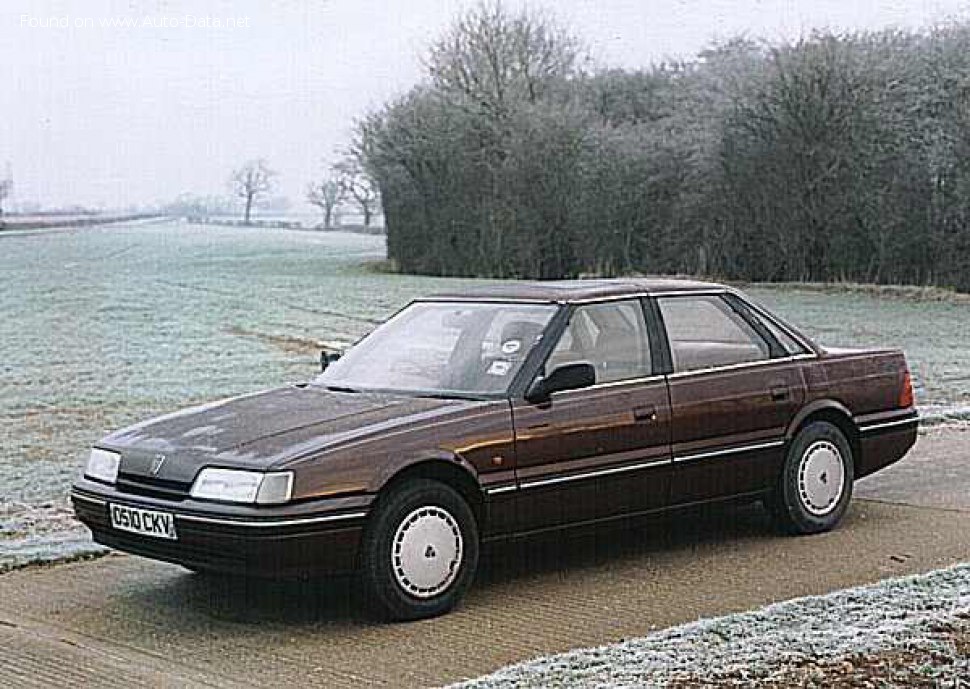
The Rover 800 827 SI/Sterling (XS) CAT (169 Hp): A Transatlantic Executive Sedan
The Rover 800 series, known internally as the XS, represented a significant chapter in the history of the British automotive manufacturer, Rover Group. Launched in 1986, the 800 series was the culmination of a joint venture with Honda, aiming to produce a competitive executive car for both European and North American markets. The specific variant, the Rover 800 827 SI/Sterling (XS) CAT (169 Hp), produced from 1988 until 1999, stands out as a prime example of this Anglo-Japanese collaboration, particularly in its more potent, V6-powered guise.
While the Rover nameplate itself may not be immediately familiar to the average American consumer, having had a limited presence in the United States, the 800 series was sold in North America as the Sterling 825 and later Sterling 827. In its primary European market, it was positioned as a comfortable, well-appointed sedan designed to compete with established German and Swedish executive offerings. This particular model, the 827 SI/Sterling with its Catalytic Converter (CAT), marked a period of refinement and increased environmental consciousness, offering a blend of British luxury aspirations and Japanese engineering reliability.
Engine and Performance of the Rover 800 827 SI/Sterling (XS) CAT (169 Hp)
At the heart of the Rover 800 827 SI/Sterling (XS) CAT (169 Hp) lay a robust and smooth 2.7-liter (2675 cm3) V6 engine, designated as the C27A-V6. This naturally aspirated powerhouse, sourced directly from Honda, was a key differentiator for the 827 models. It delivered a respectable 169 horsepower at 5900 rpm, providing ample motivation for the executive sedan. Torque figures stood at 165.95 lb.-ft. (225 Nm) peaking at 4500 rpm, ensuring responsive acceleration and effortless cruising.
The engine featured a multi-port manifold injection system and an OHC (Overhead Camshaft) valvetrain with four valves per cylinder, a sophisticated setup for its time that contributed to its refined power delivery and efficiency. With a compression ratio of 9:1, the engine was designed for reliable, everyday performance. The power was channeled to the front wheels via a 4-speed automatic transmission, emphasizing comfort and ease of driving over outright sportiness. This powertrain architecture, with its front, transverse engine layout and front-wheel drive, was typical for executive cars designed for spacious interiors and stable handling.
Performance metrics for the 827 SI/Sterling were competitive for its class in the late 1980s and early 1990s. The car could accelerate from 0 to 60 mph in a brisk 8.6 seconds, and its top speed was rated at 131.11 mph (211 km/h). Fuel economy, while not a primary selling point for large executive sedans of the era, was reasonable for its displacement and power output, averaging 23.3 US mpg (10.1 l/100 km) in combined driving conditions. With a curb weight of 3240.8 lbs (1470 kg), the power-to-weight ratio stood at 115 Hp per tonne, signifying a capable, if not overtly sporty, driving experience.
Design and Features: The Rover 800 Executive Sedan
The Rover 800 series was offered primarily as a four-door sedan, a body type that perfectly suited its executive aspirations. The design, a collaboration between Rover and Honda’s styling teams, resulted in a sleek, aerodynamic profile that was contemporary for its late 1980s launch. Its generous dimensions, with a length of 192.2 inches (4882 mm) and a width of 68.11 inches (1730 mm), provided a commanding presence on the road and a spacious cabin for five occupants.
Inside, the 827 SI/Sterling models were generally well-appointed, reflecting Rover’s ambition to compete in the luxury segment. While specific interior materials and trim levels are not detailed in the raw data, the “Sterling” designation historically implied a higher level of luxury, often including leather upholstery, wood trim, and a comprehensive list of standard features. The interior was designed for comfort, with supportive seating and ample legroom, making it suitable for long journeys. Trunk space was practical, offering 15.72 cu. ft. (445 liters) for luggage.
From a chassis perspective, the Rover 800 utilized a sophisticated double wishbone front suspension, a design known for offering excellent ride quality and precise handling. The rear featured a coil spring setup, contributing to the car’s comfortable demeanor. Braking performance was handled by ventilated discs at the front and solid discs at the rear, complemented by an Anti-lock Braking System (ABS), a crucial safety feature for the era. Steering was a hydraulic rack and pinion system, providing direct feedback and ease of maneuverability. The car rode on 195/65 R15 V tires, a standard size for executive cars of its vintage, balancing comfort and grip.
Technical Specifications of the Rover 800 827 SI/Sterling (XS) CAT (169 Hp)
| Category | Specification |
|---|---|
| General Information | |
| Brand | Rover |
| Model | 800 |
| Generation | 800 (XS) |
| Type (Engine) | 827 SI/Sterling (XS) CAT (169 Hp) |
| Production Start | 1988 |
| Production End | 1999 |
| Body Type | Sedan |
| Seats | 5 |
| Doors | 4 |
| Performance Specifications | |
| Power | 169 Hp @ 5900 rpm |
| Torque | 165.95 lb.-ft. (225 Nm) @ 4500 rpm |
| Acceleration 0-60 mph | 8.6 seconds |
| Acceleration 0-62 mph (0-100 km/h) | 9 seconds |
| Maximum Speed | 131.11 mph (211 km/h) |
| Fuel Consumption (Combined) | 23.3 US mpg (10.1 l/100 km) |
| Fuel Type | Petrol (Gasoline) |
| Weight-to-Power Ratio | 8.7 kg/Hp (115 Hp/tonne) |
| Weight-to-Torque Ratio | 6.5 kg/Nm (153.1 Nm/tonne) |
| Engine Specifications | |
| Engine Model/Code | C27A-V6 |
| Engine Displacement | 2.7 Liters (2675 cm3 / 163.24 cu. in.) |
| Number of Cylinders | 6 |
| Engine Configuration | V-engine |
| Engine Layout | Front, Transverse |
| Cylinder Bore | 3.43 in. (87 mm) |
| Piston Stroke | 2.95 in. (75 mm) |
| Compression Ratio | 9:1 |
| Valves per Cylinder | 4 |
| Valvetrain | OHC |
| Fuel Injection System | Multi-port manifold injection |
| Engine Aspiration | Naturally aspirated |
| Engine Oil Capacity | 4.76 US qt (4.5 l) |
| Coolant Capacity | 9.09 US qt (8.6 l) |
| Dimensions, Volume, and Weights | |
| Length | 192.2 in. (4882 mm) |
| Width | 68.11 in. (1730 mm) |
| Height | 54.84 in. (1393 mm) |
| Wheelbase | 108.9 in. (2766 mm) |
| Front Track | 58.54 in. (1487 mm) |
| Rear Track | 57.09 in. (1450 mm) |
| Kerb Weight | 3240.8 lbs (1470 kg) |
| Maximum Weight | 4343.11 lbs (1970 kg) |
| Maximum Load | 1102.31 lbs (500 kg) |
| Trunk (Boot) Space – Minimum | 15.72 cu. ft. (445 l) |
| Fuel Tank Capacity | 17.96 US gal (68 l) |
| Drivetrain, Brakes, and Suspension | |
| Drivetrain Architecture | Internal Combustion engine drives the front wheels |
| Drive Wheel | Front-wheel drive |
| Gearbox Type | 4-speed automatic transmission |
| Front Suspension | Double wishbone |
| Rear Suspension | Coil spring |
| Front Brakes | Ventilated discs |
| Rear Brakes | Disc |
| Assisting Systems | ABS (Anti-lock braking system) |
| Steering Type | Steering rack and pinion |
| Power Steering | Hydraulic Steering |
| Tires Size | 195/65 R15 V |
Legacy and Market Impact of the Rover 800
The Rover 800, and specifically the 827 SI/Sterling (XS) CAT (169 Hp) variant, holds a unique place in automotive history, particularly within the context of the British car industry. It was a flagship model for Rover, intended to elevate the brand’s image and compete head-on with established European executive sedans such as the Ford Granada/Scorpio, Vauxhall Carlton/Omega, and even make inroads into the territory of lower-tier BMW 5 Series or Mercedes-Benz E-Class models in its primary markets. Its presence in the United States as the Sterling 825/827 was an ambitious, though ultimately short-lived, attempt to break into the competitive American luxury segment.
The collaboration with Honda was a double-edged sword for Rover. On one hand, it provided access to reliable, high-quality Japanese engineering, particularly the C27A-V6 engine, which was widely praised for its smoothness and durability. This partnership allowed Rover to produce a technically competent and refined vehicle that might have been beyond its sole capabilities at the time. On the other hand, it led to internal debates about Rover’s distinct identity and some critics felt the car lacked a truly unique “British” character, especially compared to earlier, more idiosyncratic Rover models.
Despite initial strong sales in the UK and Europe, the Rover 800’s reputation suffered over time, particularly in export markets like the US, due to early quality control issues, especially concerning electrical systems and interior trim, which contrasted sharply with the Honda Legend’s impeccable reliability. However, later iterations, including the facelifted ‘R17’ models from 1991 onwards, addressed many of these concerns, improving build quality and refinement.
The 827 SI/Sterling, with its Honda V6, was generally considered the most desirable and reliable variant of the 800 series. It offered a compelling blend of comfortable cruising, decent performance, and a touch of traditional British luxury, albeit interpreted through a more modern lens. Its legacy is one of ambition and compromise: a valiant effort by Rover to stay relevant in a fiercely competitive segment, leveraging international partnerships to achieve its goals. While the Rover brand itself eventually faded, the 800 series, particularly the V6 models, remains a testament to a pivotal era in its history, showcasing a period when British engineering and Japanese reliability converged in an executive package.
