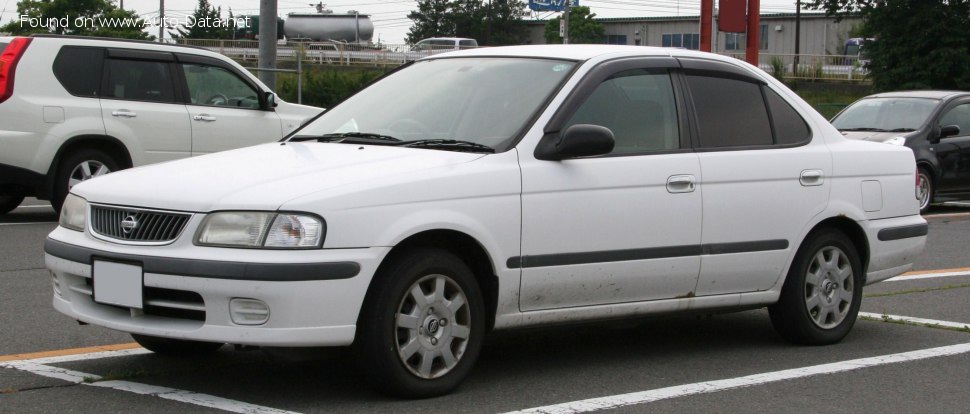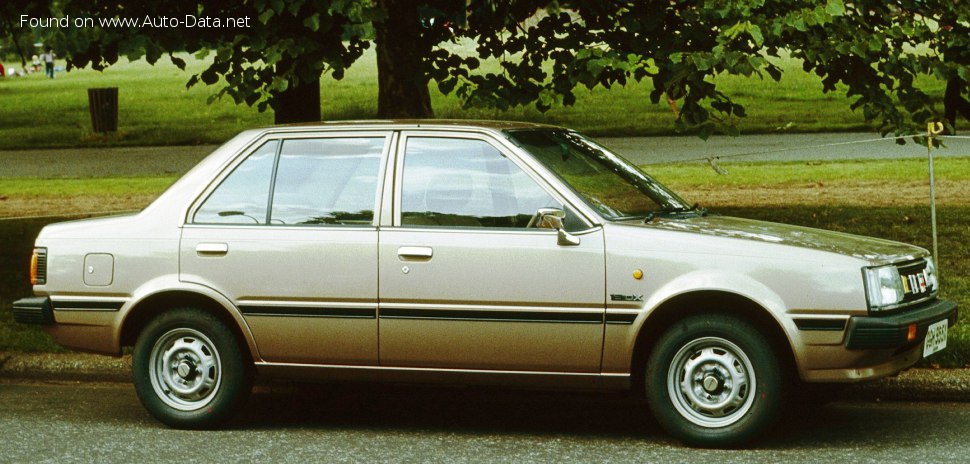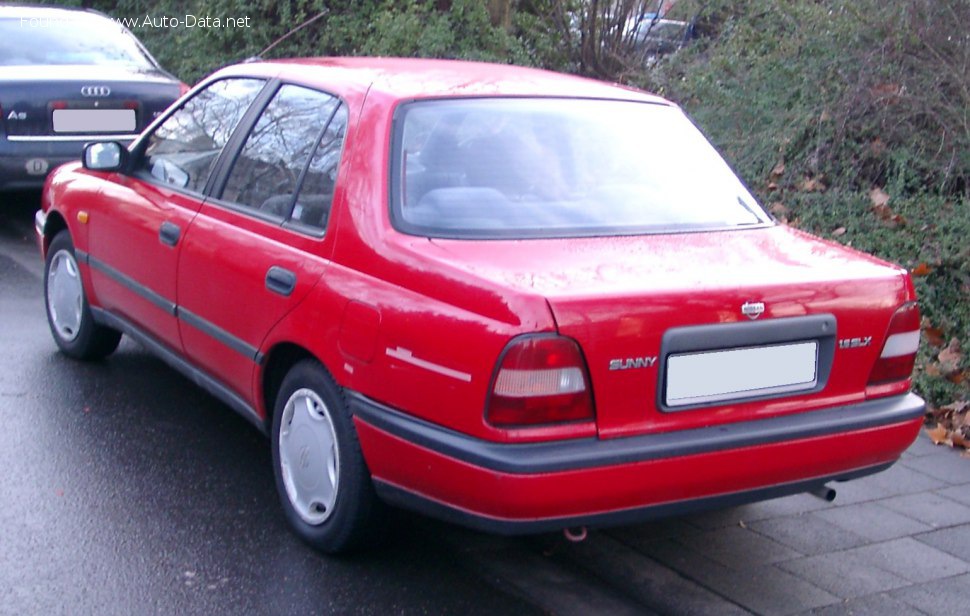
The Nissan Sunny III (N14): A Global Compact Workhorse (1990-1992)
The Nissan Sunny III, internally designated N14, represents a significant chapter in Nissan’s history of producing reliable and economical compact cars. Launched in 1990, this generation of the Sunny continued the model’s tradition of offering practical, no-nonsense transportation to a global audience. While North American markets typically received a version known as the Sentra, the Sunny nameplate, particularly the N14, was a ubiquitous sight across Europe, Asia, and other international markets. The specific variant under review, the Nissan Sunny III (N14) 1.4 16V (75 Hp) Automatic sedan, was an accessible and popular choice for families and individuals seeking efficiency and ease of use in the early 1990s. It was produced for a relatively short period, from 1990 to 1992, before subsequent revisions and updates were introduced.
The N14 generation of the Sunny was designed to be a highly competitive entry in the fiercely contested compact segment. It faced strong rivals from other Japanese manufacturers like Toyota (Corolla) and Honda (Civic), as well as European contenders such as the Volkswagen Golf and Opel Kadett/Astra. Nissan’s strategy with the Sunny N14 was to offer a blend of proven mechanicals, sensible design, and a comfortable interior package. This particular 1.4-liter automatic variant highlighted the brand’s commitment to providing a user-friendly and fuel-efficient option, particularly for urban environments where its compact dimensions and automatic transmission offered distinct advantages.
Engine and Performance of the Nissan Sunny III (N14)
At the heart of this particular Nissan Sunny III (N14) sedan was the GA14DS engine, a naturally aspirated, inline four-cylinder gasoline unit. With a displacement of 1,392 cubic centimeters (approximately 1.4 liters or 84.95 cubic inches), this engine was designed for durability and economy rather than outright speed. It featured a four-valve-per-cylinder (16V) configuration, a relatively advanced setup for a compact car engine of its era, contributing to better breathing and efficiency compared to older two-valve designs. The valvetrain utilized an OverHead Camshaft (OHC) design, a common and reliable configuration.
Power output for the GA14DS in this application was a modest 75 horsepower, achieved at 6,000 revolutions per minute. This power figure translated to a power-per-liter ratio of 53.9 horsepower per liter, indicating a focus on practical, everyday performance. Torque production was 112 Newton-meters (82.61 lb.-ft.) peaking at 4,000 rpm. These figures, while not exhilarating, were entirely adequate for urban commuting and highway cruising when paired with the vehicle’s relatively light curb weight of 2,028.25 pounds (920 kg).
A notable aspect of this specific variant was its fuel delivery system: a carburetor. While fuel injection was becoming increasingly prevalent in the early 1990s, many budget-conscious models, especially in certain markets, still utilized carburetion for its simplicity and lower cost. This system, combined with the naturally aspirated design, provided a straightforward and dependable powertrain. The engine was mounted transversely at the front, driving the front wheels, a standard layout for compact cars that optimizes interior space and traction.
Mated to this engine was a 4-speed automatic transmission. For its time, a 4-speed automatic was a common offering, providing a smooth and convenient driving experience, especially in stop-and-go traffic. While it might not offer the same fuel economy or responsiveness as a manual transmission or more modern multi-speed automatics, it significantly reduced driver fatigue and broadened the car’s appeal to a wider demographic. The drivetrain architecture, with the internal combustion engine driving the front wheels, provided predictable handling and efficient power transfer.
Design and Features of the Nissan Sunny III (N14) Sedan
The Nissan Sunny III (N14) sedan embodied the design philosophy of many compact cars of its era: functional, unpretentious, and designed for maximum practicality. Its exterior styling was clean and conservative, without excessive ornamentation, focusing on aerodynamic efficiency and passenger comfort. The sedan body type, with its traditional three-box silhouette, was particularly popular in many markets for its perceived elegance and secure trunk space.
Measuring 166.54 inches (4230 mm) in length, 66.54 inches (1690 mm) in width, and 54.92 inches (1395 mm) in height, the N14 Sunny was dimensionally compact, making it easy to maneuver and park in congested city environments. Despite its modest exterior footprint, Nissan engineers managed to carve out a surprisingly spacious interior. The wheelbase of 95.67 inches (2430 mm) contributed to a stable ride and allowed for a decent amount of legroom for its five occupants.
The interior design was straightforward and ergonomic, prioritizing ease of use for the driver. With four doors and seating for five, it was a practical family vehicle. A significant feature for a car in this segment and price point during the early 1990s was the standard trunk (boot) space of 15.54 cubic feet (440 liters), which was generous for its class and capable of accommodating family luggage or shopping hauls. The fuel tank capacity of 13.21 US gallons (50 liters) provided a respectable cruising range, aligning with its economical nature.
In terms of chassis and safety, the N14 Sunny featured a front suspension utilizing wishbones, a common and effective design for handling and ride comfort. The rear suspension employed spring struts, another tried-and-true setup for compact cars. Braking was handled by ventilated discs at the front, offering good stopping power and heat dissipation, while the rear utilized drum brakes, a cost-effective and reliable solution for the rear axle. A notable safety enhancement for the time was the inclusion of ABS (Anti-lock Braking System), an optional or standard feature on some trims, which significantly improved braking control under emergency conditions.
The steering system was a rack-and-pinion type, providing direct feedback, and was augmented by hydraulic power steering, making low-speed maneuvers and parking effortless. The car rode on 165/80 R13 tires mounted on 5J x 13-inch wheel rims, a common size for compacts, balancing comfort with affordability.
Technical Specifications
| Category | Specification | Value (Metric) | Value (US/Imperial) |
|---|---|---|---|
| General Information | |||
| Brand | Nissan | ||
| Model | Sunny | ||
| Generation | Sunny III (N14) | ||
| Type (Engine) | 1.4 16V (75 Hp) Automatic | ||
| Start of production | 1990 year | ||
| End of production | 1992 year | ||
| Powertrain Architecture | Internal Combustion engine | ||
| Body type | Sedan | ||
| Seats | 5 | ||
| Doors | 4 | ||
| Performance Specs | |||
| Fuel Type | Petrol (Gasoline) | ||
| Weight-to-power ratio | 12.3 kg/Hp | 81.5 Hp/tonne | |
| Weight-to-torque ratio | 8.2 kg/Nm | 121.7 Nm/tonne | |
| Engine Specs | |||
| Power | 75 Hp @ 6000 rpm. | ||
| Power per liter | 53.9 Hp/l | ||
| Torque | 112 Nm @ 4000 rpm. | 82.61 lb.-ft. @ 4000 rpm. | |
| Engine layout | Front, Transverse | ||
| Engine Model/Code | GA14DS | ||
| Engine displacement | 1392 cm3 | 84.95 cu. in. | |
| Number of cylinders | 4 | ||
| Engine configuration | Inline | ||
| Cylinder Bore | 73.6 mm | 2.9 in. | |
| Piston Stroke | 81.8 mm | 3.22 in. | |
| Compression ratio | 9.5:1 | ||
| Number of valves per cylinder | 4 | ||
| Fuel injection system | Carburetor | ||
| Engine aspiration | Naturally aspirated engine | ||
| Valvetrain | OHC | ||
| Engine oil capacity | 3.2 l | 3.38 US qt | 2.82 UK qt | |
| Space, Volume and Weights | |||
| Kerb Weight | 920 kg | 2028.25 lbs. | |
| Trunk (boot) space – minimum | 440 l | 15.54 cu. ft. | |
| Fuel tank capacity | 50 l | 13.21 US gal | 11 UK gal | |
| Dimensions | |||
| Length | 4230 mm | 166.54 in. | |
| Width | 1690 mm | 66.54 in. | |
| Height | 1395 mm | 54.92 in. | |
| Wheelbase | 2430 mm | 95.67 in. | |
| Front track | 1445 mm | 56.89 in. | |
| Rear (Back) track | 1430 mm | 56.3 in. | |
| Drivetrain, Brakes and Suspension Specs | |||
| Drivetrain Architecture | The Internal combustion engine (ICE) drives the front wheels of the vehicle. | ||
| Drive wheel | Front wheel drive | ||
| Number of gears and type of gearbox | 4 gears, automatic transmission | ||
| Front suspension | Wishbone | ||
| Rear suspension | Spring Strut | ||
| Front brakes | Ventilated discs | ||
| Rear brakes | Drum | ||
| Assisting systems | ABS (Anti-lock braking system) | ||
| Steering type | Steering rack and pinion | ||
| Power steering | Hydraulic Steering | ||
| Tires size | 165/80 R13 | ||
| Wheel rims size | 5J x 13 | ||
Legacy and Market Impact of the Nissan Sunny III (N14)
The Nissan Sunny III (N14) carved out a significant niche in the global compact car market, particularly in regions where reliability, affordability, and practicality were paramount. While it might not have garnered the same enthusiast following as some of its sportier contemporaries, the N14 Sunny was a true workhorse, earning a reputation for its robust engineering and low running costs. Its production run from 1990 to 1992 for this specific variant placed it squarely in a transitional period for automotive technology, bridging the gap between simpler, carbureted engines and the widespread adoption of electronic fuel injection.
In its primary markets, the N14 Sunny competed fiercely with a host of established models. In Europe, it faced off against popular choices like the Ford Escort, Opel Kadett (which became the Astra), Fiat Tipo, and the ubiquitous Volkswagen Golf. In Asian markets, its main rivals were often the Toyota Corolla, Honda Civic, and Mazda 323. What set the Sunny apart was its consistent quality and a perception of unwavering dependability, traits that Nissan had carefully cultivated over decades. Owners appreciated its fuss-free operation, generous interior space for its class, and relatively comfortable ride.
The 1.4 16V (75 Hp) Automatic variant specifically catered to a demographic that prioritized convenience and fuel economy over outright performance. It was an ideal choice for urban families, first-time car buyers, and those who valued an easy-to-drive vehicle for daily commutes. The automatic transmission, while basic by today’s standards, offered a smooth and relaxed driving experience, a significant selling point for many consumers.
The N14 generation, including this specific model, played a crucial role in Nissan’s global strategy, reinforcing its presence in key international markets. It demonstrated Nissan’s ability to produce competent, reliable, and affordable vehicles that met the diverse needs of drivers around the world. Though succeeded by newer generations and eventually by different nameplates in many regions, the Nissan Sunny III (N14) remains a testament to an era when compact sedans were the backbone of personal transportation for millions, valued for their honesty, durability, and practical design.