<h2>Suzuki Liana Sedan I 1.3 i 16V GL (90 Hp): A Practical Global Compact</h2>
<p>The <strong>Suzuki Liana Sedan I 1.3 i 16V GL (90 Hp)</strong> represents a key offering from the Japanese automaker Suzuki in the compact family car segment during the early 2000s. Launched in 2001 as part of the first generation Liana Sedan, this particular variant, with its 1.3-liter engine, was primarily targeted at European and Asian markets, where fuel efficiency and lower displacement engines were highly favored due to taxation and fuel costs. While known as the Suzuki Aerio in North America, the 1.3-liter model detailed here was not sold in the United States, which typically received larger, more powerful engine options. The Liana, an acronym for “Life In A New Age,” aimed to provide a practical, reliable, and comfortable vehicle for everyday family use, blending a conventional sedan body style with Suzuki’s reputation for robust engineering.</p>
<p>Produced from 2001 to 2004, this first-generation Liana Sedan variant was designed to compete in a highly competitive segment dominated by established players. Its architecture emphasized a balance of interior space, driving dynamics, and economical operation, making it a sensible choice for consumers seeking value and dependability. The 1.3 i 16V GL model, specifically, underscored Suzuki’s commitment to offering accessible motoring solutions without compromising on essential features or build quality for its target markets.</p>
<h3>Powertrain and Performance Characteristics</h3>
<p>At the heart of the <strong>Suzuki Liana Sedan I 1.3 i 16V GL (90 Hp)</strong> lies the M13A engine, a naturally aspirated 1.3-liter (1328 cm³) DOHC (Double Overhead Camshaft) 16-valve inline-four gasoline engine. This powerplant was engineered for efficiency and smooth operation, delivering a respectable 90 horsepower at 5750 rpm. The power per liter figure stands at 67.8 Hp/l, indicating a fairly efficient design for its time. Torque output is 85.56 lb.-ft. (116 Nm) achieved at 4750 rpm, providing adequate pulling power for city driving and highway cruising within its intended operational scope.</p>
<p>The engine features a multi-port manifold injection system, ensuring precise fuel delivery and optimal combustion. With a compression ratio of 9.5:1, it was designed to run efficiently on standard petrol (gasoline). Power is channeled to the front wheels via a 5-speed manual transmission, a common and reliable setup for compact cars of this era. This front-wheel-drive architecture, coupled with a kerb weight of 2502.25 lbs. (1135 kg), results in a weight-to-power ratio of 12.6 kg/Hp, or 79.3 Hp per tonne.</p>
<p>In terms of performance, the Liana Sedan I 1.3 i 16V GL offers modest but competent figures. It accelerates from 0 to 60 mph in a calculated 12.6 seconds (0-100 km/h in 13.3 seconds), with a maximum speed of 102.53 mph (165 km/h). These figures reflect its positioning as a practical family vehicle rather than a performance-oriented machine. Fuel economy was a significant selling point in its primary markets, with urban consumption rated at 27.4 US mpg (8.6 l/100 km) and extra-urban consumption at an impressive 35.1 US mpg (6.7 l/100 km). This efficiency, combined with a 13.21 US gallon (50-liter) fuel tank, offered a decent cruising range for daily commutes and longer journeys.</p>
<h3>Design, Features, and Practicality</h3>
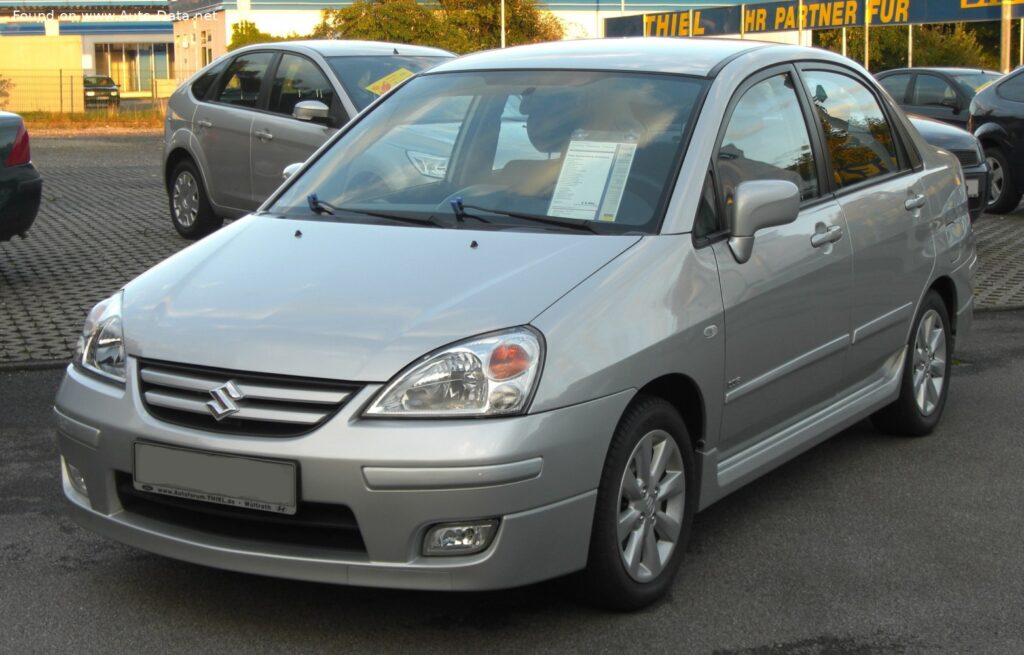
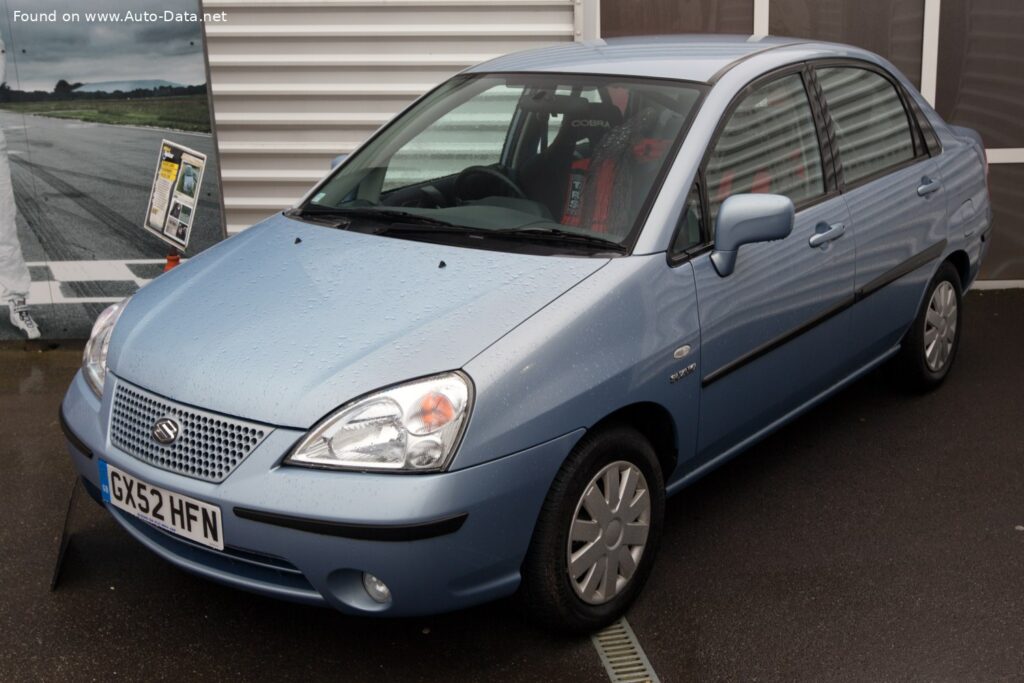
<p>The Suzuki Liana Sedan I adopted a conventional four-door, five-seat sedan body type, measuring 171.26 inches (4350 mm) in length, 66.54 inches (1690 mm) in width, and 60.83 inches (1545 mm) in height. Its wheelbase of 97.64 inches (2480 mm) contributed to a stable ride and a surprisingly spacious interior for its class. The design, while not overtly flashy, was clean and functional, with a slightly taller profile compared to some rivals, which enhanced headroom and ease of entry/exit.</p>
<p>Inside, the Liana Sedan focused on practicality and user-friendliness. The GL trim level would typically imply a good standard of equipment for its segment, likely including features such as power windows, central locking, and potentially air conditioning, though specific trim details can vary by market. A significant advantage of the sedan body style was its generous trunk space, offering 16.95 cu. ft. (480 liters) of cargo volume, making it highly suitable for families and individuals requiring ample luggage capacity.</p>
<p>For safety, the Liana Sedan I 1.3 i 16V GL was equipped with an Anti-lock Braking System (ABS), a crucial active safety feature for the early 2000s. The suspension system utilized coil springs at both the front and rear, designed to provide a comfortable ride and predictable handling. Braking duties were handled by ventilated discs at the front and traditional drum brakes at the rear. The steering system was a hydraulic rack and pinion setup, offering direct and responsive feedback. The car rode on 185/65 R14 tires fitted to 14-inch wheel rims, a common specification for economical compact cars of its time, balancing grip with ride comfort and affordability.</p>
<h3>Technical Specifications</h3>
<table border=”1″ style=”width:100%; border-collapse: collapse;”>
<tr>
<th style=”padding: 8px; text-align: left; background-color: #f2f2f2;”>Category</th>
<th style=”padding: 8px; text-align: left; background-color: #f2f2f2;”>Specification</th>
</tr>
<tr>
<td style=”padding: 8px; border: 1px solid #ddd;”>Brand</td>
<td style=”padding: 8px; border: 1px solid #ddd;”>Suzuki</td>
</tr>
<tr>
<td style=”padding: 8px; border: 1px solid #ddd;”>Model</td>
<td style=”padding: 8px; border: 1px solid #ddd;”>Liana Sedan I 1.3 i 16V GL (90 Hp)</td>
</tr>
<tr>
<td style=”padding: 8px; border: 1px solid #ddd;”>Production Years</td>
<td style=”padding: 8px; border: 1px solid #ddd;”>2001 – 2004</td>
</tr>
<tr>
<td style=”padding: 8px; border: 1px solid #ddd;”>Body Type</td>
<td style=”padding: 8px; border: 1px solid #ddd;”>Sedan, 4 Doors, 5 Seats</td>
</tr>
<tr>
<td style=”padding: 8px; border: 1px solid #ddd;”>Powertrain Architecture</td>
<td style=”padding: 8px; border: 1px solid #ddd;”>Internal Combustion Engine (ICE)</td>
</tr>
<tr>
<td style=”padding: 8px; border: 1px solid #ddd;”>Engine Model/Code</td>
<td style=”padding: 8px; border: 1px solid #ddd;”>M13A</td>
</tr>
<tr>
<td style=”padding: 8px; border: 1px solid #ddd;”>Engine Displacement</td>
<td style=”padding: 8px; border: 1px solid #ddd;”>1328 cm³ (1.3 liters / 81.04 cu. in.)</td>
</tr>
<tr>
<td style=”padding: 8px; border: 1px solid #ddd;”>Number of Cylinders</td>
<td style=”padding: 8px; border: 1px solid #ddd;”>4, Inline</td>
</tr>
<tr>
<td style=”padding: 8px; border: 1px solid #ddd;”>Valvetrain</td>
<td style=”padding: 8px; border: 1px solid #ddd;”>DOHC, 4 valves per cylinder (16V total)</td>
</tr>
<tr>
<td style=”padding: 8px; border: 1px solid #ddd;”>Fuel Injection System</td>
<td style=”padding: 8px; border: 1px solid #ddd;”>Multi-port manifold injection</td>
</tr>
<tr>
<td style=”padding: 8px; border: 1px solid #ddd;”>Engine Aspiration</td>
<td style=”padding: 8px; border: 1px solid #ddd;”>Naturally aspirated</td;
</tr>
<tr>
<td style=”padding: 8px; border: 1px solid #ddd;”>Compression Ratio</td>
<td style=”padding: 8px; border: 1px solid #ddd;”>9.5:1</td>
</tr>
<tr>
<td style=”padding: 8px; border: 1px solid #ddd;”>Power</td>
<td style=”padding: 8px; border: 1px solid #ddd;”>90 Hp @ 5750 rpm</td>
</tr>
<tr>
<td style=”padding: 8px; border: 1px solid #ddd;”>Torque</td>
<td style=”padding: 8px; border: 1px solid #ddd;”>85.56 lb.-ft. (116 Nm) @ 4750 rpm</td>
</tr>
<tr>
<td style=”padding: 8px; border: 1px solid #ddd;”>Acceleration 0-60 mph</td>
<td style=”padding: 8px; border: 1px solid #ddd;”>12.6 sec</td>
</tr>
<tr>
<td style=”padding: 8px; border: 1px solid #ddd;”>Maximum Speed</td>
<td style=”padding: 8px; border: 1px solid #ddd;”>102.53 mph (165 km/h)</td>
</tr>
<tr>
<td style=”padding: 8px; border: 1px solid #ddd;”>Fuel Type</td>
<td style=”padding: 8px; border: 1px solid #ddd;”>Petrol (Gasoline)</td>
</tr>
<tr>
<td style=”padding: 8px; border: 1px solid #ddd;”>Fuel Consumption (Urban)</td>
<td style=”padding: 8px; border: 1px solid #ddd;”>27.4 US mpg (8.6 l/100 km)</td>
</tr>
<tr>
<td style=”padding: 8px; border: 1px solid #ddd;”>Fuel Consumption (Extra Urban)</td>
<td style=”padding: 8px; border: 1px solid #ddd;”>35.1 US mpg (6.7 l/100 km)</td>
</tr>
<tr>
<td style=”padding: 8px; border: 1px solid #ddd;”>Drive Wheel</td>
<td style=”padding: 8px; border: 1px solid #ddd;”>Front-wheel drive</td>
</tr>
<tr>
<td style=”padding: 8px; border: 1px solid #ddd;”>Gearbox Type</td>
<td style=”padding: 8px; border: 1px solid #ddd;”>5 gears, manual transmission</td>
</tr>
<tr>
<td style=”padding: 8px; border: 1px solid #ddd;”>Front Suspension</td>
<td style=”padding: 8px; border: 1px solid #ddd;”>Coil spring</td>
</tr>
<tr>
<td style=”padding: 8px; border: 1px solid #ddd;”>Rear Suspension</td>
<td style=”padding: 8px; border: 1px solid #ddd;”>Coil spring</td>
</tr>
<tr>
<td style=”padding: 8px; border: 1px solid #ddd;”>Front Brakes</td>
<td style=”padding: 8px; border: 1px solid #ddd;”>Ventilated discs</td>
</tr>
<tr>
<td style=”padding: 8px; border: 1px solid #ddd;”>Rear Brakes</td>
<td style=”padding: 8px; border: 1px solid #ddd;”>Drum</td>
</tr>
<tr>
<td style=”padding: 8px; border: 1px solid #ddd;”>Assisting Systems</td>
<td style=”padding: 8px; border: 1px solid #ddd;”>ABS (Anti-lock braking system)</td>
</tr>
<tr>
<td style=”padding: 8px; border: 1px solid #ddd;”>Steering Type</td>
<td style=”padding: 8px; border: 1px solid #ddd;”>Steering rack and pinion, Hydraulic Power Steering</td>
</tr>
<tr>
<td style=”padding: 8px; border: 1px solid #ddd;”>Tires Size</td>
<td style=”padding: 8px; border: 1px solid #ddd;”>185/65 R14</td>
</tr>
<tr>
<td style=”padding: 8px; border: 1px solid #ddd;”>Wheel Rims Size</td>
<td style=”padding: 8px; border: 1px solid #ddd;”>14 inches</td>
</tr>
<tr>
<td style=”padding: 8px; border: 1px solid #ddd;”>Kerb Weight</td>
<td style=”padding: 8px; border: 1px solid #ddd;”>2502.25 lbs. (1135 kg)</td>
</tr>
<tr>
<td style=”padding: 8px; border: 1px solid #ddd;”>Maximum Weight</td>
<td style=”padding: 8px; border: 1px solid #ddd;”>3615.58 lbs. (1640 kg)</td>
</tr>
<tr>
<td style=”padding: 8px; border: 1px solid #ddd;”>Maximum Load</td>
<td style=”padding: 8px; border: 1px solid #ddd;”>1113.33 lbs. (505 kg)</td>