The Rover 800 Coupe 820 Ti (200 Hp): A British Executive Performer
The Rover 800 Coupe 820 Ti (200 Hp) represents a distinctive chapter in the history of the British automotive industry. Launched in 1994 and produced until 1999, this model was the pinnacle of the Rover 800 series, serving as the flagship luxury executive coupe for the Rover Group. While the Rover brand and its products were never officially sold in the United States, the 800 Coupe carved out a niche in its primary European markets, offering a blend of traditional British luxury, sophisticated styling, and surprising performance, particularly in its turbocharged 820 Ti guise. It was conceived as a more exclusive and sporting variant of the successful 800 Series sedan, aiming to compete with established European luxury marques by offering a unique proposition in the executive segment.
The 800 Coupe was a crucial statement piece for Rover during a period of significant change and challenge for the company. It showcased Rover’s capabilities in design and engineering, moving beyond the Honda-derived platforms that underpinned much of the 800 Series sedan’s early development. The Coupe, in particular, featured unique bodywork and a more bespoke feel, designed to appeal to buyers seeking exclusivity and a more engaging driving experience than its four-door counterpart. The 820 Ti variant, with its potent turbocharged engine, was the performance king of the lineup, promising brisk acceleration and a respectable top speed for its class.
Engine & Performance: The Heart of the Rover 800 Coupe 820 Ti (200 Hp)
Under the hood of the Rover 800 Coupe 820 Ti (200 Hp) lay a formidable powertrain for its era: Rover’s own T16T engine. This was a 2.0-liter (1994 cm³ or 121.68 cu. in.) inline-four cylinder engine, featuring a Double Overhead Camshaft (DOHC) valvetrain with four valves per cylinder, ensuring efficient breathing. What truly set the 820 Ti apart was its turbocharger, which dramatically boosted its output. This forced-induction system allowed the compact 2.0-liter unit to generate a robust 200 horsepower at 6000 rpm, a significant figure for a four-cylinder engine in the mid-1990s.
Equally impressive was the torque delivery. The T16T engine produced 240 Nm (177.01 lb.-ft.) of torque at a remarkably low 2100 rpm. This broad and accessible torque band contributed significantly to the car’s real-world drivability and effortless acceleration. The engine was configured in a front, transverse layout, driving the front wheels through a precise 5-speed manual transmission. This setup, while common for front-wheel-drive vehicles, was tuned to deliver a sporting character befitting a coupe.
Performance figures for the 820 Ti were competitive. It could accelerate from 0 to 60 mph in a brisk 7.6 seconds (calculated), with a 0-100 km/h sprint completed in 8 seconds flat. The car’s maximum speed was an impressive 230 km/h (142.92 mph), making it one of the faster executive coupes of its time. Despite its performance aspirations, the 820 Ti also offered reasonable fuel economy for a turbocharged engine, with an extra-urban (highway) consumption rated at 7.7 l/100 km (30.5 US mpg) and urban (city) consumption at 11.8 l/100 km (19.9 US mpg). This balance of power and efficiency made it a compelling choice for European buyers.
Design & Features: Crafting a British Coupe Aesthetic
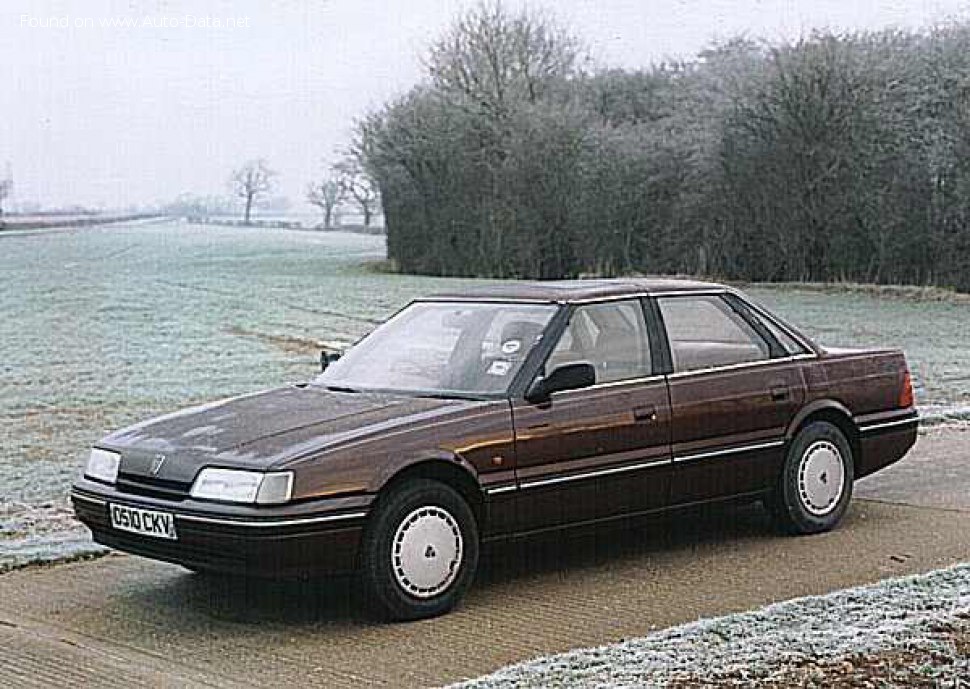
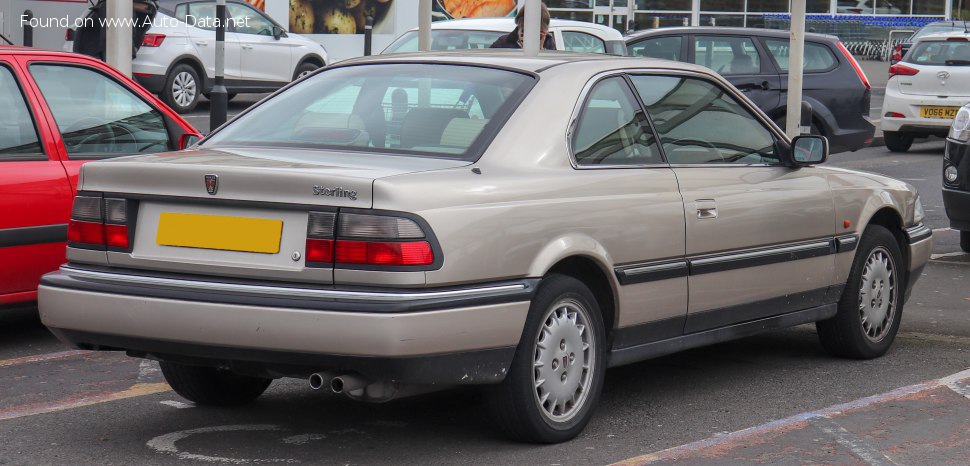
The design of the Rover 800 Coupe was a key differentiator from its sedan sibling. While the provided data curiously lists “4 Doors,” the Rover 800 Coupe was, in fact, a dedicated two-door model, reflecting its true coupe identity and aiming for a more exclusive, streamlined appearance. Its body was notably distinct from the sedan from the A-pillar back, featuring a lower, sleeker roofline, wider rear haunches, and a unique rear window treatment. The overall length of 192.13 inches (4880 mm) and width of 68.11 inches (1730 mm) gave it a substantial road presence, while the height of 54.72 inches (1390 mm) contributed to its elegant profile. The wheelbase measured 108.9 inches (2766 mm), providing a stable platform.
Inside, the 800 Coupe aimed for a luxurious ambiance, typical of British executive cars of the era. Despite its coupe designation, it offered seating for five occupants, making it a relatively practical choice for a two-door vehicle. The interior was characterized by high-quality materials, including leather upholstery and wood trim, which were hallmarks of Rover’s approach to luxury. The trunk space was generous for a coupe, offering 16.6 cu. ft. (470 liters) of cargo capacity, enhancing its usability for long journeys.
Key features included a robust chassis with a double wishbone front suspension and a coil spring rear suspension, designed to provide a comfortable ride with competent handling. Braking was handled by ventilated discs at the front and solid discs at the rear, ensuring ample stopping power for the 200 Hp engine. The steering system was a hydraulic rack and pinion setup, offering good feedback to the driver. The car rode on 205/55 R16 tires, providing a good balance of grip and ride comfort. The kerb weight of 2976.24 lbs. (1350 kg) underscored its solid build quality, contributing to a planted feel on the road.
Technical Specifications
| Category | Specification | Value (US Units) |
|---|---|---|
| General Information | ||
| Brand | Rover | N/A |
| Model | 800 | N/A |
| Generation | 800 Coupe | N/A |
| Type (Engine) | 820 Ti (200 Hp) | N/A |
| Start of Production | 1994 year | N/A |
| End of Production | 1999 year | N/A |
| Powertrain Architecture | Internal Combustion engine | N/A |
| Body type | Coupe (2 Doors – *Note: Data incorrectly states 4 Doors*) | N/A |
| Seats | 5 | N/A |
| Doors | 2 (*Note: Data incorrectly states 4 Doors*) | N/A |
| Performance Specifications | ||
| Fuel consumption (economy) – urban | 11.8 l/100 km | 19.9 US mpg |
| Fuel consumption (economy) – extra urban | 7.7 l/100 km | 30.5 US mpg |
| Fuel Type | Petrol (Gasoline) | N/A |
| Acceleration 0 – 60 mph (Calculated) | 7.6 sec | N/A |
| Acceleration 0 – 100 km/h | 8 sec | N/A |
| Maximum speed | 230 km/h | 142.92 mph |
| Weight-to-power ratio | 6.8 kg/Hp | 14.99 lbs/Hp |
| Weight-to-torque ratio | 5.6 kg/Nm | 12.35 lbs/Nm |
| Engine Specifications | ||
| Power | 200 Hp @ 6000 rpm | N/A |
| Power per liter | 100.3 Hp/l | N/A |
| Torque | 240 Nm @ 2100 rpm | 177.01 lb.-ft. @ 2100 rpm |
| Engine layout | Front, Transverse | N/A |
| Engine Model/Code | T16T | N/A |
| Engine displacement | 1994 cm³ | 121.68 cu. in. |
| Number of cylinders | 4 | N/A |
| Engine configuration | Inline | N/A |
| Cylinder Bore | 84.5 mm | 3.33 in. |
| Piston Stroke | 89 mm | 3.5 in. |
| Compression ratio | 8.5:1 | N/A |
| Number of valves per cylinder | 4 | N/A |
| Fuel injection system | Multi-port manifold injection | N/A |
| Engine aspiration | Turbocharger | N/A |
| Valvetrain | DOHC | N/A |
| Engine oil capacity | 4.5 l | 4.76 US qt |
| Engine oil specification | Not specified | N/A |
| Coolant | 8.5 l | 8.98 US qt |
| Space, Volume and Weights | ||
| Kerb Weight | 1350 kg | 2976.24 lbs. |
| Max. weight | 1910 kg | 4210.83 lbs. |
| Max load | 560 kg | 1234.59 lbs. |
| Trunk (boot) space – minimum | 470 l | 16.6 cu. ft. |
| Fuel tank capacity | 68 l | 17.96 US gal |
| Dimensions | ||
| Length | 4880 mm | 192.13 in. |
| Width | 1730 mm | 68.11 in. |
| Height | 1390 mm | 54.72 in. |
| Wheelbase | 2766 mm | 108.9 in. |
| Front track | 1490 mm | 58.66 in. |
| Rear (Back) track | 1450 mm | 57.09 in. |
| Drivetrain, Brakes and Suspension Specs | ||
| Drivetrain Architecture | Front wheel drive. Internal Combustion engine. | N/A |
| Drive wheel | Front wheel drive | N/A |
| Number of gears and type of gearbox | 5 gears, manual transmission | N/A |
| Front suspension | Double wishbone | N/A |
| Rear suspension | Coil spring | N/A |
| Front brakes | Ventilated discs | N/A |
| Rear brakes | Disc | N/A |
| Steering type | Steering rack and pinion | N/A |
| Power steering | Hydraulic Steering | N/A |
| Tires size | 205/55 R16 | N/A |
Legacy & Market Impact
The Rover 800 Coupe, especially in its 820 Ti (200 Hp) iteration, held a unique position in the European automotive landscape of the 1990s. As a product of the Rover Group, it represented a last flourish of independent British executive car manufacturing before the brand’s eventual acquisition and subsequent decline. The 800 series as a whole was designed to compete with the likes of the Ford Scorpio, Vauxhall (Opel) Omega, and to a lesser extent, entry-level models from BMW and Mercedes-Benz, offering a more quintessentially British luxury experience. The Coupe, however, aimed for a more specialist segment, often cross-shopping with vehicles like the Volvo C70 Coupe or the Peugeot 406 Coupe, though the Rover often felt more substantial and traditionally luxurious.
Its impact was significant in demonstrating Rover’s ability to produce a stylish, performance-oriented, and luxurious vehicle that resonated with a segment of European buyers. The 820 Ti, with its powerful turbocharged engine, helped to dispel any notions that Rover was solely focused on staid, conservative motoring. It garnered a reputation for its comfortable ride, refined interior, and surprisingly strong performance, making it a capable grand tourer.
Despite its merits, the Rover 800 Coupe faced challenges inherent to the Rover brand’s struggles in the late 20th century, including perceptions of build quality and reliability compared to its German rivals, though the Honda partnership had largely improved these aspects for the 800 series. Today, the Rover 800 Coupe 820 Ti is considered a modern classic, particularly among enthusiasts of British cars. It is appreciated for its distinctive design, the potent performance of its T16T engine, and its historical significance as one of the last truly British-designed and built executive coupes. Its rarity outside of the UK and Europe further solidifies its status as a desirable collector’s item for those who appreciate its unique blend of heritage, luxury, and performance.