The Peugeot 307 CC (facelift 2005): A European Convertible Icon
The Peugeot 307 CC (facelift 2005) represents a significant chapter in the evolution of the coupe-cabriolet segment, a niche Peugeot helped to popularize in Europe. Launched as a refreshed version of the original 307 CC, this model, specifically the 2.0i (140 Hp) Automatic variant, debuted in 2005 and remained in production until 2009. While not officially sold in the United States, the 307 CC was a familiar sight on European roads, embodying the French automaker’s flair for design and practical innovation. It offered the versatility of a fixed-roof coupe with the open-air exhilaration of a convertible, all within a single, elegantly styled package.
Positioned as a more accessible and family-friendly alternative to traditional sports convertibles, the 307 CC aimed to blend everyday usability with weekend leisure. Its four-seat configuration and retractable hardtop mechanism were key selling points, making it a compelling option for consumers seeking a versatile and stylish vehicle. The facelift introduced subtle but effective styling updates, aligning it more closely with Peugeot’s contemporary design language while retaining the distinctive silhouette that made the 307 CC a recognizable presence.
Engine and Performance of the Peugeot 307 CC (facelift 2005)
Under the hood of the Peugeot 307 CC (facelift 2005) 2.0i (140 Hp) Automatic lay a robust and well-proven powertrain designed for smooth, everyday driving. This variant was equipped with a naturally aspirated 2.0-liter (1997 cm3 or 121.86 cu. in.) inline four-cylinder gasoline engine. Designated by engine codes RFJ EW10A or RFN EW10J4, this unit featured a Double Overhead Camshaft (DOHC) valvetrain with four valves per cylinder, optimizing airflow for a broad powerband. Fuel delivery was managed by a multi-port manifold injection system, contributing to its Euro 4 emission standard compliance.
The engine produced a respectable 140 horsepower at 6000 rpm, with a maximum torque of 200 Nm (147.51 lb.-ft.) available at 4000 rpm. This power output, combined with a compression ratio of 10.8:1, provided adequate performance for its segment. The engine’s front, transverse layout drove the front wheels through a 4-speed automatic transmission. While a more modern transmission might have offered greater efficiency, this automatic unit was engineered for comfortable cruising, a characteristic well-suited to the convertible’s relaxed demeanor.
In terms of acceleration, the 307 CC 2.0i Automatic could sprint from 0 to 60 mph in an estimated 10.7 seconds, reaching 100 km/h (62 mph) in 11.3 seconds. Its top speed was rated at 200 km/h (124.27 mph). The vehicle’s curb weight of 3302.52 lbs. (1498 kg) resulted in a weight-to-power ratio of 10.7 kg/Hp, or 93.5 Hp per tonne, indicating a balanced performance profile rather than outright sportiness.
Fuel efficiency for the 2.0i Automatic was rated at a combined 8.4 liters per 100 km, which translates to approximately 28 US mpg. Urban consumption stood at 12.2 l/100 km (19.3 US mpg), while extra-urban driving yielded 6.3 l/100 km (37.3 US mpg). CO2 emissions were 199 g/km, reflecting its compliance with the Euro 4 standard prevalent at the time.
Design and Features
The Distinctive Coupe-Cabriolet Body of the Peugeot 307 CC (facelift 2005)
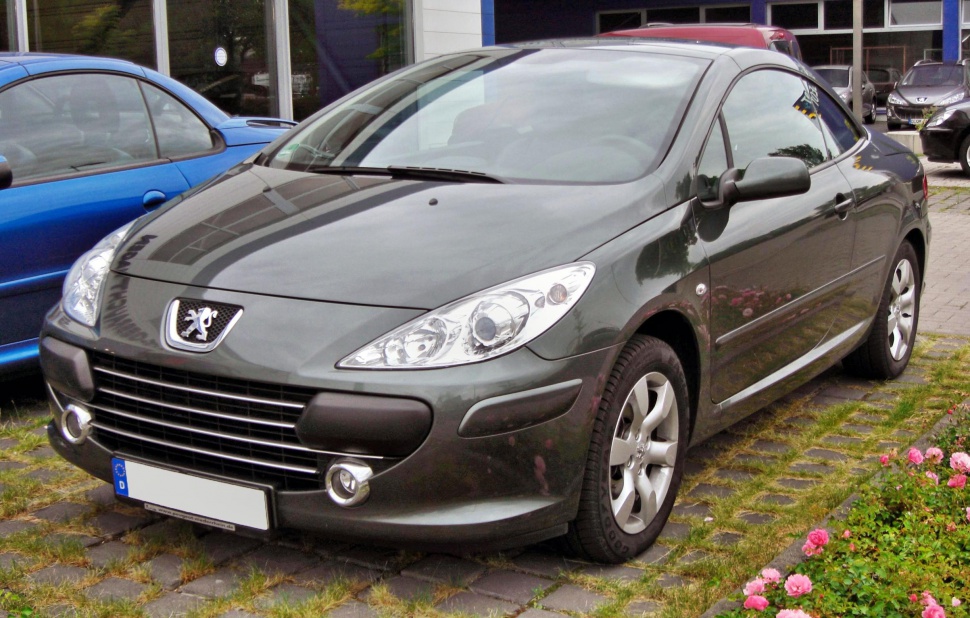
The defining feature of the Peugeot 307 CC (facelift 2005) was its innovative coupe-cabriolet body type, a design that allowed it to transform from a stylish two-door coupe into an open-top convertible at the touch of a button. This retractable hardtop mechanism was a marvel of engineering, offering enhanced security and weather protection compared to traditional soft-top convertibles, alongside improved cabin refinement. The facelifted model retained the elegant lines of its predecessor, characterized by a sloping roofline when the top was up and a clean, uncluttered profile when stowed.
Measuring 171.65 inches (4360 mm) in length, 69.25 inches (1759 mm) in width, and 56.06 inches (1424 mm) in height, the 307 CC presented a compact yet substantial footprint. Its wheelbase of 102.68 inches (2608 mm) contributed to a stable ride and allowed for a relatively spacious four-seat interior, a key differentiator in the convertible market. While the rear seats were more suited for occasional use or children, they provided a level of practicality often missing in two-seat roadsters.
The vehicle’s design also incorporated practical elements such as a minimum turning circle of 36.42 feet (11.1 meters), making it maneuverable in urban environments. The trunk space varied significantly depending on the roof’s position; with the top up, it offered a generous 12.36 cu. ft. (350 liters), shrinking to 7.2 cu. ft. (204 liters) when the hardtop was stowed, a common compromise for retractable roof designs.
Standard features included ventilated disc brakes at the front and disc brakes at the rear, complemented by an Anti-lock Braking System (ABS) for enhanced safety. The steering system utilized a rack and pinion setup, offering precise control. The 307 CC rode on 16-inch wheels fitted with 205/55 R16 V tires, providing a good balance of comfort and grip. Its drag coefficient (Cd) of 0.31 was respectable for a car of its type, contributing to both aesthetics and aerodynamic efficiency.
Technical Specifications
| General Information | |
|---|---|
| Brand | Peugeot |
| Model | 307 |
| Generation | 307 CC (facelift 2005) |
| Type (Engine) | 2.0i (140 Hp) Automatic |
| Start of Production | 2005 year |
| End of Production | 2009 year |
| Powertrain Architecture | Internal Combustion Engine, Front-Wheel Drive |
| Body Type | Coupe – Cabriolet |
| Seats | 4 |
| Doors | 2 |
| Performance Specifications | |
| Fuel Consumption (Urban) | 12.2 l/100 km (19.3 US mpg) |
| Fuel Consumption (Extra Urban) | 6.3 l/100 km (37.3 US mpg) |
| Fuel Consumption (Combined) | 8.4 l/100 km (28 US mpg) |
| CO2 Emissions | 199 g/km |
| Fuel Type | Petrol (Gasoline) |
| Acceleration 0 – 60 mph | 10.7 sec |
| Acceleration 0 – 100 km/h | 11.3 sec |
| Maximum Speed | 200 km/h (124.27 mph) |
| Emission Standard | Euro 4 |
| Weight-to-Power Ratio | 10.7 kg/Hp (93.5 Hp/tonne) |
| Weight-to-Torque Ratio | 7.5 kg/Nm (133.5 Nm/tonne) |
| Engine Specifications | |
| Power | 140 Hp @ 6000 rpm |
| Power per liter | 70.1 Hp/l |
| Torque | 200 Nm @ 4000 rpm (147.51 lb.-ft. @ 4000 rpm) |
| Engine Layout | Front, Transverse |
| Engine Model/Code | RFJ EW10A, RFN EW10J4 |
| Engine Displacement | 1997 cm3 (121.86 cu. in.) |
| Number of Cylinders | 4 |
| Engine Configuration | Inline |
| Cylinder Bore | 85 mm (3.35 in.) |
| Piston Stroke | 88 mm (3.46 in.) |
| Compression Ratio | 10.8:1 |
| Number of Valves per Cylinder | 4 |
| Fuel Injection System | Multi-port manifold injection |
| Engine Aspiration | Naturally aspirated engine |
| Valvetrain | DOHC |
| Engine Oil Capacity | 4.3 l (4.54 US qt) |
| Coolant Capacity | 6.8 l (7.19 US qt) |
| Space, Volume and Weights | |
| Curb Weight | 1498 kg (3302.52 lbs.) |
| Max. Weight | 1900 kg (4188.78 lbs.) |
| Max Load | 402 kg (886.26 lbs.) |
| Trunk (Boot) Space – Minimum | 204 l (7.2 cu. ft.) |
| Trunk (Boot) Space – Maximum | 350 l (12.36 cu. ft.) |
| Fuel Tank Capacity | 60 l (15.85 US gal) |
| Permitted Trailer Load with Brakes (12%) | 1320 kg (2910.1 lbs.) |
| Permitted Trailer Load without Brakes | 750 kg (1653.47 lbs.) |
| Dimensions | |
| Length | 4360 mm (171.65 in.) |
| Width | 1759 mm (69.25 in.) |
| Height | 1424 mm (56.06 in.) |
| Wheelbase | 2608 mm (102.68 in.) |
| Front Track | 1497 mm (58.94 in.) |
| Rear (Back) Track | 1492 mm (58.74 in.) |
| Ride Height (Ground Clearance) | 120 mm (4.72 in.) |
| Drag Coefficient (Cd) | 0.31 |
| Minimum Turning Circle (Turning Diameter) | 11.1 m (36.42 ft) |
| Drivetrain, Brakes and Suspension Specifications | |
| Drivetrain Architecture | Front-wheel drive, Internal Combustion Engine |
| Drive Wheel | Front-wheel drive |
| Number of Gears and Type of Gearbox | 4 gears, automatic transmission |
| Front Brakes | Ventilated discs |
| Rear Brakes | Disc |
| Assisting Systems | ABS (Anti-lock braking system) |
| Steering Type | Steering rack and pinion |
| Tires Size | 205/55 R16 V |
| Wheel Rims Size | 16 inches |
Legacy and Market Impact
The Peugeot 307 CC (facelift 2005) played a crucial role in shaping the European automotive landscape of the early to mid-2000s, particularly within the burgeoning coupe-cabriolet segment. Peugeot had been a pioneer in this niche, dating back to the 1930s with its ‘Eclipse’ models, and the 307 CC continued this heritage by offering a more affordable and practical approach to open-top motoring. Its success inspired numerous competitors to enter the market, solidifying the retractable hardtop as a desirable feature for convertibles.
In its primary European market, the 307 CC competed against a growing array of rivals. Key competitors included the Renault Mégane CC, which offered a similar blend of style and practicality, the Opel Astra TwinTop, and later, the Volkswagen Eos. Each of these models vied for the attention of buyers seeking a car that could serve as a comfortable, weather-proof coupe during colder months and a liberating convertible when the sun shone. The 307 CC distinguished itself with Peugeot’s characteristic blend of comfortable ride quality, distinctive styling, and a relatively spacious interior for a convertible.
The facelifted 307 CC maintained the model’s reputation for offering a compelling package of features and design. While it wasn’t a performance powerhouse, its 2.0-liter engine and automatic transmission provided a refined and relaxed driving experience, perfectly suited for cruising along coastal roads or through scenic countryside. Its advanced safety features for the era, including ABS, contributed to its appeal as a sensible choice for a convertible.
The 307 CC’s legacy is rooted in its contribution to popularizing the concept of the accessible, four-seat coupe-cabriolet. It demonstrated that the allure of a retractable hardtop could be brought to a broader audience, moving beyond exclusive, high-end sports cars. Its successor, the Peugeot 308 CC, continued this tradition, but the 307 CC remains a memorable example of Peugeot’s innovative spirit and its ability to blend style, technology, and everyday usability in a segment that continues to evolve. Even today, the 307 CC is remembered for its elegant transformation and its role in making open-top driving a more versatile and practical option for European families.