The Toyota RAV4 III (XA30) Long 3.5 V6 (269 Hp) Automatic: A Powerful Evolution in the Compact SUV Segment
The Toyota RAV4, an acronym for “Recreational Activity Vehicle: 4-wheel drive,” has long been a trailblazer in the compact SUV market. The third generation, known internally as the XA30, marked a significant evolution in the model’s lineage, growing in size, sophistication, and power. Introduced in November 2005 and produced through 2009, the Toyota RAV4 III (XA30) Long variant, especially when equipped with the potent 3.5-liter V6 engine and automatic transmission, represented a departure from its more utilitarian predecessors. This iteration of the RAV4 aimed to bridge the gap between compact practicality and mid-size SUV comfort and performance, offering enhanced space, a more refined ride, and a surprisingly robust powertrain for its class.
Designed primarily for the North American market, where consumer demand for larger, more powerful vehicles was consistently strong, the RAV4 III (XA30) Long provided an appealing blend of Toyota’s renowned reliability, expanded cargo and passenger capacity, and an engine that delivered exhilarating acceleration. It cemented the RAV4’s position as a dominant force in the rapidly expanding compact crossover segment, appealing to families and individuals seeking versatility without the bulk or fuel consumption of traditional body-on-frame SUVs.
Engine and Performance: The Heart of the Toyota RAV4 III (XA30) Long
Under the hood, the Toyota RAV4 III (XA30) Long 3.5 V6 (269 Hp) Automatic was powered by Toyota’s acclaimed 2GR-FE engine. This naturally aspirated 3.5-liter (3456 cm³ or 210.9 cu. in.) V-engine was a marvel of engineering, featuring a DOHC (Dual Overhead Camshaft) valvetrain with VVT-i (Variable Valve Timing with intelligence). This advanced technology allowed for optimal valve timing across the engine’s RPM range, contributing to both impressive power delivery and reasonable fuel efficiency for a V6 of its era.
The 2GR-FE V6 produced a substantial 269 horsepower at 6200 rpm, a figure that placed it among the most powerful engines in its class at the time. Torque output was equally impressive, peaking at 245.61 lb.-ft. (333 Nm) at 4700 rpm. This robust power translated into spirited acceleration and confident passing maneuvers, making the RAV4 III V6 feel much more capable than many of its four-cylinder rivals. With a power-to-weight ratio of 5.9 kg/Hp (168.1 Hp/tonne) and a torque-to-weight ratio of 4.8 kg/Nm (208.1 Nm/tonne), the vehicle offered a lively driving experience.
The engine was mated to a 4-speed automatic transmission, which, while perhaps not as sophisticated as the 5-speed or 6-speed units that would become common in later years, was well-matched to the V6’s broad power band. Power was delivered to the front wheels, a configuration that prioritized fuel efficiency and ease of manufacturing, though all-wheel drive was also available on other RAV4 III variants. Despite its power, the RAV4 III V6 maintained respectable fuel economy figures for its class, achieving an estimated 22.2 US mpg in urban driving and 29 US mpg on the highway, with a 15.85 US gallon fuel tank providing a decent cruising range.
Design and Features: Practicality Meets Modernity
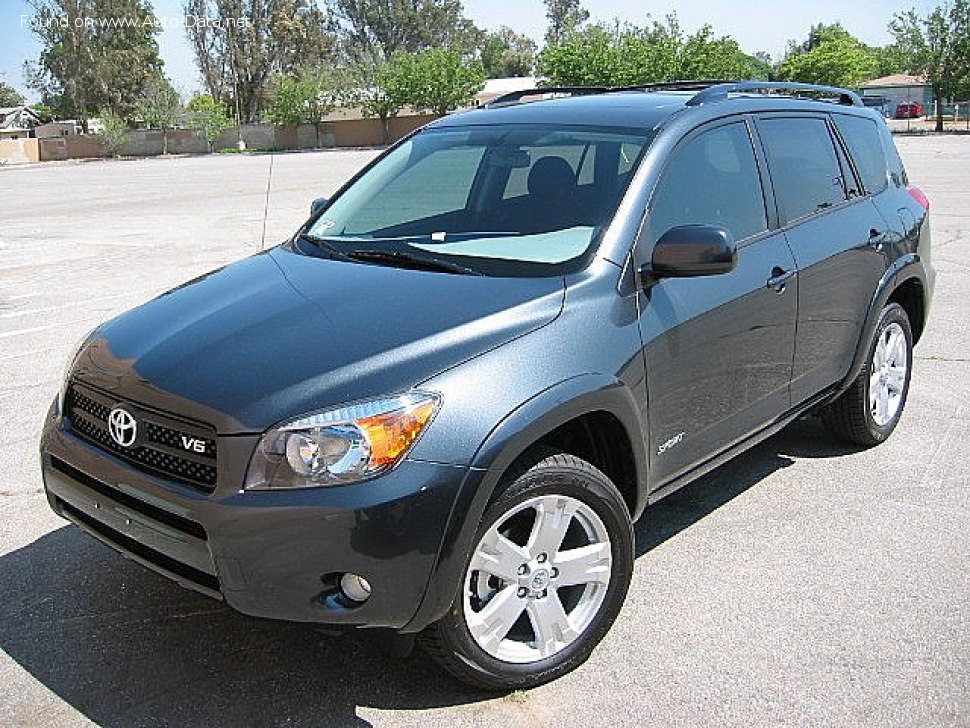
The Toyota RAV4 III (XA30) Long moved away from the more angular, compact design of its predecessors, adopting a smoother, more aerodynamic aesthetic. With a drag coefficient (Cd) of 0.33, it was designed to cut through the air efficiently. The “Long” designation referred to its extended wheelbase and overall length, accommodating an optional third row of seating, allowing for 5 to 7 passengers. This made it a compelling alternative to larger, less fuel-efficient SUVs for growing families.
Measuring 181.1 inches (4600 mm) in length, 71.46 to 73.03 inches (1815-1855 mm) in width, and 68.7 to 69.09 inches (1745-1755 mm) in height, the RAV4 III offered a spacious interior. The wheelbase of 104.72 inches (2660 mm) contributed to a stable ride and increased interior volume. Cargo capacity was a strong suit, with a minimum trunk space of 12.29 cu. ft. (348 liters) behind the second row, expanding to a cavernous 73 cu. ft. (2067 liters) with the rear seats folded down. This flexibility was crucial for active lifestyles and family hauling duties.
The vehicle’s architecture featured an independent McPherson strut front suspension with coil springs and an anti-roll bar, paired with a double wishbone rear suspension. This setup provided a comfortable and composed ride, with handling characteristics that were more car-like than traditional SUVs. Braking was handled by ventilated discs at the front and solid discs at the rear, complemented by a standard ABS (Anti-lock Braking System) for enhanced safety and control during emergency stops. The steering system utilized a rack and pinion setup, offering precise and responsive feedback. With a ground clearance of 7.48 inches (190 mm) and approach/departure angles of 29.3° and 25.4° respectively, the RAV4 III maintained a degree of off-road capability, though its primary domain remained paved roads. The 17-inch wheels (7J x 17) fitted with 225/65 R17 tires provided a good balance of comfort and grip.
Technical Specifications: Toyota RAV4 III (XA30) Long 3.5 V6 (269 Hp) Automatic
| Category | Specification | US Equivalent |
|---|---|---|
General Information |
||
| Brand | Toyota | |
| Model | RAV4 | |
| Generation | RAV4 III (XA30) Long | |
| Type (Engine) | 3.5 V6 (269 Hp) Automatic | |
| Start of Production | November, 2005 | |
| End of Production | 2009 | |
| Powertrain Architecture | Internal Combustion engine | |
| Body Type | SUV | |
| Seats | 5-7 | |
| Doors | 5 | |
Performance Specs |
||
| Fuel Consumption (Urban) | 10.6 l/100 km | 22.2 US mpg |
| Fuel Consumption (Extra Urban) | 8.1 l/100 km | 29 US mpg |
| Fuel Type | Petrol (Gasoline) | |
| Weight-to-Power Ratio | 5.9 kg/Hp | |
| Weight-to-Torque Ratio | 4.8 kg/Nm | |
Engine Specs |
||
| Power | 269 Hp @ 6200 rpm | |
| Power per Liter | 77.8 Hp/l | |
| Torque | 333 Nm @ 4700 rpm | 245.61 lb.-ft. @ 4700 rpm |
| Engine Layout | Front, Transverse | |
| Engine Model/Code | 2GR-FE | |
| Engine Displacement | 3456 cm³ | 210.9 cu. in. |
| Number of Cylinders | 6 | |
| Engine Configuration | V-engine | |
| Cylinder Bore | 94 mm | 3.7 in. |
| Piston Stroke | 83 mm | 3.27 in. |
| Compression Ratio | 10.8:1 | |
| Valves per Cylinder | 4 | |
| Fuel Injection System | Multi-port manifold injection | |
| Engine Aspiration | Naturally aspirated engine | |
| Valvetrain | DOHC, VVT-i | |
| Engine Oil Capacity | 6.1 l | 6.45 US qt |
| Coolant Capacity | 8.9 l | 9.4 US qt |
Space, Volume and Weights |
||
| Curb Weight | 1600 kg | 3527.4 lbs. |
| Max. Weight (Gross Vehicle Weight) | 2086 kg | 4598.84 lbs. |
| Max Load | 486 kg | 1071.45 lbs. |
| Trunk Space (Minimum) | 348 l | 12.29 cu. ft. |
| Trunk Space (Maximum) | 2067 l | 73 cu. ft. |
| Fuel Tank Capacity | 60 l | 15.85 US gal |
| Permitted Trailer Load (without brakes) | 907 kg | 1999.59 lbs. |
Dimensions |
||
| Length | 4600 mm | 181.1 in. |
| Width | 1815-1855 mm | 71.46 – 73.03 in. |
| Height | 1745-1755 mm | 68.7 – 69.09 in. |
| Wheelbase | 2660 mm | 104.72 in. |
| Front Track | 1560 mm | 61.42 in. |
| Rear Track | 1560 mm | 61.42 in. |
| Ride Height (Ground Clearance) | 190 mm | 7.48 in. |
| Drag Coefficient (Cd) | 0.33 | |
| Minimum Turning Circle | 11.4 m | 37.4 ft. |
| Approach Angle | 29.3° | |
| Departure Angle | 25.4° | |
Drivetrain, Brakes and Suspension Specs |
||
| Drivetrain Architecture | The Internal combustion engine (ICE) drives the front wheels of the vehicle. | |
| Drive Wheel | Front-wheel drive | |
| Number of Gears and Type of Gearbox | 4 gears, automatic transmission | |
| Front Suspension | Independent, type McPherson with coil spring and anti-roll bar | |
| Rear Suspension | Double wishbone | |
| Front Brakes | Ventilated discs | |
| Rear Brakes | Disc | |
| Assisting Systems | ABS (Anti-lock Braking System) | |
| Steering Type | Steering rack and pinion | |
| Tire Size | 225/65 R17 | |
| Wheel Rims Size | 7J x 17 | |
Legacy and Market Impact of the Toyota RAV4 III (XA30) Long
The third-generation Toyota RAV4, particularly the XA30 Long with its powerful V6 engine option, left a significant mark on the automotive landscape. It was a pivotal model that evolved the compact SUV concept from a niche, somewhat rugged vehicle into a mainstream family hauler with broad appeal. In the competitive North American market, it went head-to-head with established rivals such as the Honda CR-V, Ford Escape, and Nissan Rogue, often surpassing them in terms of available power and interior volume.
The RAV4 III’s reputation was built on Toyota’s core strengths: legendary reliability, high resale value, and practical design. The availability of a V6 engine in a segment traditionally dominated by four-cylinders gave it a distinct advantage, attracting buyers who desired more performance for towing light trailers (up to approximately 2,000 lbs without brakes) or simply for a more confident driving experience. This strategic move allowed the RAV4 to capture a wider audience, including those who might have otherwise considered larger, less efficient mid-size SUVs.
Its expanded dimensions and optional third-row seating were game-changers, transforming the RAV4 from a personal utility vehicle into a viable family transport option. This move anticipated the market’s shift towards crossovers that blended car-like driving dynamics with SUV versatility, effectively making it a precursor to many of today’s popular three-row crossovers. While the 4-speed automatic transmission might seem rudimentary by today’s standards, it was robust and reliable, perfectly suited to the V6 engine’s characteristics.
The Toyota RAV4 III (XA30) Long played a crucial role in solidifying the RAV4’s status as a segment leader and a global bestseller. It demonstrated Toyota’s ability to adapt to evolving consumer preferences, offering a more refined, spacious, and powerful package without compromising the core values of durability and efficiency that buyers had come to expect from the brand. Its success paved the way for future generations of the RAV4 to continue its trajectory as one of the most popular and influential SUVs worldwide.