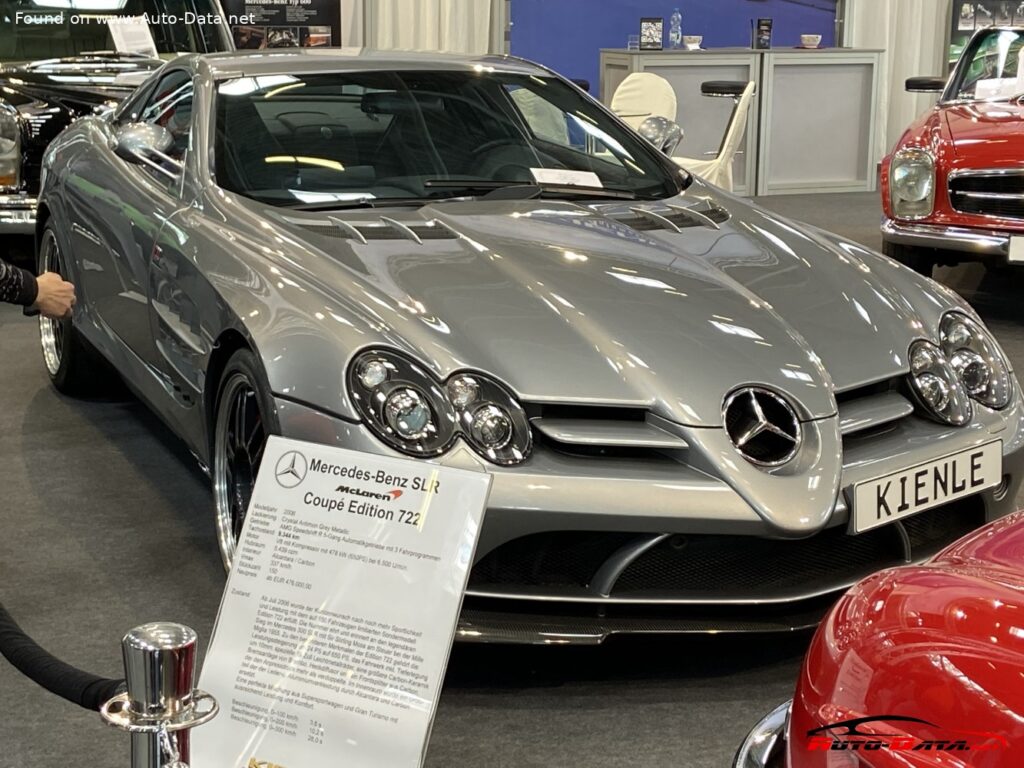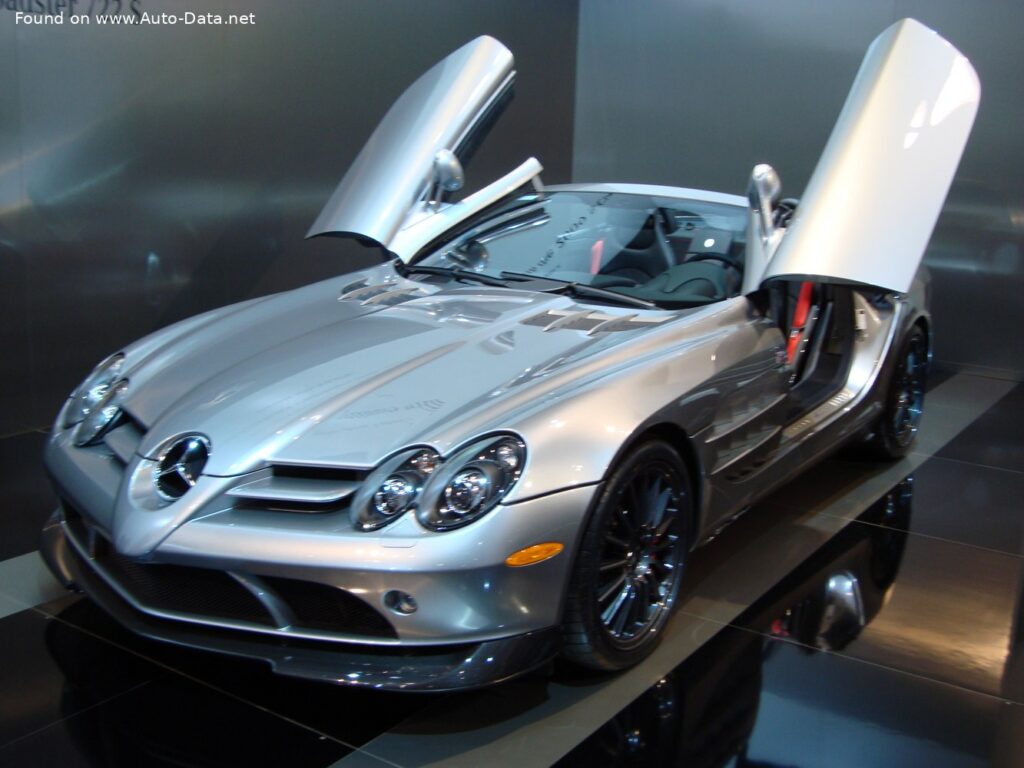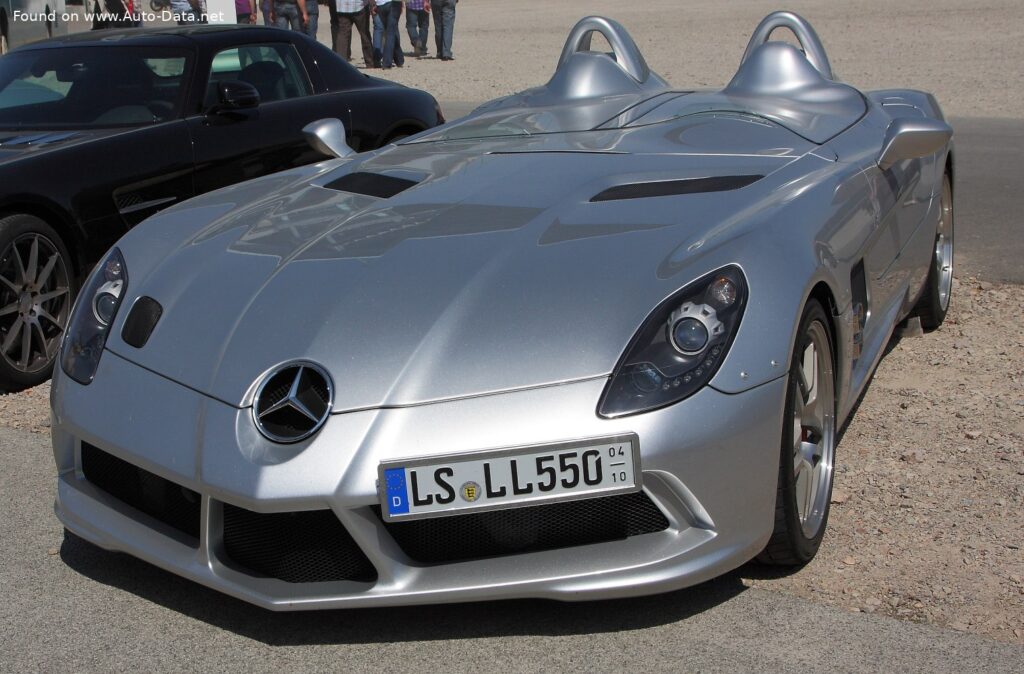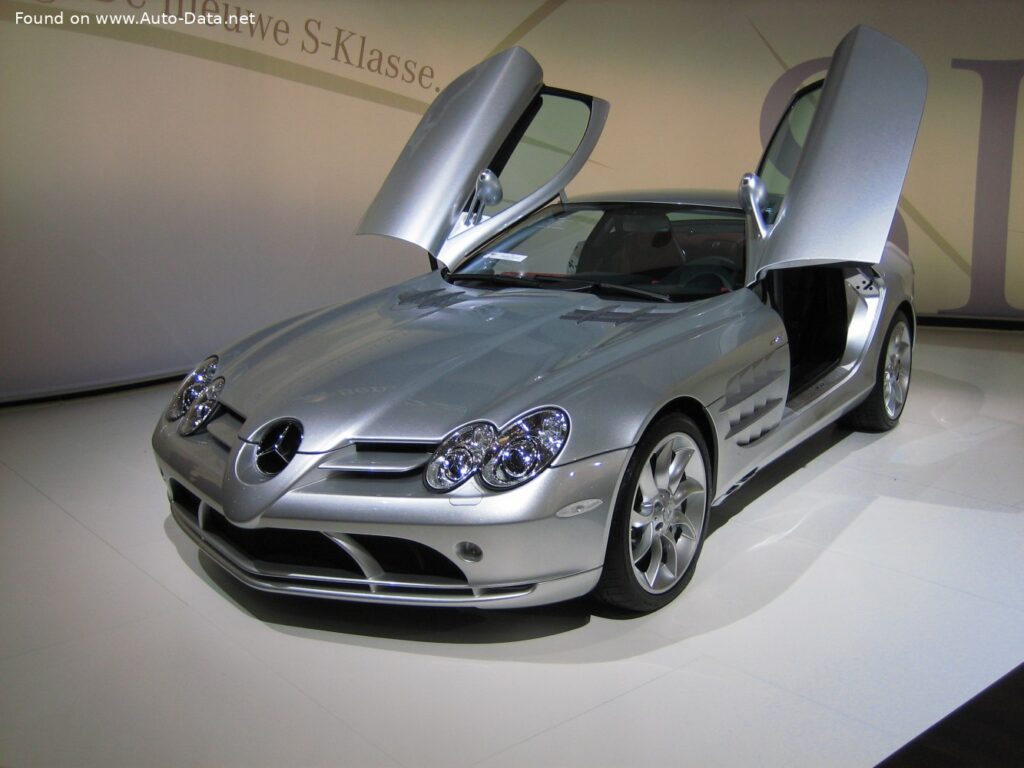
The Mercedes-Benz SLR McLaren (C199) Coupe 5.5 V8 Kompressor (626 Hp) AMG SPEEDSHIFT R: A Grand Tourer Supercar
The Mercedes-Benz SLR McLaren (C199) Coupe stands as a monumental achievement in automotive engineering, a product of a unique collaboration between two titans of the automotive and motorsport worlds: Mercedes-Benz and McLaren Automotive. Launched in 2004, this front mid-engine, rear-wheel-drive grand tourer was conceived to blend the luxurious comfort and engineering prowess of Mercedes-Benz with the lightweight construction and high-performance pedigree of McLaren, fresh from their successful partnership in Formula 1. The specific variant, the Mercedes-Benz SLR McLaren (C199) Coupe 5.5 V8 Kompressor (626 Hp) AMG SPEEDSHIFT R, represents the initial and most iconic iteration of this limited-production supercar, establishing itself as a halo car for both brands and a significant entry in the exclusive segment of ultra-high-performance vehicles.
Positioned as a spiritual successor to the legendary Mercedes-Benz 300 SLR racing car of the 1950s, the C199 was designed not just for outright speed but also for long-distance cruising in opulent comfort. It occupied a distinct niche, offering supercar performance without sacrificing the refinement expected of a Mercedes-Benz. Its production run, spanning from 2004 to 2008 for the coupe variant, saw a limited number of these extraordinary machines reach discerning collectors and enthusiasts worldwide, cementing its status as a highly sought-after modern classic.
Engine & Performance: The Heart of the Mercedes-Benz SLR McLaren (C199) Coupe 5.5 V8 Kompressor (626 Hp) AMG SPEEDSHIFT R
At the core of the SLR McLaren’s formidable capabilities is its handcrafted 5.5-liter (5,439 cm³ or 331.91 cu. in.) M 155.980 V8 engine. This powertrain, developed by AMG, is not just a large-displacement V8; it’s a supercharged masterpiece. The “Kompressor” designation signifies the inclusion of a Lysholm-type twin-screw supercharger, coupled with an intercooler, which force-feeds air into the engine, dramatically boosting power output. This setup allows the engine to produce a staggering 626 horsepower at 6500 rpm and an immense 575.3 lb.-ft. of torque, available across a broad rev range from 3250 to 5000 rpm. This flat torque curve ensures exhilarating acceleration at virtually any speed.
The engine’s layout is front-longitudinal, placing the V8 behind the front axle line, contributing to an optimal weight distribution crucial for high-performance handling. Power is efficiently transferred to the rear wheels via a sophisticated 5-speed AMG SPEEDSHIFT R automatic transmission. While some purists might have preferred a manual gearbox, the SPEEDSHIFT R was engineered for rapid shifts, offering both fully automatic and manual modes via steering wheel-mounted paddles, providing a balance of convenience and driver engagement suitable for a grand tourer with supercar aspirations.
Performance figures for the SLR McLaren were nothing short of sensational for its time. It could rocket from 0 to 60 mph in a blistering 3.6 seconds (0-100 km/h in 3.8 seconds), and continue its relentless acceleration to 200 km/h in just 10.6 seconds, and 300 km/h in 28.8 seconds. The top speed was officially rated at 207.54 mph (334 km/h), placing it firmly in the elite club of the fastest production cars in the world. Its weight-to-power ratio of 2.7 kg/Hp (or 369.8 Hp per tonne) underscores its incredible thrust, demonstrating how effectively its 3,732.43-pound curb weight was managed by its potent engine.
Despite its prodigious power, Mercedes-Benz and AMG also focused on relative efficiency for a vehicle of this caliber. The combined fuel consumption was rated at 16.2 US mpg (14.5 l/100 km), with CO2 emissions of 348 g/km, adhering to Euro 4 emission standards. These figures, while high by conventional standards, were commendable for a supercharged V8 producing over 600 horsepower in the mid-2000s.
Design & Features: Form Meets Function
The design of the Mercedes-Benz SLR McLaren (C199) Coupe is instantly recognizable, a harmonious blend of Mercedes-Benz’s elegant styling cues and McLaren’s aerodynamic efficiency. Its long hood, set-back cabin, and side-exit exhaust pipes were direct homages to the iconic 300 SLR. The body, primarily constructed from carbon fiber reinforced plastic (CFRP), was not only lightweight but also incredibly rigid, offering exceptional crash protection and enhancing dynamic performance. The two-door, two-seat coupe body type emphasized its exclusive, driver-centric nature.
Measuring 183.31 inches in length, 75.12 inches in width, and a mere 49.65 inches in height, with a substantial 106.3-inch wheelbase, the SLR McLaren possessed a commanding presence. Its aggressive stance was further accentuated by large, staggered wheel sizes: 245/40 R18 tires on 9J x 18 rims at the front, and massive 295/35 R18 tires on 11.5J x 18 rims at the rear, ensuring maximum grip and stability.
Aerodynamics played a crucial role in the SLR’s design. It featured a flat underbody and a rear airbrake that automatically deployed under hard braking to increase downforce and aid deceleration. This active aerodynamic element was a nod to McLaren’s Formula 1 expertise, providing both functional benefits and a dramatic visual flair. The distinctive “gills” on the side fenders and the long, flowing lines contributed to its low drag coefficient while also aiding engine cooling.
Inside, the cabin was a luxurious affair, designed to cocoon its two occupants in comfort befitting a Mercedes-Benz. High-quality leather, carbon fiber trim, and aluminum accents adorned the interior. The driver-focused cockpit featured clear instrumentation and ergonomic controls. Despite its supercar performance, the SLR offered practical amenities like a 9.61 cu. ft. (272 liters) trunk, making it genuinely suitable for grand touring. Safety features, while not as extensive as modern vehicles, included an Anti-lock Braking System (ABS) as standard, complemented by the inherent strength of its carbon fiber monocoque chassis and advanced braking system. The front brakes featured large 370 mm ventilated discs, providing immense stopping power.
The suspension system comprised double wishbones at both the front and rear, utilizing coil springs and transverse stabilizers to provide a sophisticated balance of ride comfort and precise handling. This setup, combined with hydraulic power steering, offered a direct and engaging driving experience, allowing the driver to fully exploit the car’s immense power.
Technical Specifications
| Category | Specification |
|---|---|
| Brand | Mercedes-Benz |
| Model | SLR McLaren |
| Generation | SLR McLaren (C199) Coupe |
| Type (Engine) | 5.5 V8 Kompressor (626 Hp) AMG SPEEDSHIFT R |
| Start of Production | 2004 |
| End of Production | 2008 |
| Powertrain Architecture | Internal Combustion Engine |
| Body Type | Coupe |
| Seats | 2 |
| Doors | 2 |
| Fuel Consumption (Urban NEDC) | 20.9 l/100 km (11.3 US mpg) |
| Fuel Consumption (Extra Urban NEDC) | 10.8 l/100 km (21.8 US mpg) |
| Fuel Consumption (Combined NEDC) | 14.5 l/100 km (16.2 US mpg) |
| CO2 Emissions (NEDC) | 348 g/km |
| Fuel Type | Petrol (Gasoline) |
| Acceleration 0 – 60 mph | 3.6 sec |
| Acceleration 0 – 100 km/h | 3.8 sec |
| Acceleration 0 – 200 km/h | 10.6 sec |
| Acceleration 0 – 300 km/h | 28.8 sec |
| Maximum Speed | 334 km/h (207.54 mph) |
| Emission Standard | Euro 4 |
| Weight-to-Power Ratio | 2.7 kg/Hp (369.8 Hp/tonne) |
| Weight-to-Torque Ratio | 2.2 kg/Nm (460.7 Nm/tonne) |
| Power | 626 Hp @ 6500 rpm |
| Power per Liter | 115.1 Hp/l |
| Torque | 780 Nm (575.3 lb.-ft.) @ 3250-5000 rpm |
| Engine Layout | Front, Longitudinal |
| Engine Model/Code | M 155.980 |
| Engine Displacement | 5439 cm³ (331.91 cu. in.) |
| Number of Cylinders | 8 |
| Engine Configuration | V-engine |
| Cylinder Bore | 97 mm (3.82 in.) |
| Piston Stroke | 92 mm (3.62 in.) |
| Compression Ratio | 8.8:1 |
| Number of Valves per Cylinder | 3 |
| Fuel Injection System | Multi-port manifold injection |
| Engine Aspiration | Supercharger, Intercooler |
| Valvetrain | SOHC |
| Engine Oil Capacity | 8.5 l (8.98 US qt) |
| Coolant Capacity | 11 l (11.62 US qt) |
| Kerb Weight | 1693 kg (3732.43 lbs.) |
| Max. Weight | 1940 kg (4276.97 lbs.) |
| Max Load | 247 kg (544.54 lbs.) |
| Trunk (Boot) Space – Minimum | 272 l (9.61 cu. ft.) |
| Fuel Tank Capacity | 97 l (25.62 US gal) |
| Length | 4656 mm (183.31 in.) |
| Width | 1908 mm (75.12 in.) |
| Height | 1261 mm (49.65 in.) |
| Wheelbase | 2700 mm (106.3 in.) |
| Front Track | 1638 mm (64.49 in.) |
| Rear (Back) Track | 1569 mm (61.77 in.) |
| Front Overhang | 966 mm (38.03 in.) |
| Rear Overhang | 990 mm (38.98 in.) |
| Minimum Turning Circle (Turning Diameter) | 12.2 m (40.03 ft.) |
| Approach Angle | 10° |
| Departure Angle | 16.5° |
| Drivetrain Architecture | The Internal combustion engine (ICE) drives the rear wheels of the vehicle. |
| Drive Wheel | Rear wheel drive |
| Number of Gears and Type of Gearbox | 5 gears, automatic transmission AMG SPEEDSHIFT R |
| Front Suspension | Coil spring, Double wishbone, Transverse stabilizer |
| Rear Suspension | Double wishbone, Coil spring |
| Front Brakes | Ventilated discs, 370 mm |
| Rear Brakes | Disc |
| Assisting Systems | ABS (Anti-lock braking system) |
| Steering Type | Steering rack and pinion |
| Power Steering | Hydraulic Steering |
| Front Wheel Tires | 245/40 R18 |
| Rear Wheel Tires | 295/35 R18 |
| Front Wheel Rims | 9J x 18 |
| Rear Wheel Rims | 11.5J x 18 |
Legacy & Market Impact of the Mercedes-Benz SLR McLaren
The Mercedes-Benz SLR McLaren carved out a unique and enduring legacy in the automotive world. It was more than just a collaboration; it was a statement piece, demonstrating what was possible when two engineering powerhouses combined their expertise. Its reputation quickly grew as a high-performance grand tourer that offered a compelling alternative to the more track-focused supercars of its era, such as the Ferrari Enzo and the Porsche Carrera GT. While the Enzo and Carrera GT were raw, uncompromising machines, the SLR McLaren offered a blend of blistering speed, immense power, and genuine luxury, making it more comfortable for cross-continental journeys.
Its primary competitors were found in the upper echelons of the exotic car market. Beyond the aforementioned hypercars, it also competed with high-end grand tourers like the Aston Martin Vanquish S and certain Bentley Continental GT variants, though the SLR consistently offered a higher degree of outright performance and exclusivity. Its limited production numbers, coupled with its distinctive design and formidable performance, ensured its status as an instant collectible.
Historically, the SLR McLaren is significant for several reasons. It represented the pinnacle of Mercedes-Benz’s performance offerings before the full proliferation of AMG as a standalone performance brand for such halo vehicles. It also showcased McLaren’s road car capabilities beyond their F1 dominance, laying groundwork for future stand-alone McLaren models. The car’s advanced carbon fiber construction, active aerodynamics, and supercharged V8 engine pushed boundaries for production vehicles at the time, influencing subsequent supercar and grand tourer designs.
Today, the Mercedes-Benz SLR McLaren remains a highly coveted vehicle among collectors and enthusiasts. Its unique heritage, stunning performance, and luxurious appointments ensure its place as an iconic machine that perfectly encapsulates a specific era of automotive collaboration and engineering excellence. It stands as a testament to the ambitious vision that brought Mercedes-Benz and McLaren together, creating a car that was truly greater than the sum of its already impressive parts.