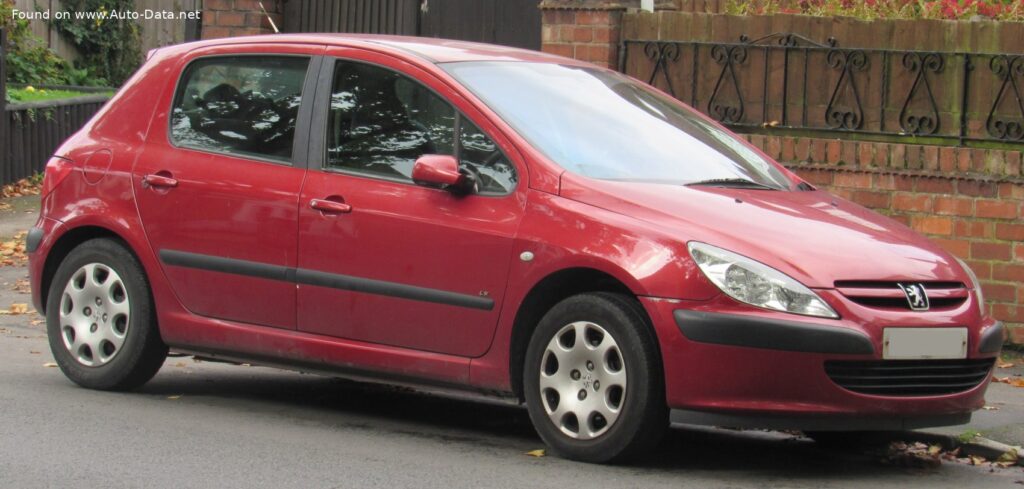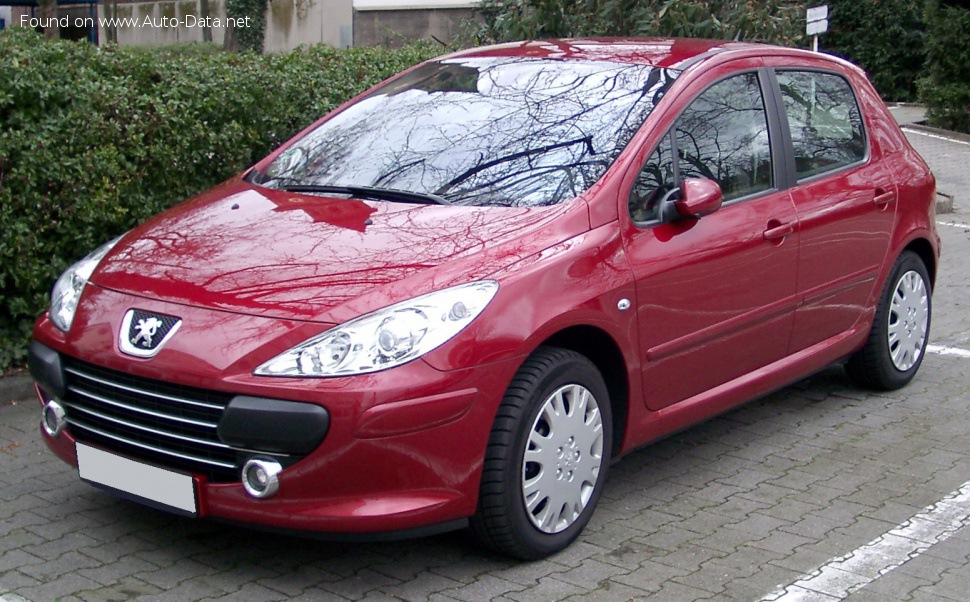
Introduction to the Peugeot 307 (facelift 2005) 1.6 HDi (109 Hp)
The Peugeot 307 (facelift 2005) 1.6 HDi (109 Hp) represents a significant evolution in Peugeot’s C-segment offerings, particularly within the European market where it was a strong contender. Launched in 2005, this updated version of the popular 307 hatchback aimed to refresh its appeal, enhance its technology, and refine its driving dynamics, building upon the success of the original model introduced in 2001. Positioned as a versatile compact family car, the 307 was known for its spacious interior, comfortable ride, and a broad range of efficient powertrains, with the 1.6 HDi diesel engine being a cornerstone of its appeal, especially in regions prioritizing fuel economy and lower emissions.
While never officially sold in the United States, the Peugeot 307 played a crucial role in Europe’s highly competitive compact car segment, competing against stalwarts like the Volkswagen Golf, Ford Focus, and Opel Astra. The 2005 facelift, often referred to as the 307 Phase 2, brought a more aggressive front-end design, improved interior materials, and updated electronic systems, ensuring the model remained contemporary until its replacement by the Peugeot 308 in 2007-2008. The 1.6 HDi variant, with its 109 horsepower output, struck an excellent balance between performance and exceptional fuel efficiency, making it a popular choice for both urban commuting and long-distance travel across the continent.
Engine and Performance: The Efficient Heart of the Peugeot 307 (facelift 2005) 1.6 HDi
At the core of this particular Peugeot 307 (facelift 2005) 1.6 HDi model is the highly regarded 1.6-liter (1560 cm³ or 95.2 cu. in.) HDi (High-pressure Direct injection) turbocharged diesel engine, a powerplant developed in collaboration with Ford. This inline four-cylinder unit, designated as the 9HZ DV6TED4, is characterized by its advanced common rail fuel injection system, double overhead camshaft (DOHC) valvetrain with four valves per cylinder, and a turbocharger coupled with an intercooler. These technologies work in concert to deliver a compelling blend of power and efficiency.
The engine produces a respectable 109 horsepower at 4000 rpm, providing ample thrust for daily driving in the compact segment. More importantly for a diesel, it delivers a robust 240 Nm (177.01 lb.-ft.) of torque at a remarkably low 1750 rpm. This strong, low-end torque is a defining characteristic of modern diesel engines, offering excellent responsiveness and effortless acceleration, particularly in city traffic and when overtaking. The power delivery is smooth and linear, a testament to the sophisticated engine management system.
Performance figures for the Peugeot 307 (facelift 2005) 1.6 HDi (109 Hp) reflect its balanced nature. It accelerates from 0 to 60 mph in a brisk 10.6 seconds, with 0-100 km/h achieved in 11.2 seconds, making it competitive within its class. The top speed is rated at 116.82 mph (188 km/h). Crucially, its fuel economy is where the 1.6 HDi truly shines. The combined fuel consumption is an impressive 4.9 liters per 100 kilometers, translating to approximately 48 US mpg. Even in urban driving, it achieves 38.6 US mpg, while extra-urban driving can see figures as high as 54.7 US mpg. These numbers made it an exceptionally economical choice for European drivers facing high fuel prices.
Mated to a precise 5-speed manual transmission, the engine channels its power to the front wheels, a standard layout for this segment. The vehicle also adheres to the Euro 4 emission standard, with CO2 emissions of 129 g/km, reflecting its relatively clean operation for a diesel of its era. The engine’s compression ratio of 17.6:1 further underscores its diesel architecture, optimized for efficiency and torque production.
Design and Features: Practicality Meets Refinement
The 2005 facelift brought a fresh aesthetic to the Peugeot 307 (facelift 2005), particularly enhancing its front fascia. The redesigned front bumper featured a larger, more prominent grille, often referred to as the “lion’s mouth” grille, which aligned it with Peugeot’s contemporary design language seen on models like the 407. New headlights with clear lenses and integrated turn signals further modernized its appearance, giving it a more assertive and sophisticated look compared to the original 307. The body type remained a versatile hatchback, available in both 3-door and 5-door configurations, offering flexibility to cater to different customer needs.
Measuring 165.83 inches in length, 68.74 inches in width, and 59.45 inches in height, the 307 was a relatively tall car for its class, a design choice that contributed significantly to its interior spaciousness and ease of entry and exit. The 102.68-inch wheelbase provided a stable platform and contributed to a comfortable ride, a hallmark of Peugeot vehicles. With a kerb weight of 2740.35 lbs (1243 kg), the 1.6 HDi model maintained a favorable weight-to-power ratio of 11.4 kg/Hp.
Inside, the Peugeot 307 (facelift 2005) offered seating for five occupants, with a focus on ergonomics and comfort. The interior received subtle updates with the facelift, including improved trim materials and minor revisions to the dashboard layout and instrumentation. Practicality was a strong suit, with a minimum trunk (boot) space of 12.04 cu. ft. (341 liters) that could expand to an impressive 46.9 cu. ft. (1328 liters) with the rear seats folded down, making it highly adaptable for cargo.
In terms of features and safety, the 307 was well-equipped for its time. Standard safety systems included an Anti-lock Braking System (ABS), which worked in conjunction with ventilated disc brakes at the front and solid discs at the rear, ensuring confident stopping power. Power steering, specifically a steering rack and pinion system, provided ease of maneuverability, particularly in urban environments, with a minimum turning circle of 36.52 feet. The vehicle rode on 195/65 R15 tires, mounted on 15-inch wheel rims, offering a good balance of comfort and grip. While specific airbag counts are not detailed in the provided data, a comprehensive airbag system (front, side, and curtain) was typically standard or optional for European compacts of this vintage, further enhancing occupant protection. The overall design prioritized a bright and airy cabin, contributing to a pleasant driving and passenger experience.
Technical Specifications
| Category | Specification |
|---|---|
| Brand | Peugeot |
| Model | 307 |
| Generation | 307 (facelift 2005) |
| Type (Engine) | 1.6 HDi (109 Hp) |
| Start of Production | 2005 year |
| End of Production | 2008 year |
| Powertrain Architecture | Internal Combustion engine |
| Body Type | Hatchback |
| Seats | 5 |
| Doors | 3-5 |
| Performance Specs | |
| Fuel Consumption (Urban) | 6.1 l/100 km (38.6 US mpg) |
| Fuel Consumption (Extra Urban) | 4.3 l/100 km (54.7 US mpg) |
| Fuel Consumption (Combined) | 4.9 l/100 km (48 US mpg) |
| CO2 Emissions | 129 g/km |
| Fuel Type | Diesel |
| Acceleration 0 – 60 mph | 10.6 sec |
| Maximum Speed | 116.82 mph (188 km/h) |
| Emission Standard | Euro 4 |
| Weight-to-Power Ratio | 11.4 kg/Hp (87.7 Hp/tonne) |
| Weight-to-Torque Ratio | 5.2 kg/Nm (193.1 Nm/tonne) |
| Engine Specs | |
| Power | 109 Hp @ 4000 rpm |
| Power per Liter | 69.9 Hp/l |
| Torque | 240 Nm @ 1750 rpm (177.01 lb.-ft. @ 1750 rpm) |
| Engine Layout | Front, Transverse |
| Engine Model/Code | 9HZ DV6TED4 |
| Engine Displacement | 1560 cm³ (1.6 Liters / 95.2 cu. in.) |
| Number of Cylinders | 4 |
| Engine Configuration | Inline |
| Cylinder Bore | 75 mm (2.95 in.) |
| Piston Stroke | 88.3 mm (3.48 in.) |
| Compression Ratio | 17.6:1 |
| Number of Valves per Cylinder | 4 |
| Fuel Injection System | Diesel Commonrail |
| Engine Aspiration | Turbocharger, Intercooler |
| Valvetrain | DOHC |
| Engine Oil Capacity | 3.8 l (4.02 US qt) |
| Coolant Capacity | 6.5 l (6.87 US qt) |
| Space, Volume and Weights | |
| Kerb Weight | 1243 kg (2740.35 lbs.) |
| Max. Weight | 1770 kg (3902.18 lbs.) |
| Max Load | 527 kg (1161.84 lbs.) |
| Trunk (boot) space – Minimum | 341 l (12.04 cu. ft.) |
| Trunk (boot) space – Maximum | 1328 l (46.9 cu. ft.) |
| Fuel Tank Capacity | 60 l (15.85 US gal) |
| Permitted Trailer Load with Brakes (12%) | 1360 kg (2998.29 lbs.) |
| Permitted Trailer Load without Brakes | 655 kg (1444.03 lbs.) |
| Dimensions | |
| Length | 4212 mm (165.83 in.) |
| Width | 1746 mm (68.74 in.) |
| Height | 1510 mm (59.45 in.) |
| Wheelbase | 2608 mm (102.68 in.) |
| Front Track | 1505 mm (59.25 in.) |
| Rear (Back) Track | 1500 mm (59.06 in.) |
| Ride Height (Ground Clearance) | 120 mm (4.72 in.) |
| Drag Coefficient (Cd) | 0.31 |
| Minimum Turning Circle (Turning Diameter) | 11.13 m (36.52 ft.) |
| Drivetrain, Brakes and Suspension Specs | |
| Drivetrain Architecture | Front wheel drive, Internal Combustion engine |
| Drive Wheel | Front wheel drive |
| Number of Gears and Type of Gearbox | 5 gears, manual transmission |
| Front Brakes | Ventilated discs |
| Rear Brakes | Disc |
| Assisting Systems | ABS (Anti-lock braking system) |
| Steering Type | Steering rack and pinion |
| Tires Size | 195/65 R15 |
| Wheel Rims Size | 15 |
Legacy and Market Impact
The Peugeot 307 (facelift 2005) 1.6 HDi (109 Hp), and the 307 range as a whole, carved out a significant niche in the European compact car market during its production run from 2001 to 2008, with the facelifted model representing its mature and refined phase. It was a direct successor to the highly successful Peugeot 306 and faced intense competition from well-established rivals such as the Volkswagen Golf, Ford Focus, Renault Mégane, and Opel Astra. Despite this formidable opposition, the 307 managed to achieve considerable sales success, partly due to its distinctive styling, practical interior, and comfortable ride quality, which were typical Peugeot characteristics.
The introduction of advanced HDi diesel engines, particularly the 1.6 HDi, was pivotal to the 307’s market performance. In an era where European consumers increasingly valued fuel efficiency and lower running costs, these engines offered compelling advantages. The 1.6 HDi (109 Hp) model, with its impressive 48 US mpg combined fuel economy and relatively low 129 g/km CO2 emissions (meeting Euro 4 standards), became a favored choice for private buyers and fleet operators alike. It solidified Peugeot’s reputation as a leader in diesel technology, providing a smooth, torquey, and economical alternative to gasoline powertrains.
The 307’s legacy is intertwined with its innovative “tall car” design approach, which aimed to maximize interior space and visibility within a compact footprint. This design philosophy, while initially polarizing, ultimately contributed to its practicality and family-friendly appeal. While early models of the 307 faced some scrutiny regarding reliability and electrical issues, the 2005 facelift aimed to address these concerns with updated electronics and improved build quality, enhancing the model’s overall reputation in its later years.
The Peugeot 307 (facelift 2005) also played a crucial role in bridging Peugeot’s design language from the more rounded aesthetic of the late 1990s to the bolder, more aggressive styling that would define models like the 407 and eventually the 308. Its absence from the North American market is typical for many European C-segment vehicles, as market preferences, different emission standards, and Peugeot’s strategic withdrawal from the U.S. in the early 1990s meant such models were not imported. Nonetheless, in its primary European and other international markets, the 307, especially in its efficient HDi guise, was a highly relevant and successful vehicle, laying the groundwork for its successor and reinforcing Peugeot’s position as a key player in the global automotive landscape.