The Suzuki Liana Sedan I (facelift 2004): A Practical Global Contender
The Suzuki Liana Sedan I (facelift 2004) represents a significant iteration of Suzuki’s compact car offering, primarily targeting markets outside of North America where it was known as the Suzuki Aerio. Launched in 2004 as a refreshed version of the first-generation Liana sedan, this model aimed to enhance its appeal with updated styling, improved features, and a commitment to economical and reliable daily transportation. Positioned in the highly competitive C-segment, the Liana (an acronym for “Life In A New Age”) was designed to offer a blend of practicality, affordability, and a surprisingly spacious interior for its class. This particular variant, equipped with the 1.6-liter inline-four engine and a 4-speed automatic transmission, exemplifies Suzuki’s strategy to provide accessible and straightforward motoring to a global audience, particularly in Europe and Asia where its compact dimensions and fuel efficiency were highly valued.
Engine and Performance of the Suzuki Liana
At the heart of the Suzuki Liana Sedan I (facelift 2004) 1.6i Automatic lies Suzuki’s robust M16A engine. This naturally aspirated, 1.6-liter (1586 cm3 or 96.78 cubic inches) inline-four powertrain was engineered for reliability and efficiency. Featuring a Dual Overhead Camshaft (DOHC) valvetrain with four valves per cylinder, it was capable of producing a respectable 107 horsepower at 5500 rpm. This power output, combined with a compression ratio of 9.7:1 and a multi-port manifold injection system, allowed the engine to deliver a strong balance of performance and fuel economy for its segment.
Torque figures for this M16A engine stood at 144 Nm, which translates to approximately 106.21 lb-ft, peaking at 4000 rpm. This torque delivery profile ensured adequate responsiveness for city driving and sufficient grunt for highway cruising, particularly when paired with the 4-speed automatic transmission. While a 4-speed automatic might seem modest by today’s standards, it was a common and reliable choice for compact vehicles of this era, prioritizing smooth shifts and durability over intricate gear ratios. The powertrain architecture featured a front, transverse engine layout, driving the front wheels, a conventional and efficient setup for a compact sedan.
Performance metrics highlighted the Liana’s role as a pragmatic daily driver. With a maximum speed of 170 km/h (approximately 105.63 mph), it offered adequate capabilities for most road conditions. The vehicle’s weight-to-power ratio was 10.8 kg/Hp (or 92.2 Hp/tonne), indicating a reasonable power delivery for its curb weight of 2557.36 lbs (1160 kg). Fuel economy was a strong suit for the Liana, with a combined rating of 7.5 l/100 km (31.4 US mpg). Urban consumption was rated at 9.6 l/100 km (24.5 US mpg), while extra-urban driving achieved an impressive 6.3 l/100 km (37.3 US mpg), underscoring its economical nature and compliance with Euro 4 emission standards.
Design and Features
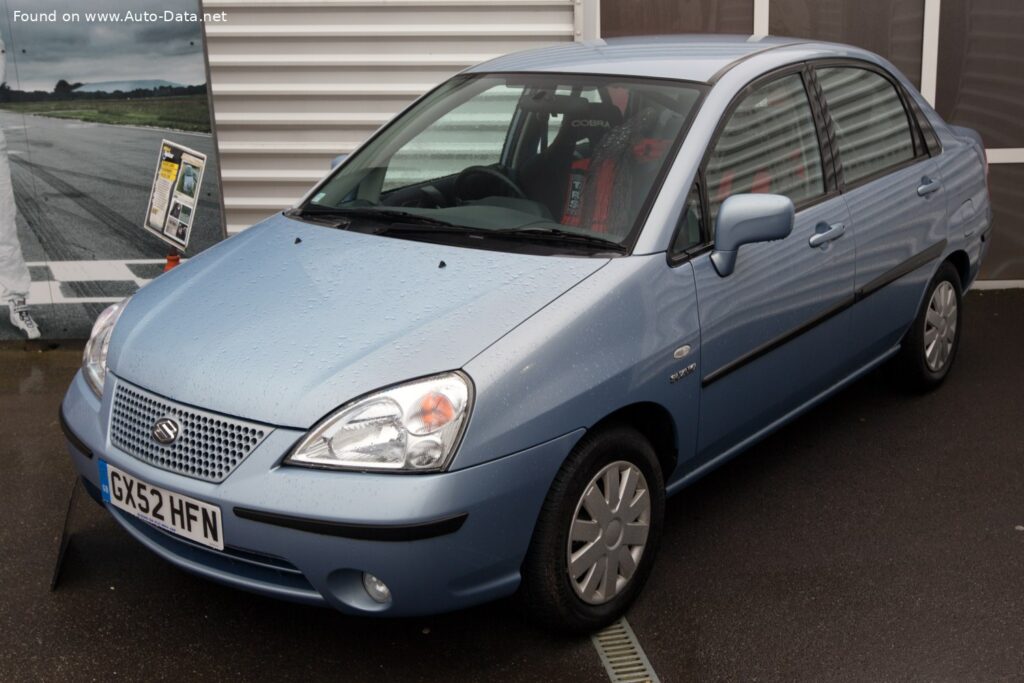
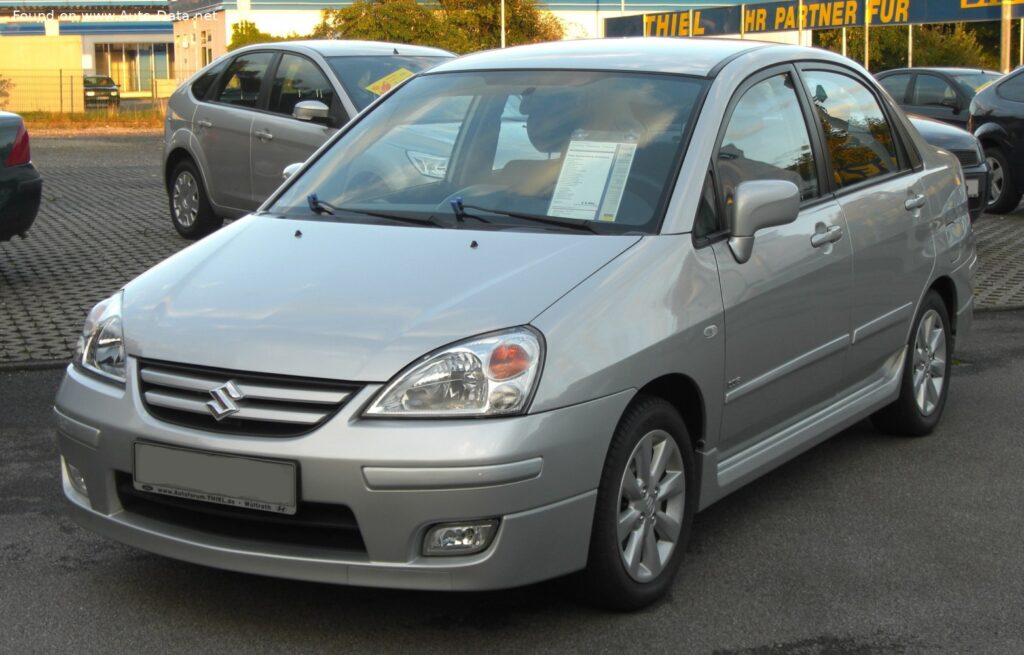
The Suzuki Liana Sedan I (facelift 2004) retained the practical four-door, five-seat sedan body type of its predecessor, but introduced subtle aesthetic enhancements to keep it competitive. The facelift typically included revised front and rear fascias, featuring updated grilles, headlights, and taillights designed to give the car a more contemporary appearance. Its dimensions—171.26 inches (4350 mm) in length, 66.54 inches (1690 mm) in width, and 57.24 inches (1454 mm) in height—positioned it firmly within the compact sedan segment, making it maneuverable in urban environments while still offering a decent interior volume.
The wheelbase of 97.64 inches (2480 mm) contributed to a stable ride and allowed for a surprisingly spacious cabin for its exterior footprint. The Liana was often praised for its generous headroom and legroom, particularly for front occupants, making it a comfortable option for families or those needing ample interior space. Standard features for the era included power windows, air conditioning, and a basic audio system, reflecting its focus on value. From a safety perspective, the Liana Sedan I (facelift 2004) came equipped with an Anti-lock Braking System (ABS) as standard, a crucial safety feature for improved control during emergency braking scenarios. While not laden with advanced driver-assistance systems found in modern vehicles, its fundamental safety equipment was competent for its time and market segment.
Technical Specifications
| Category | Specification |
|---|---|
| Brand | Suzuki |
| Model | Liana |
| Generation | Liana Sedan I (facelift 2004) |
| Type | 1.6i (107 Hp) 2WD Automatic |
| Production Start | 2004 |
| Production End | 2007 |
| Powertrain Architecture | Internal Combustion Engine |
| Body Type | Sedan |
| Seats | 5 |
| Doors | 4 |
| Fuel Type | Petrol (Gasoline) |
| Fuel Consumption – Urban | 9.6 l/100 km (24.5 US mpg) |
| Fuel Consumption – Extra Urban | 6.3 l/100 km (37.3 US mpg) |
| Fuel Consumption – Combined | 7.5 l/100 km (31.4 US mpg) |
| Maximum Speed | 170 km/h (105.63 mph) |
| Emission Standard | Euro 4 |
| Weight-to-Power Ratio | 10.8 kg/Hp (92.2 Hp/tonne) |
| Weight-to-Torque Ratio | 8.1 kg/Nm (124.1 Nm/tonne) |
| Power | 107 Hp @ 5500 rpm |
| Power per Liter | 67.5 Hp/l |
| Torque | 144 Nm @ 4000 rpm (106.21 lb-ft @ 4000 rpm) |
| Engine Layout | Front, Transverse |
| Engine Model/Code | M16A |
| Engine Displacement | 1586 cm3 (1.6 liters / 96.78 cu. in.) |
| Number of Cylinders | 4 |
| Engine Configuration | Inline |
| Cylinder Bore | 78 mm (3.07 in.) |
| Piston Stroke | 83 mm (3.27 in.) |
| Compression Ratio | 9.7:1 |
| Valves per Cylinder | 4 |
| Fuel Injection System | Multi-port manifold injection |
| Engine Aspiration | Naturally aspirated engine |
| Valvetrain | DOHC |
| Engine Oil Capacity | 4.1 l (4.33 US qt) |
| Coolant Capacity | 6.9 l (7.29 US qt) |
| Kerb Weight | 1160 kg (2557.36 lbs) |
| Length | 4350 mm (171.26 in.) |
| Width | 1690 mm (66.54 in.) |
| Height | 1454 mm (57.24 in.) |
| Wheelbase | 2480 mm (97.64 in.) |
| Drivetrain Architecture | The Internal Combustion Engine (ICE) drives the front wheels of the vehicle. |
| Drive Wheel | Front-wheel drive |
| Number of Gears & Gearbox Type | 4 gears, automatic transmission |
| Assisting Systems | ABS (Anti-lock braking system) |
Legacy and Market Impact
The Suzuki Liana Sedan I (facelift 2004) carved out a niche for itself as a dependable, no-frills family sedan in its primary markets of Europe and Asia. While it never achieved the blockbuster sales figures of segment leaders like the Toyota Corolla, Honda Civic, or Volkswagen Golf (which often offered more premium features or dynamic driving experiences), the Liana consistently delivered on its promise of robust mechanicals, excellent fuel economy, and a surprisingly spacious and practical interior for its exterior footprint.
Its reputation was built on Suzuki’s long-standing commitment to reliability and low running costs. Owners often lauded the Liana for its trouble-free operation and ease of maintenance, making it a popular choice for budget-conscious families and fleet operators. In markets where affordability and durability were paramount, the Liana presented a compelling alternative to more expensive or complex rivals. Its compact dimensions made it particularly well-suited for congested European cities and dense Asian urban centers, where parking and maneuverability were key considerations.
In North America, the Liana was marketed as the Aerio, and while hatchback and wagon variants saw some limited success, the sedan struggled to gain significant traction against entrenched competitors. The American market, at the time, was increasingly gravitating towards larger sedans or SUVs, and the Aerio/Liana’s somewhat quirky styling and utilitarian interior, while practical, didn’t resonate as strongly with mainstream buyers. However, its global presence underscored Suzuki’s ambition to be a significant player in the compact car segment, offering a value proposition that appealed to a broad international demographic.
The Liana’s legacy is one of quiet competence rather than groundbreaking innovation. It served as a reliable workhorse for many, embodying Suzuki’s engineering ethos of creating durable, efficient, and accessible vehicles. Although production ended in 2007, paving the way for models like the Suzuki SX4, the Liana remains a testament to a period when automotive design prioritized straightforward functionality and cost-effectiveness, leaving behind a loyal following in the markets it served best.